Background - Scenario Drivers and Critical
Issues with a Focus on Technology Trends,
and Systems Architecture
Near-Shore-Development Seminar
Barry Demchak
May 19, 2009
Introduction and Projects
https://sosa.ucsd.edu/
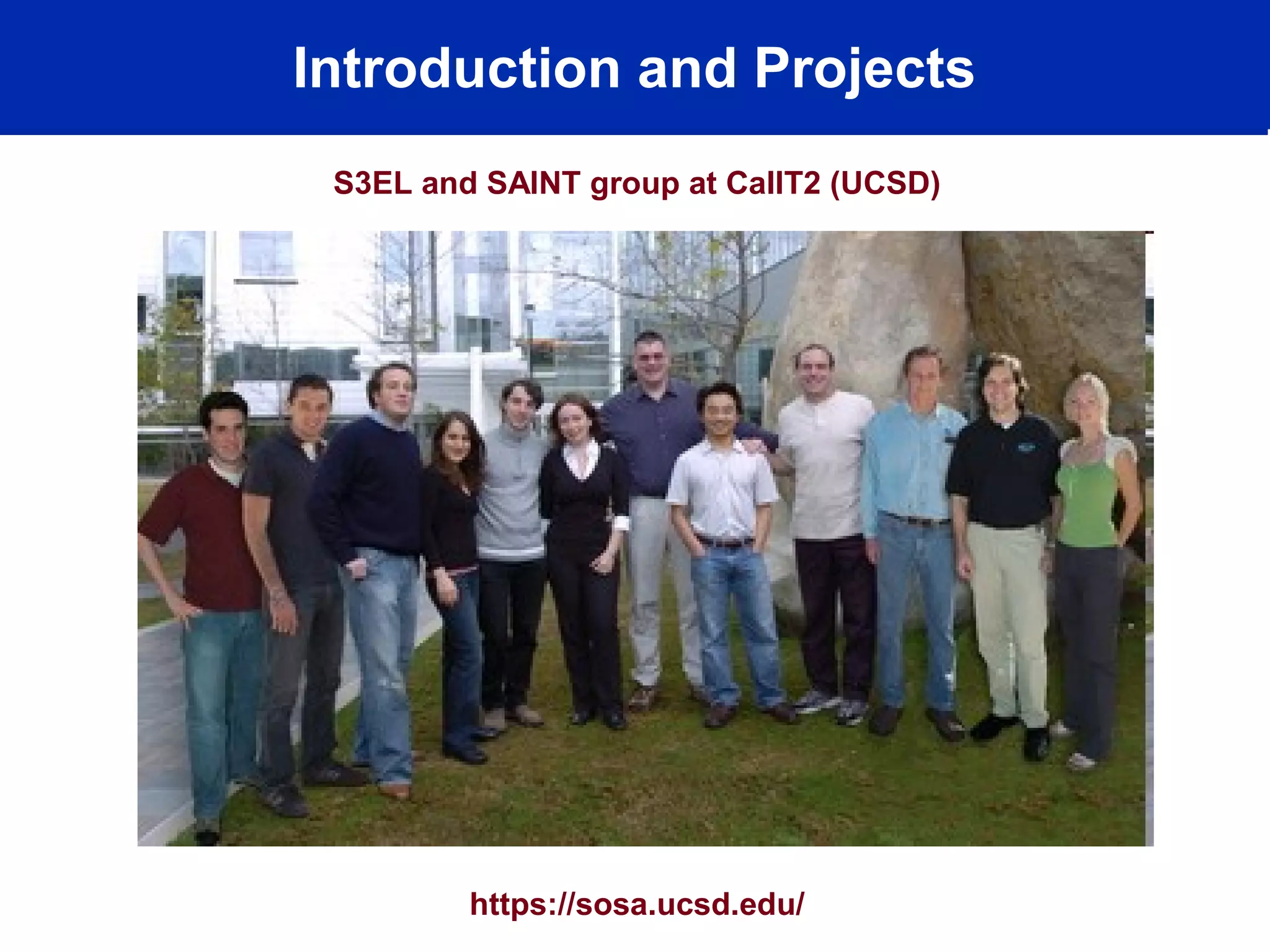
S3EL and SAINT group at CalIT2 (UCSD)
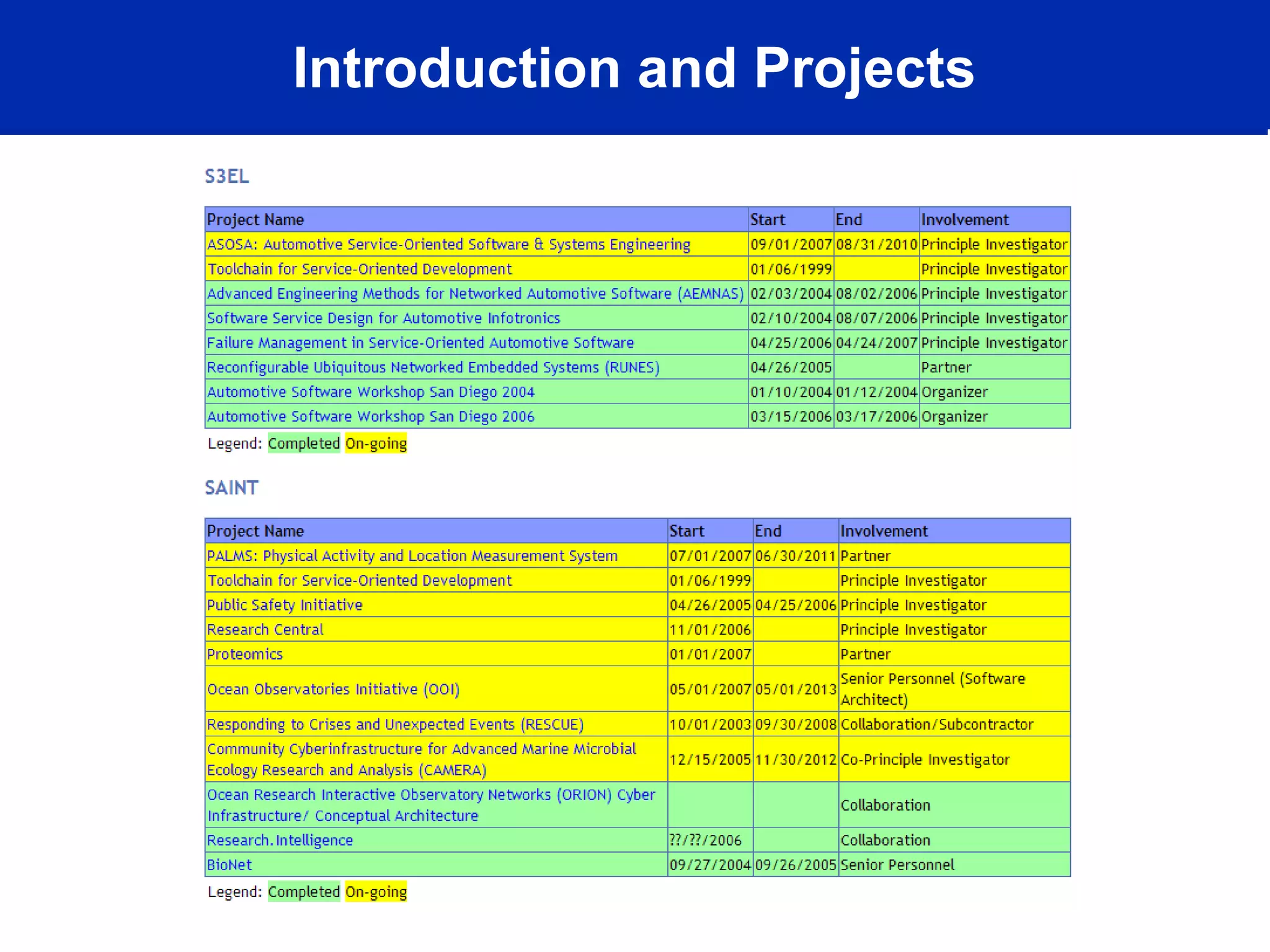
Introduction and Projects
A Scary Number
14,000
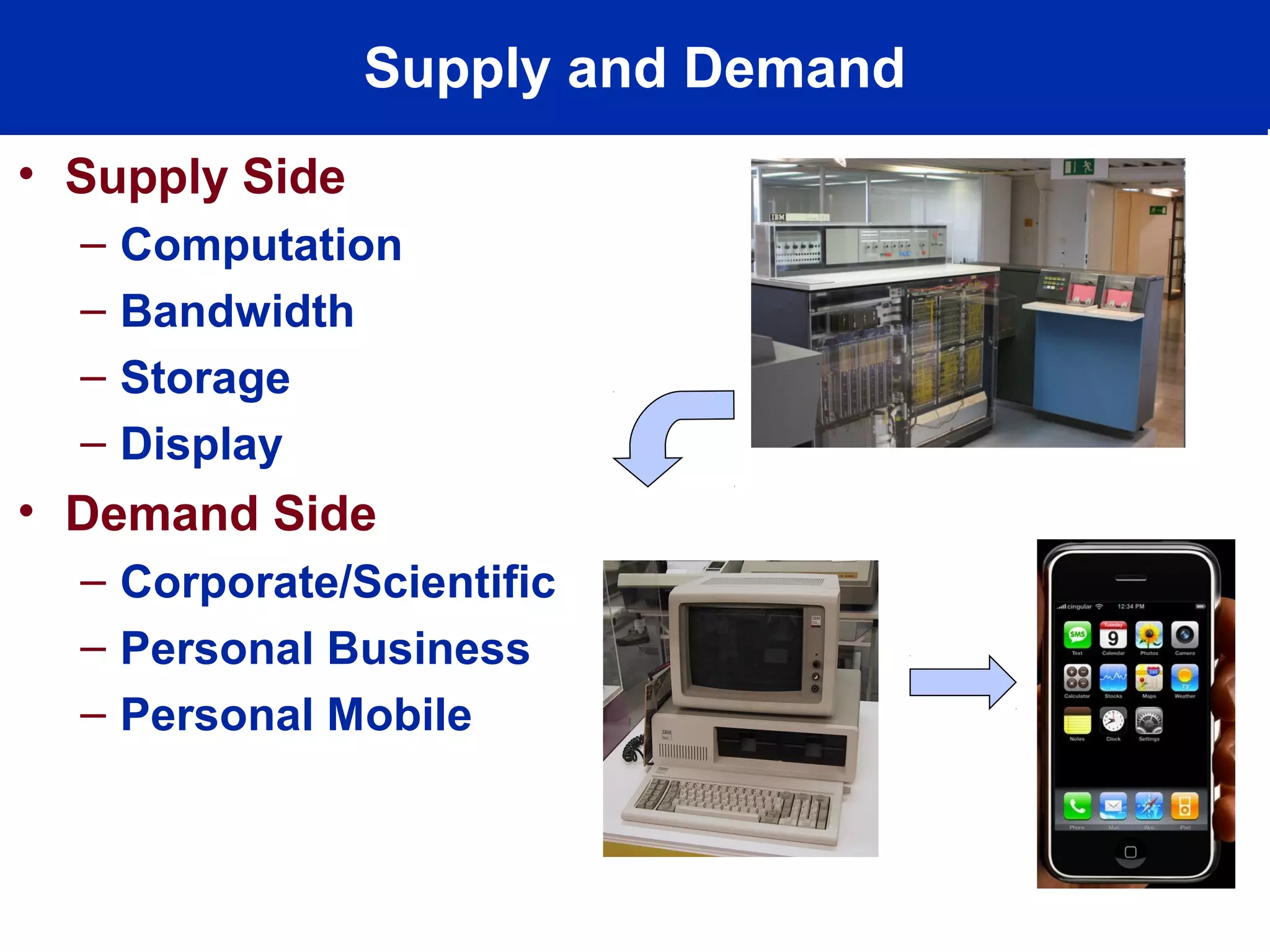
• Supply Side
– Computation
– Bandwidth
– Storage
– Display
• Demand Side
– Corporate/Scientific
– Personal Business
– Personal Mobile
Supply and Demand
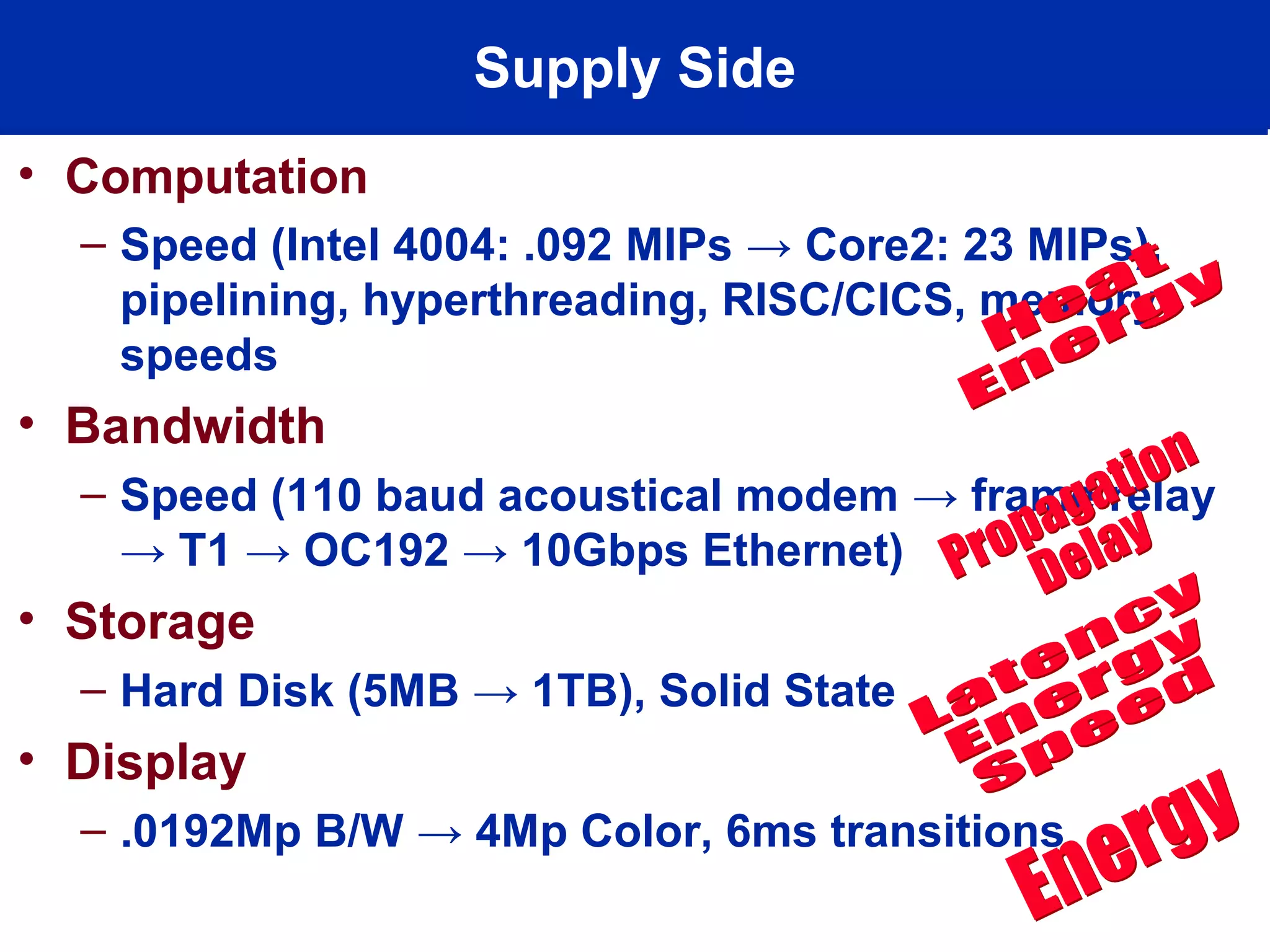
Supply Side
• Computation
– Speed (Intel 4004: .092 MIPs → Core2: 23 MIPs),
pipelining, hyperthreading, RISC/CICS, memory
speeds
• Bandwidth
– Speed (110 baud acoustical modem → frame relay
→ T1 → OC192 → 10Gbps Ethernet)
• Storage
– Hard Disk (5MB → 1TB), Solid State
• Display
– .0192Mp B/W → 4Mp Color, 6ms transitions
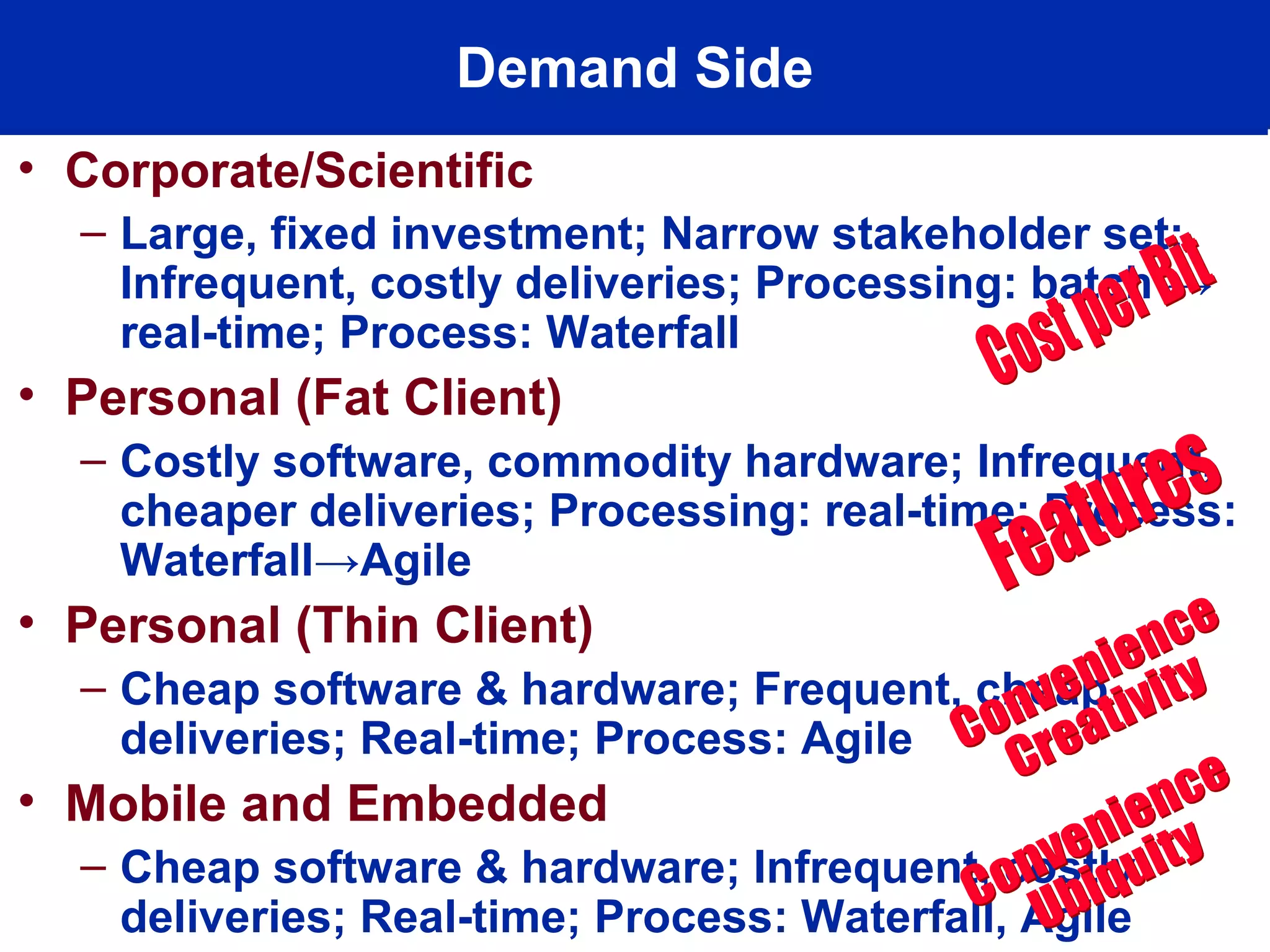
Demand Side
• Corporate/Scientific
– Large, fixed investment; Narrow stakeholder set;
Infrequent, costly deliveries; Processing: batch →
real-time; Process: Waterfall
• Personal (Fat Client)
– Costly software, commodity hardware; Infrequent,
cheaper deliveries; Processing: real-time; Process:
Waterfall→Agile
• Personal (Thin Client)
– Cheap software & hardware; Frequent, cheap
deliveries; Real-time; Process: Agile
• Mobile and Embedded
– Cheap software & hardware; Infrequent, costly
deliveries; Real-time; Process: Waterfall, Agile
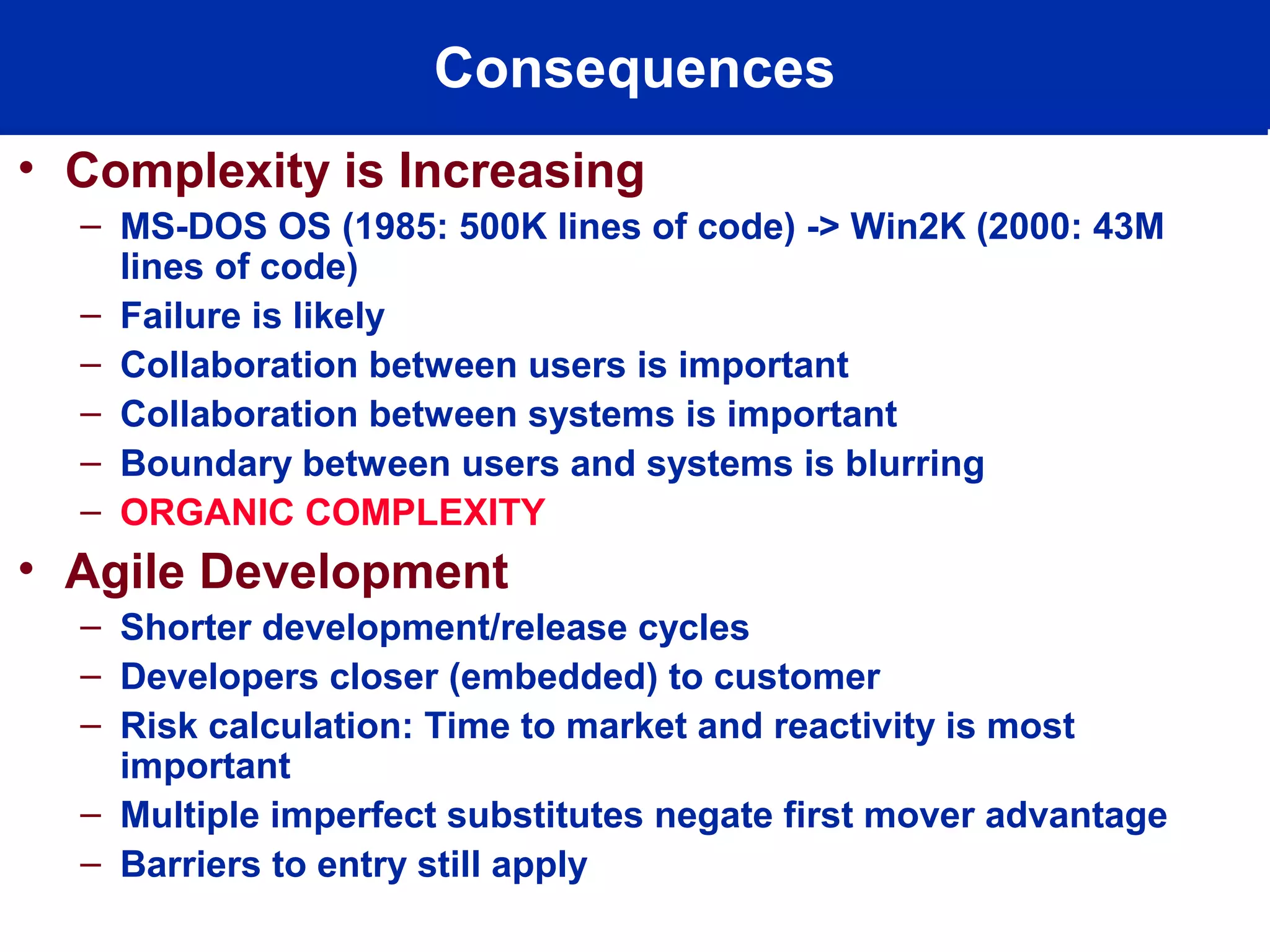
Consequences
• Complexity is Increasing
– MS-DOS OS (1985: 500K lines of code) -> Win2K (2000: 43M
lines of code)
– Failure is likely
– Collaboration between users is important
– Collaboration between systems is important
– Boundary between users and systems is blurring
– ORGANIC COMPLEXITY
• Agile Development
– Shorter development/release cycles
– Developers closer (embedded) to customer
– Risk calculation: Time to market and reactivity is most
important
– Multiple imperfect substitutes negate first mover advantage
– Barriers to entry still apply
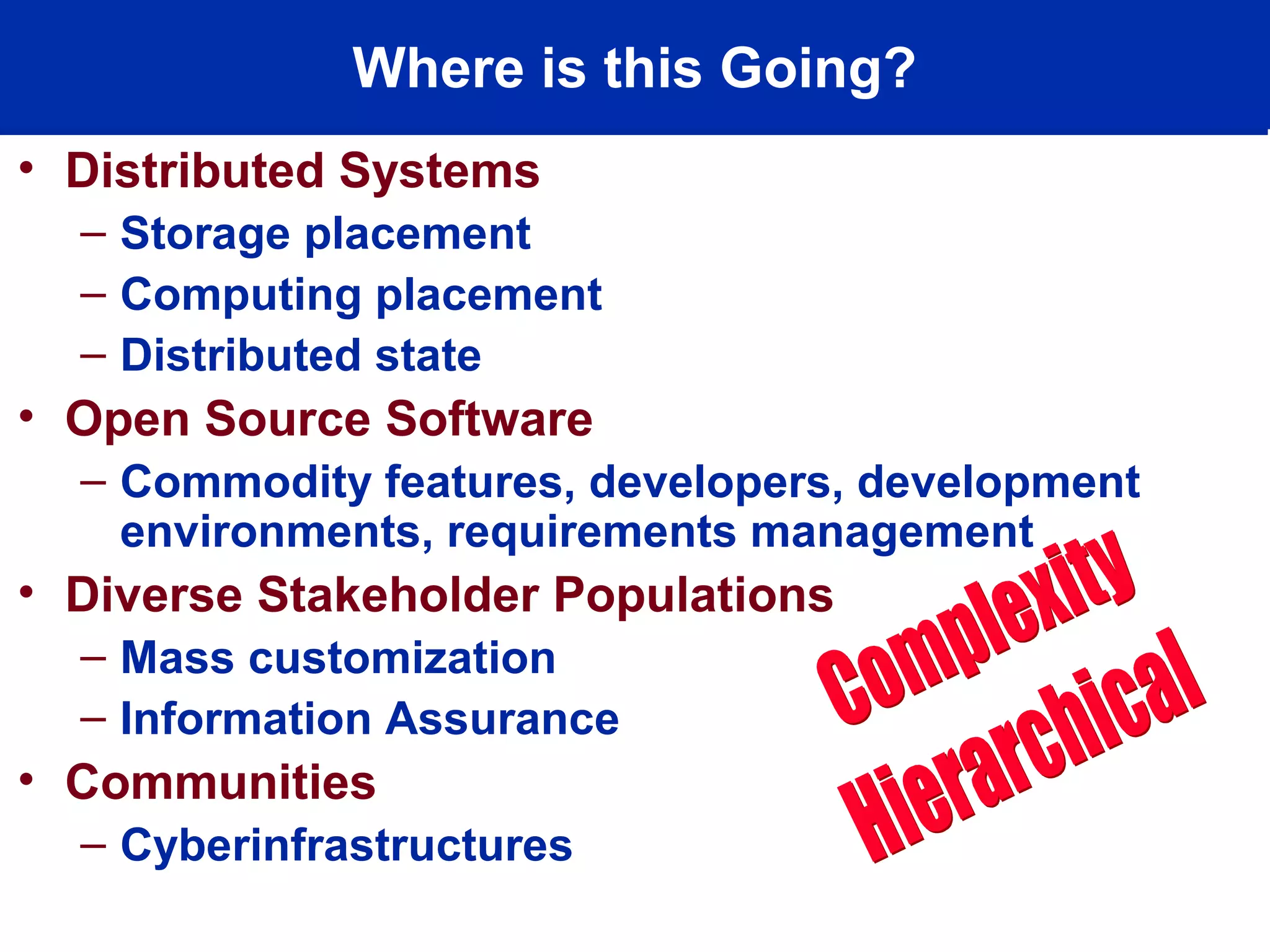
Where is this Going?
• Distributed Systems
– Storage placement
– Computing placement
– Distributed state
• Open Source Software
– Commodity features, developers, development
environments, requirements management
• Diverse Stakeholder Populations
– Mass customization
– Information Assurance
• Communities
– Cyberinfrastructures
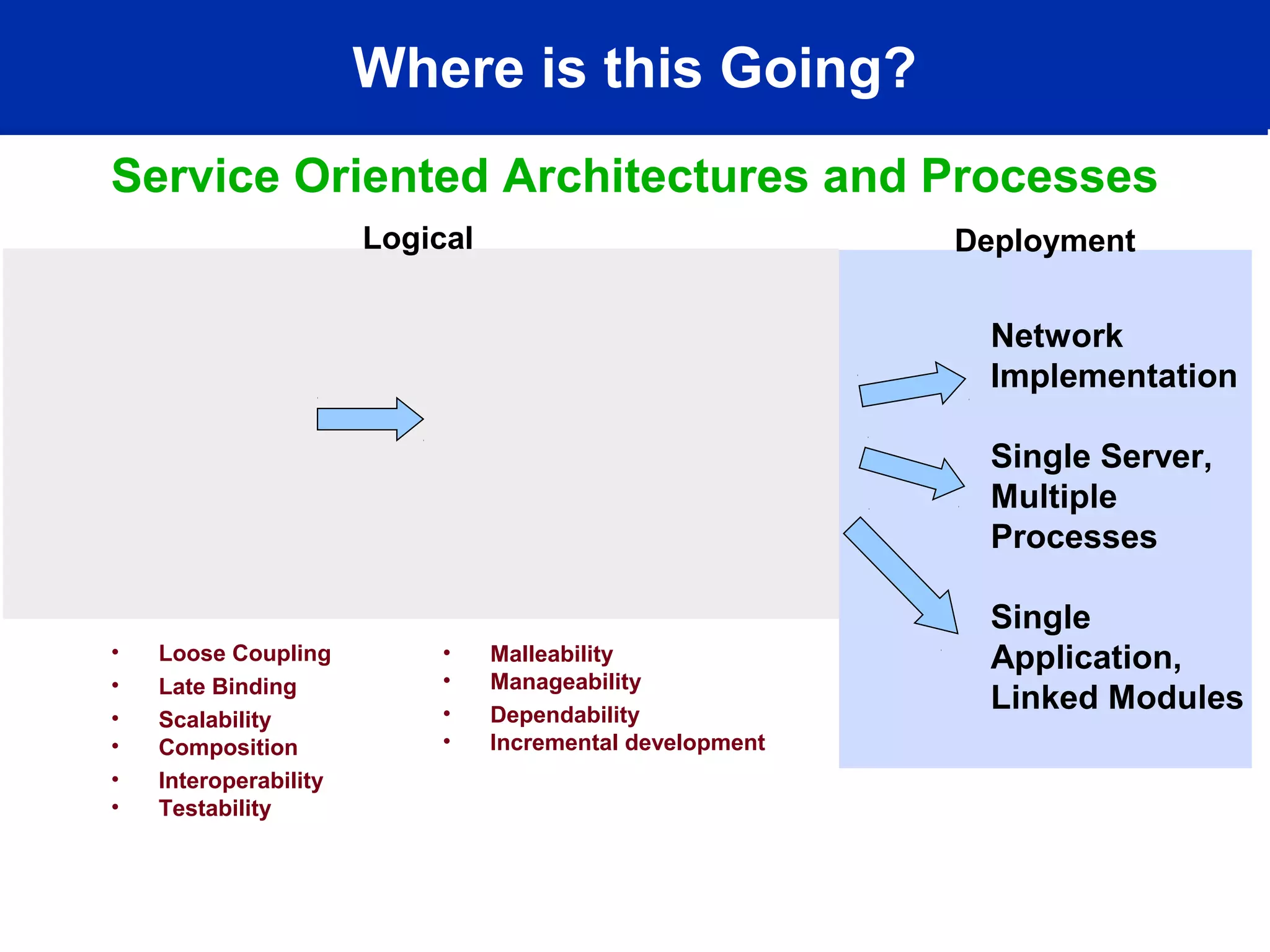
Where is this Going?
• Loose Coupling
• Late Binding
• Scalability
• Composition
• Interoperability
• Testability
Network
Implementation
Single Server,
Multiple
Processes
Single
Application,
Linked Modules
Logical Deployment
• Malleability
• Manageability
• Dependability
• Incremental development
Service Oriented Architectures and Processes
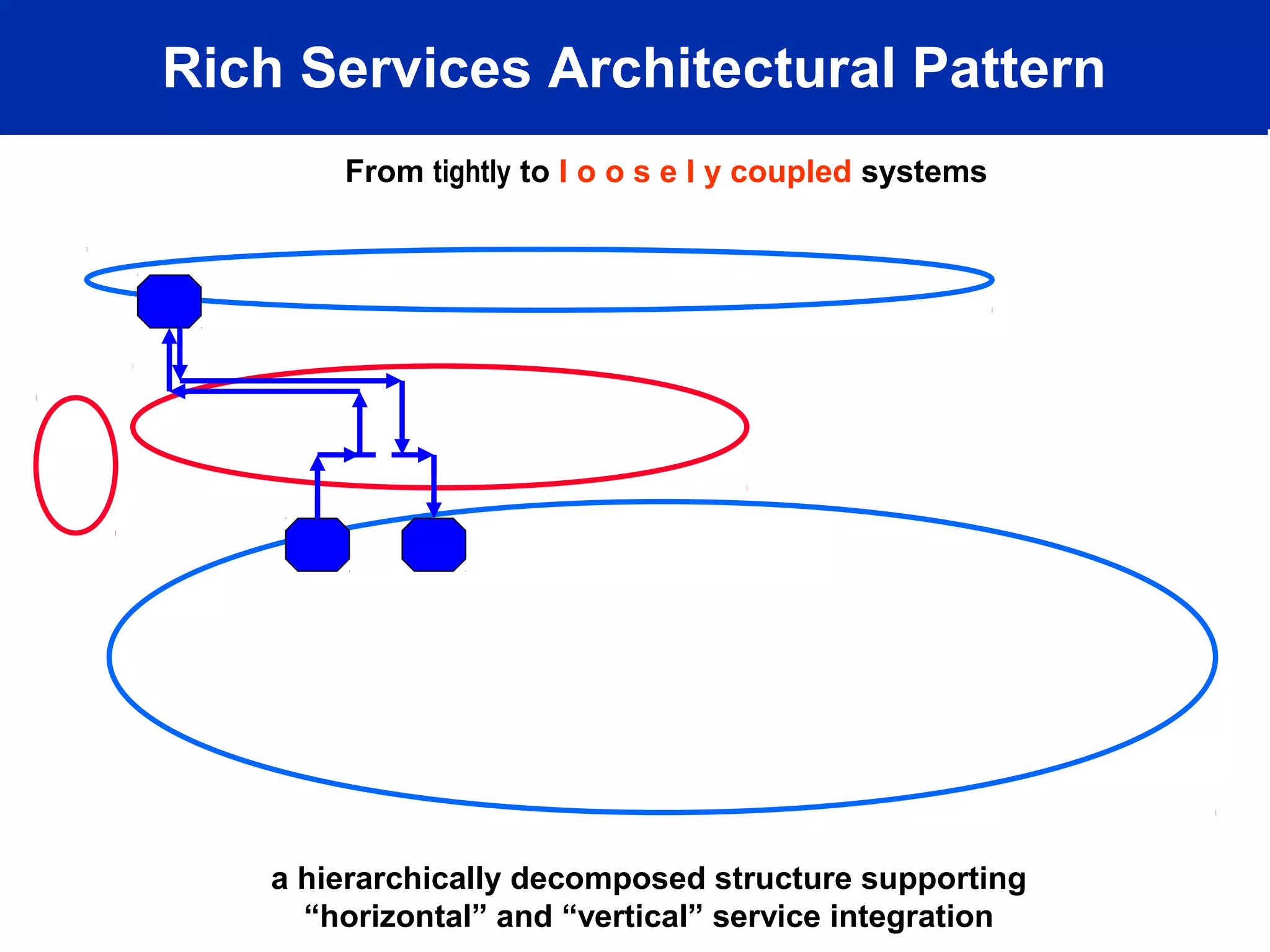
Rich Services Architectural Pattern
From tightly to l o o s e l y coupled systems
a hierarchically decomposed structure supporting
“horizontal” and “vertical” service integration
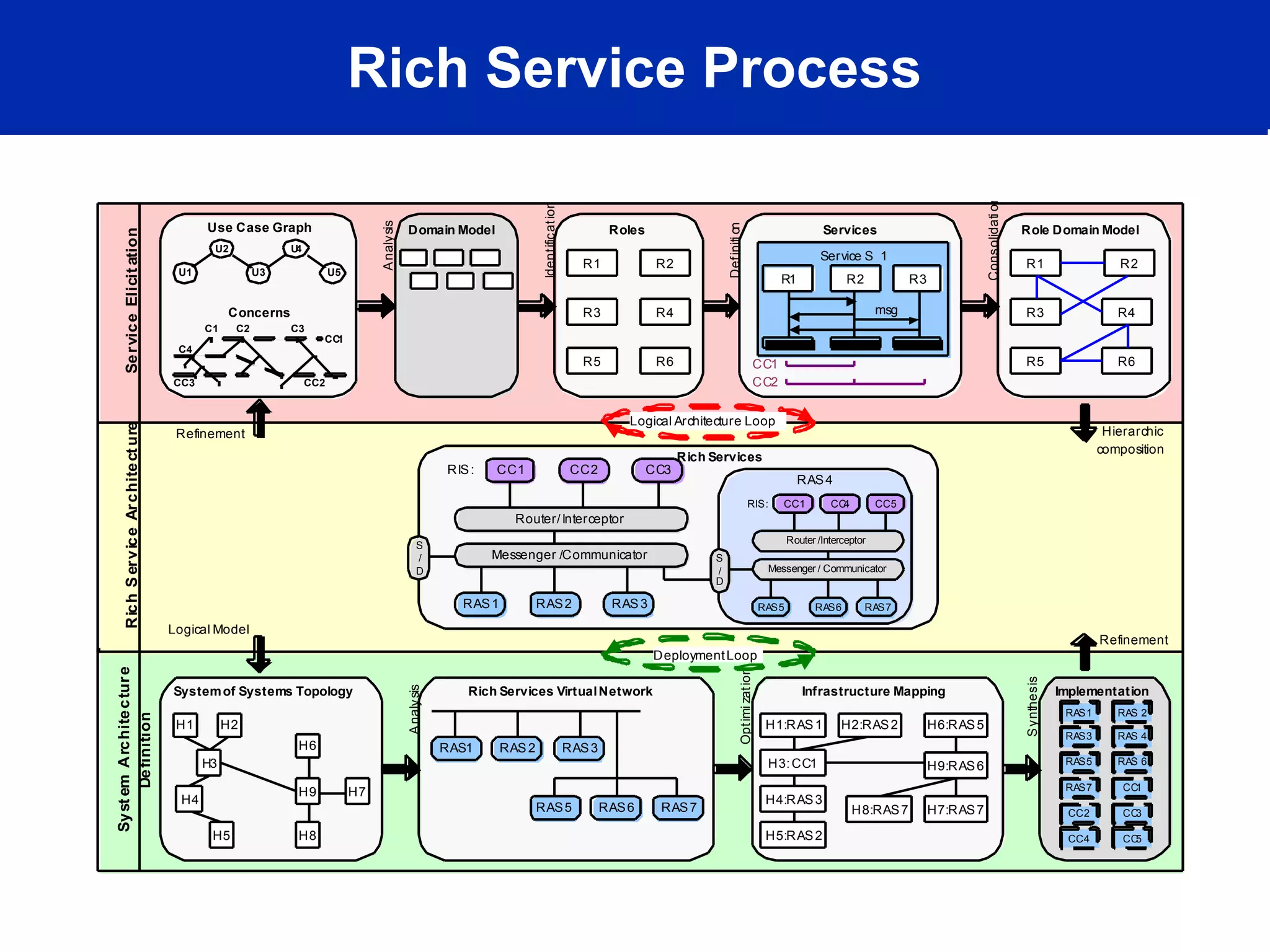
Rich Service Process
Rich Services VirtualNetwork
Rich Services
RAS4
Services
Service S 1
Roles
U1
U2
U3
U4
U5
Use Case Graph
Concerns
C1 C2 C3
C4
CC1
CC2CC3
Domain Model
R1 R2
R3 R4
R5 R6
R1 R2
msg
R3
CC1
CC2
Role Domain Model
R1 R2
R3 R4
R5 R6
CC1 CC2 CC3
Router/Interceptor
Messenger /Communicator
RAS1 RAS2
CC1 CC4 CC5
Router /Interceptor
Messenger / Communicator
RAS5 RAS6RAS3
S
/
D
S
/
D
RIS:
RIS:
ServiceElicitationRichServiceArchitecture
RAS7
Systemof Systems Topology
H1 H2
H3
H5
H6
H7
H8
H9
H4
RAS1 RAS2 RAS3
RAS5 RAS6 RAS7
Infrastructure Mapping
H1:RAS1 H2:RAS2
H3:CC1
H5:RAS2
H6:RAS5
H7:RAS7H8:RAS7
H9:RAS6
H4:RAS3
Optimization
Implementation
RAS1 RAS 2
RAS3 RAS 4
RAS5 RAS 6
RAS7 CC1
CC2 CC3
CC4 CC5
Analysis
Synthesis
Analysis
Identification
Definition
Consolidation
Refinement
Hierarchic
composition
Refinement
Logical Model
SystemArchitecture
Definition
Logical Architecture Loop
DeploymentLoop
Logical Architecture (PALMS)
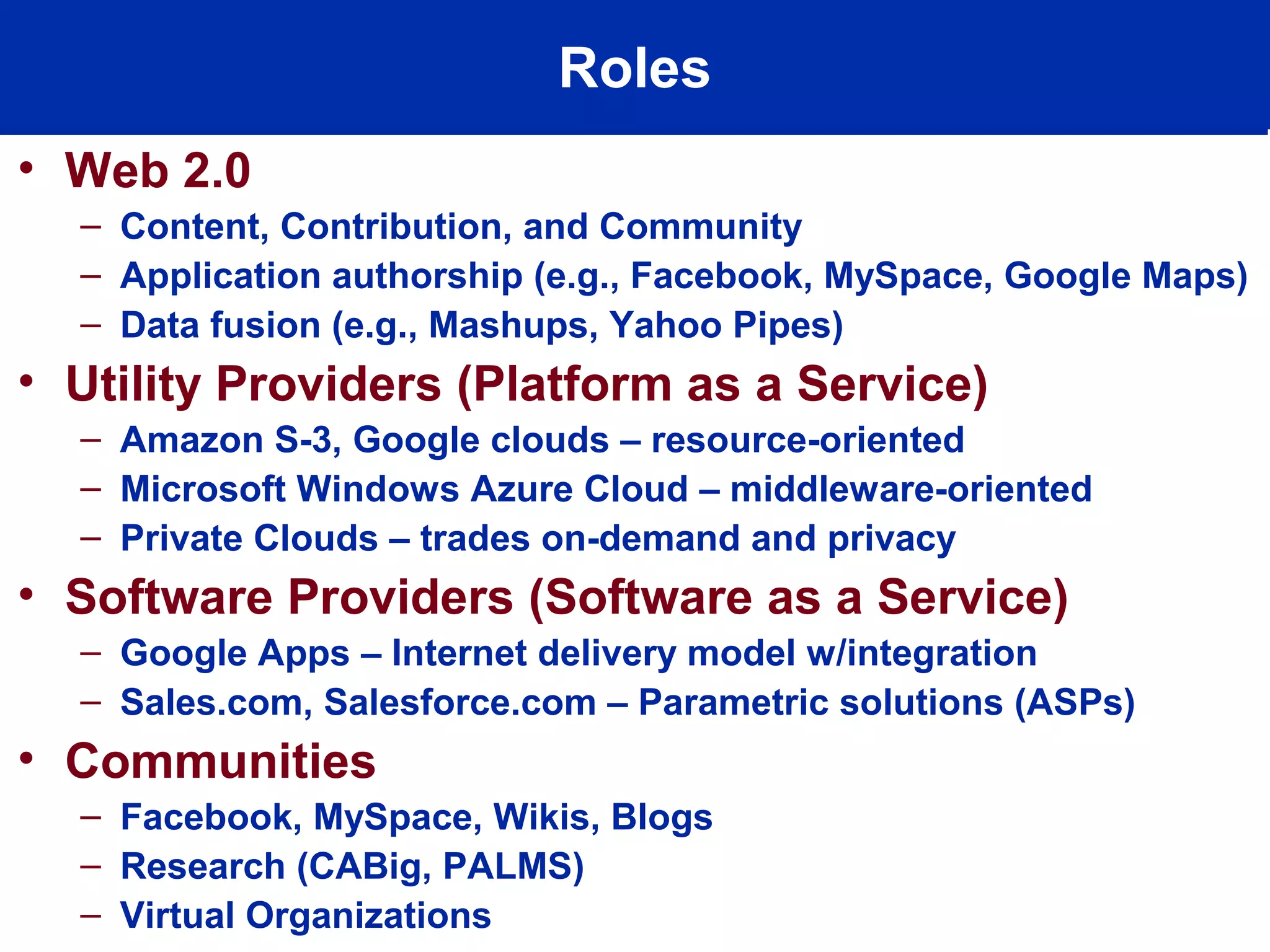
Roles
• Web 2.0
– Content, Contribution, and Community
– Application authorship (e.g., Facebook, MySpace, Google Maps)
– Data fusion (e.g., Mashups, Yahoo Pipes)
• Utility Providers (Platform as a Service)
– Amazon S-3, Google clouds – resource-oriented
– Microsoft Windows Azure Cloud – middleware-oriented
– Private Clouds – trades on-demand and privacy
• Software Providers (Software as a Service)
– Google Apps – Internet delivery model w/integration
– Sales.com, Salesforce.com – Parametric solutions (ASPs)
• Communities
– Facebook, MySpace, Wikis, Blogs
– Research (CABig, PALMS)
– Virtual Organizations
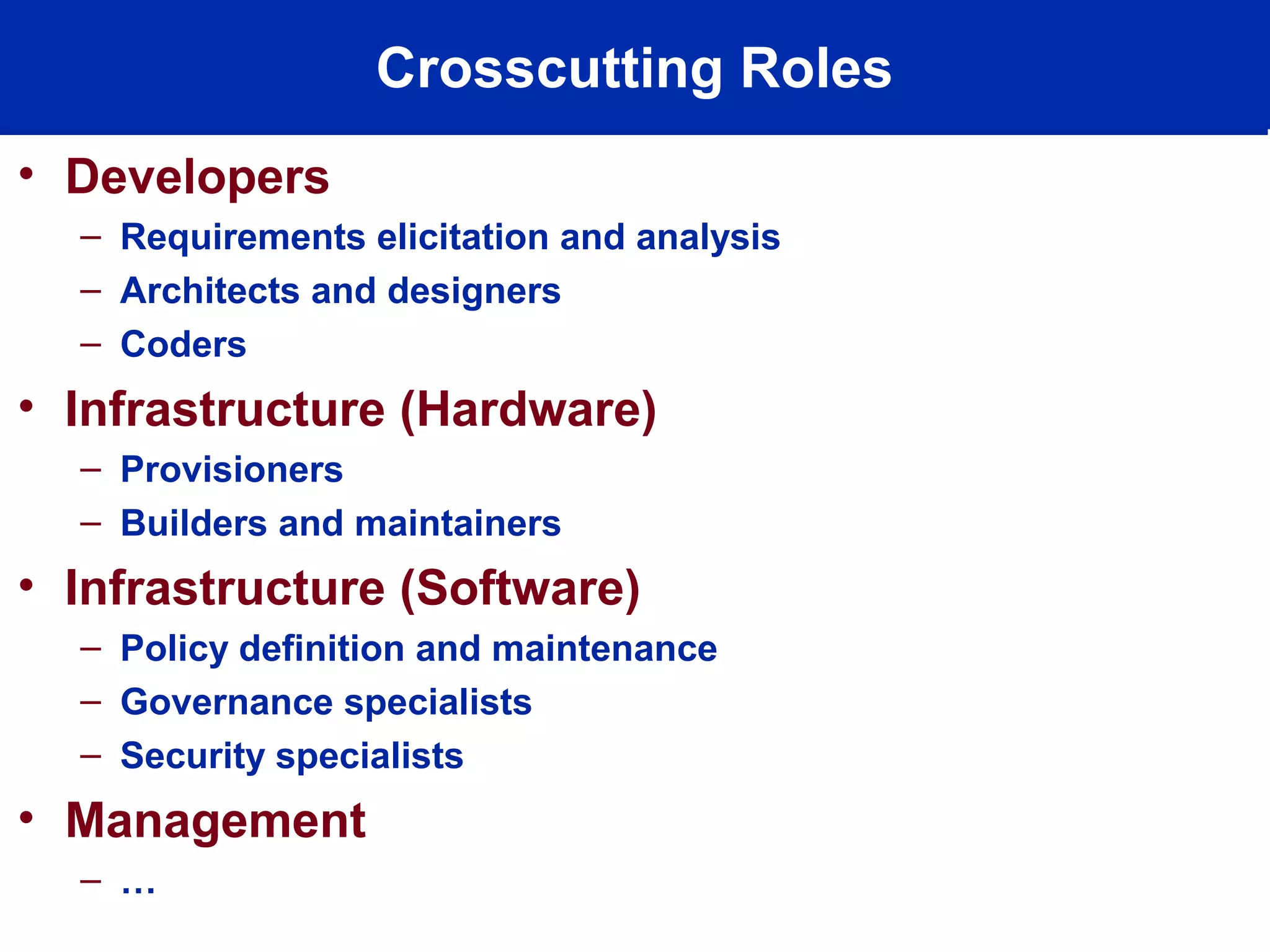
Crosscutting Roles
• Developers
– Requirements elicitation and analysis
– Architects and designers
– Coders
• Infrastructure (Hardware)
– Provisioners
– Builders and maintainers
• Infrastructure (Software)
– Policy definition and maintenance
– Governance specialists
– Security specialists
• Management
– …
Questions
Notes
Notes leading to
presentation

Background scenario drivers and critical issues with a focus on technology trends, and systems architecture

  • 1.
    Background - ScenarioDrivers and Critical Issues with a Focus on Technology Trends, and Systems Architecture Near-Shore-Development Seminar Barry Demchak May 19, 2009
  • 2.
  • 3.
  • 4.
  • 5.
    • Supply Side –Computation – Bandwidth – Storage – Display • Demand Side – Corporate/Scientific – Personal Business – Personal Mobile Supply and Demand
  • 6.
    Supply Side • Computation –Speed (Intel 4004: .092 MIPs → Core2: 23 MIPs), pipelining, hyperthreading, RISC/CICS, memory speeds • Bandwidth – Speed (110 baud acoustical modem → frame relay → T1 → OC192 → 10Gbps Ethernet) • Storage – Hard Disk (5MB → 1TB), Solid State • Display – .0192Mp B/W → 4Mp Color, 6ms transitions
  • 7.
    Demand Side • Corporate/Scientific –Large, fixed investment; Narrow stakeholder set; Infrequent, costly deliveries; Processing: batch → real-time; Process: Waterfall • Personal (Fat Client) – Costly software, commodity hardware; Infrequent, cheaper deliveries; Processing: real-time; Process: Waterfall→Agile • Personal (Thin Client) – Cheap software & hardware; Frequent, cheap deliveries; Real-time; Process: Agile • Mobile and Embedded – Cheap software & hardware; Infrequent, costly deliveries; Real-time; Process: Waterfall, Agile
  • 8.
    Consequences • Complexity isIncreasing – MS-DOS OS (1985: 500K lines of code) -> Win2K (2000: 43M lines of code) – Failure is likely – Collaboration between users is important – Collaboration between systems is important – Boundary between users and systems is blurring – ORGANIC COMPLEXITY • Agile Development – Shorter development/release cycles – Developers closer (embedded) to customer – Risk calculation: Time to market and reactivity is most important – Multiple imperfect substitutes negate first mover advantage – Barriers to entry still apply
  • 9.
    Where is thisGoing? • Distributed Systems – Storage placement – Computing placement – Distributed state • Open Source Software – Commodity features, developers, development environments, requirements management • Diverse Stakeholder Populations – Mass customization – Information Assurance • Communities – Cyberinfrastructures
  • 10.
    Where is thisGoing? • Loose Coupling • Late Binding • Scalability • Composition • Interoperability • Testability Network Implementation Single Server, Multiple Processes Single Application, Linked Modules Logical Deployment • Malleability • Manageability • Dependability • Incremental development Service Oriented Architectures and Processes
  • 11.
    Rich Services ArchitecturalPattern From tightly to l o o s e l y coupled systems a hierarchically decomposed structure supporting “horizontal” and “vertical” service integration
  • 12.
    Rich Service Process RichServices VirtualNetwork Rich Services RAS4 Services Service S 1 Roles U1 U2 U3 U4 U5 Use Case Graph Concerns C1 C2 C3 C4 CC1 CC2CC3 Domain Model R1 R2 R3 R4 R5 R6 R1 R2 msg R3 CC1 CC2 Role Domain Model R1 R2 R3 R4 R5 R6 CC1 CC2 CC3 Router/Interceptor Messenger /Communicator RAS1 RAS2 CC1 CC4 CC5 Router /Interceptor Messenger / Communicator RAS5 RAS6RAS3 S / D S / D RIS: RIS: ServiceElicitationRichServiceArchitecture RAS7 Systemof Systems Topology H1 H2 H3 H5 H6 H7 H8 H9 H4 RAS1 RAS2 RAS3 RAS5 RAS6 RAS7 Infrastructure Mapping H1:RAS1 H2:RAS2 H3:CC1 H5:RAS2 H6:RAS5 H7:RAS7H8:RAS7 H9:RAS6 H4:RAS3 Optimization Implementation RAS1 RAS 2 RAS3 RAS 4 RAS5 RAS 6 RAS7 CC1 CC2 CC3 CC4 CC5 Analysis Synthesis Analysis Identification Definition Consolidation Refinement Hierarchic composition Refinement Logical Model SystemArchitecture Definition Logical Architecture Loop DeploymentLoop
  • 13.
  • 14.
    Roles • Web 2.0 –Content, Contribution, and Community – Application authorship (e.g., Facebook, MySpace, Google Maps) – Data fusion (e.g., Mashups, Yahoo Pipes) • Utility Providers (Platform as a Service) – Amazon S-3, Google clouds – resource-oriented – Microsoft Windows Azure Cloud – middleware-oriented – Private Clouds – trades on-demand and privacy • Software Providers (Software as a Service) – Google Apps – Internet delivery model w/integration – Sales.com, Salesforce.com – Parametric solutions (ASPs) • Communities – Facebook, MySpace, Wikis, Blogs – Research (CABig, PALMS) – Virtual Organizations
  • 15.
    Crosscutting Roles • Developers –Requirements elicitation and analysis – Architects and designers – Coders • Infrastructure (Hardware) – Provisioners – Builders and maintainers • Infrastructure (Software) – Policy definition and maintenance – Governance specialists – Security specialists • Management – …
  • 16.
  • 17.

Editor's Notes

  • #2 <number> Thank the host!
  • #12 <number>