Extensible and Dynamic
Topic Types for DDS
MARS – Jacksonville, FL – March 2010
Presenter: Rick Warren, RTI
Submitting POCs:
 Angelo Corsaro, PrismTech: angelo.corsaro@prismtech.com
 Gerardo Pardo, RTI: gerardo.pardo@rti.com
 Robert Poth, PrismTech: robert.poth@prismtech.com
 Rick Warren, RTI: rick.warren@rti.com
Supporting POCs:
 Virginie Watine, Thales: virginie.watine@thalesgroup.com
document number: 2010-03-02
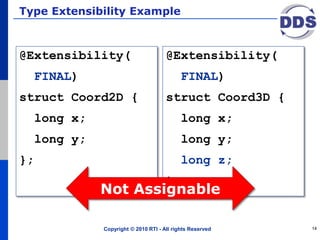
Structure of this Presentation
Overview of specification and process
Specification contents
 Very detailed discussion last time
 This presentation focuses on what’s changed
AB feedback
Copyright © 2010 RTI - All rights Reserved 2
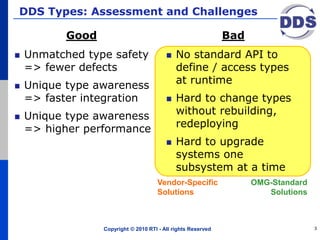
DDS Types: Assessment and Challenges
Good
Unmatched type safety
=> fewer defects
Unique type awareness
=> faster integration
Unique type awareness
=> higher performance
Bad
No standard API to
define / access types
at runtime
Hard to change types
without rebuilding,
redeploying
Hard to upgrade
systems one
subsystem at a time
Copyright © 2010 RTI - All rights Reserved 3
Vendor-Specific
Solutions
OMG-Standard
Solutions
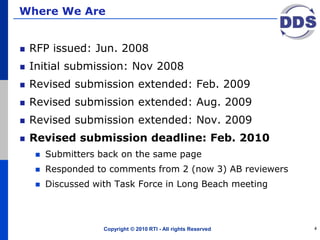
Where We Are
RFP issued: Jun. 2008
Initial submission: Nov 2008
Revised submission extended: Feb. 2009
Revised submission extended: Aug. 2009
Revised submission extended: Nov. 2009
Revised submission deadline: Feb. 2010
 Submitters back on the same page
 Responded to comments from 2 (now 3) AB reviewers
 Discussed with Task Force in Long Beach meeting
Copyright © 2010 RTI - All rights Reserved 4
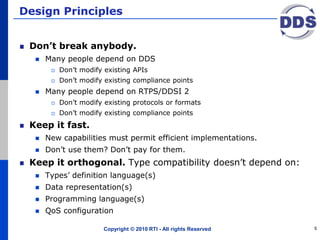
Design Principles
Don’t break anybody.
 Many people depend on DDS
 Don’t modify existing APIs
 Don’t modify existing compliance points
 Many people depend on RTPS/DDSI 2
 Don’t modify existing protocols or formats
 Don’t modify existing compliance points
Keep it fast.
 New capabilities must permit efficient implementations.
 Don’t use them? Don’t pay for them.
Keep it orthogonal. Type compatibility doesn’t depend on:
 Types’ definition language(s)
 Data representation(s)
 Programming language(s)
 QoS configuration
Copyright © 2010 RTI - All rights Reserved 5
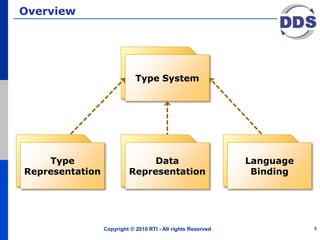
Overview
Copyright © 2010 RTI - All rights Reserved 6
Type System
Type
Representation
Language
Binding
Data
Representation
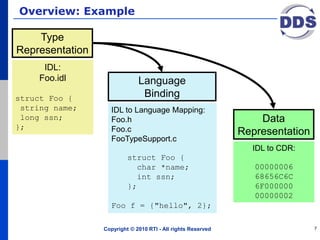
Overview: Example
Copyright © 2010 RTI - All rights Reserved 7
Type
Representation
Language
Binding
Data
Representation
IDL:
Foo.idl
struct Foo {
string name;
long ssn;
};
IDL to Language Mapping:
Foo.h
Foo.c
FooTypeSupport.c
struct Foo {
char *name;
int ssn;
};
Foo f = {"hello", 2};
IDL to CDR:
00000006
68656C6C
6F000000
00000002
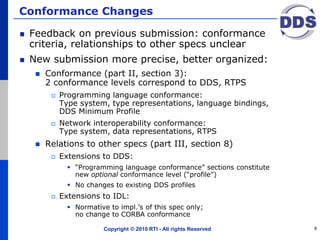
Conformance Changes
Feedback on previous submission: conformance
criteria, relationships to other specs unclear
New submission more precise, better organized:
 Conformance (part II, section 3):
2 conformance levels correspond to DDS, RTPS
 Programming language conformance:
Type system, type representations, language bindings,
DDS Minimum Profile
 Network interoperability conformance:
Type system, data representations, RTPS
 Relations to other specs (part III, section 8)
 Extensions to DDS:
 “Programming language conformance” sections constitute
new optional conformance level (“profile”)
 No changes to existing DDS profiles
 Extensions to IDL:
 Normative to impl.’s of this spec only;
no change to CORBA conformance
Copyright © 2010 RTI - All rights Reserved 8
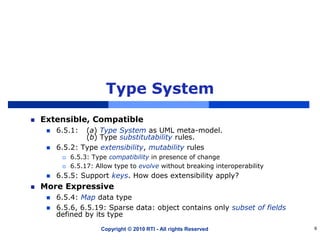
Type System
Extensible, Compatible
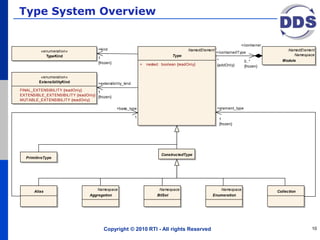
 6.5.1: (a) Type System as UML meta-model.
(b) Type substitutability rules.
 6.5.2: Type extensibility, mutability rules
 6.5.3: Type compatibility in presence of change
 6.5.17: Allow type to evolve without breaking interoperability
 6.5.5: Support keys. How does extensibility apply?
More Expressive
 6.5.4: Map data type
 6.5.6, 6.5.19: Sparse data: object contains only subset of fields
defined by its type
Copyright © 2010 RTI - All rights Reserved 9
Type System Overview
Copyright © 2010 RTI - All rights Reserved 10
class Type System
NamedElement
Type
+ nested: boolean {readOnly}
PrimitiveType
«enumeration»
TypeKind
Collection
Namespace
Aggregation
Namespace
Enumeration
NamedElement
Namespace
Module
Namespace
BitSet
Alias
ConstructedType
«enumeration»
ExtensibilityKind
FINAL_EXTENSIBILITY {readOnly}
EXTENSIBLE_EXTENSIBILITY {readOnly}
MUTABLE_EXTENSIBILITY {readOnly}
+/container
0..*
{frozen}
+/containedType
*
{addOnly}
+extensibility_kind
1
{frozen}
+element_type
1
{frozen}
+kind
1
{frozen}
+base_type
1
Type System Overview
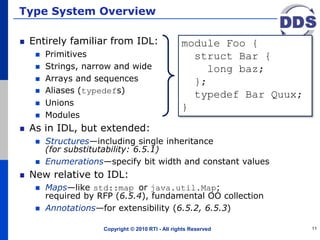
Entirely familiar from IDL:
 Primitives
 Strings, narrow and wide
 Arrays and sequences
 Aliases (typedefs)
 Unions
 Modules
As in IDL, but extended:
 Structures—including single inheritance
(for substitutability: 6.5.1)
 Enumerations—specify bit width and constant values
New relative to IDL:
 Maps—like std::map or java.util.Map;
required by RFP (6.5.4), fundamental OO collection
 Annotations—for extensibility (6.5.2, 6.5.3)
Copyright © 2010 RTI - All rights Reserved 11
module Foo {
struct Bar {
long baz;
};
typedef Bar Quux;
}
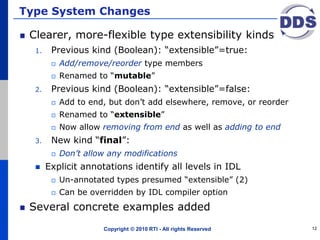
Type System Changes
Clearer, more-flexible type extensibility kinds
1. Previous kind (Boolean): “extensible”=true:
 Add/remove/reorder type members
 Renamed to “mutable”
2. Previous kind (Boolean): “extensible”=false:
 Add to end, but don’t add elsewhere, remove, or reorder
 Renamed to “extensible”
 Now allow removing from end as well as adding to end
3. New kind “final”:
 Don’t allow any modifications
 Explicit annotations identify all levels in IDL
 Un-annotated types presumed “extensible” (2)
 Can be overridden by IDL compiler option
Several concrete examples added
Copyright © 2010 RTI - All rights Reserved 12
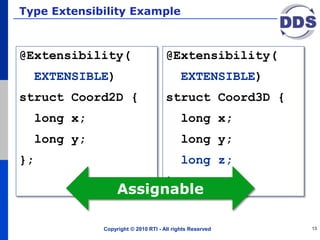
Type Extensibility Example
@Extensibility(
EXTENSIBLE)
struct Coord2D {
long x;
long y;
};
@Extensibility(
EXTENSIBLE)
struct Coord3D {
long x;
long y;
long z;
};
Copyright © 2010 RTI - All rights Reserved 13
Assignable
Type Extensibility Example
@Extensibility(
FINAL)
struct Coord2D {
long x;
long y;
};
@Extensibility(
FINAL)
struct Coord3D {
long x;
long y;
long z;
};
Copyright © 2010 RTI - All rights Reserved 14
Not Assignable
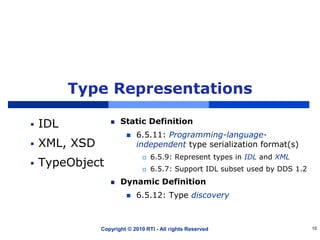
Type Representations
 IDL
 XML, XSD
 TypeObject
Copyright © 2010 RTI - All rights Reserved 15
Static Definition
 6.5.11: Programming-language-
independent type serialization format(s)
 6.5.9: Represent types in IDL and XML
 6.5.7: Support IDL subset used by DDS 1.2
Dynamic Definition
 6.5.12: Type discovery
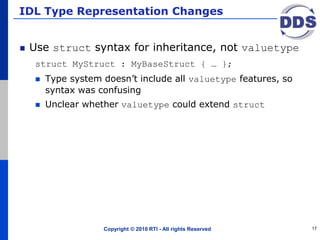
IDL Type Representation Changes
Added optional pragmas to delimit IDL segments
using new extended syntax
#pragma dds_xtopics begin [<version_number>]
// IDL definitions
#pragma dds_xtopics end
 Document conformance requirements for human readers
 Help non-conforming compilers recognize problems
sooner, give more meaningful errors
 No particular errors or warnings mandated
Copyright © 2010 RTI - All rights Reserved 16
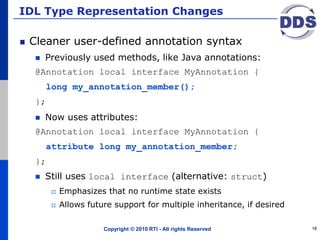
IDL Type Representation Changes
Use struct syntax for inheritance, not valuetype
struct MyStruct : MyBaseStruct { … };
 Type system doesn’t include all valuetype features, so
syntax was confusing
 Unclear whether valuetype could extend struct
Copyright © 2010 RTI - All rights Reserved 17
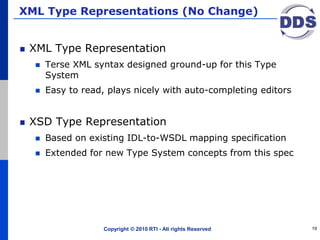
IDL Type Representation Changes
Cleaner user-defined annotation syntax
 Previously used methods, like Java annotations:
@Annotation local interface MyAnnotation {
long my_annotation_member();
};
 Now uses attributes:
@Annotation local interface MyAnnotation {
attribute long my_annotation_member;
};
 Still uses local interface (alternative: struct)
 Emphasizes that no runtime state exists
 Allows future support for multiple inheritance, if desired
Copyright © 2010 RTI - All rights Reserved 18
XML Type Representations (No Change)
XML Type Representation
 Terse XML syntax designed ground-up for this Type
System
 Easy to read, plays nicely with auto-completing editors
XSD Type Representation
 Based on existing IDL-to-WSDL mapping specification
 Extended for new Type System concepts from this spec
Copyright © 2010 RTI - All rights Reserved 19
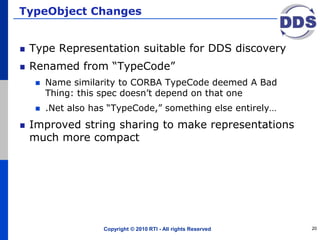
TypeObject Changes
Type Representation suitable for DDS discovery
Renamed from “TypeCode”
 Name similarity to CORBA TypeCode deemed A Bad
Thing: this spec doesn’t depend on that one
 .Net also has “TypeCode,” something else entirely…
Improved string sharing to make representations
much more compact
Copyright © 2010 RTI - All rights Reserved 20
Data Representations
 Extended CDR
 XML
Copyright © 2010 RTI - All rights Reserved 21
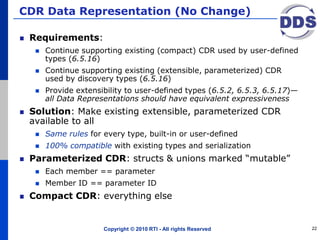
CDR Data Representation (No Change)
Requirements:
 Continue supporting existing (compact) CDR used by user-defined
types (6.5.16)
 Continue supporting existing (extensible, parameterized) CDR
used by discovery types (6.5.16)
 Provide extensibility to user-defined types (6.5.2, 6.5.3, 6.5.17)—
all Data Representations should have equivalent expressiveness
Solution: Make existing extensible, parameterized CDR
available to all
 Same rules for every type, built-in or user-defined
 100% compatible with existing types and serialization
Parameterized CDR: structs & unions marked “mutable”
 Each member == parameter
 Member ID == parameter ID
Compact CDR: everything else
Copyright © 2010 RTI - All rights Reserved 22
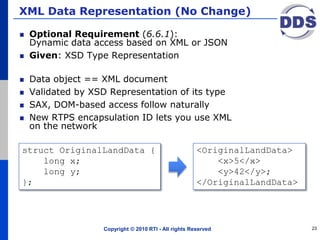
XML Data Representation (No Change)
Optional Requirement (6.6.1):
Dynamic data access based on XML or JSON
Given: XSD Type Representation
Data object == XML document
Validated by XSD Representation of its type
SAX, DOM-based access follow naturally
New RTPS encapsulation ID lets you use XML
on the network
Copyright © 2010 RTI - All rights Reserved 23
struct OriginalLandData {
long x;
long y;
};
<OriginalLandData>
<x>5</x>
<y>42</y>;
</OriginalLandData>
Language Bindings
 Plain Language Binding
 Dynamic Language Binding
Copyright © 2010 RTI - All rights Reserved 24
Plain Language Binding (No Change)
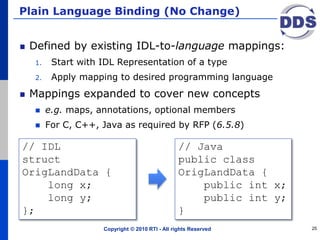
Defined by existing IDL-to-language mappings:
1. Start with IDL Representation of a type
2. Apply mapping to desired programming language
Mappings expanded to cover new concepts
 e.g. maps, annotations, optional members
 For C, C++, Java as required by RFP (6.5.8)
Copyright © 2010 RTI - All rights Reserved 25
// IDL
struct
OrigLandData {
long x;
long y;
};
// Java
public class
OrigLandData {
public int x;
public int y;
}
Dynamic Language Binding (No Change)
Classes
 DynamicTypeFactory: Creates new types (6.5.20)
 DynamicType: Introspect type definitions (6.5.13)
 Informed by CORBA TypeCode API
 DynamicData: Introspect objects (6.5.18)
 Informed by CORBA DynAny, JMS MapMessage,
TIBCO Rendezvous self-describing messages
 DynamicTypeSupport: Registers types with DDS (6.5.20)
 DynamicDataWriter: Writes objects of any (single) type,
each represented by a DynamicData object (6.5.21)
 DynamicDataReader: Reads objects of any (single) type,
each represented by a DynamicData object (6.5.21)
Copyright © 2010 RTI - All rights Reserved 26
Use by DDS
 Data Representation Compatibility
 Type Compatibility
 Built-in Types
Copyright © 2010 RTI - All rights Reserved 27
Data Representation Compatibility
Reader and writer must agree
on which Data Representation to use
 6.5.14: Encapsulation specification, negotiation
 6.5.15: Is encapsulation request-offer?
 6.6.2: Optional: Custom encapsulation API
Largely unchanged from previous submission
Solution: DataRepresentationQosPolicy
 List of representation IDs (standard = XCDR, XML)
 Applies to both readers and writers
 Included in corresponding built-in topic data types
 Request-Offer semantics
 Writer offers single representation it will use
 Reader requests a list of representations
 Compatible iff writer’s representation is in reader’s list
 Can describe proposed representations, future additions, and
vendor extensions
Copyright © 2010 RTI - All rights Reserved 28
Type Compatibility
If I write type “Foo” and you read type “Bar”, can
we communicate?
New submission clearer, more flexible
based on feedback on previous submission
3 parts:
1. Physical: type assignability
2. Intentional: type signature
3. Enforcement: QoS policy governs how above are applied
(NEW in this submission)
Copyright © 2010 RTI - All rights Reserved 29
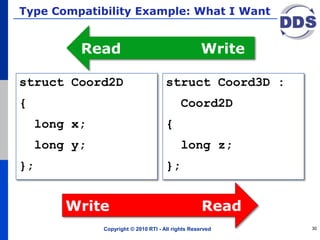
Type Compatibility Example: What I Want
struct Coord2D
{
long x;
long y;
};
struct Coord3D :
Coord2D
{
long z;
};
Copyright © 2010 RTI - All rights Reserved 30
Read Write
Write Read
1. Type Assignability
Structural compatibility:
Can sample serialized according to one type be
deserialized according to another?
 Reminder: Rules designed to require no writer-specific
runtime checks at deserialization time
Intrinsic property of types’ definitions
 Governed in part by extensibility kind
 No action required by application programmer
Copyright © 2010 RTI - All rights Reserved 31
2. Type Signature
Do I intend the types to be compatible?
Lists of equivalent types, base types provided at
registration time
Clarification to previous submission: both reader
and writer declarations taken into account
New since previous submission: lists can contain
patterns, not just literal names
Copyright © 2010 RTI - All rights Reserved 32
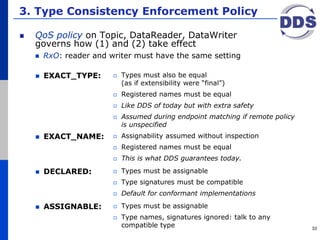
3. Type Consistency Enforcement Policy
QoS policy on Topic, DataReader, DataWriter
governs how (1) and (2) take effect
 RxO: reader and writer must have the same setting
Copyright © 2010 RTI - All rights Reserved 33
 EXACT_TYPE:  Types must also be equal
(as if extensibility were “final”)
 Registered names must be equal
 Like DDS of today but with extra safety
 Assumed during endpoint matching if remote policy
is unspecified
 EXACT_NAME:  Assignability assumed without inspection
 Registered names must be equal
 This is what DDS guarantees today.
 DECLARED:  Types must be assignable
 Type signatures must be compatible
 Default for conformant implementations
 ASSIGNABLE:  Types must be assignable
 Type names, signatures ignored: talk to any
compatible type
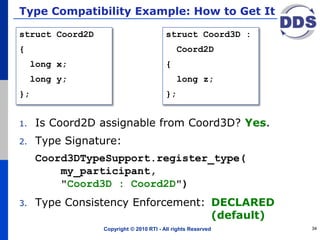
Type Compatibility Example: How to Get It
1. Is Coord2D assignable from Coord3D? Yes.
2. Type Signature:
Coord3DTypeSupport.register_type(
my_participant,
"Coord3D : Coord2D")
3. Type Consistency Enforcement: DECLARED
(default)
Copyright © 2010 RTI - All rights Reserved 34
struct Coord2D
{
long x;
long y;
};
struct Coord3D :
Coord2D
{
long z;
};
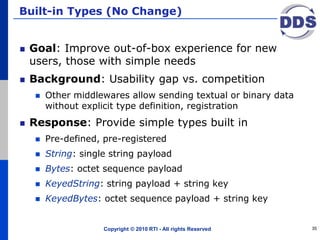
Built-in Types (No Change)
Goal: Improve out-of-box experience for new
users, those with simple needs
Background: Usability gap vs. competition
 Other middlewares allow sending textual or binary data
without explicit type definition, registration
Response: Provide simple types built in
 Pre-defined, pre-registered
 String: single string payload
 Bytes: octet sequence payload
 KeyedString: string payload + string key
 KeyedBytes: octet sequence payload + string key
Copyright © 2010 RTI - All rights Reserved 35
Summary
Copyright © 2010 RTI - All rights Reserved 36
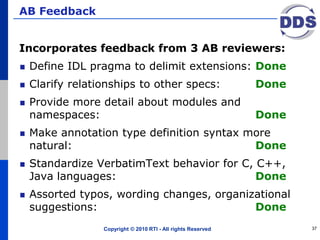
AB Feedback
Incorporates feedback from 3 AB reviewers:
Define IDL pragma to delimit extensions: Done
Clarify relationships to other specs: Done
Provide more detail about modules and
namespaces: Done
Make annotation type definition syntax more
natural: Done
Standardize VerbatimText behavior for C, C++,
Java languages: Done
Assorted typos, wording changes, organizational
suggestions: Done
Copyright © 2010 RTI - All rights Reserved 37
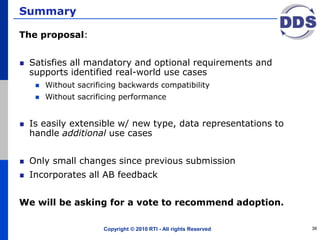
Summary
The proposal:
Satisfies all mandatory and optional requirements and
supports identified real-world use cases
 Without sacrificing backwards compatibility
 Without sacrificing performance
Is easily extensible w/ new type, data representations to
handle additional use cases
Only small changes since previous submission
Incorporates all AB feedback
We will be asking for a vote to recommend adoption.
Copyright © 2010 RTI - All rights Reserved 38
Q & A
Copyright © 2010 RTI - All rights Reserved 39

Extensible and Dynamic Topic Types for DDS

  • 1.
    Extensible and Dynamic TopicTypes for DDS MARS – Jacksonville, FL – March 2010 Presenter: Rick Warren, RTI Submitting POCs:  Angelo Corsaro, PrismTech: angelo.corsaro@prismtech.com  Gerardo Pardo, RTI: gerardo.pardo@rti.com  Robert Poth, PrismTech: robert.poth@prismtech.com  Rick Warren, RTI: rick.warren@rti.com Supporting POCs:  Virginie Watine, Thales: virginie.watine@thalesgroup.com document number: 2010-03-02
  • 2.
    Structure of thisPresentation Overview of specification and process Specification contents  Very detailed discussion last time  This presentation focuses on what’s changed AB feedback Copyright © 2010 RTI - All rights Reserved 2
  • 3.
    DDS Types: Assessmentand Challenges Good Unmatched type safety => fewer defects Unique type awareness => faster integration Unique type awareness => higher performance Bad No standard API to define / access types at runtime Hard to change types without rebuilding, redeploying Hard to upgrade systems one subsystem at a time Copyright © 2010 RTI - All rights Reserved 3 Vendor-Specific Solutions OMG-Standard Solutions
  • 4.
    Where We Are RFPissued: Jun. 2008 Initial submission: Nov 2008 Revised submission extended: Feb. 2009 Revised submission extended: Aug. 2009 Revised submission extended: Nov. 2009 Revised submission deadline: Feb. 2010  Submitters back on the same page  Responded to comments from 2 (now 3) AB reviewers  Discussed with Task Force in Long Beach meeting Copyright © 2010 RTI - All rights Reserved 4
  • 5.
    Design Principles Don’t breakanybody.  Many people depend on DDS  Don’t modify existing APIs  Don’t modify existing compliance points  Many people depend on RTPS/DDSI 2  Don’t modify existing protocols or formats  Don’t modify existing compliance points Keep it fast.  New capabilities must permit efficient implementations.  Don’t use them? Don’t pay for them. Keep it orthogonal. Type compatibility doesn’t depend on:  Types’ definition language(s)  Data representation(s)  Programming language(s)  QoS configuration Copyright © 2010 RTI - All rights Reserved 5
  • 6.
    Overview Copyright © 2010RTI - All rights Reserved 6 Type System Type Representation Language Binding Data Representation
  • 7.
    Overview: Example Copyright ©2010 RTI - All rights Reserved 7 Type Representation Language Binding Data Representation IDL: Foo.idl struct Foo { string name; long ssn; }; IDL to Language Mapping: Foo.h Foo.c FooTypeSupport.c struct Foo { char *name; int ssn; }; Foo f = {"hello", 2}; IDL to CDR: 00000006 68656C6C 6F000000 00000002
  • 8.
    Conformance Changes Feedback onprevious submission: conformance criteria, relationships to other specs unclear New submission more precise, better organized:  Conformance (part II, section 3): 2 conformance levels correspond to DDS, RTPS  Programming language conformance: Type system, type representations, language bindings, DDS Minimum Profile  Network interoperability conformance: Type system, data representations, RTPS  Relations to other specs (part III, section 8)  Extensions to DDS:  “Programming language conformance” sections constitute new optional conformance level (“profile”)  No changes to existing DDS profiles  Extensions to IDL:  Normative to impl.’s of this spec only; no change to CORBA conformance Copyright © 2010 RTI - All rights Reserved 8
  • 9.
    Type System Extensible, Compatible 6.5.1: (a) Type System as UML meta-model. (b) Type substitutability rules.  6.5.2: Type extensibility, mutability rules  6.5.3: Type compatibility in presence of change  6.5.17: Allow type to evolve without breaking interoperability  6.5.5: Support keys. How does extensibility apply? More Expressive  6.5.4: Map data type  6.5.6, 6.5.19: Sparse data: object contains only subset of fields defined by its type Copyright © 2010 RTI - All rights Reserved 9
  • 10.
    Type System Overview Copyright© 2010 RTI - All rights Reserved 10 class Type System NamedElement Type + nested: boolean {readOnly} PrimitiveType «enumeration» TypeKind Collection Namespace Aggregation Namespace Enumeration NamedElement Namespace Module Namespace BitSet Alias ConstructedType «enumeration» ExtensibilityKind FINAL_EXTENSIBILITY {readOnly} EXTENSIBLE_EXTENSIBILITY {readOnly} MUTABLE_EXTENSIBILITY {readOnly} +/container 0..* {frozen} +/containedType * {addOnly} +extensibility_kind 1 {frozen} +element_type 1 {frozen} +kind 1 {frozen} +base_type 1
  • 11.
    Type System Overview Entirelyfamiliar from IDL:  Primitives  Strings, narrow and wide  Arrays and sequences  Aliases (typedefs)  Unions  Modules As in IDL, but extended:  Structures—including single inheritance (for substitutability: 6.5.1)  Enumerations—specify bit width and constant values New relative to IDL:  Maps—like std::map or java.util.Map; required by RFP (6.5.4), fundamental OO collection  Annotations—for extensibility (6.5.2, 6.5.3) Copyright © 2010 RTI - All rights Reserved 11 module Foo { struct Bar { long baz; }; typedef Bar Quux; }
  • 12.
    Type System Changes Clearer,more-flexible type extensibility kinds 1. Previous kind (Boolean): “extensible”=true:  Add/remove/reorder type members  Renamed to “mutable” 2. Previous kind (Boolean): “extensible”=false:  Add to end, but don’t add elsewhere, remove, or reorder  Renamed to “extensible”  Now allow removing from end as well as adding to end 3. New kind “final”:  Don’t allow any modifications  Explicit annotations identify all levels in IDL  Un-annotated types presumed “extensible” (2)  Can be overridden by IDL compiler option Several concrete examples added Copyright © 2010 RTI - All rights Reserved 12
  • 13.
    Type Extensibility Example @Extensibility( EXTENSIBLE) structCoord2D { long x; long y; }; @Extensibility( EXTENSIBLE) struct Coord3D { long x; long y; long z; }; Copyright © 2010 RTI - All rights Reserved 13 Assignable
  • 14.
    Type Extensibility Example @Extensibility( FINAL) structCoord2D { long x; long y; }; @Extensibility( FINAL) struct Coord3D { long x; long y; long z; }; Copyright © 2010 RTI - All rights Reserved 14 Not Assignable
  • 15.
    Type Representations  IDL XML, XSD  TypeObject Copyright © 2010 RTI - All rights Reserved 15 Static Definition  6.5.11: Programming-language- independent type serialization format(s)  6.5.9: Represent types in IDL and XML  6.5.7: Support IDL subset used by DDS 1.2 Dynamic Definition  6.5.12: Type discovery
  • 16.
    IDL Type RepresentationChanges Added optional pragmas to delimit IDL segments using new extended syntax #pragma dds_xtopics begin [<version_number>] // IDL definitions #pragma dds_xtopics end  Document conformance requirements for human readers  Help non-conforming compilers recognize problems sooner, give more meaningful errors  No particular errors or warnings mandated Copyright © 2010 RTI - All rights Reserved 16
  • 17.
    IDL Type RepresentationChanges Use struct syntax for inheritance, not valuetype struct MyStruct : MyBaseStruct { … };  Type system doesn’t include all valuetype features, so syntax was confusing  Unclear whether valuetype could extend struct Copyright © 2010 RTI - All rights Reserved 17
  • 18.
    IDL Type RepresentationChanges Cleaner user-defined annotation syntax  Previously used methods, like Java annotations: @Annotation local interface MyAnnotation { long my_annotation_member(); };  Now uses attributes: @Annotation local interface MyAnnotation { attribute long my_annotation_member; };  Still uses local interface (alternative: struct)  Emphasizes that no runtime state exists  Allows future support for multiple inheritance, if desired Copyright © 2010 RTI - All rights Reserved 18
  • 19.
    XML Type Representations(No Change) XML Type Representation  Terse XML syntax designed ground-up for this Type System  Easy to read, plays nicely with auto-completing editors XSD Type Representation  Based on existing IDL-to-WSDL mapping specification  Extended for new Type System concepts from this spec Copyright © 2010 RTI - All rights Reserved 19
  • 20.
    TypeObject Changes Type Representationsuitable for DDS discovery Renamed from “TypeCode”  Name similarity to CORBA TypeCode deemed A Bad Thing: this spec doesn’t depend on that one  .Net also has “TypeCode,” something else entirely… Improved string sharing to make representations much more compact Copyright © 2010 RTI - All rights Reserved 20
  • 21.
    Data Representations  ExtendedCDR  XML Copyright © 2010 RTI - All rights Reserved 21
  • 22.
    CDR Data Representation(No Change) Requirements:  Continue supporting existing (compact) CDR used by user-defined types (6.5.16)  Continue supporting existing (extensible, parameterized) CDR used by discovery types (6.5.16)  Provide extensibility to user-defined types (6.5.2, 6.5.3, 6.5.17)— all Data Representations should have equivalent expressiveness Solution: Make existing extensible, parameterized CDR available to all  Same rules for every type, built-in or user-defined  100% compatible with existing types and serialization Parameterized CDR: structs & unions marked “mutable”  Each member == parameter  Member ID == parameter ID Compact CDR: everything else Copyright © 2010 RTI - All rights Reserved 22
  • 23.
    XML Data Representation(No Change) Optional Requirement (6.6.1): Dynamic data access based on XML or JSON Given: XSD Type Representation Data object == XML document Validated by XSD Representation of its type SAX, DOM-based access follow naturally New RTPS encapsulation ID lets you use XML on the network Copyright © 2010 RTI - All rights Reserved 23 struct OriginalLandData { long x; long y; }; <OriginalLandData> <x>5</x> <y>42</y>; </OriginalLandData>
  • 24.
    Language Bindings  PlainLanguage Binding  Dynamic Language Binding Copyright © 2010 RTI - All rights Reserved 24
  • 25.
    Plain Language Binding(No Change) Defined by existing IDL-to-language mappings: 1. Start with IDL Representation of a type 2. Apply mapping to desired programming language Mappings expanded to cover new concepts  e.g. maps, annotations, optional members  For C, C++, Java as required by RFP (6.5.8) Copyright © 2010 RTI - All rights Reserved 25 // IDL struct OrigLandData { long x; long y; }; // Java public class OrigLandData { public int x; public int y; }
  • 26.
    Dynamic Language Binding(No Change) Classes  DynamicTypeFactory: Creates new types (6.5.20)  DynamicType: Introspect type definitions (6.5.13)  Informed by CORBA TypeCode API  DynamicData: Introspect objects (6.5.18)  Informed by CORBA DynAny, JMS MapMessage, TIBCO Rendezvous self-describing messages  DynamicTypeSupport: Registers types with DDS (6.5.20)  DynamicDataWriter: Writes objects of any (single) type, each represented by a DynamicData object (6.5.21)  DynamicDataReader: Reads objects of any (single) type, each represented by a DynamicData object (6.5.21) Copyright © 2010 RTI - All rights Reserved 26
  • 27.
    Use by DDS Data Representation Compatibility  Type Compatibility  Built-in Types Copyright © 2010 RTI - All rights Reserved 27
  • 28.
    Data Representation Compatibility Readerand writer must agree on which Data Representation to use  6.5.14: Encapsulation specification, negotiation  6.5.15: Is encapsulation request-offer?  6.6.2: Optional: Custom encapsulation API Largely unchanged from previous submission Solution: DataRepresentationQosPolicy  List of representation IDs (standard = XCDR, XML)  Applies to both readers and writers  Included in corresponding built-in topic data types  Request-Offer semantics  Writer offers single representation it will use  Reader requests a list of representations  Compatible iff writer’s representation is in reader’s list  Can describe proposed representations, future additions, and vendor extensions Copyright © 2010 RTI - All rights Reserved 28
  • 29.
    Type Compatibility If Iwrite type “Foo” and you read type “Bar”, can we communicate? New submission clearer, more flexible based on feedback on previous submission 3 parts: 1. Physical: type assignability 2. Intentional: type signature 3. Enforcement: QoS policy governs how above are applied (NEW in this submission) Copyright © 2010 RTI - All rights Reserved 29
  • 30.
    Type Compatibility Example:What I Want struct Coord2D { long x; long y; }; struct Coord3D : Coord2D { long z; }; Copyright © 2010 RTI - All rights Reserved 30 Read Write Write Read
  • 31.
    1. Type Assignability Structuralcompatibility: Can sample serialized according to one type be deserialized according to another?  Reminder: Rules designed to require no writer-specific runtime checks at deserialization time Intrinsic property of types’ definitions  Governed in part by extensibility kind  No action required by application programmer Copyright © 2010 RTI - All rights Reserved 31
  • 32.
    2. Type Signature DoI intend the types to be compatible? Lists of equivalent types, base types provided at registration time Clarification to previous submission: both reader and writer declarations taken into account New since previous submission: lists can contain patterns, not just literal names Copyright © 2010 RTI - All rights Reserved 32
  • 33.
    3. Type ConsistencyEnforcement Policy QoS policy on Topic, DataReader, DataWriter governs how (1) and (2) take effect  RxO: reader and writer must have the same setting Copyright © 2010 RTI - All rights Reserved 33  EXACT_TYPE:  Types must also be equal (as if extensibility were “final”)  Registered names must be equal  Like DDS of today but with extra safety  Assumed during endpoint matching if remote policy is unspecified  EXACT_NAME:  Assignability assumed without inspection  Registered names must be equal  This is what DDS guarantees today.  DECLARED:  Types must be assignable  Type signatures must be compatible  Default for conformant implementations  ASSIGNABLE:  Types must be assignable  Type names, signatures ignored: talk to any compatible type
  • 34.
    Type Compatibility Example:How to Get It 1. Is Coord2D assignable from Coord3D? Yes. 2. Type Signature: Coord3DTypeSupport.register_type( my_participant, "Coord3D : Coord2D") 3. Type Consistency Enforcement: DECLARED (default) Copyright © 2010 RTI - All rights Reserved 34 struct Coord2D { long x; long y; }; struct Coord3D : Coord2D { long z; };
  • 35.
    Built-in Types (NoChange) Goal: Improve out-of-box experience for new users, those with simple needs Background: Usability gap vs. competition  Other middlewares allow sending textual or binary data without explicit type definition, registration Response: Provide simple types built in  Pre-defined, pre-registered  String: single string payload  Bytes: octet sequence payload  KeyedString: string payload + string key  KeyedBytes: octet sequence payload + string key Copyright © 2010 RTI - All rights Reserved 35
  • 36.
    Summary Copyright © 2010RTI - All rights Reserved 36
  • 37.
    AB Feedback Incorporates feedbackfrom 3 AB reviewers: Define IDL pragma to delimit extensions: Done Clarify relationships to other specs: Done Provide more detail about modules and namespaces: Done Make annotation type definition syntax more natural: Done Standardize VerbatimText behavior for C, C++, Java languages: Done Assorted typos, wording changes, organizational suggestions: Done Copyright © 2010 RTI - All rights Reserved 37
  • 38.
    Summary The proposal: Satisfies allmandatory and optional requirements and supports identified real-world use cases  Without sacrificing backwards compatibility  Without sacrificing performance Is easily extensible w/ new type, data representations to handle additional use cases Only small changes since previous submission Incorporates all AB feedback We will be asking for a vote to recommend adoption. Copyright © 2010 RTI - All rights Reserved 38
  • 39.
    Q & A Copyright© 2010 RTI - All rights Reserved 39

Editor's Notes

  • #2 Lots of material in a short amount of time, so here’s the format:If I’m not clear, let me know right away.If you have a quick question, go ahead and ask itIf you have a longer question of discussion point, we’ll talk about it at the end.
  • #4 DDS is unique among pub-sub systems in providing interoperable static type safety.Applications that use data already expect certain contents; by making expectations explicit, enable: type-aware integration (e.g. relational mapping) compact network representation.
  • #6 Many systems are already committed to, deployed on DDS 1.2, RTPS 2 (such as, many international navies). Breaking compatibility with those specs makes integration really hard, costs a lot of time and money for users an vendors alike. Don’t do it.People choose DDS for its performance. Don’t break that either.
  • #9 Already, DDS conformance and RTPS conformance are independent. This spec pertains to both programming APIs and network representation, so it makes the same distinction.
  • #23 Remember why we decided to use parameterized encoding for discovery in the first place:We knew it would change in future versions.We knew vendors would add extensions.But we created a special enclave: built-in topic data types are extensible, but no one else.This spec generalizes the model that has proven itself over a decade.
  • #24 Nothing very new here: IDL  WSDL let you do this before. Now it’s official.
  • #26 C, C++, Java covers almost all DDS users.Ada is a tiny fraction.Scripting languages are covered by Web-Enabled.
  • #31 This is one common use case. After we talk about the different pieces, we’ll see how to accomplish it.
  • #34 “DECLARED” is the default for conforming implementations. Call get_default_qos and you will get this.When a conforming implementation talks to a non-conforming implementation, this policy will be missing, so according to the type defaulting rules, it will assume “EXACT_TYPE.”