Introduction to
Research:
Basic Concepts
DR. SUVARNA GANVIR
PROFESSOR AND HOD
DEPT OF NEUROPHYSIOTHERAPY, AHMEDNAGAR.
1
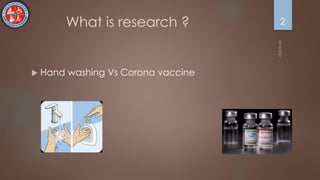
What is research ?
 Hand washing Vs Corona vaccine
2
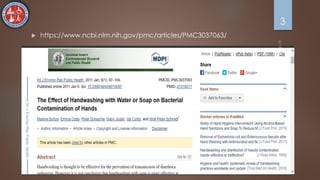
 https://www.ncbi.nlm.nih.gov/pmc/articles/PMC3037063/
3
Definition
‱ Systematic process
‱ Aimed at acquiring new knowledge/
testingthehypothesis
‱ Through
 Verifiable examination of data
 Empirical testing of hypothesis
4
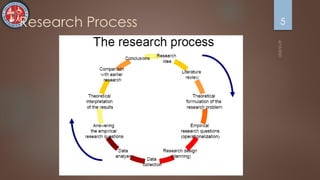
Research Process 5
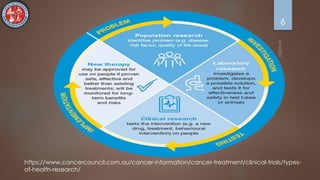
https://www.cancercouncil.com.au/cancer-information/cancer-treatment/clinical-trials/types-
of-health-research/
6
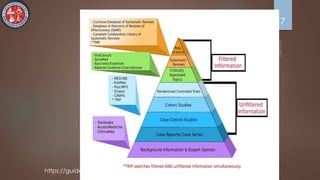
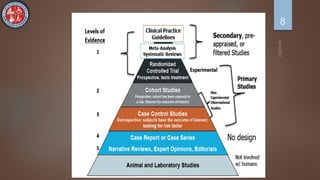
https://guides.himmelfarb.gwu.edu/ebm/studytypes
7
8
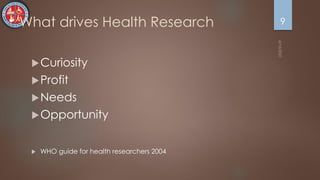
What drives Health Research
Curiosity
Profit
Needs
Opportunity
 WHO guide for health researchers 2004
9
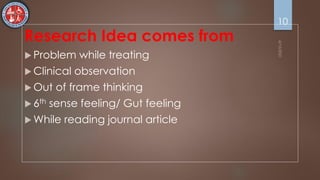
Research Idea comes from
 Problem while treating
 Clinical observation
 Out of frame thinking
 6th sense feeling/ Gut feeling
 While reading journal article
10
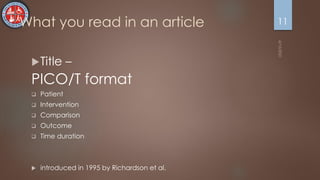
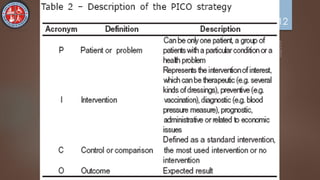
What you read in an article
Title –
PICO/T format
 Patient
 Intervention
 Comparison
 Outcome
 Time duration
 introduced in 1995 by Richardson et al.
11
12
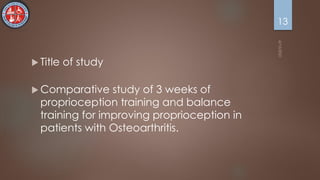
 Title of study
 Comparative study of 3 weeks of
proprioception training and balance
training for improving proprioception in
patients with Osteoarthritis.
13
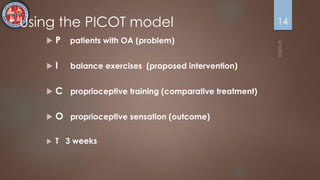
Using the PICOT model
 P patients with OA (problem)
 I balance exercises (proposed intervention)
 C proprioceptive training (comparative treatment)
 O proprioceptive sensation (outcome)
 T 3 weeks
14
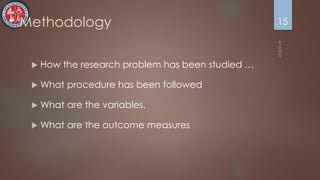
Methodology
 How the research problem has been studied 

 What procedure has been followed
 What are the variables.
 What are the outcome measures
15
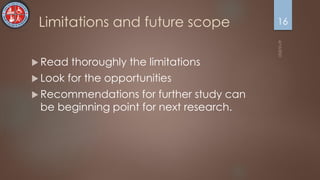
Limitations and future scope
 Read thoroughly the limitations
 Look for the opportunities
 Recommendations for further study can
be beginning point for next research.
16
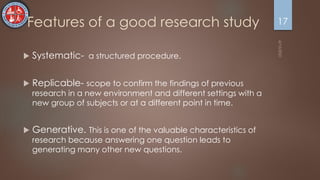
Features of a good research study
 Systematic- a structured procedure.
 Replicable- scope to confirm the findings of previous
research in a new environment and different settings with a
new group of subjects or at a different point in time.
 Generative. This is one of the valuable characteristics of
research because answering one question leads to
generating many other new questions.
17
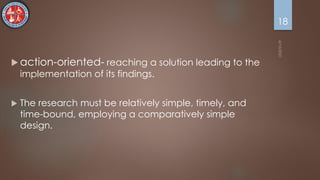
 action-oriented- reaching a solution leading to the
implementation of its findings.
 The research must be relatively simple, timely, and
time-bound, employing a comparatively simple
design.
18
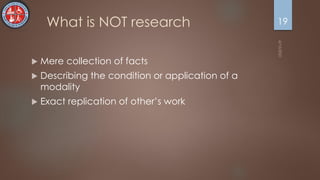
What is NOT research
 Mere collection of facts
 Describing the condition or application of a
modality
 Exact replication of other’s work
19
Pre- Research
 Identification of a issue or problem
 Extensive literature search ------Specifically
related to your current geographical location
 Writing well defined research question
 Designing appropriate research methods
 Preparing all the related documents skeleton
 Preparing a complete proposal
20
Peri Research
 Begin with data collection
 Fill up the documents at regular intervals
 Follow the study design as described in the proposal
 Note down any deviations/obstructions
 Keep the time limit – follow the Gantt chart
 Finish up the collection of data in specific time.
 Write up should be done according to the standard
guidelines.
21
Post Research
PUBLISH IT.
Start a new study.
22
Activity
 Write PICOT format.
 Limitations of study and future scope .
 What new study can be taken up.
23
Thank you
24

Introduction to research

  • 1.
    Introduction to Research: Basic Concepts DR.SUVARNA GANVIR PROFESSOR AND HOD DEPT OF NEUROPHYSIOTHERAPY, AHMEDNAGAR. 1
  • 2.
    What is research?  Hand washing Vs Corona vaccine 2
  • 3.
  • 4.
    Definition ‱ Systematic process ‱Aimed at acquiring new knowledge/ testingthehypothesis ‱ Through  Verifiable examination of data  Empirical testing of hypothesis 4
  • 5.
  • 6.
  • 7.
  • 8.
  • 9.
    What drives HealthResearch Curiosity Profit Needs Opportunity  WHO guide for health researchers 2004 9
  • 10.
    Research Idea comesfrom  Problem while treating  Clinical observation  Out of frame thinking  6th sense feeling/ Gut feeling  While reading journal article 10
  • 11.
    What you readin an article Title – PICO/T format  Patient  Intervention  Comparison  Outcome  Time duration  introduced in 1995 by Richardson et al. 11
  • 12.
  • 13.
     Title ofstudy  Comparative study of 3 weeks of proprioception training and balance training for improving proprioception in patients with Osteoarthritis. 13
  • 14.
    Using the PICOTmodel  P patients with OA (problem)  I balance exercises (proposed intervention)  C proprioceptive training (comparative treatment)  O proprioceptive sensation (outcome)  T 3 weeks 14
  • 15.
    Methodology  How theresearch problem has been studied 
  What procedure has been followed  What are the variables.  What are the outcome measures 15
  • 16.
    Limitations and futurescope  Read thoroughly the limitations  Look for the opportunities  Recommendations for further study can be beginning point for next research. 16
  • 17.
    Features of agood research study  Systematic- a structured procedure.  Replicable- scope to confirm the findings of previous research in a new environment and different settings with a new group of subjects or at a different point in time.  Generative. This is one of the valuable characteristics of research because answering one question leads to generating many other new questions. 17
  • 18.
     action-oriented- reachinga solution leading to the implementation of its findings.  The research must be relatively simple, timely, and time-bound, employing a comparatively simple design. 18
  • 19.
    What is NOTresearch  Mere collection of facts  Describing the condition or application of a modality  Exact replication of other’s work 19
  • 20.
    Pre- Research  Identificationof a issue or problem  Extensive literature search ------Specifically related to your current geographical location  Writing well defined research question  Designing appropriate research methods  Preparing all the related documents skeleton  Preparing a complete proposal 20
  • 21.
    Peri Research  Beginwith data collection  Fill up the documents at regular intervals  Follow the study design as described in the proposal  Note down any deviations/obstructions  Keep the time limit – follow the Gantt chart  Finish up the collection of data in specific time.  Write up should be done according to the standard guidelines. 21
  • 22.
  • 23.
    Activity  Write PICOTformat.  Limitations of study and future scope .  What new study can be taken up. 23
  • 24.