
Internet ResearchReferencingReference listsANDIn-text references
Referencing	= 	supporting your ideas with 	credible sourcesKey terminology:Reference listIn-text referenceWhat’s the difference?
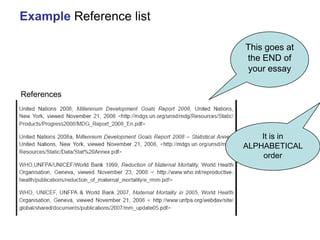
Example Reference listThis goes at the END of your essayReferencesIt is in ALPHABETICAL order
Example In-Text ReferencesThese go inside the body of your essay
Why MUST we reference?To avoid PLAGIARISM
What is plagiarism?Copying text from the Internet and pretending it’s your ownFailing to use “quotation marks” and correct in-text referencingSubmitting the same essay as someone else
INTERNETMy EssayThis is plagiarism!
What are the consequences?Formal warning that stays on your academic recordBeing given a zero gradeBeing excluded from receiving your academic certificate, diploma or even degree
Avoid plagiarism by:Paraphrasing (use your OWN WORDS) Using in-text references (in the body paragraphs of your essay)Including a reference list (at the end of your essay)Important pieces in your reference list:Author		Year of publication	Title of PublicationPublisher	Place of publication		Web Address (URL)Date viewed
Source: http://news.bbc.co.uk/2/hi/south_asia/7570192.stmResearching and Recording SourcesLondon, EnglandStruggling with India’s gender bias
London, EnglandStruggling with India’s gender biasWho is the publisher?Who is the author?What’s the year of publication?What’s the title of publication?What is the place ofpublication?What’s the web address?What’s the date YOU viewed this article??
Web Address (URL)PublisherPlace of publicationLondon, EnglandStruggling with India’s gender biasTitle of PublicationAuthorYear of PublicationWho is the publisher?Who is the author?What’s the year of publication?What’s the title of publication?What is the place ofpublication?What’s the web address?What’s the date YOU viewed this article??
Source:http://www.thp.org/where_we_work/south_asia/india/research_reports/chronic_hunger_and_status_of_womenResearching and Recording Sources
Women and girls on India receive far less education than men, due both to social norms and fears of violence.India has the largest population of non-school-going working girls.India's government guarantees free primary school education for both boys and girls up to age 14. This goal has been repeatedly communicated, but primary education in India is not universal. Overall, the literacy rate for women is 39 percent versus 64 percent for men. The rate for women in the four large northern states - Bihar, Uttar Pradesh, Rajasthan and Madhya Pradesh - is lower than the national average: it was 25 percent in 1991. Attendance rates from the 1981 census suggest that no more than 1/3 of all girls (and a lower proportion of rural girls) aged 5-14 are attending school.Before India became an independent country in 1947, less than 8% of females were literate.  Even with the progress that has been made, there were 16 million more illiterate females in Indian in 1991 than there were in 1981. Who is the author?What’s the year of publication?What’s the title of publication?What is the place ofpublication?What’s the web address?What’s the date YOU viewed this article?
Web Address (URL)PublisherTitle of PublicationYear of PublicationAuthorWomen and girls on India receive far less education than men, due both to social norms and fears of violence.India has the largest population of non-school-going working girls.India's government guarantees free primary school education for both boys and girls up to age 14. This goal has been repeatedly communicated, but primary education in India is not universal. Overall, the literacy rate for women is 39 percent versus 64 percent for men. The rate for women in the four large northern states - Bihar, Uttar Pradesh, Rajasthan and Madhya Pradesh - is lower than the national average: it was 25 percent in 1991. Attendance rates from the 1981 census suggest that no more than 1/3 of all girls (and a lower proportion of rural girls) aged 5-14 are attending school.Before India became an independent country in 1947, less than 8% of females were literate.  Even with the progress that has been made, there were 16 million more illiterate females in Indian in 1991 than there were in 1981. Place of publicationAuthor		Year of publication		Title of PublicationPublisher		Place of publication		Web Address (URL)
How is men’s education in India compared to women’s education in India?  What reasons are given for this difference?Women and girls in India receive less education than men, due both to social norms and fears of violence.
A.  How is men’s education in India compared to women’s education in India?  What reasons are given for this difference?Women and girls in India receive less education than men, due both to social norms and fears of violence.Is this plagiarism?YES!
A.  How is men’s education in India compared to women’s education in India?  What reasons are given for this difference?Women and girls in India receive less education than men, due both to social norms and fears of violence.Women and girls on India receive far less education than men, due both to social norms and fears of violence.India has the largest population of non-school-going working girls.India's government guarantees free primary school education for both boys and girls up to age 14. This goal has been repeatedly communicated, but primary education in India is not universal. Overall, the literacy rate for women is 39 percent versus 64 percent for men. The rate for women in the four large northern states - Bihar, Uttar Pradesh, Rajasthan and Madhya Pradesh - is lower than the national average: it was 25 percent in 1991. Attendance rates from the 1981 census suggest that no more than 1/3 of all girls (and a lower proportion of rural girls) aged 5-14 are attending school.
Paraphrase this sentence:Women and girls in India receive less education than men, due both to social norms and fears of violence.
Paraphrase this sentence:Women and girls in India receive less education than men, due both to social norms and fears of violence.EXAMPLE:In India, women are not educated as much as men because of cultural beliefs (Coonrod 1998).
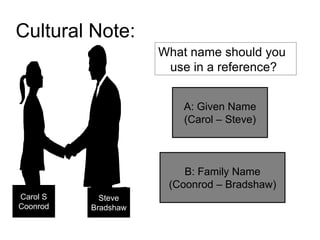
Cultural Note:What name should you use in a reference?A: Given Name (Carol – Steve)B: Family Name (Coonrod – Bradshaw)Carol S CoonrodSteve Bradshaw

Introduction to Referencing

  • 1.
  • 2.
    Referencing = supporting yourideas with credible sourcesKey terminology:Reference listIn-text referenceWhat’s the difference?
  • 3.
    Example Reference listThisgoes at the END of your essayReferencesIt is in ALPHABETICAL order
  • 4.
    Example In-Text ReferencesThesego inside the body of your essay
  • 5.
    Why MUST wereference?To avoid PLAGIARISM
  • 6.
    What is plagiarism?Copyingtext from the Internet and pretending it’s your ownFailing to use “quotation marks” and correct in-text referencingSubmitting the same essay as someone else
  • 7.
  • 8.
    What are theconsequences?Formal warning that stays on your academic recordBeing given a zero gradeBeing excluded from receiving your academic certificate, diploma or even degree
  • 9.
    Avoid plagiarism by:Paraphrasing(use your OWN WORDS) Using in-text references (in the body paragraphs of your essay)Including a reference list (at the end of your essay)Important pieces in your reference list:Author Year of publication Title of PublicationPublisher Place of publication Web Address (URL)Date viewed
  • 10.
    Source: http://news.bbc.co.uk/2/hi/south_asia/7570192.stmResearching andRecording SourcesLondon, EnglandStruggling with India’s gender bias
  • 11.
    London, EnglandStruggling withIndia’s gender biasWho is the publisher?Who is the author?What’s the year of publication?What’s the title of publication?What is the place ofpublication?What’s the web address?What’s the date YOU viewed this article??
  • 12.
    Web Address (URL)PublisherPlaceof publicationLondon, EnglandStruggling with India’s gender biasTitle of PublicationAuthorYear of PublicationWho is the publisher?Who is the author?What’s the year of publication?What’s the title of publication?What is the place ofpublication?What’s the web address?What’s the date YOU viewed this article??
  • 13.
  • 14.
    Women and girlson India receive far less education than men, due both to social norms and fears of violence.India has the largest population of non-school-going working girls.India's government guarantees free primary school education for both boys and girls up to age 14. This goal has been repeatedly communicated, but primary education in India is not universal. Overall, the literacy rate for women is 39 percent versus 64 percent for men. The rate for women in the four large northern states - Bihar, Uttar Pradesh, Rajasthan and Madhya Pradesh - is lower than the national average: it was 25 percent in 1991. Attendance rates from the 1981 census suggest that no more than 1/3 of all girls (and a lower proportion of rural girls) aged 5-14 are attending school.Before India became an independent country in 1947, less than 8% of females were literate. Even with the progress that has been made, there were 16 million more illiterate females in Indian in 1991 than there were in 1981. Who is the author?What’s the year of publication?What’s the title of publication?What is the place ofpublication?What’s the web address?What’s the date YOU viewed this article?
  • 15.
    Web Address (URL)PublisherTitleof PublicationYear of PublicationAuthorWomen and girls on India receive far less education than men, due both to social norms and fears of violence.India has the largest population of non-school-going working girls.India's government guarantees free primary school education for both boys and girls up to age 14. This goal has been repeatedly communicated, but primary education in India is not universal. Overall, the literacy rate for women is 39 percent versus 64 percent for men. The rate for women in the four large northern states - Bihar, Uttar Pradesh, Rajasthan and Madhya Pradesh - is lower than the national average: it was 25 percent in 1991. Attendance rates from the 1981 census suggest that no more than 1/3 of all girls (and a lower proportion of rural girls) aged 5-14 are attending school.Before India became an independent country in 1947, less than 8% of females were literate. Even with the progress that has been made, there were 16 million more illiterate females in Indian in 1991 than there were in 1981. Place of publicationAuthor Year of publication Title of PublicationPublisher Place of publication Web Address (URL)
  • 16.
    How is men’seducation in India compared to women’s education in India? What reasons are given for this difference?Women and girls in India receive less education than men, due both to social norms and fears of violence.
  • 17.
    A. Howis men’s education in India compared to women’s education in India? What reasons are given for this difference?Women and girls in India receive less education than men, due both to social norms and fears of violence.Is this plagiarism?YES!
  • 18.
    A. Howis men’s education in India compared to women’s education in India? What reasons are given for this difference?Women and girls in India receive less education than men, due both to social norms and fears of violence.Women and girls on India receive far less education than men, due both to social norms and fears of violence.India has the largest population of non-school-going working girls.India's government guarantees free primary school education for both boys and girls up to age 14. This goal has been repeatedly communicated, but primary education in India is not universal. Overall, the literacy rate for women is 39 percent versus 64 percent for men. The rate for women in the four large northern states - Bihar, Uttar Pradesh, Rajasthan and Madhya Pradesh - is lower than the national average: it was 25 percent in 1991. Attendance rates from the 1981 census suggest that no more than 1/3 of all girls (and a lower proportion of rural girls) aged 5-14 are attending school.
  • 19.
    Paraphrase this sentence:Womenand girls in India receive less education than men, due both to social norms and fears of violence.
  • 20.
    Paraphrase this sentence:Womenand girls in India receive less education than men, due both to social norms and fears of violence.EXAMPLE:In India, women are not educated as much as men because of cultural beliefs (Coonrod 1998).
  • 21.
    Cultural Note:What nameshould you use in a reference?A: Given Name (Carol – Steve)B: Family Name (Coonrod – Bradshaw)Carol S CoonrodSteve Bradshaw