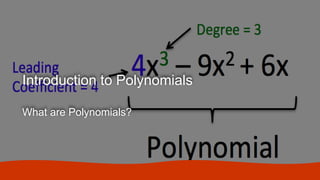
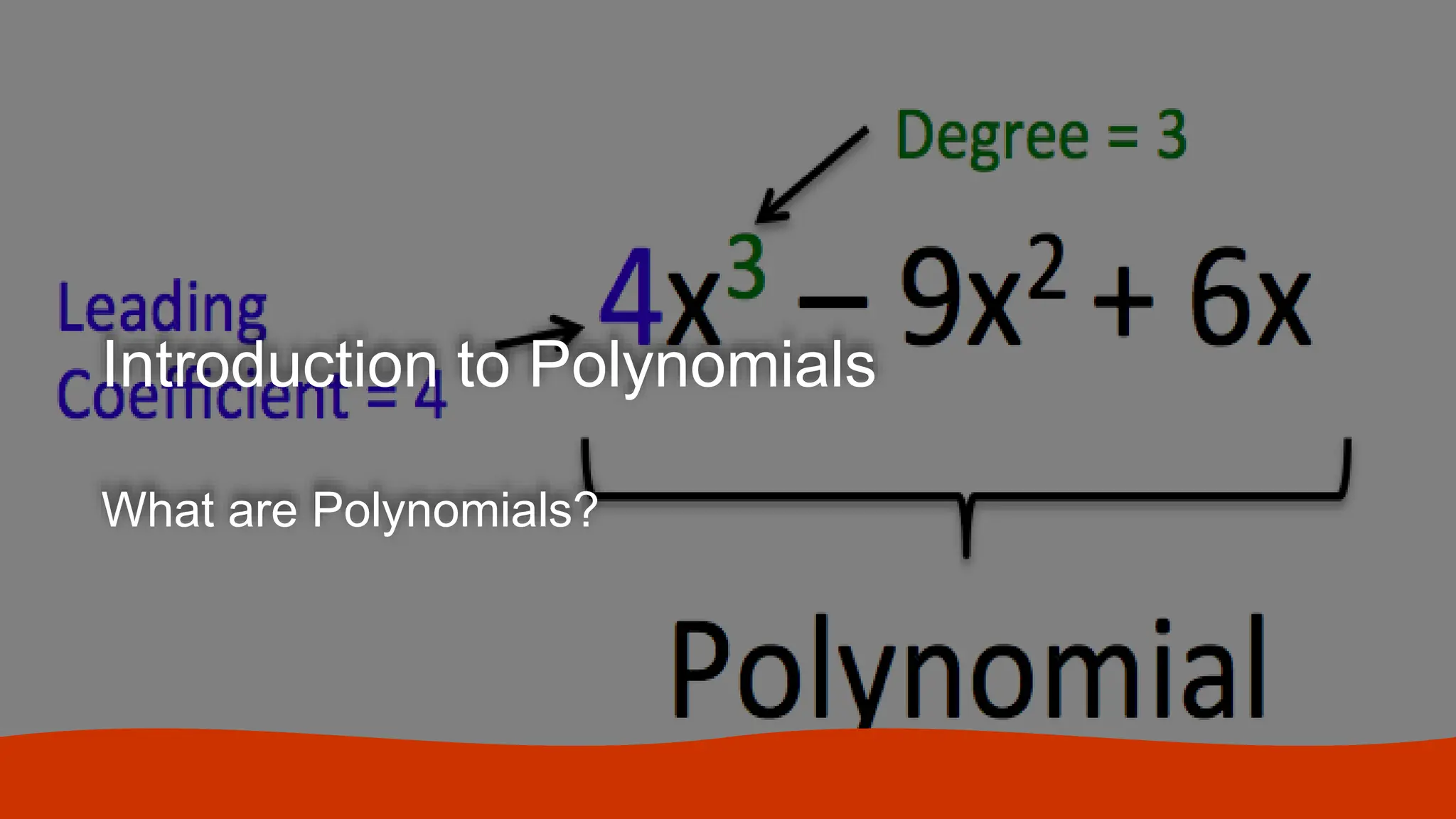
Introduction to Polynomials
What are Polynomials?
Understanding Terms in Algebra
• Terms are the building blocks
of algebraic expressions.
• A term can be a constant, a
variable, or a combination of
both.
• For example, 2x, 3, and x^2
are all terms.
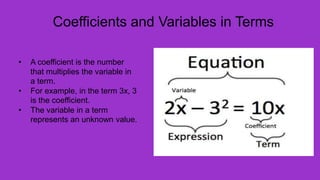
Coefficients and Variables in Terms
• A coefficient is the number
that multiplies the variable in
a term.
• For example, in the term 3x, 3
is the coefficient.
• The variable in a term
represents an unknown value.
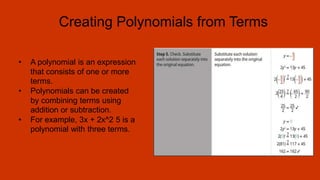
Creating Polynomials from Terms
• A polynomial is an expression
that consists of one or more
terms.
• Polynomials can be created
by combining terms using
addition or subtraction.
• For example, 3x + 2x^2 5 is a
polynomial with three terms.
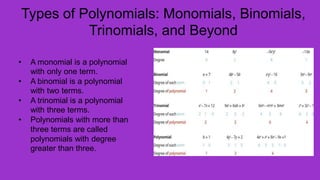
Types of Polynomials: Monomials, Binomials,
Trinomials, and Beyond
• A monomial is a polynomial
with only one term.
• A binomial is a polynomial
with two terms.
• A trinomial is a polynomial
with three terms.
• Polynomials with more than
three terms are called
polynomials with degree
greater than three.
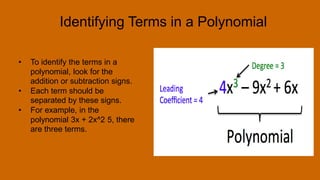
Identifying Terms in a Polynomial
• To identify the terms in a
polynomial, look for the
addition or subtraction signs.
• Each term should be
separated by these signs.
• For example, in the
polynomial 3x + 2x^2 5, there
are three terms.
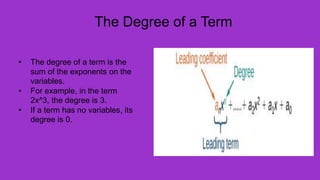
The Degree of a Term
• The degree of a term is the
sum of the exponents on the
variables.
• For example, in the term
2x^3, the degree is 3.
• If a term has no variables, its
degree is 0.
The Degree of a Polynomial
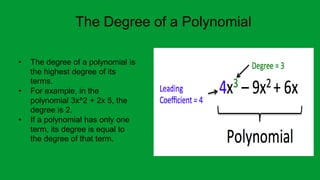
• The degree of a polynomial is
the highest degree of its
terms.
• For example, in the
polynomial 3x^2 + 2x 5, the
degree is 2.
• If a polynomial has only one
term, its degree is equal to
the degree of that term.
Arranging Polynomials in Order
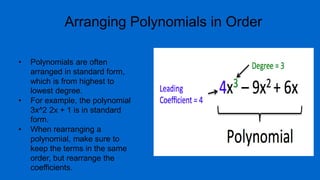
• Polynomials are often
arranged in standard form,
which is from highest to
lowest degree.
• For example, the polynomial
3x^2 2x + 1 is in standard
form.
• When rearranging a
polynomial, make sure to
keep the terms in the same
order, but rearrange the
coefficients.
Positive and Negative Coefficients in
Polynomials
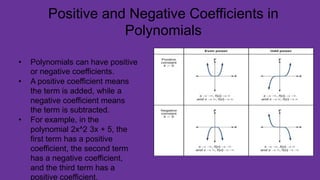
• Polynomials can have positive
or negative coefficients.
• A positive coefficient means
the term is added, while a
negative coefficient means
the term is subtracted.
• For example, in the
polynomial 2x^2 3x + 5, the
first term has a positive
coefficient, the second term
has a negative coefficient,
and the third term has a
positive coefficient.

Introduction to Polynomials.pptx

  • 1.
  • 2.
    Understanding Terms inAlgebra • Terms are the building blocks of algebraic expressions. • A term can be a constant, a variable, or a combination of both. • For example, 2x, 3, and x^2 are all terms.
  • 3.
    Coefficients and Variablesin Terms • A coefficient is the number that multiplies the variable in a term. • For example, in the term 3x, 3 is the coefficient. • The variable in a term represents an unknown value.
  • 4.
    Creating Polynomials fromTerms • A polynomial is an expression that consists of one or more terms. • Polynomials can be created by combining terms using addition or subtraction. • For example, 3x + 2x^2 5 is a polynomial with three terms.
  • 5.
    Types of Polynomials:Monomials, Binomials, Trinomials, and Beyond • A monomial is a polynomial with only one term. • A binomial is a polynomial with two terms. • A trinomial is a polynomial with three terms. • Polynomials with more than three terms are called polynomials with degree greater than three.
  • 6.
    Identifying Terms ina Polynomial • To identify the terms in a polynomial, look for the addition or subtraction signs. • Each term should be separated by these signs. • For example, in the polynomial 3x + 2x^2 5, there are three terms.
  • 7.
    The Degree ofa Term • The degree of a term is the sum of the exponents on the variables. • For example, in the term 2x^3, the degree is 3. • If a term has no variables, its degree is 0.
  • 8.
    The Degree ofa Polynomial • The degree of a polynomial is the highest degree of its terms. • For example, in the polynomial 3x^2 + 2x 5, the degree is 2. • If a polynomial has only one term, its degree is equal to the degree of that term.
  • 9.
    Arranging Polynomials inOrder • Polynomials are often arranged in standard form, which is from highest to lowest degree. • For example, the polynomial 3x^2 2x + 1 is in standard form. • When rearranging a polynomial, make sure to keep the terms in the same order, but rearrange the coefficients.
  • 10.
    Positive and NegativeCoefficients in Polynomials • Polynomials can have positive or negative coefficients. • A positive coefficient means the term is added, while a negative coefficient means the term is subtracted. • For example, in the polynomial 2x^2 3x + 5, the first term has a positive coefficient, the second term has a negative coefficient, and the third term has a positive coefficient.