Introduction to Multi-Sensory
      Taste Perception
‘Cooking is probably the most multisensual art. I
          try to stimulate all the senses.’
              (Ferran Adrià, El Bulli)
“ Neuroscientists have come to realise that their
    insights, from studies of the multisensory
   integration can be extended to help explain
                 flavour perception

 Psychology and cognitive neuroscience can help
    create novel flavours, taste sensations and
   dining experiences that can more effectively
  stimulate the mind, and not just the mouth, of
                  the consumer”

Professor Charles Spence head of the Crossmodal Research
Laboratory based at the Department of Experimental
Psychology, Oxford University
Areas of Interest

• How all the senses play their own roles in our
  appreciation of food

• How our enjoyment of food is affected by
  other influences, our environment, our
  mood, how it is presented, who prepares
  it, etc.
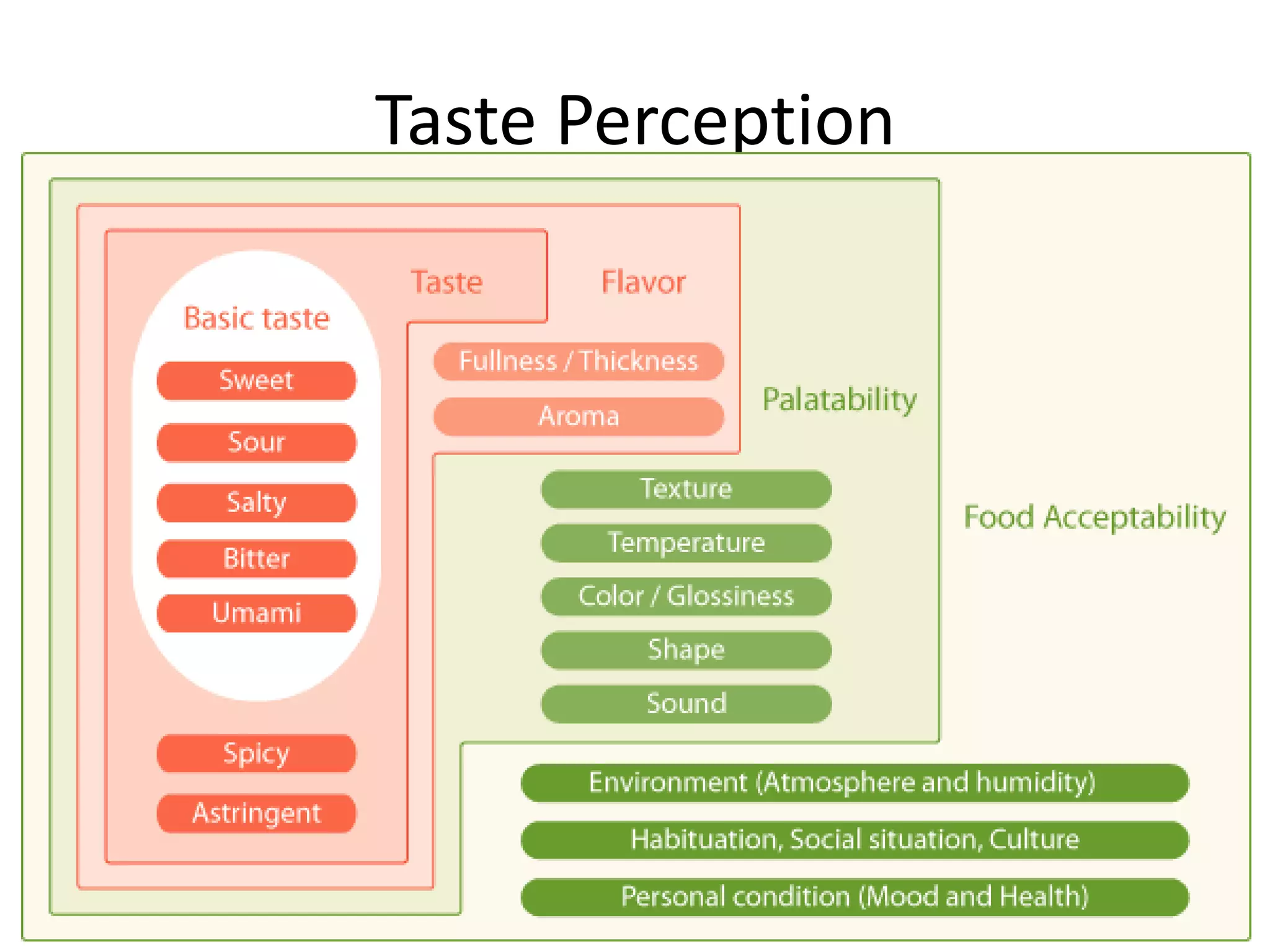
Taste Perception
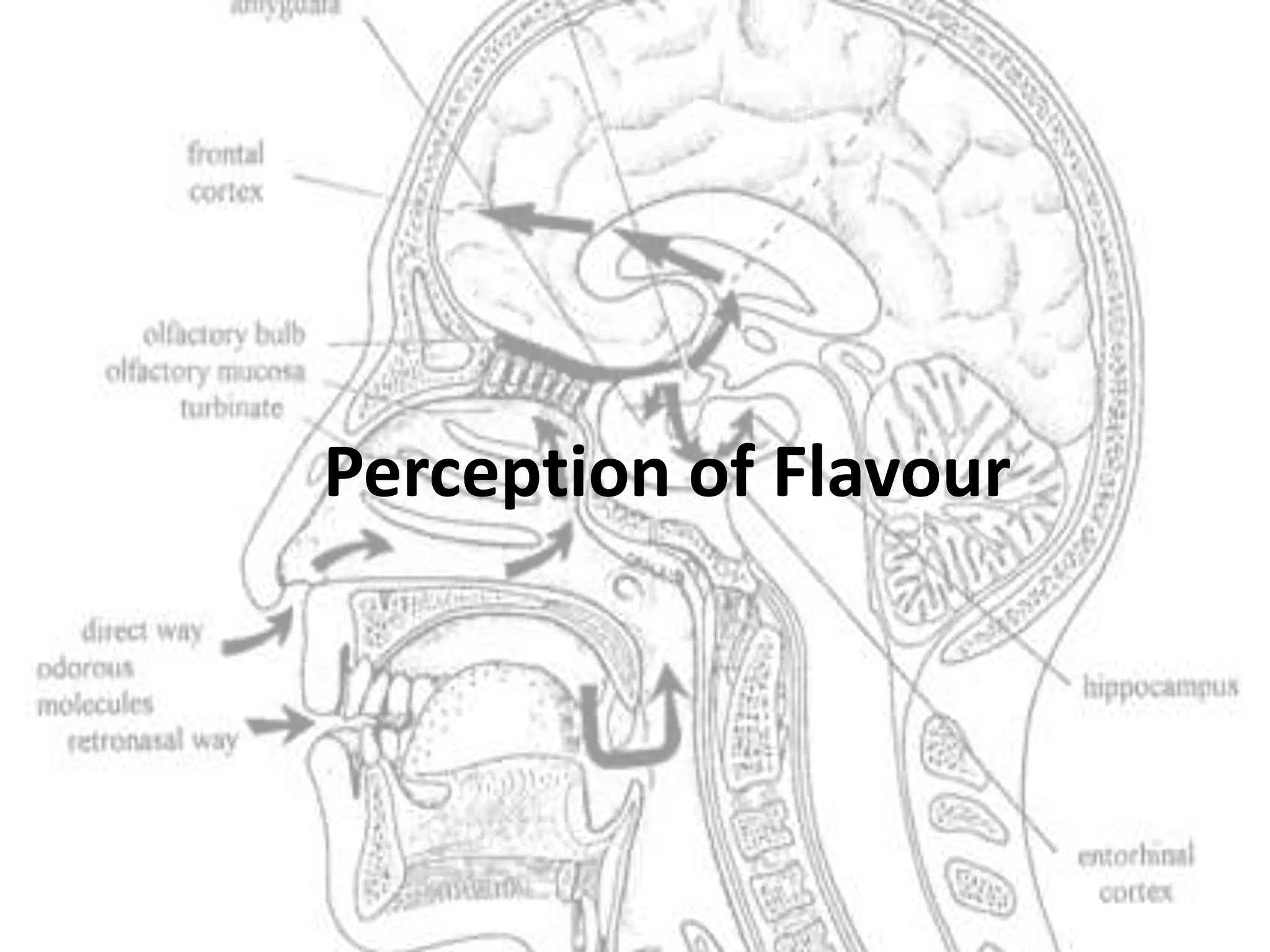
Perception of Flavour
One thing is certain, we all find it extremely difficult
     to distinguish between tastes and smells
The Ventriloquist In Your Mouth
• When bacon and egg ice-cream was first
  created, it was only moderately pleasant

• The breakthrough came when a piece of crispy
  fried bread was added to the plate

• It appears as though the bacon is ‘ventriloquised’
  towards, and hence becomes perceptually
  localised within, the crispy bread, while the eggy
  flavour stays behind in the more texturally
  appropriate soft ice-cream
Aroma Sensitivity
• Humans remarkable sense of smell

• We can distinguish a diversity of odors-
  approximately 10,000 scents

• Scent through the back of the mouth is called
  retronasal olfaction

• Scents via the nostrils it is called orthonasal
  olfaction
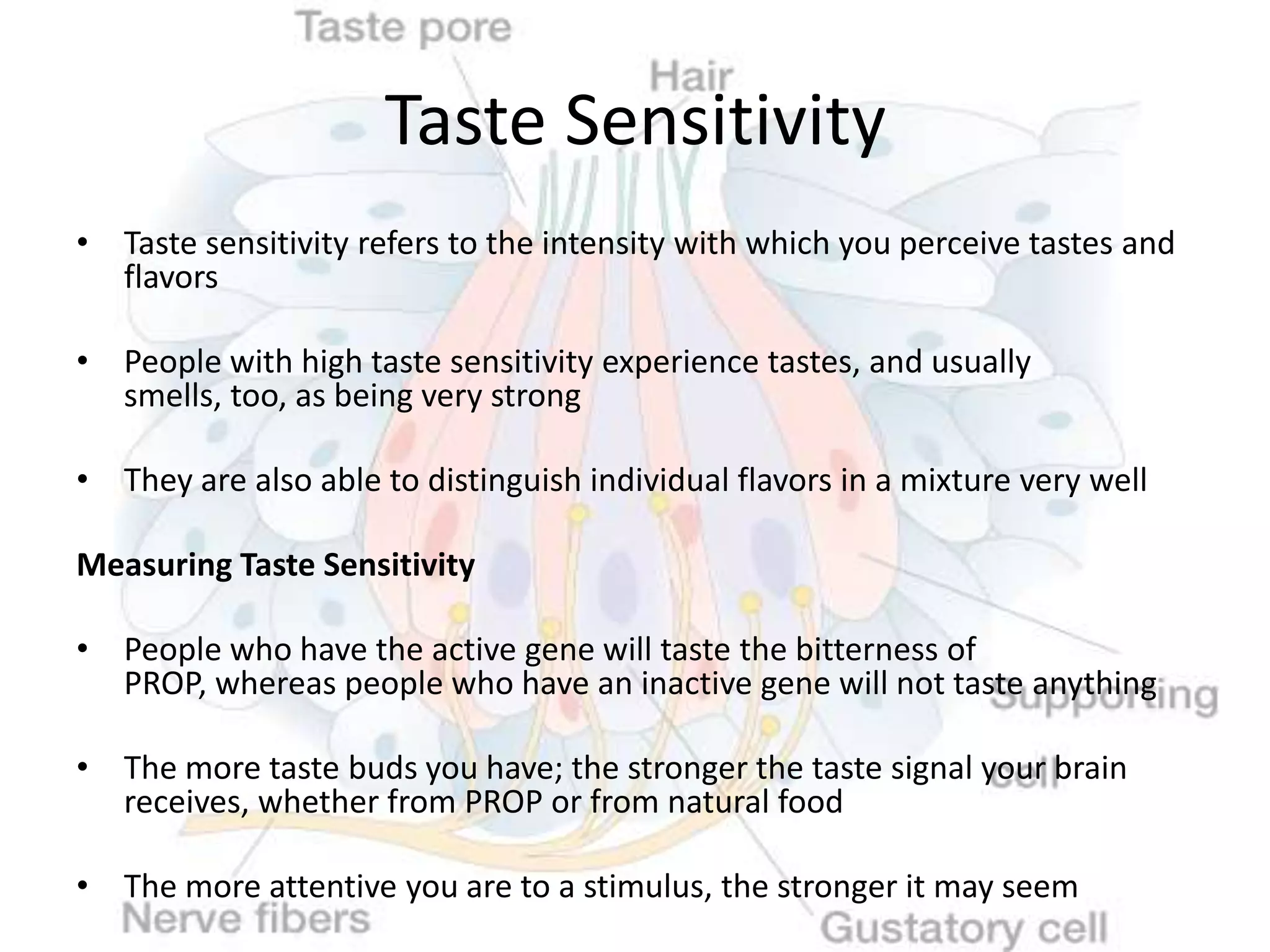
Taste Sensitivity
• Taste sensitivity refers to the intensity with which you perceive tastes and
  flavors

• People with high taste sensitivity experience tastes, and usually
  smells, too, as being very strong

• They are also able to distinguish individual flavors in a mixture very well

Measuring Taste Sensitivity

• People who have the active gene will taste the bitterness of
  PROP, whereas people who have an inactive gene will not taste anything

• The more taste buds you have; the stronger the taste signal your brain
  receives, whether from PROP or from natural food

• The more attentive you are to a stimulus, the stronger it may seem
Taster Types
Mildly sensitive tasters     Moderately sensitive     Highly sensitive tasters
                                  tasters


  Weak to undetectable         Moderate to strong     Very strong sensation
sensation from PROP and     sensation from PROP and   from PROP and mint
          mint                        mint


The flavor of food is not     The flavor of food is    The flavor of food is
    that important                 important                important


 Many foods liked; few       Many foods liked; few     Great variation in the
   foods disliked; not        foods disliked; often   number of foods liked;
 passionate about food       passionate about food    often passionate about
                                                               food
•   Mildly sensitive     •   Moderately          •   Highly sensitive
    taster                   sensitive taster        taster

                                                 •   This tongue is
•   The fungiform        •   The fungiform           covered with
    papillae are the         papillae on this        fungiform
    small pinkish dots       tongue are larger       papillae.
    on this tongue           and more rounded
                             than those of a     •   Note that this
                                                     tongue does not
•   Note that they are       mildly sensitive        have any blue
    small and seed-          taster                  areas like those in
    shaped                                           the other tongues
Taste Changes With Age
The Geography of Taste
Map shows the prevalence of the ability to taste a prop The darker the area in this map the
      higher the percentage of the native population of the area who can taste PTC


              Over 85% in the darkest areas, and as low as 5% in the lightest.
Taste Smell and Reasoning
• Mildly sensitive tasters tend rely more on logical reasoning
  to arrive at decisions than do other tasters

• Moderately sensitive tasters are more likely to "play things
  by ear" and improvise

• Highly sensitive tasters tend to spend time mulling things
  over, often "sleeping" on a problem if it is complex

• Strong tasters of PROP, and people who sense coolness
  when they taste mints, say :
   –   The crackle of flames of a wood fire stimulate my imagination
   –   My thoughts often don't occur as words but as visual images
   –   I like to watch cloud shapes change in the sky
   –   I can be deeply moved by a sunset.
Food Stimulates all our senses
We have to know what we are eating


• We also need to react emotionally
•Do we like it? is it poison? Should we enjoy it or spit it out?
• Flavor messages go to the emotional centers
Sensory Dominance
• Many studies published
  over the last 75 years have
  shown that visual cues
  (especially those concerned
  with a food or drink’s
  colour) can have a profound
  effect on both the sensory-
  discriminative and hedonic
  aspects of multisensory
  flavour perception
The pleasure of food is critically dependent on
 all sensory attributes being right, and so food
 can, for instance, shock us simply by serving it
    at the wrong temperature, or if it has an
               inappropriate colour
Factors That Affect Food Perception
• Sight: the visual attributes of the stimulus will likely evoke expectations

• Taste: the tongue, palate, soft palate, and areas in the upper throat detect
  sensations

• Smell: the receptors of the olfactory system detect molecules in the air

• Chemesthisis: mediates information about irritants through nerve endings

• Texture: Texture plays a major role in our recognition of foods

• Temperature: we have expectations for the serving temperature for most
  foods and beverages

• Hearing: this can set expectations, effect how we experience textures
Sight


                          Sound


                      Texture


        Temperature
Sensory Incongruity

• The deliberate mismatching of the sensory
  attributes of a dish or food product

• Sensory incongruity can elicit negative as well
  as positive responses

• Sensory incongruity is more challenging
Sensory Incongruity
• There is always a possibility that when the ‘moment of
  truth’ comes, and any one (or more) of the other sensory
  properties of the product do not match up to the
  expectations that have been created by one of the other
  senses

• The likely reaction of a diner to such an experience
  depends on

   –   The nature of the sensory incongruity involved
   –   Whether the incongruity is hidden or visible
   –   The situation or context in which the incongruity is experienced
   –   The person who happens to be experiencing it
Adaption and Suppression

• Adaptation: When subject to a constant stimulus, the senses become less
  responsive


• Mixture Suppression: The phenomenon that individual taste and smell
  characteristics are perceived as less intense in mixtures than alone
Environment
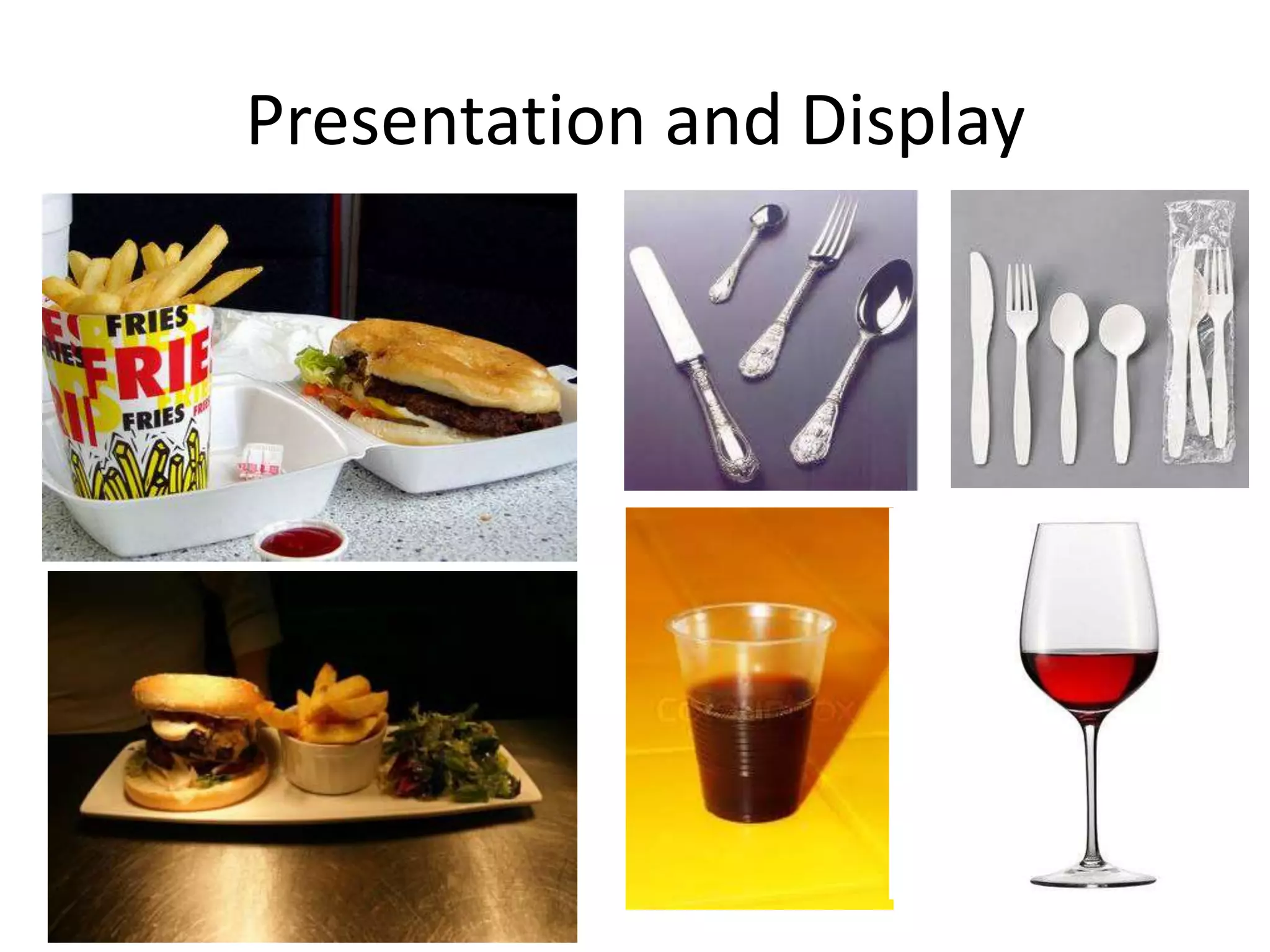
Presentation and Display
A Little Research….


What flavour would you expect these drinks to be?

Introduction to Multi Sensory Taste Perception

  • 1.
  • 2.
    ‘Cooking is probablythe most multisensual art. I try to stimulate all the senses.’ (Ferran Adrià, El Bulli)
  • 3.
    “ Neuroscientists havecome to realise that their insights, from studies of the multisensory integration can be extended to help explain flavour perception Psychology and cognitive neuroscience can help create novel flavours, taste sensations and dining experiences that can more effectively stimulate the mind, and not just the mouth, of the consumer” Professor Charles Spence head of the Crossmodal Research Laboratory based at the Department of Experimental Psychology, Oxford University
  • 4.
    Areas of Interest •How all the senses play their own roles in our appreciation of food • How our enjoyment of food is affected by other influences, our environment, our mood, how it is presented, who prepares it, etc.
  • 5.
  • 6.
  • 7.
    One thing iscertain, we all find it extremely difficult to distinguish between tastes and smells
  • 8.
    The Ventriloquist InYour Mouth • When bacon and egg ice-cream was first created, it was only moderately pleasant • The breakthrough came when a piece of crispy fried bread was added to the plate • It appears as though the bacon is ‘ventriloquised’ towards, and hence becomes perceptually localised within, the crispy bread, while the eggy flavour stays behind in the more texturally appropriate soft ice-cream
  • 9.
    Aroma Sensitivity • Humansremarkable sense of smell • We can distinguish a diversity of odors- approximately 10,000 scents • Scent through the back of the mouth is called retronasal olfaction • Scents via the nostrils it is called orthonasal olfaction
  • 10.
    Taste Sensitivity • Tastesensitivity refers to the intensity with which you perceive tastes and flavors • People with high taste sensitivity experience tastes, and usually smells, too, as being very strong • They are also able to distinguish individual flavors in a mixture very well Measuring Taste Sensitivity • People who have the active gene will taste the bitterness of PROP, whereas people who have an inactive gene will not taste anything • The more taste buds you have; the stronger the taste signal your brain receives, whether from PROP or from natural food • The more attentive you are to a stimulus, the stronger it may seem
  • 11.
    Taster Types Mildly sensitivetasters Moderately sensitive Highly sensitive tasters tasters Weak to undetectable Moderate to strong Very strong sensation sensation from PROP and sensation from PROP and from PROP and mint mint mint The flavor of food is not The flavor of food is The flavor of food is that important important important Many foods liked; few Many foods liked; few Great variation in the foods disliked; not foods disliked; often number of foods liked; passionate about food passionate about food often passionate about food
  • 12.
    Mildly sensitive • Moderately • Highly sensitive taster sensitive taster taster • This tongue is • The fungiform • The fungiform covered with papillae are the papillae on this fungiform small pinkish dots tongue are larger papillae. on this tongue and more rounded than those of a • Note that this tongue does not • Note that they are mildly sensitive have any blue small and seed- taster areas like those in shaped the other tongues
  • 13.
  • 14.
    The Geography ofTaste Map shows the prevalence of the ability to taste a prop The darker the area in this map the higher the percentage of the native population of the area who can taste PTC Over 85% in the darkest areas, and as low as 5% in the lightest.
  • 15.
    Taste Smell andReasoning • Mildly sensitive tasters tend rely more on logical reasoning to arrive at decisions than do other tasters • Moderately sensitive tasters are more likely to "play things by ear" and improvise • Highly sensitive tasters tend to spend time mulling things over, often "sleeping" on a problem if it is complex • Strong tasters of PROP, and people who sense coolness when they taste mints, say : – The crackle of flames of a wood fire stimulate my imagination – My thoughts often don't occur as words but as visual images – I like to watch cloud shapes change in the sky – I can be deeply moved by a sunset.
  • 16.
  • 17.
    We have toknow what we are eating • We also need to react emotionally •Do we like it? is it poison? Should we enjoy it or spit it out? • Flavor messages go to the emotional centers
  • 18.
    Sensory Dominance • Manystudies published over the last 75 years have shown that visual cues (especially those concerned with a food or drink’s colour) can have a profound effect on both the sensory- discriminative and hedonic aspects of multisensory flavour perception
  • 19.
    The pleasure offood is critically dependent on all sensory attributes being right, and so food can, for instance, shock us simply by serving it at the wrong temperature, or if it has an inappropriate colour
  • 20.
    Factors That AffectFood Perception • Sight: the visual attributes of the stimulus will likely evoke expectations • Taste: the tongue, palate, soft palate, and areas in the upper throat detect sensations • Smell: the receptors of the olfactory system detect molecules in the air • Chemesthisis: mediates information about irritants through nerve endings • Texture: Texture plays a major role in our recognition of foods • Temperature: we have expectations for the serving temperature for most foods and beverages • Hearing: this can set expectations, effect how we experience textures
  • 21.
    Sight Sound Texture Temperature
  • 22.
    Sensory Incongruity • Thedeliberate mismatching of the sensory attributes of a dish or food product • Sensory incongruity can elicit negative as well as positive responses • Sensory incongruity is more challenging
  • 23.
    Sensory Incongruity • Thereis always a possibility that when the ‘moment of truth’ comes, and any one (or more) of the other sensory properties of the product do not match up to the expectations that have been created by one of the other senses • The likely reaction of a diner to such an experience depends on – The nature of the sensory incongruity involved – Whether the incongruity is hidden or visible – The situation or context in which the incongruity is experienced – The person who happens to be experiencing it
  • 24.
    Adaption and Suppression •Adaptation: When subject to a constant stimulus, the senses become less responsive • Mixture Suppression: The phenomenon that individual taste and smell characteristics are perceived as less intense in mixtures than alone
  • 25.
  • 26.
  • 27.
    A Little Research…. Whatflavour would you expect these drinks to be?

Editor's Notes

  • #8 It is responsible for sensation in the face and certain motor functions such as biting, chewing, and swallowing. 
  • #11 Cornell have been using the flavor of peppermints as a substitute of PROP in measuring taste sensitivity, because peppermint flavor is more pleasant, and measures more aspects of flavor. The response to peppermint involves not only taste (for the sweetness), but also smell, and sensitivity to trigeminal activation (= the cool feeling of mint). Most foods present some combination of these sensations, so we believe that testing with peppermints reflects general flavor sensitivity. When we test with peppermint, we score the intensity of the "rush" of sensation people may get in the back of the throat and the nose as well as the intensity of flavor. This rush of sensation is due to the activation of the trigeminal nerve endings in the taste buds and in the nosesucrose for sweet senstivity, citric acid for sour sensitivity, and of course sodium chloride for salt senstivity. 
  • #12 Cornell have been using the flavor of peppermints as a substitute of PROP in measuring taste sensitivity, because peppermint flavor is more pleasant, and measures more aspects of flavor. The response to peppermint involves not only taste (for the sweetness), but also smell, and sensitivity to trigeminal activation (= the cool feeling of mint). Most foods present some combination of these sensations, so we believe that testing with peppermints reflects general flavor sensitivity. When we test with peppermint, we score the intensity of the "rush" of sensation people may get in the back of the throat and the nose as well as the intensity of flavor. This rush of sensation is due to the activation of the trigeminal nerve endings in the taste buds and in the nosesucrose for sweet senstivity, citric acid for sour sensitivity, and of course sodium chloride for salt senstivity. 
  • #14 Cornell Uni study found that children are more sensitive than their parents ...this may explain why many children are often picky eaters! Here is a graph showing the differences between children ages 3-5 years and their parents in their mean responses to PROP. The vertical scale shows the intensity of the response - the higher the number, the more intense the response.
  • #15  Data presented by LL Cavalli-Sforza and his colleagues in The History and Geography of Human Genes,
  • #16 taste sensitivities tend to approach decision-making in differing ways, even problems concerning issues that have nothing to do with flavor or food!In other words they become absorbed in and take pleasure from VISUAL experiences. Coupled with this visual absorption and pleasure is a tendency to experience vivid memories.The reason for these differences may come from the fact that taste, smell, and trigeminal sensations all reach the same area on the right side of the brain
  • #19 In a classic experiment, French researchers colored a white wine red with an odorless dye and asked a panel of wine experts to describe its taste. The connoisseurs described the wine using typical red wine descriptors rather than terms they would use to evaluate white wine, suggesting that the color played a significant role in the way they perceived the drink.
  • #21 In a classic experiment, French researchers colored a white wine red with an odorless dye and asked a panel of wine experts to describe its taste. The connoisseurs described the wine using typical red wine descriptors rather than terms they would use to evaluate white wine, suggesting that the color played a significant role in the way they perceived the drink.
  • #22 When the frequency was turned up, the Pringles seemed much crunchier; when it was turned down, they seemed softer.
  • #25 Adaption; music in the car, hot water,