Parts of themicroscope
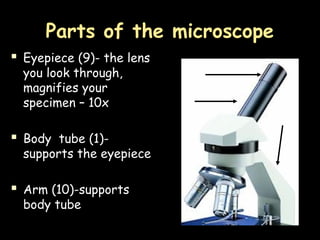
Eyepiece (9)- the lens
you look through,
magnifies your
specimen – 10x
Body tube (1)-
supports the eyepiece
Arm (10)-supports
body tube
3.
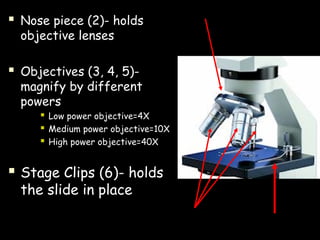
Nose piece(2)- holds
objective lenses
Objectives (3, 4, 5)-
magnify by different
powers
Low power objective=4X
Medium power objective=10X
High power objective=40X
Stage Clips (6)- holds
the slide in place
4.
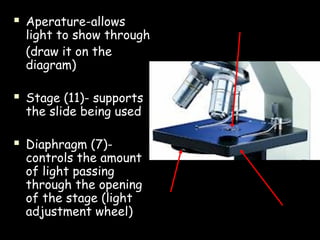
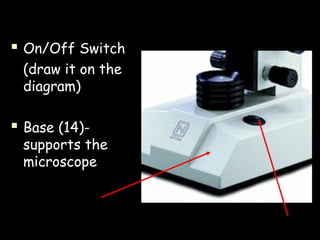
Aperature-allows
light toshow through
(draw it on the
diagram)
Stage (11)- supports
the slide being used
Diaphragm (7)-
controls the amount
of light passing
through the opening
of the stage (light
adjustment wheel)
5.
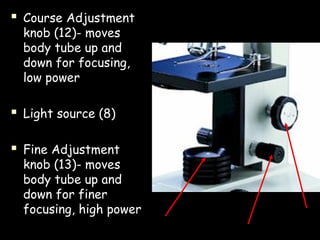
Course Adjustment
knob(12)- moves
body tube up and
down for focusing,
low power
Light source (8)
Fine Adjustment
knob (13)- moves
body tube up and
down for finer
focusing, high power
COMPOUND LIGHT
MIRCROSCOPE
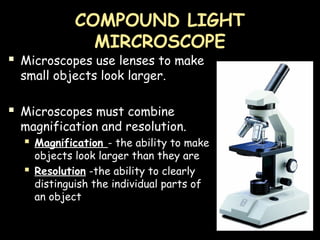
Microscopesuse lenses to make
small objects look larger.
Microscopes must combine
magnification and resolution.
Magnification - the ability to make
objects look larger than they are
Resolution -the ability to clearly
distinguish the individual parts of
an object
8.
Safety and ProperUse
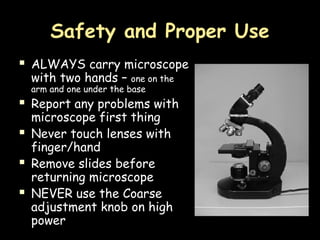
ALWAYS carry microscope
with two hands – one on the
arm and one under the base
Report any problems with
microscope first thing
Never touch lenses with
finger/hand
Remove slides before
returning microscope
NEVER use the Coarse
adjustment knob on high
power
9.
Total Magnification
Total Magnification
Whatis
What is total magnification?
total magnification?
The sum power of all the lenses you are
viewing the specimen with.
How do you calculate total magnification?
Eyepiece x objective lens = total mag.
Ex. Our microscopes using medium power.
10 x 10 = 100x (objects appear 100 times
larger than they are.)
10.
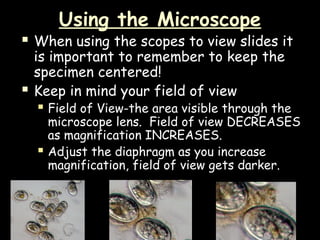
Using the Microscope
When using the scopes to view slides it
is important to remember to keep the
specimen centered!
Keep in mind your field of view
Field of View-the area visible through the
microscope lens. Field of view DECREASES
as magnification INCREASES.
Adjust the diaphragm as you increase
magnification, field of view gets darker.
11.
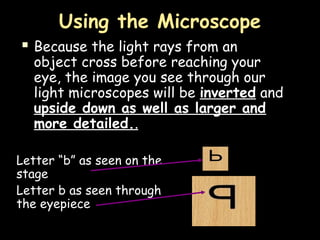
Using the Microscope
Because the light rays from an
object cross before reaching your
eye, the image you see through our
light microscopes will be inverted and
upside down as well as larger and
more detailed..
Letter “b” as seen on the
stage
Letter b as seen through
the eyepiece
12.
Image inversion
Becauseof this image inversion it is
important to remember
-When you move your slide right it
will move left in the field of vision
-When moving the slide up it will
move down in the field of vision
13.
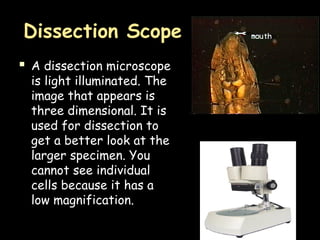
Dissection Scope
Adissection microscope
is light illuminated. The
image that appears is
three dimensional. It is
used for dissection to
get a better look at the
larger specimen. You
cannot see individual
cells because it has a
low magnification.