PREPARED BY:
MOHAMMAD NAIM ISMAIL
CHAPTER 1
WHAT IS MARKETING?
At the end of this chapter, students will be able to:
Learning Outcomes
•Define the meaning of marketing
•Identify and explain the five basic concepts in marketing
•Define the meaning of marketing management
•Identify and explain the five types of marketing
•Discuss customer relationship management
TOPICS
WHAT IS MARKETING
IS IT ABOUT SALES
1.1 Definition of Marketing
TOPICS
IS IT ABOUT PROMOTION
IS IT ABOUT ADVERTISING
INTRODUCTION
WHY MARKETING IS
IMPORTANT IN BUSINES
Fig. 1
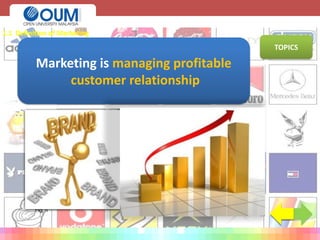
Marketing is managing profitable
customer relationship
TOPICS
1.1 Definition of Marketing
Fig. 1
Marketing is a process of planning & executing the
conception, pricing, promotion & distribution of
ideas, goods & services to create exchanges that
satisfy the objectives of individuals & organizations’
goals.
1.1 Definition of Marketing
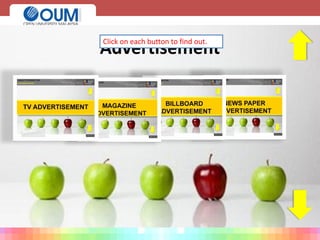
Advertisement
Click on each button to find out.
Advertisement
Fig. 1
MAGAZINE ADS ADS
1-1: Definition of Marketing
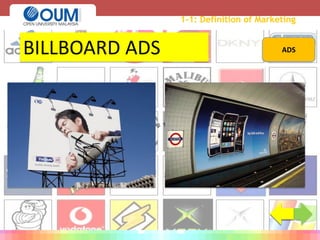
Fig. 1
BILLBOARD ADS ADS
1-1: Definition of Marketing
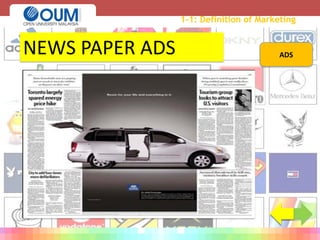
NEWS PAPER ADS ADS
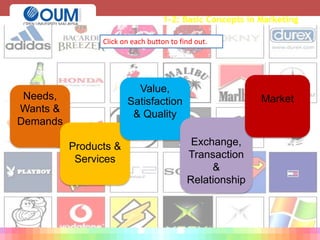
1-2: Basic Concepts in Marketing
Click on each button to find out.
Needs,
Wants &
Demands
Products &
Services
Value,
Satisfaction
& Quality
Exchange,
Transaction
&
Relationship
Market
1-2: Basic Concepts in Marketing
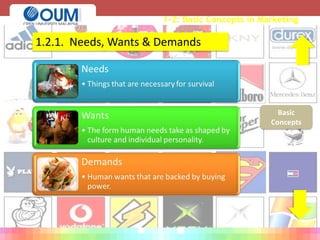
1.2.1. Needs, Wants & Demands
Basic
Concepts
1-1: Basic Concepts in Marketing
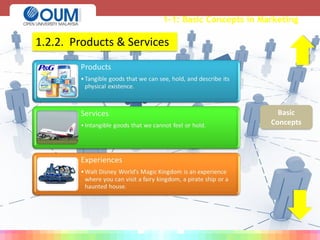
1.2.2. Products & Services
Basic
Concepts
1-2: Basic Concepts in Marketing
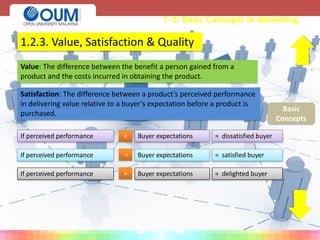
Value: The difference between the benefit a person gained from a
product and the costs incurred in obtaining the product.
Satisfaction: The difference between a product’s perceived performance
in delivering value relative to a buyer’s expectation before a product is
purchased.
If perceived performance <
>
=
Buyer expectations = dissatisfied buyer
If perceived performance Buyer expectations = satisfied buyer
If perceived performance Buyer expectations = delighted buyer
1.2.3. Value, Satisfaction & Quality
Basic
Concepts
1-2: Basic Concepts in Marketing
The act of obtaining
a desired object
from someone by
offering something
in return.
1.2.4. Exchange, Transaction & Relationships
Basic
Concepts
1-2: Basic Concepts in Marketing
Fig. 5
1.2.5. Market
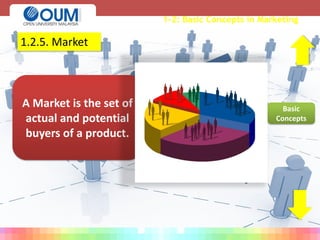
A Market is the set of
actual and potential
buyers of a product.
Basic
Concepts
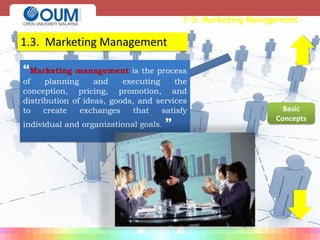
1-3: Marketing Management
“Marketing management is the process
of planning and executing the
conception, pricing, promotion, and
distribution of ideas, goods, and services
to create exchanges that satisfy
individual and organizational goals. ”
1.3. Marketing Management
Basic
Concepts
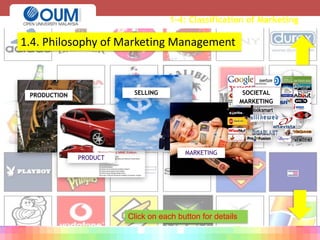
1-4: Classification of Marketing
Click on each button for details
1.4. Philosophy of Marketing Management
PRODUCTION
PRODUCT
SELLING SOCIETAL
MARKETING
MARKETING
1-4: Classification of Marketing
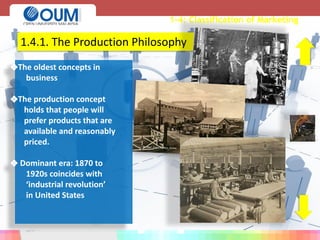
❖The oldest concepts in
business
❖The production concept
holds that people will
prefer products that are
available and reasonably
priced.
❖ Dominant era: 1870 to
1920s coincides with
‘industrial revolution’
in United States
1.4.1. The Production Philosophy
1-4: Classification of Marketing
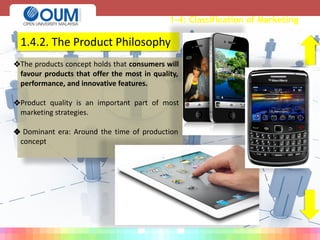
❖The products concept holds that consumers will
favour products that offer the most in quality,
performance, and innovative features.
❖Product quality is an important part of most
marketing strategies.
❖ Dominant era: Around the time of production
concept
1.4.2. The Product Philosophy
1-4: Classification of Marketing
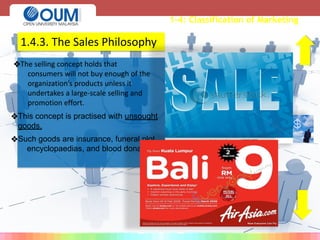
❖The selling concept holds that
consumers will not buy enough of the
organization’s products unless it
undertakes a large-scale selling and
promotion effort.
❖Such goods are insurance, funeral plot,
encyclopaedias, and blood donation.
❖This concept is practised with unsought
goods.
1.4.3. The Sales Philosophy
1-4: Classification of Marketing
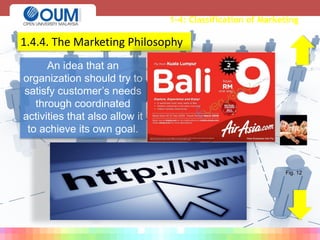
An idea that an
organization should try to
satisfy customer’s needs
through coordinated
activities that also allow it
to achieve its own goal.
Fig. 12
1.4.4. The Marketing Philosophy
1-4: Classification of Marketing
The societal marketing
concept holds that the
organization’s task is to
determine the needs, wants,
and interests of target
markets and to deliver the
desired satisfactions more
effectively and efficiently
than competitors in a way
that preserves or enhances
the consumer’s and the
society’s well-being.
1.4.5. The Societal Marketing Philosophy

BDPM1103_01_WHAT IS MARKETING.ppt.pdf

  • 1.
    PREPARED BY: MOHAMMAD NAIMISMAIL CHAPTER 1 WHAT IS MARKETING?
  • 2.
    At the endof this chapter, students will be able to: Learning Outcomes •Define the meaning of marketing •Identify and explain the five basic concepts in marketing •Define the meaning of marketing management •Identify and explain the five types of marketing •Discuss customer relationship management TOPICS
  • 3.
    WHAT IS MARKETING ISIT ABOUT SALES 1.1 Definition of Marketing TOPICS IS IT ABOUT PROMOTION IS IT ABOUT ADVERTISING
  • 4.
  • 5.
    Fig. 1 Marketing ismanaging profitable customer relationship TOPICS 1.1 Definition of Marketing
  • 6.
    Fig. 1 Marketing isa process of planning & executing the conception, pricing, promotion & distribution of ideas, goods & services to create exchanges that satisfy the objectives of individuals & organizations’ goals. 1.1 Definition of Marketing
  • 7.
    Advertisement Click on eachbutton to find out.
  • 8.
  • 9.
    1-1: Definition ofMarketing Fig. 1 BILLBOARD ADS ADS
  • 10.
    1-1: Definition ofMarketing NEWS PAPER ADS ADS
  • 11.
    1-2: Basic Conceptsin Marketing Click on each button to find out. Needs, Wants & Demands Products & Services Value, Satisfaction & Quality Exchange, Transaction & Relationship Market
  • 12.
    1-2: Basic Conceptsin Marketing 1.2.1. Needs, Wants & Demands Basic Concepts
  • 13.
    1-1: Basic Conceptsin Marketing 1.2.2. Products & Services Basic Concepts
  • 14.
    1-2: Basic Conceptsin Marketing Value: The difference between the benefit a person gained from a product and the costs incurred in obtaining the product. Satisfaction: The difference between a product’s perceived performance in delivering value relative to a buyer’s expectation before a product is purchased. If perceived performance < > = Buyer expectations = dissatisfied buyer If perceived performance Buyer expectations = satisfied buyer If perceived performance Buyer expectations = delighted buyer 1.2.3. Value, Satisfaction & Quality Basic Concepts
  • 15.
    1-2: Basic Conceptsin Marketing The act of obtaining a desired object from someone by offering something in return. 1.2.4. Exchange, Transaction & Relationships Basic Concepts
  • 16.
    1-2: Basic Conceptsin Marketing Fig. 5 1.2.5. Market A Market is the set of actual and potential buyers of a product. Basic Concepts
  • 17.
    1-3: Marketing Management “Marketingmanagement is the process of planning and executing the conception, pricing, promotion, and distribution of ideas, goods, and services to create exchanges that satisfy individual and organizational goals. ” 1.3. Marketing Management Basic Concepts
  • 18.
    1-4: Classification ofMarketing Click on each button for details 1.4. Philosophy of Marketing Management PRODUCTION PRODUCT SELLING SOCIETAL MARKETING MARKETING
  • 19.
    1-4: Classification ofMarketing ❖The oldest concepts in business ❖The production concept holds that people will prefer products that are available and reasonably priced. ❖ Dominant era: 1870 to 1920s coincides with ‘industrial revolution’ in United States 1.4.1. The Production Philosophy
  • 20.
    1-4: Classification ofMarketing ❖The products concept holds that consumers will favour products that offer the most in quality, performance, and innovative features. ❖Product quality is an important part of most marketing strategies. ❖ Dominant era: Around the time of production concept 1.4.2. The Product Philosophy
  • 21.
    1-4: Classification ofMarketing ❖The selling concept holds that consumers will not buy enough of the organization’s products unless it undertakes a large-scale selling and promotion effort. ❖Such goods are insurance, funeral plot, encyclopaedias, and blood donation. ❖This concept is practised with unsought goods. 1.4.3. The Sales Philosophy
  • 22.
    1-4: Classification ofMarketing An idea that an organization should try to satisfy customer’s needs through coordinated activities that also allow it to achieve its own goal. Fig. 12 1.4.4. The Marketing Philosophy
  • 23.
    1-4: Classification ofMarketing The societal marketing concept holds that the organization’s task is to determine the needs, wants, and interests of target markets and to deliver the desired satisfactions more effectively and efficiently than competitors in a way that preserves or enhances the consumer’s and the society’s well-being. 1.4.5. The Societal Marketing Philosophy