
Adopting Kubernetes and DevOps in Production The Easy Way
—— Feynman Zhou ——
KubeSphere Community Manager, CNCF Ambassador
—— Rick Zhao ——
Senior DevOps Engineer, Jenkins Member, CDF Amabassador
X
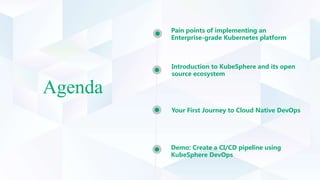
Agenda
Introduction to KubeSphere and its open
source ecosystem
Your First Journey to Cloud Native DevOps
Demo: Create a CI/CD pipeline using
KubeSphere DevOps
Pain points of implementing an
Enterprise-grade Kubernetes platform
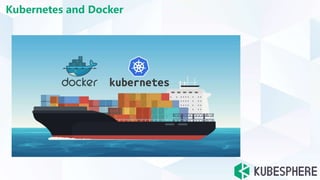
Kubernetes and Docker
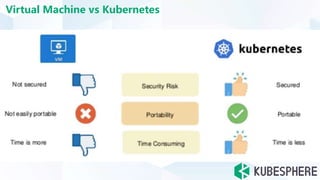
Virtual Machine vs Kubernetes
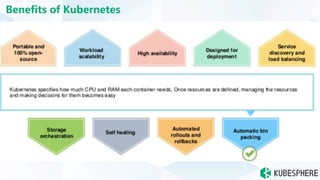
Benefits of Kubernetes
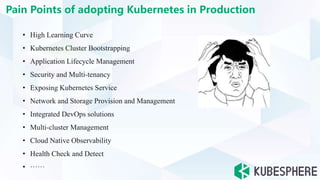
Pain Points of adopting Kubernetes in Production
• High Learning Curve
• Kubernetes Cluster Bootstrapping
• Application Lifecycle Management
• Security and Multi-tenancy
• Exposing Kubernetes Service
• Network and Storage Provision and Management
• Integrated DevOps solutions
• Multi-cluster Management
• Cloud Native Observability
• Health Check and Detect
• ······
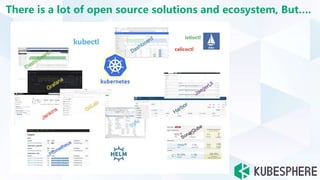
There is a lot of open source solutions and ecosystem, But….
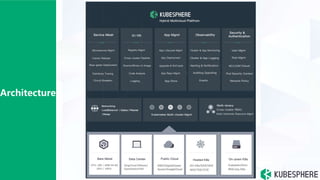
What is KubeSphere
KubeSphere is a distributed operating system managing cloud native applications with
Kubernetes as its kernel, and provides a plug-and-play open architecture for third-party
applications seamless integration to boost its ecosystem.
kubesphere.io
github.com/kubesphere
Architecture
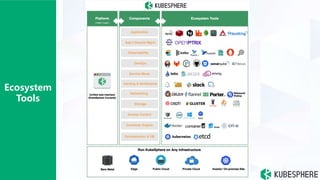
Ecosystem
Tools
Comparison
UI
Multi-Tenancy &
Security
App Management
Kubernetes KubeSphere
K8s dashboard and kubectl
command
User-friendly wizard web UI
Supported by kubectl and yaml
without UI
No Application lifecycle management and App store
CI/CD Yes, built-in Jenkins pipelines and S2i & B2i
Service Mesh
Yes, Istio-based microservice framework
Installation Online & Complicated Simple, support both online & offline (Kubekey)
Observability
Configured manually and accessed
through different portals outside
Out-of-box monitoring, logging, k8s events and
auditing, alerting and notification
Storage/Network
Different open-source options with
mass maintenance effort required
Intuitive web console for installing and managing
popular open source solutions
No
No
Compatible with K8s RBAC with UI enhancement,
Network Policy, OAuth & LDAP
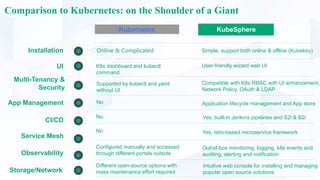
Comparison to Kubernetes: on the Shoulder of a Giant
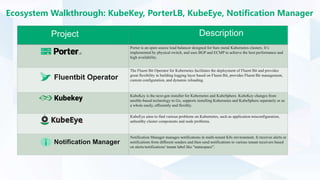
Ecosystem Walkthrough: KubeKey, PorterLB, KubeEye, Notification Manager
Porter is an open source load balancer designed for bare metal Kubernetes clusters. It’s
implemented by physical switch, and uses BGP and ECMP to achieve the best performance and
high availability.
The Fluent Bit Operator for Kubernetes facilitates the deployment of Fluent Bit and provides
great flexibility in building logging layer based on Fluent Bit, provides Fluent Bit management,
custom configuration, and dynamic reloading.
KubeKey is the next-gen installer for Kubernetes and KubeSphere. KubeKey changes from
ansible-based technology to Go, supports installing Kubernetes and KubeSphere separately or as
a whole easily, efficiently and flexibly.
KubeEye aims to find various problems on Kubernetes, such as application misconfiguration,
unhealthy cluster components and node problems.
Notification Manager manages notifications in multi-tenant K8s environment. It receives alerts or
notifications from different senders and then send notifications to various tenant receivers based
on alerts/notifications' tenant label like "namespace".
Project Description
Fluentbit Operator
Notification Manager
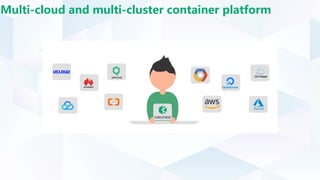
Multi-cloud and multi-cluster container platform
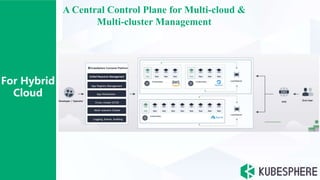
A Central Control Plane for Multi-cloud &
Multi-cluster Management
For Hybrid
Cloud
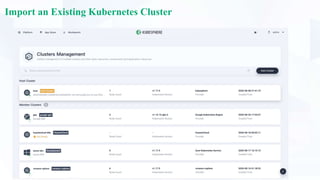
Import an Existing Kubernetes Cluster
For Hybrid
Cloud
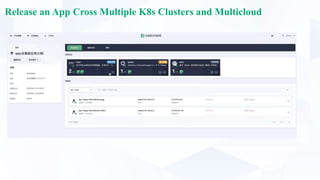
Release an App Cross Multiple K8s Clusters and Multicloud
For Hybrid
Cloud
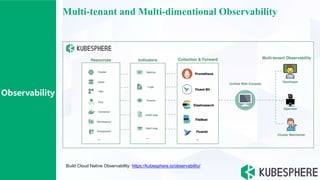
Multi-tenant and Multi-dimentional Observability
Observability
Build Cloud Native Observability: https://kubesphere.io/observability/
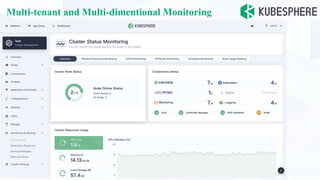
Multi-tenant and Multi-dimentional Monitoring
Observability
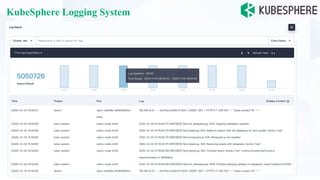
KubeSphere Logging System
Observability
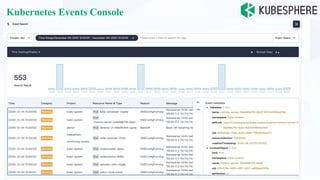
Kubernetes Events Console
Observability
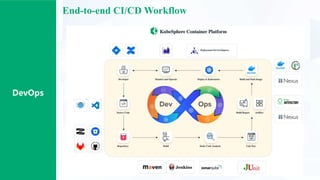
End-to-end CI/CD Workflow
DevOps
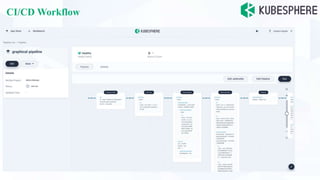
CI/CD Workflow
Observability
Observability
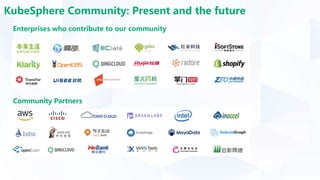
KubeSphere Community: Present and the future
Enterprises who contribute to our community
Community Partners
Follow us!
twitter.com/kubesphere
kubesphere.io
github.com/kubesphere
Channel/KubeSphere
kubesphere.slack.com

Introduction to KubeSphere and its open source ecosystem

  • 1.
    Adopting Kubernetes andDevOps in Production The Easy Way —— Feynman Zhou —— KubeSphere Community Manager, CNCF Ambassador —— Rick Zhao —— Senior DevOps Engineer, Jenkins Member, CDF Amabassador X
  • 2.
    Agenda Introduction to KubeSphereand its open source ecosystem Your First Journey to Cloud Native DevOps Demo: Create a CI/CD pipeline using KubeSphere DevOps Pain points of implementing an Enterprise-grade Kubernetes platform
  • 3.
  • 4.
  • 5.
  • 6.
    Pain Points ofadopting Kubernetes in Production • High Learning Curve • Kubernetes Cluster Bootstrapping • Application Lifecycle Management • Security and Multi-tenancy • Exposing Kubernetes Service • Network and Storage Provision and Management • Integrated DevOps solutions • Multi-cluster Management • Cloud Native Observability • Health Check and Detect • ······
  • 7.
    There is alot of open source solutions and ecosystem, But….
  • 8.
    What is KubeSphere KubeSphereis a distributed operating system managing cloud native applications with Kubernetes as its kernel, and provides a plug-and-play open architecture for third-party applications seamless integration to boost its ecosystem. kubesphere.io github.com/kubesphere
  • 9.
  • 10.
  • 11.
    Comparison UI Multi-Tenancy & Security App Management KubernetesKubeSphere K8s dashboard and kubectl command User-friendly wizard web UI Supported by kubectl and yaml without UI No Application lifecycle management and App store CI/CD Yes, built-in Jenkins pipelines and S2i & B2i Service Mesh Yes, Istio-based microservice framework Installation Online & Complicated Simple, support both online & offline (Kubekey) Observability Configured manually and accessed through different portals outside Out-of-box monitoring, logging, k8s events and auditing, alerting and notification Storage/Network Different open-source options with mass maintenance effort required Intuitive web console for installing and managing popular open source solutions No No Compatible with K8s RBAC with UI enhancement, Network Policy, OAuth & LDAP Comparison to Kubernetes: on the Shoulder of a Giant
  • 12.
    Ecosystem Walkthrough: KubeKey,PorterLB, KubeEye, Notification Manager Porter is an open source load balancer designed for bare metal Kubernetes clusters. It’s implemented by physical switch, and uses BGP and ECMP to achieve the best performance and high availability. The Fluent Bit Operator for Kubernetes facilitates the deployment of Fluent Bit and provides great flexibility in building logging layer based on Fluent Bit, provides Fluent Bit management, custom configuration, and dynamic reloading. KubeKey is the next-gen installer for Kubernetes and KubeSphere. KubeKey changes from ansible-based technology to Go, supports installing Kubernetes and KubeSphere separately or as a whole easily, efficiently and flexibly. KubeEye aims to find various problems on Kubernetes, such as application misconfiguration, unhealthy cluster components and node problems. Notification Manager manages notifications in multi-tenant K8s environment. It receives alerts or notifications from different senders and then send notifications to various tenant receivers based on alerts/notifications' tenant label like "namespace". Project Description Fluentbit Operator Notification Manager
  • 13.
  • 14.
    A Central ControlPlane for Multi-cloud & Multi-cluster Management For Hybrid Cloud
  • 15.
    Import an ExistingKubernetes Cluster For Hybrid Cloud
  • 16.
    Release an AppCross Multiple K8s Clusters and Multicloud For Hybrid Cloud
  • 17.
    Multi-tenant and Multi-dimentionalObservability Observability Build Cloud Native Observability: https://kubesphere.io/observability/
  • 18.
    Multi-tenant and Multi-dimentionalMonitoring Observability
  • 19.
  • 20.
  • 21.
  • 22.
  • 23.
    Observability KubeSphere Community: Presentand the future Enterprises who contribute to our community Community Partners
  • 24.