Human Resource Department (HRD)
A Guideline for the
Directors of RCDC’s
HRD
Prepared by:
Mr. Furquan Mirza
3rdYear, CSE-IIUC
BoT Member of RCDC
CONTENTS
1. Introduction to Human Resource Development
2. Features of HRD
3. Objectives HRD
4. Functions of HRD
5. Process of HRD
6. HRM Vs HRD
7. Training and HRD Process Model
8. HRD Challenges
9. Conclusion
1. Introduction to Human Resource Development
❖Human Resource Development is the framework for helping employee or members
of any organization to develop their personal and organizational skills, knowledge,
accountability, morale attitude, bravery and abilities.
❖It is a set of systematic and planned activities by an Organization or HR department
to provide its members with necessary skills to meet current and future expectation
of organization.
❖Human resource development is the part of Human resource management that
specifically deals with training and development of the employees in the organization.
❖It improves the utilization value of an organization.
❖It includes training a person after he or she is hired.
❖It distributes resources that are beneficial for the employee’s task and any other
development.
❖It is one of the 21 Central Executive departments of RCDC.
2. Features of HRD
1. HRD is a systematic and planned approach.
2. HRD is a continuous process for the development of all types of
employee’s skills such as technical skill, managerial skill, behavioral and
conceptual skill.
3. HRD develops the skills and knowledge not only at individual level
but also at dyadic level, group and organizational level.
4. HRD is a multi-disciplinary subject. It uses education, management,
psychology, communication and economics for the development of
employees or members.
5. HRD advices employees about how to improve their strengths and
how to remove their weakness.
3. Objectives of HRD
❖To enhance organizational capabilities.
❖To aid total quality management.
❖To provide comprehensive framework for HRD.
❖To prevent employees’ obsolescence
❖To develop creative ability and talent.
❖To prepare employee for higher level task.
❖To promote individual and collective morale, a sense
of responsibility, co-operative attitude and a good
relationships.
4. Functions of HRD
1. Performance Appraisal
2. Employee Appraisal
3. Employee Training
4. Executive Development
5. Career Planning and Development
6. Succession Planning and Development
7. Organizational Change and Development
8. Involvement in social welfare
9. Solving Complexity of Organization
10. Selection and Recruitment of Employee
General Functions
4. Functions of HRD
1. Training and Development
2. Organizational Development
3. Career Development
Basic Functions
Basic Functions
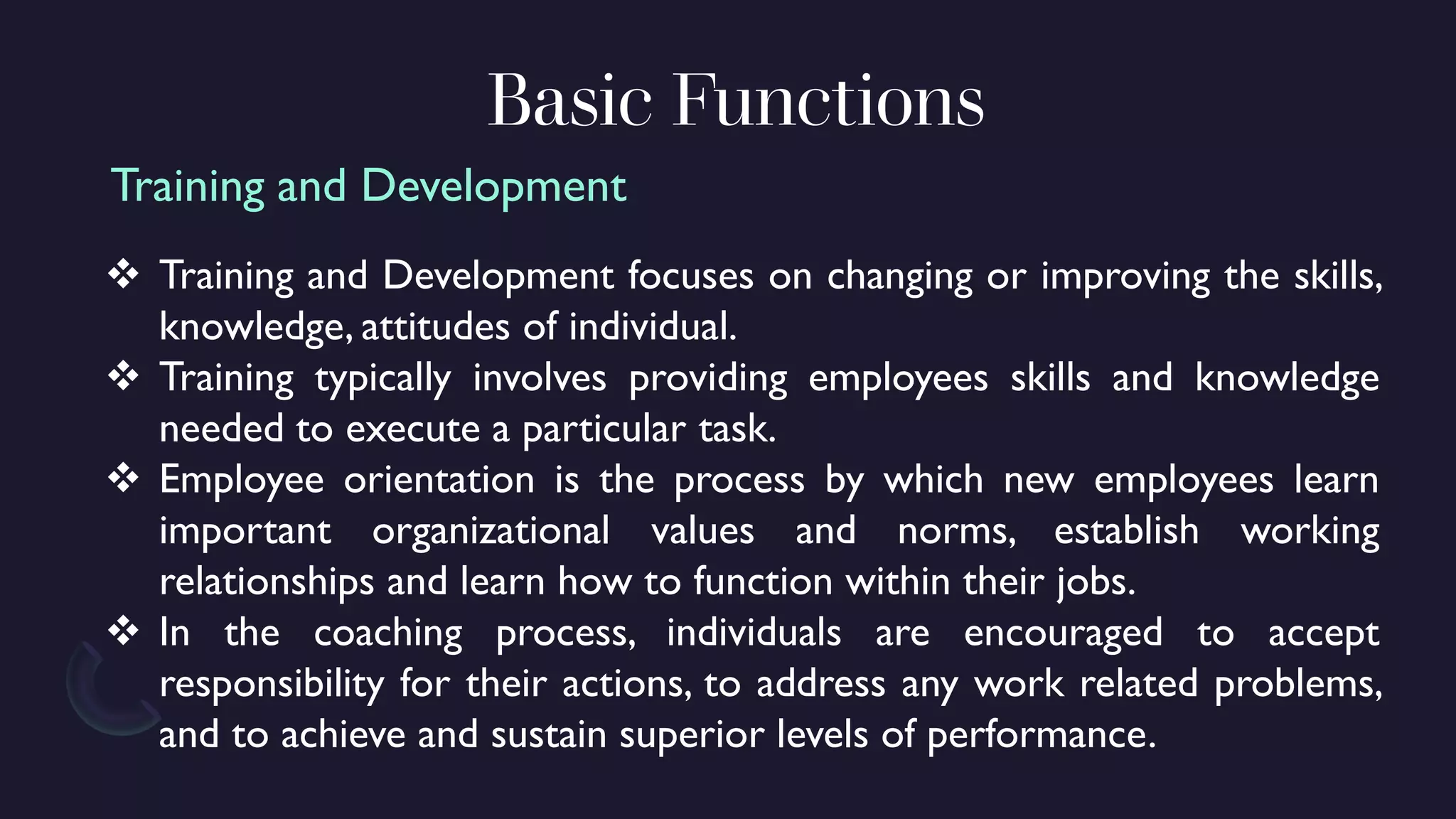
❖ Training and Development focuses on changing or improving the skills,
knowledge, attitudes of individual.
❖ Training typically involves providing employees skills and knowledge
needed to execute a particular task.
❖ Employee orientation is the process by which new employees learn
important organizational values and norms, establish working
relationships and learn how to function within their jobs.
❖ In the coaching process, individuals are encouraged to accept
responsibility for their actions, to address any work related problems,
and to achieve and sustain superior levels of performance.
Training and Development
Basic Functions
❖ Coaching involves treating employees as partners in achieving both
personal and organizational goals.
❖ Counselling techniques are used to help employees deal with personal
problem that may interfere with achievement of these goals mentioned
above.
❖ Counselling programs may address such issues as substance abuse, stress
management, smoking cessation, fitness, nutrition or weight control.
❖ HRD professionals are also responsible for coordinating management
training and development programs to ensure to ensures that directors
and Co-Directors of CEC have the knowledge and skills necessary to be
effective in their position.
Training and Development
Basic Functions
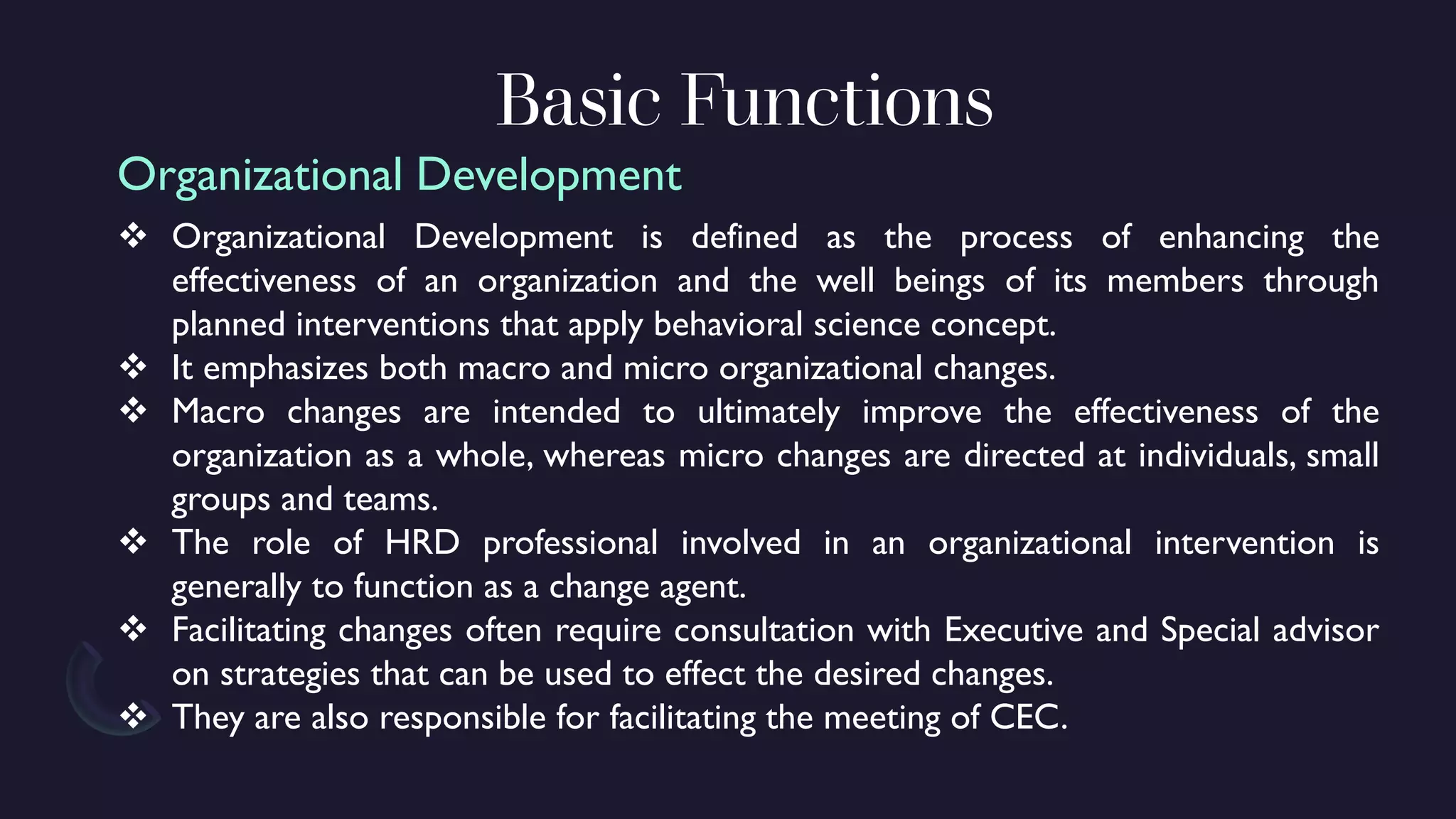
❖ Organizational Development is defined as the process of enhancing the
effectiveness of an organization and the well beings of its members through
planned interventions that apply behavioral science concept.
❖ It emphasizes both macro and micro organizational changes.
❖ Macro changes are intended to ultimately improve the effectiveness of the
organization as a whole, whereas micro changes are directed at individuals, small
groups and teams.
❖ The role of HRD professional involved in an organizational intervention is
generally to function as a change agent.
❖ Facilitating changes often require consultation with Executive and Special advisor
on strategies that can be used to effect the desired changes.
❖ They are also responsible for facilitating the meeting of CEC.
Organizational Development
Basic Functions
❖ Career development is an ongoing process by which individual progress through a
series of stages, each of which is characterized by a relatively unique set of issues,
themes and tasks.
❖ Career development involves two distinct major process;
1. Career Planning and
2. Career Management
❖ Career Planning involves activities performed by an individual often with the
assistance of experts (BoT Members of RCDC) to assess skills and abilities in
order to establish a realistic career plan.
❖ Career management involves taking the necessary steps to achieve the plan
established in career planning and generally focused on what organization can do
to foster employee career development.
Career Development
5. Processes or Phases of HRD
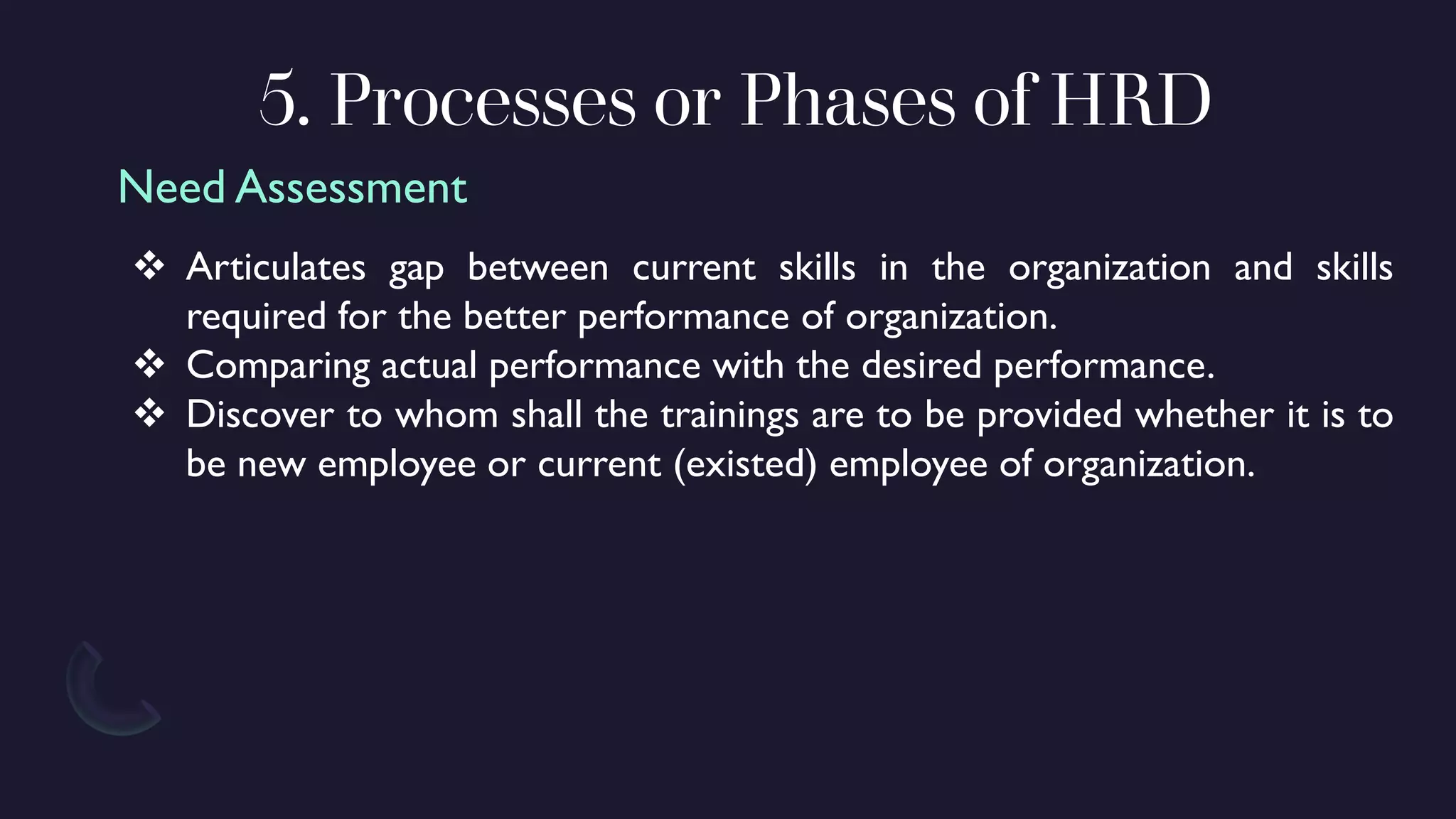
❖ Articulates gap between current skills in the organization and skills
required for the better performance of organization.
❖ Comparing actual performance with the desired performance.
❖ Discover to whom shall the trainings are to be provided whether it is to
be new employee or current (existed) employee of organization.
Need Assessment
5. Processes or Phases of HRD
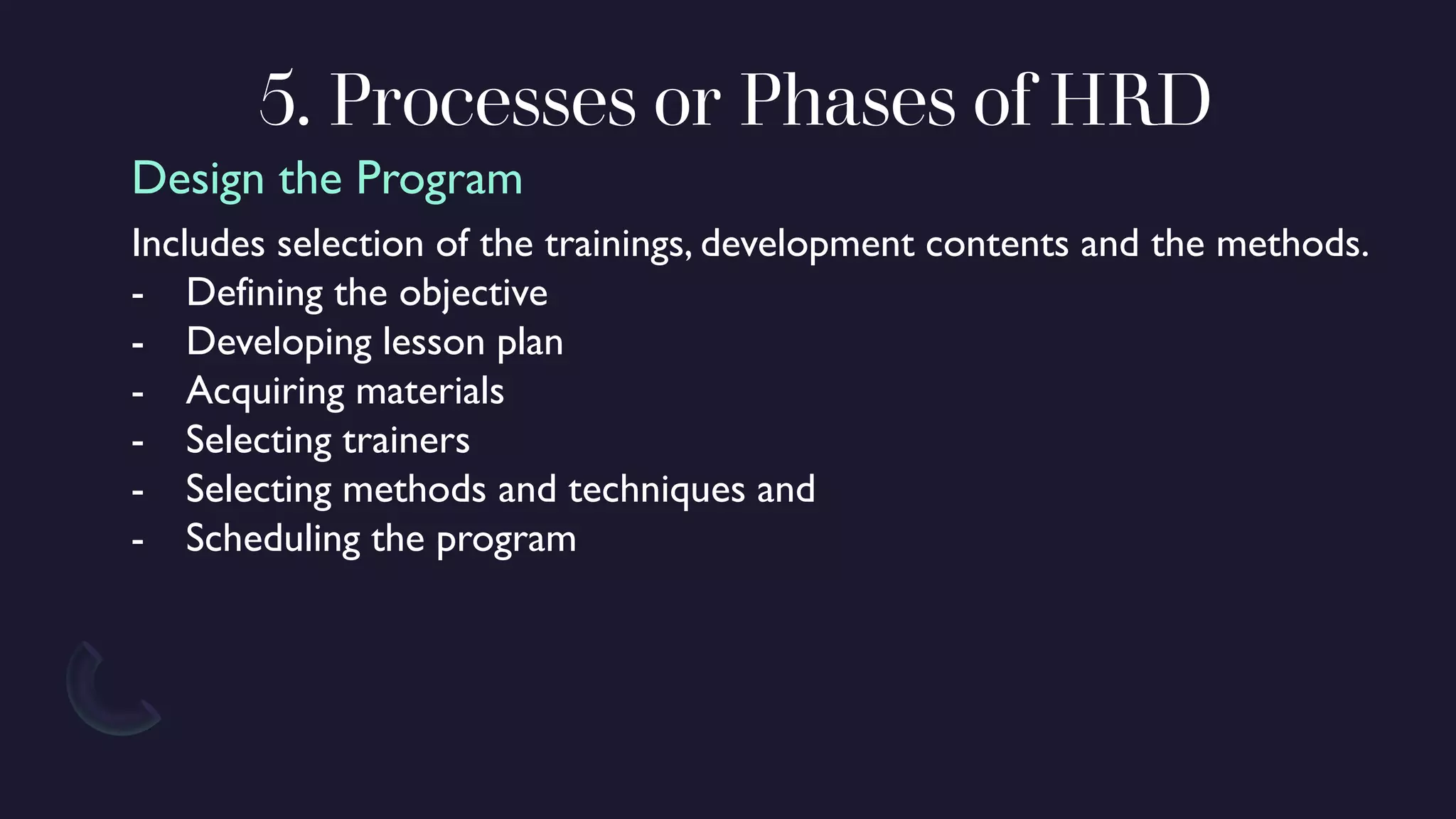
Includes selection of the trainings, development contents and the methods.
- Defining the objective
- Developing lesson plan
- Acquiring materials
- Selecting trainers
- Selecting methods and techniques and
- Scheduling the program
Design the Program
5. Processes or Phases of HRD
❖ Delivering most appropriate training sessions as per the requirement of
forms and thus creating a productive learning environment for ongoing
improvement of employees.
❖ It may include on the job training, off the job training and internet based
training.
Implementation
5. Processes or Phases of HRD
❖ The effectiveness of HRD intervention is measured in this phase.
❖ Evaluation shall be on the scale of
✓ Reaction
✓ Learning and
✓ Behavior of the participants.
Evaluation
6. HRM Vs HRD
❖ Human Resource Management (HRM) can be defined as the effective
selection and utilization of employees to best achieve the goals and
strategies of an organization as well as the goals and needs of employees.
❖ HRM can be divided into
✓ Primary Function: Directly involved in obtaining, maintaining and
developing the employees.
✓ Secondary Function: Either provides support for general management
activities or are involve in determining or changing the structure of
the organization.
Human Resource Management (HRM)
6. HRM Vs HRD
❖ Human Resource Development activities are intended to ensure that the
organizational members have the skills or competencies to meet the
current and future job demands.
❖ As we have discussed earlier, HRD can be a stand alone function or it
can be one of the primary functions within HRM.
Human Resource Development (HRD)
7. Training and HRD Process Model
Assess Needs
Prioritize Needs Define Objective
Develop Lesson
Plan
Acquire Material
SelectTrainer
Select Method
Schedule program
Select Evaluation
Criteria
Determine
Evaluation Design
Intervention or
conduction of
Program
Interrupt Result
Deliver the HRD
Program
8. Challenge of HRD
❖Changing Workforce Demographic
❖Leadership Development
❖Competing with other CBOs and CSOs
❖Eliminating the skill gap
❖Increasing workforce diversity
❖Facilitating organizational constitution
❖Need for life long learning
❖Need for organizational learning
9. Conclusion
❖ HRD, as a part of larger human resource management system,
includes trainings and development, career development and
organization development program and process.
❖ HRD managers and staffs must establish working relationship with the
line managers to coordinate HRD programs and processes through
the organization.
❖ To be effective, HRD professionals must possess a number of
competencies and must be able to serve in a number of roles.
THANK YOU

Hrd guideline

  • 1.
    Human Resource Department(HRD) A Guideline for the Directors of RCDC’s HRD Prepared by: Mr. Furquan Mirza 3rdYear, CSE-IIUC BoT Member of RCDC
  • 2.
    CONTENTS 1. Introduction toHuman Resource Development 2. Features of HRD 3. Objectives HRD 4. Functions of HRD 5. Process of HRD 6. HRM Vs HRD 7. Training and HRD Process Model 8. HRD Challenges 9. Conclusion
  • 3.
    1. Introduction toHuman Resource Development ❖Human Resource Development is the framework for helping employee or members of any organization to develop their personal and organizational skills, knowledge, accountability, morale attitude, bravery and abilities. ❖It is a set of systematic and planned activities by an Organization or HR department to provide its members with necessary skills to meet current and future expectation of organization. ❖Human resource development is the part of Human resource management that specifically deals with training and development of the employees in the organization. ❖It improves the utilization value of an organization. ❖It includes training a person after he or she is hired. ❖It distributes resources that are beneficial for the employee’s task and any other development. ❖It is one of the 21 Central Executive departments of RCDC.
  • 4.
    2. Features ofHRD 1. HRD is a systematic and planned approach. 2. HRD is a continuous process for the development of all types of employee’s skills such as technical skill, managerial skill, behavioral and conceptual skill. 3. HRD develops the skills and knowledge not only at individual level but also at dyadic level, group and organizational level. 4. HRD is a multi-disciplinary subject. It uses education, management, psychology, communication and economics for the development of employees or members. 5. HRD advices employees about how to improve their strengths and how to remove their weakness.
  • 5.
    3. Objectives ofHRD ❖To enhance organizational capabilities. ❖To aid total quality management. ❖To provide comprehensive framework for HRD. ❖To prevent employees’ obsolescence ❖To develop creative ability and talent. ❖To prepare employee for higher level task. ❖To promote individual and collective morale, a sense of responsibility, co-operative attitude and a good relationships.
  • 6.
    4. Functions ofHRD 1. Performance Appraisal 2. Employee Appraisal 3. Employee Training 4. Executive Development 5. Career Planning and Development 6. Succession Planning and Development 7. Organizational Change and Development 8. Involvement in social welfare 9. Solving Complexity of Organization 10. Selection and Recruitment of Employee General Functions
  • 7.
    4. Functions ofHRD 1. Training and Development 2. Organizational Development 3. Career Development Basic Functions
  • 8.
    Basic Functions ❖ Trainingand Development focuses on changing or improving the skills, knowledge, attitudes of individual. ❖ Training typically involves providing employees skills and knowledge needed to execute a particular task. ❖ Employee orientation is the process by which new employees learn important organizational values and norms, establish working relationships and learn how to function within their jobs. ❖ In the coaching process, individuals are encouraged to accept responsibility for their actions, to address any work related problems, and to achieve and sustain superior levels of performance. Training and Development
  • 9.
    Basic Functions ❖ Coachinginvolves treating employees as partners in achieving both personal and organizational goals. ❖ Counselling techniques are used to help employees deal with personal problem that may interfere with achievement of these goals mentioned above. ❖ Counselling programs may address such issues as substance abuse, stress management, smoking cessation, fitness, nutrition or weight control. ❖ HRD professionals are also responsible for coordinating management training and development programs to ensure to ensures that directors and Co-Directors of CEC have the knowledge and skills necessary to be effective in their position. Training and Development
  • 10.
    Basic Functions ❖ OrganizationalDevelopment is defined as the process of enhancing the effectiveness of an organization and the well beings of its members through planned interventions that apply behavioral science concept. ❖ It emphasizes both macro and micro organizational changes. ❖ Macro changes are intended to ultimately improve the effectiveness of the organization as a whole, whereas micro changes are directed at individuals, small groups and teams. ❖ The role of HRD professional involved in an organizational intervention is generally to function as a change agent. ❖ Facilitating changes often require consultation with Executive and Special advisor on strategies that can be used to effect the desired changes. ❖ They are also responsible for facilitating the meeting of CEC. Organizational Development
  • 11.
    Basic Functions ❖ Careerdevelopment is an ongoing process by which individual progress through a series of stages, each of which is characterized by a relatively unique set of issues, themes and tasks. ❖ Career development involves two distinct major process; 1. Career Planning and 2. Career Management ❖ Career Planning involves activities performed by an individual often with the assistance of experts (BoT Members of RCDC) to assess skills and abilities in order to establish a realistic career plan. ❖ Career management involves taking the necessary steps to achieve the plan established in career planning and generally focused on what organization can do to foster employee career development. Career Development
  • 12.
    5. Processes orPhases of HRD ❖ Articulates gap between current skills in the organization and skills required for the better performance of organization. ❖ Comparing actual performance with the desired performance. ❖ Discover to whom shall the trainings are to be provided whether it is to be new employee or current (existed) employee of organization. Need Assessment
  • 13.
    5. Processes orPhases of HRD Includes selection of the trainings, development contents and the methods. - Defining the objective - Developing lesson plan - Acquiring materials - Selecting trainers - Selecting methods and techniques and - Scheduling the program Design the Program
  • 14.
    5. Processes orPhases of HRD ❖ Delivering most appropriate training sessions as per the requirement of forms and thus creating a productive learning environment for ongoing improvement of employees. ❖ It may include on the job training, off the job training and internet based training. Implementation
  • 15.
    5. Processes orPhases of HRD ❖ The effectiveness of HRD intervention is measured in this phase. ❖ Evaluation shall be on the scale of ✓ Reaction ✓ Learning and ✓ Behavior of the participants. Evaluation
  • 16.
    6. HRM VsHRD ❖ Human Resource Management (HRM) can be defined as the effective selection and utilization of employees to best achieve the goals and strategies of an organization as well as the goals and needs of employees. ❖ HRM can be divided into ✓ Primary Function: Directly involved in obtaining, maintaining and developing the employees. ✓ Secondary Function: Either provides support for general management activities or are involve in determining or changing the structure of the organization. Human Resource Management (HRM)
  • 17.
    6. HRM VsHRD ❖ Human Resource Development activities are intended to ensure that the organizational members have the skills or competencies to meet the current and future job demands. ❖ As we have discussed earlier, HRD can be a stand alone function or it can be one of the primary functions within HRM. Human Resource Development (HRD)
  • 18.
    7. Training andHRD Process Model Assess Needs Prioritize Needs Define Objective Develop Lesson Plan Acquire Material SelectTrainer Select Method Schedule program Select Evaluation Criteria Determine Evaluation Design Intervention or conduction of Program Interrupt Result Deliver the HRD Program
  • 19.
    8. Challenge ofHRD ❖Changing Workforce Demographic ❖Leadership Development ❖Competing with other CBOs and CSOs ❖Eliminating the skill gap ❖Increasing workforce diversity ❖Facilitating organizational constitution ❖Need for life long learning ❖Need for organizational learning
  • 20.
    9. Conclusion ❖ HRD,as a part of larger human resource management system, includes trainings and development, career development and organization development program and process. ❖ HRD managers and staffs must establish working relationship with the line managers to coordinate HRD programs and processes through the organization. ❖ To be effective, HRD professionals must possess a number of competencies and must be able to serve in a number of roles.
  • 21.