Download as PDF, PPTX


![Map on collections
let list = ["c", "d", "a", "b"]
var uppercasedList = [String]()
for char in list {
uppercasedList.append(char.uppercaseString)
}](https://image.slidesharecdn.com/functionalprogrammingswift-150507062925-lva1-app6891/85/Map-Reduce-and-Filter-in-Swift-12-320.jpg)
![Map on collections
let list = ["c", "d", "a", "b"]
let uppercasedList = list.map ({
(char: String) -> String in
char.uppercaseString
})](https://image.slidesharecdn.com/functionalprogrammingswift-150507062925-lva1-app6891/85/Map-Reduce-and-Filter-in-Swift-13-320.jpg)
![Map on collections
let list = ["c", "d", "a", "b"]
let uppercasedList = list.map
({$0.uppercaseString})](https://image.slidesharecdn.com/functionalprogrammingswift-150507062925-lva1-app6891/85/Map-Reduce-and-Filter-in-Swift-14-320.jpg)
![Map on collections
let list = ["c", "d", "a", "b"]
let uppercasedList = list.map
{$0.uppercaseString}](https://image.slidesharecdn.com/functionalprogrammingswift-150507062925-lva1-app6891/85/Map-Reduce-and-Filter-in-Swift-15-320.jpg)
![FlatMap
func flatMap(transform: T -> [U]) ->[U]
Return an Array containing the results of calling
`transform(x)` on each element x of flattening self](https://image.slidesharecdn.com/functionalprogrammingswift-150507062925-lva1-app6891/85/Map-Reduce-and-Filter-in-Swift-16-320.jpg)
![FlatMap
let multiList = [["c", "d"], ["a"], ["b"]]
var uppercasedMultiList = multiList
.flatMap{ $0 }
.map {$0.uppercaseString}](https://image.slidesharecdn.com/functionalprogrammingswift-150507062925-lva1-app6891/85/Map-Reduce-and-Filter-in-Swift-17-320.jpg)



![Reduce
let numbers = [1, 2, 3, 4, 5, 6, 7, 8, 9, 10]
var sum = 0
for i in numbers {
sum += i
}](https://image.slidesharecdn.com/functionalprogrammingswift-150507062925-lva1-app6891/85/Map-Reduce-and-Filter-in-Swift-22-320.jpg)
![Reduce
let numbers = [1, 2, 3, 4, 5, 6, 7, 8, 9, 10]
let sum = numbers.reduce(0, combine: {
(total, number) in
return total + number
})](https://image.slidesharecdn.com/functionalprogrammingswift-150507062925-lva1-app6891/85/Map-Reduce-and-Filter-in-Swift-23-320.jpg)
![Reduce
let numbers = [1, 2, 3, 4, 5, 6, 7, 8, 9, 10]
let sum = numbers.reduce(0) {
(total, number) in
return total + number
}](https://image.slidesharecdn.com/functionalprogrammingswift-150507062925-lva1-app6891/85/Map-Reduce-and-Filter-in-Swift-24-320.jpg)
![Reduce
let numbers = [1, 2, 3, 4, 5, 6, 7, 8, 9, 10]
let sum = numbers.reduce(0) {
(total, number) in
total + number
}](https://image.slidesharecdn.com/functionalprogrammingswift-150507062925-lva1-app6891/85/Map-Reduce-and-Filter-in-Swift-25-320.jpg)
![Reduce
let numbers = [1, 2, 3, 4, 5, 6, 7, 8, 9, 10]
let sum = numbers.reduce(0) { $0 + $1 }](https://image.slidesharecdn.com/functionalprogrammingswift-150507062925-lva1-app6891/85/Map-Reduce-and-Filter-in-Swift-26-320.jpg)
![Reduce
let numbers = [1, 2, 3, 4, 5, 6, 7, 8, 9, 10]
let sum = numbers.reduce(0, +}](https://image.slidesharecdn.com/functionalprogrammingswift-150507062925-lva1-app6891/85/Map-Reduce-and-Filter-in-Swift-27-320.jpg)
![Filter
func filter(includeElement: T -> Bool)
-> [T]
Return an Array containing the elements x of self for
which `includeElement(x)` is true](https://image.slidesharecdn.com/functionalprogrammingswift-150507062925-lva1-app6891/85/Map-Reduce-and-Filter-in-Swift-28-320.jpg)
![Filter
let numbers = [1, 2, 3, 4, 5, 6, 7, 8, 9, 10]
let evenNumbers = numbers
.filter { $0 % 2 == 0 }](https://image.slidesharecdn.com/functionalprogrammingswift-150507062925-lva1-app6891/85/Map-Reduce-and-Filter-in-Swift-29-320.jpg)
![Map Filter reduce
let numbers = [1, 2, 3, 4, 5, 6, 7, 8, 9, 10]
let iEvenSum = numbers
.map { $0 + 1 }
.filter { $0 % 2 == 0 }
.reduce(0, +)](https://image.slidesharecdn.com/functionalprogrammingswift-150507062925-lva1-app6891/85/Map-Reduce-and-Filter-in-Swift-30-320.jpg)


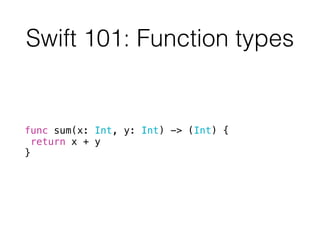
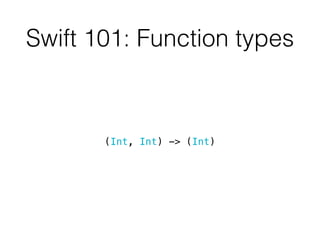
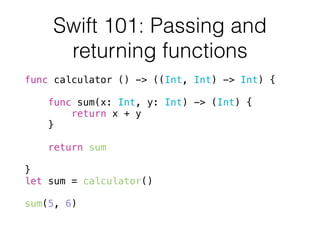
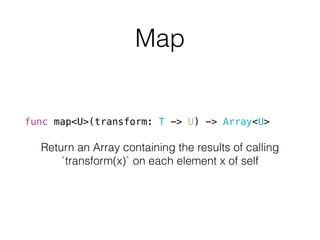
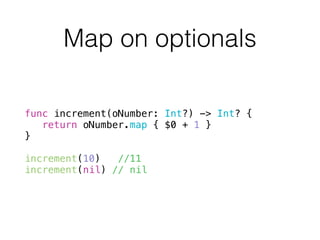
This document discusses functional programming concepts like map, reduce, and filter and provides Swift code examples for applying these concepts. It begins with an introduction to functional programming and key concepts. It then covers Swift basics like function types and passing functions. The bulk of the document explains and demonstrates map, reduce, filter and their uses on arrays and optionals in Swift. It concludes with suggestions for further functional programming topics and resources.


![[Let'Swift 2019] 실용적인 함수형 프로그래밍 워크샵](https://cdn.slidesharecdn.com/ss_thumbnails/practicalfunctionalprogramming-191113054017-thumbnail.jpg?width=640&height=640&fit=bounds)


