Introduction To Financial
System
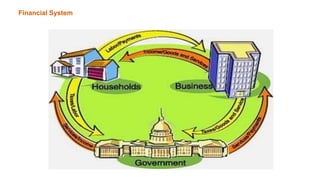
Financial System
The Financial System
• Definition:
• Set of arrangements/conventions
• Embracing the lending and borrowing of funds by non-financial economic
units, and
• The intermediation of this function by financial intermediaries
• To:
• Facilitate the transfer of funds
• Create additional money when required
• Create markets in debt and equity instruments (and derivatives)
• So that the price and allocation of funds are determined efficiently
The Financial System
• The financial system comprises of:
• the financial markets
• financial intermediaries
• and other financial institutions
• That execute the financial decisions of households, firms/businesses and
governments
• The roles and functions and interrelationship of the elements of the financial
system both local and international:
• Performs the essential economic function of channeling funds (net savers
who spend less than their income) from those with a surplus of funds to
those who wish to borrow (net spenders who wish to spend more than
their income)
Roles and Functions of the financial system
• Acts as an intermediary between surplus and deficit economic units
• Plays an important role in the allocation of funds to their most efficient use
amongst competing demands
• In a market system such as the South African financial system, this
allocation of funds is achieved through the price mechanism with prices
being set by the forces of supply and demand within the various financial
markets
• The financial system is global meaning that extensive international
telecommunication networks link financial markets and intermediaries so
that the trading of securities and transfer of payments can take place 24
hours a day
Financial Intermediation and the Flow of Funds
Understand financial intermediation, financial instruments and the flow of funds in the financial
system
• The financial system has four elements:
• Lenders and borrowers
• Financial institutions
• Financial instruments
• Financial markets
• The interaction between the various components of the financial system is shown on the next slide
Financial Intermediation and the Flow of Funds
Lenders and Borrowers
• Lenders are the ultimate providers of savings (can be referred to as
investors in that they expend cash on the acquisition of financial assets
such as bonds and shares and real or tangible assets such as land,
buildings, gold, and paintings)
• Borrowers are the ultimate users of those savings
• Both are non-financial entities and are referred to as surplus and deficit
economic units respectively
Financial Intermediation and the Flow of Funds
• Lenders and borrowers can be categorised into four sectors:
• Household (individuals and families; In South Africa it also includes
private charitable, religious and non-profit bodies as well as
unincorporated businesses such as farmers and professional
partnerships)
• Business or corporate (all non-financial firms or companies producing
and distributing goods and services)
• Government (central and provincial governments as well as
• local authorities)
• Foreign (all individuals and institutions situated in the rest of the
world)
Financial Intermediation and the Flow of Funds
Financial Intermediaries
• Financial institutions that expedite the flow of funds from lenders to
borrowers
• Types of financial intermediaries include:
• Banks
• Insurance companies
• Pension and provident funds
• Collective investment schemes (also referred to as unit trusts or
mutual funds)
Financial Intermediation and the Flow of Funds
• Banks accept deposits from lenders and on-lend the funds to borrowers
• Insurers and pension- and provident funds receive contractual savings
from households and re-invest the funds mainly in shares and other
securities such as bonds. In addition insurers perform the function of risk
diversification i.e. they enable individuals or firms to distribute their risk
amongst a large population of insured individuals or firms
• Collective investment schemes pool the funds of many small investors and
re-invest the funds in shares, bonds and other financial assets with each
investor having a proportional claim on such assets. Collective investment
schemes play a risk diversification role in that they spread the risk by
investing in number of different securities
Financial Instruments
• Financial instruments or claims can be defined as promises to pay money
in the future in exchange for present funds i.e. money today
• Financial instruments (marketable and non-marketable), are created to
satisfy the needs of the various participants.
• They are created to satisfy the needs of financial system participants and
as a result of financial innovation in the borrowing and financial
intermediation processes, a wide range of financial instruments and
products exists
• Financial claims can be categorised as:
• Indirect or
• Primary securities
Financial Instruments
• Within these two categories financial instruments can be characterised as
marketable or non-marketable
• Marketable instruments can be traded in secondary markets, while
non-marketable instruments cannot
• To recover their investment, holders of marketable securities can sell
their securities to other investors in the secondary market
• To recover their investment, holders of non-marketable financial
instruments have recourse only to the issuers of the securities.
• Non-marketable claims generally involve the household sector (retail
sector) while marketable claims are usually issued by the corporate
and government sectors (wholesale sector)
Examples of the different categories of financial instruments are shown on
the following slide
Financial Instruments
Financial Markets
Financial Markets
Characteristics of a good financial market:
• Provision of timely and accurate price and volume information: Both on past
securities transactions and the prevailing supply and demand for securities
• Internal efficiency: Transaction costs as a percentage of the value of the trade are
low; even minimal
• Provision of liquidity: The degree to which a security can be quickly and cheaply
turned into cash. Liquidity requires marketability, price continuity and market depth
• Marketability: The security’s ability to be sold quickly
• Price continuity: Prices do not change from one transaction to another in the absence of
substantial new information
• Market depth: The ability of the market to absorb large trade volumes without a significant
impact on prices i.e. there are many potential buyers and sellers willing to trade at a price
above and below the current market price
• External or informational efficiency: Securities prices adapt quickly to new
information so that current market prices are fair in that they reflect all available
information on the security
Financial Markets
• Market makers: Stand ready to buy or sell certain securities at all times. They
quote both a bid and an offer price to the market and profit from the spread
between bid and offer prices as well as from changes in market prices. Market
makers adjust their bid or offer prices depending upon positions that they hold
and/or upon their outlook for changes in prices
• Hedgers: Are exposed to the risk of adverse market price movements and
mitigate the risk by using hedging instruments such as derivatives
• Speculators: Attempt to make a profit by taking a view on the market. If their
view is correct, they make profits. If their view is wrong, they make losses
• Arbitrageurs: Attempt to make profits by exploiting inefficiencies in market
prices. They simultaneously buy securities in the market where the price is
relatively cheap and sell securities in the market where the price is relatively
expensive; thereby making risk-less profits
Financial Markets
• The categories of financial market participants are not necessarily mutually
exclusive.
• For example a financial intermediary such as a bank may, given the range of
its business activities, be a financial advisor, market marker, dealer, broker,
speculator, arbitrageur and hedger

Introduction To Financial System.pptx

  • 1.
  • 3.
  • 4.
    The Financial System •Definition: • Set of arrangements/conventions • Embracing the lending and borrowing of funds by non-financial economic units, and • The intermediation of this function by financial intermediaries • To: • Facilitate the transfer of funds • Create additional money when required • Create markets in debt and equity instruments (and derivatives) • So that the price and allocation of funds are determined efficiently
  • 5.
    The Financial System •The financial system comprises of: • the financial markets • financial intermediaries • and other financial institutions • That execute the financial decisions of households, firms/businesses and governments • The roles and functions and interrelationship of the elements of the financial system both local and international: • Performs the essential economic function of channeling funds (net savers who spend less than their income) from those with a surplus of funds to those who wish to borrow (net spenders who wish to spend more than their income)
  • 6.
    Roles and Functionsof the financial system • Acts as an intermediary between surplus and deficit economic units • Plays an important role in the allocation of funds to their most efficient use amongst competing demands • In a market system such as the South African financial system, this allocation of funds is achieved through the price mechanism with prices being set by the forces of supply and demand within the various financial markets • The financial system is global meaning that extensive international telecommunication networks link financial markets and intermediaries so that the trading of securities and transfer of payments can take place 24 hours a day
  • 7.
    Financial Intermediation andthe Flow of Funds Understand financial intermediation, financial instruments and the flow of funds in the financial system • The financial system has four elements: • Lenders and borrowers • Financial institutions • Financial instruments • Financial markets • The interaction between the various components of the financial system is shown on the next slide
  • 9.
    Financial Intermediation andthe Flow of Funds Lenders and Borrowers • Lenders are the ultimate providers of savings (can be referred to as investors in that they expend cash on the acquisition of financial assets such as bonds and shares and real or tangible assets such as land, buildings, gold, and paintings) • Borrowers are the ultimate users of those savings • Both are non-financial entities and are referred to as surplus and deficit economic units respectively
  • 10.
    Financial Intermediation andthe Flow of Funds • Lenders and borrowers can be categorised into four sectors: • Household (individuals and families; In South Africa it also includes private charitable, religious and non-profit bodies as well as unincorporated businesses such as farmers and professional partnerships) • Business or corporate (all non-financial firms or companies producing and distributing goods and services) • Government (central and provincial governments as well as • local authorities) • Foreign (all individuals and institutions situated in the rest of the world)
  • 12.
    Financial Intermediation andthe Flow of Funds Financial Intermediaries • Financial institutions that expedite the flow of funds from lenders to borrowers • Types of financial intermediaries include: • Banks • Insurance companies • Pension and provident funds • Collective investment schemes (also referred to as unit trusts or mutual funds)
  • 13.
    Financial Intermediation andthe Flow of Funds • Banks accept deposits from lenders and on-lend the funds to borrowers • Insurers and pension- and provident funds receive contractual savings from households and re-invest the funds mainly in shares and other securities such as bonds. In addition insurers perform the function of risk diversification i.e. they enable individuals or firms to distribute their risk amongst a large population of insured individuals or firms • Collective investment schemes pool the funds of many small investors and re-invest the funds in shares, bonds and other financial assets with each investor having a proportional claim on such assets. Collective investment schemes play a risk diversification role in that they spread the risk by investing in number of different securities
  • 14.
    Financial Instruments • Financialinstruments or claims can be defined as promises to pay money in the future in exchange for present funds i.e. money today • Financial instruments (marketable and non-marketable), are created to satisfy the needs of the various participants. • They are created to satisfy the needs of financial system participants and as a result of financial innovation in the borrowing and financial intermediation processes, a wide range of financial instruments and products exists • Financial claims can be categorised as: • Indirect or • Primary securities
  • 17.
    Financial Instruments • Withinthese two categories financial instruments can be characterised as marketable or non-marketable • Marketable instruments can be traded in secondary markets, while non-marketable instruments cannot • To recover their investment, holders of marketable securities can sell their securities to other investors in the secondary market • To recover their investment, holders of non-marketable financial instruments have recourse only to the issuers of the securities. • Non-marketable claims generally involve the household sector (retail sector) while marketable claims are usually issued by the corporate and government sectors (wholesale sector) Examples of the different categories of financial instruments are shown on the following slide
  • 18.
  • 19.
  • 20.
    Financial Markets Characteristics ofa good financial market: • Provision of timely and accurate price and volume information: Both on past securities transactions and the prevailing supply and demand for securities • Internal efficiency: Transaction costs as a percentage of the value of the trade are low; even minimal • Provision of liquidity: The degree to which a security can be quickly and cheaply turned into cash. Liquidity requires marketability, price continuity and market depth • Marketability: The security’s ability to be sold quickly • Price continuity: Prices do not change from one transaction to another in the absence of substantial new information • Market depth: The ability of the market to absorb large trade volumes without a significant impact on prices i.e. there are many potential buyers and sellers willing to trade at a price above and below the current market price • External or informational efficiency: Securities prices adapt quickly to new information so that current market prices are fair in that they reflect all available information on the security
  • 21.
    Financial Markets • Marketmakers: Stand ready to buy or sell certain securities at all times. They quote both a bid and an offer price to the market and profit from the spread between bid and offer prices as well as from changes in market prices. Market makers adjust their bid or offer prices depending upon positions that they hold and/or upon their outlook for changes in prices • Hedgers: Are exposed to the risk of adverse market price movements and mitigate the risk by using hedging instruments such as derivatives • Speculators: Attempt to make a profit by taking a view on the market. If their view is correct, they make profits. If their view is wrong, they make losses • Arbitrageurs: Attempt to make profits by exploiting inefficiencies in market prices. They simultaneously buy securities in the market where the price is relatively cheap and sell securities in the market where the price is relatively expensive; thereby making risk-less profits
  • 22.
    Financial Markets • Thecategories of financial market participants are not necessarily mutually exclusive. • For example a financial intermediary such as a bank may, given the range of its business activities, be a financial advisor, market marker, dealer, broker, speculator, arbitrageur and hedger