Introduction to Financial Management
Financial Statement, Cash Flow & Taxes
Presented by Ageng Cahya , Ardiaz Ajie, Ryan Zulqudsie
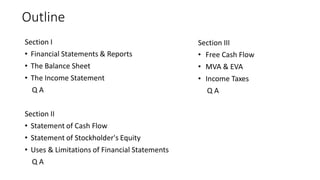
Outline
Section I
• Financial Statements & Reports
• The Balance Sheet
• The Income Statement
Q A
Section II
• Statement of Cash Flow
• Statement of Stockholder's Equity
• Uses & Limitations of Financial Statements
Q A
Section III
• Free Cash Flow
• MVA & EVA
• Income Taxes
Q A
Section I
Financial Statements & Reports | The Balance Sheet | The Income Statement
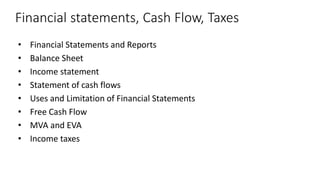
Financial statements, Cash Flow, Taxes
• Financial Statements and Reports
• Balance Sheet
• Income statement
• Statement of cash flows
• Uses and Limitation of Financial Statements
• Free Cash Flow
• MVA and EVA
• Income taxes
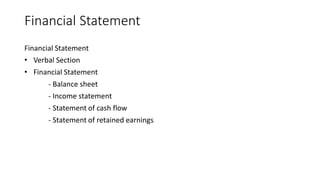
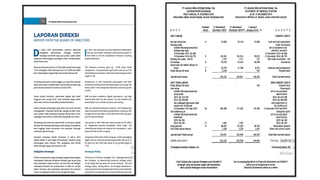
Financial Statement
Financial Statement
• Verbal Section
• Financial Statement
- Balance sheet
- Income statement
- Statement of cash flow
- Statement of retained earnings
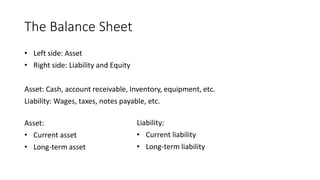
The Balance Sheet
• Left side: Asset
• Right side: Liability and Equity
Asset: Cash, account receivable, Inventory, equipment, etc.
Liability: Wages, taxes, notes payable, etc.
Liability:
• Current liability
• Long-term liability
Asset:
• Current asset
• Long-term asset
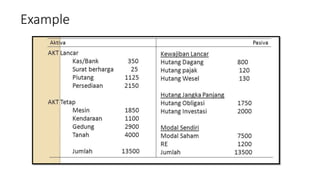
Example
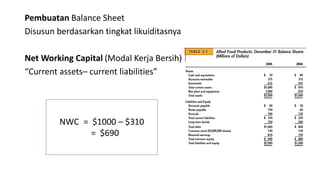
Pembuatan Balance Sheet
Disusun berdasarkan tingkat likuiditasnya
Net Working Capital (Modal Kerja Bersih)
“Current assets– current liabilities”
NWC = $1000 – $310
= $690
Additional point of balance sheet
• Cash vs other assets: cash, account receivable, inventory
• Working Capital
• Other sources of funds
• Depreciation methods: IRS and GAAP
• Market values vs book values
• The time dimension
Income Statement
Report summarizing a firm’s revenues, expenses, and profits during a reporting
period Monthly, quarterly, annualy
“Net income = Net sales - operation costs interest – taxes”
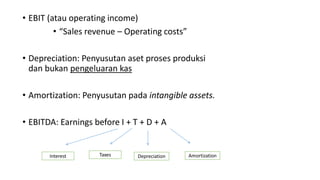
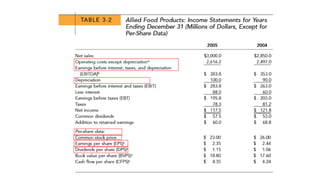
• EBIT (atau operating income)
• “Sales revenue – Operating costs”
• Depreciation: Penyusutan aset proses produksi
dan bukan pengeluaran kas
• Amortization: Penyusutan pada intangible assets.
• EBITDA: Earnings before I + T + D + A
Interest Taxes Depreciation Amortization
Section II
Financial Statements & Reports | The Balance Sheet | The Income Statement
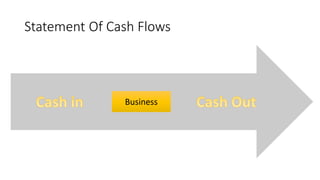
Statement Of Cash Flows
Business
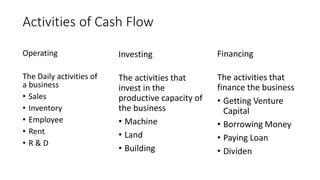
Activities of Cash Flow
Operating
The Daily activities of
a business
• Sales
• Inventory
• Employee
• Rent
• R & D
Investing
The activities that
invest in the
productive capacity of
the business
• Machine
• Land
• Building
Financing
The activities that
finance the business
• Getting Venture
Capital
• Borrowing Money
• Paying Loan
• Dividen
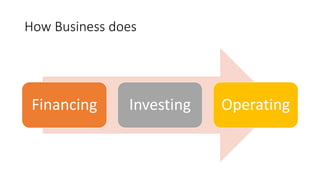
How Business does
Financing Investing Operating
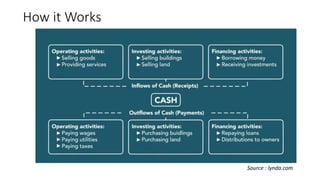
How it Works
Source : lynda.com
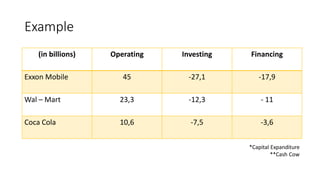
Example
(in billions) Operating Investing Financing
Exxon Mobile 45 -27,1 -17,9
Wal – Mart 23,3 -12,3 - 11
Coca Cola 10,6 -7,5 -3,6
*Capital Expanditure
**Cash Cow
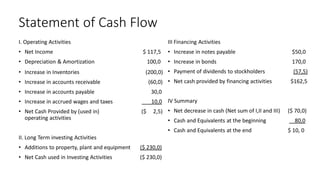
Statement of Cash Flow
I. Operating Activities
• Net Income $ 117,5
• Depreciation & Amortization 100,0
• Increase in Inventories (200,0)
• Increase in accounts receivable (60,0)
• Increase in accounts payable 30,0
• Increase in accrued wages and taxes 10,0
• Net Cash Provided by (used in) ($ 2,5)
operating activities
II. Long Term investing Activities
• Additions to property, plant and equipment ($ 230,0)
• Net Cash used in Investing Activities ($ 230,0)
III Financing Activities
• Increase in notes payable $50,0
• Increase in bonds 170,0
• Payment of dividends to stockholders (57,5)
• Net cash provided by financing activities $162,5
IV Summary
• Net decrease in cash (Net sum of I,II and III) ($ 70,0)
• Cash and Equivalents at the beginning 80,0
• Cash and Equivalents at the end $ 10, 0
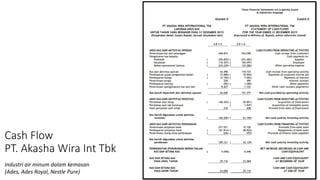
Cash Flow
PT. Akasha Wira Int Tbk
Industri air minum dalam kemasan
(Ades, Ades Royal, Nestle Pure)
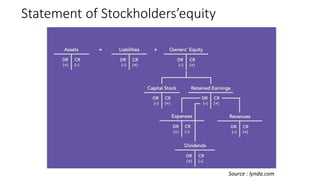
Statement of Stockholders’equity
Source : lynda.com
Uses & Limitation
The uses are to both internal (managerial) and external (financial) users.
External users take the information to make :
• investment
• Credit
• Regulatory decisions.
Section III
Free Cash Flow | MVA & EVA | Income Taxes
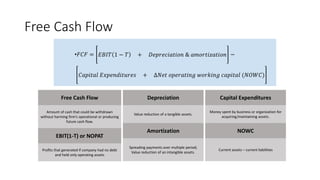
Free Cash Flow
•𝐹𝐶𝐹 = 𝐸𝐵𝐼𝑇 1 − 𝑇 + 𝐷𝑒𝑝𝑟𝑒𝑐𝑖𝑎𝑡𝑖𝑜𝑛 & 𝑎𝑚𝑜𝑟𝑡𝑖𝑧𝑎𝑡𝑖𝑜𝑛 −
𝐶𝑎𝑝𝑖𝑡𝑎𝑙 𝐸𝑥𝑝𝑒𝑛𝑑𝑖𝑡𝑢𝑟𝑒𝑠 + ∆𝑁𝑒𝑡 𝑜𝑝𝑒𝑟𝑎𝑡𝑖𝑛𝑔 𝑤𝑜𝑟𝑘𝑖𝑛𝑔 𝑐𝑎𝑝𝑖𝑡𝑎𝑙 (𝑁𝑂𝑊𝐶)
Free Cash Flow
Amount of cash that could be withdrawn
without harming firm’s operational or producing
future cash flow.
EBIT(1-T) or NOPAT
Profits that generated if company had no debt
and held only operating assets
Depreciation
Value reduction of a tangible assets.
Capital Expenditures
Money spent by business or organization for
acquiring/maintaining assets.
NOWC
Current assets – current liabilities
Amortization
Spreading payments over multiple period;
Value reduction of an intangible assets.
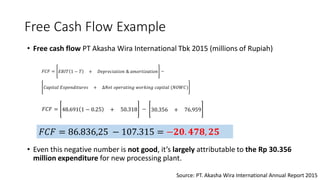
Free Cash Flow Example
• Free cash flow PT Akasha Wira International Tbk 2015 (millions of Rupiah)
• Even this negative number is not good, it’s largely attributable to the Rp 30.356
million expenditure for new processing plant.
𝐹𝐶𝐹 = 𝐸𝐵𝐼𝑇 1 − 𝑇 + 𝐷𝑒𝑝𝑟𝑒𝑐𝑖𝑎𝑡𝑖𝑜𝑛 & 𝑎𝑚𝑜𝑟𝑡𝑖𝑧𝑎𝑡𝑖𝑜𝑛 −
𝐶𝑎𝑝𝑖𝑡𝑎𝑙 𝐸𝑥𝑝𝑒𝑛𝑑𝑖𝑡𝑢𝑟𝑒𝑠 + ∆𝑁𝑒𝑡 𝑜𝑝𝑒𝑟𝑎𝑡𝑖𝑛𝑔 𝑤𝑜𝑟𝑘𝑖𝑛𝑔 𝑐𝑎𝑝𝑖𝑡𝑎𝑙 (𝑁𝑂𝑊𝐶)
𝐹𝐶𝐹 = 48.691 1 − 0.25 + 50.318 − 30.356 + 76.959
𝐹𝐶𝐹 = 86.836,25 − 107.315 = −𝟐𝟎. 𝟒𝟕𝟖, 𝟐𝟓
Source: PT. Akasha Wira International Annual Report 2015
Why is FCF an Important Determinant?
o Accounting statements are primarily used by creditors or tax collectors.
o For that reason, corporate decision makers/security analysts modify data to meet
their needs.
oThe most important modification is concept of Free Cash Flow (FCF).
MVA & EVA
o Accounting statements don’t reflect market values. Therefore, it can’t be used for
evaluating managers’ performance.
o MVA & EVA is used by analyst as additional performance measures.
o Market Value Added (MVA) is the excess of the market value of equity over its
book value.
• If it’s positive, the company has added value. If it is negative, the company has
destroyed value.
MVA & EVA (cont.)
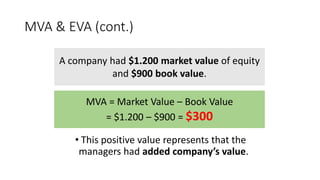
• This positive value represents that the
managers had added company’s value.
A company had $1.200 market value of equity
and $900 book value.
MVA = Market Value – Book Value
= $1.200 – $900 = $300
MVA & EVA (cont.)
• EVA, sometimes called economic profit, if the excess of NOPAT over capital costs.
• EVA is an estimate of a business’ true economic profit for a given year.
• If EVA is positive, company generate more that it needs
Income Taxes
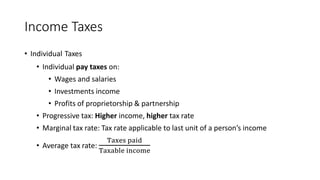
• Individual Taxes
• Individual pay taxes on:
• Wages and salaries
• Investments income
• Profits of proprietorship & partnership
• Progressive tax: Higher income, higher tax rate
• Marginal tax rate: Tax rate applicable to last unit of a person’s income
• Average tax rate:
Taxes paid
Taxable income
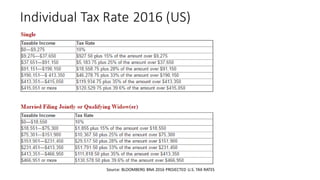
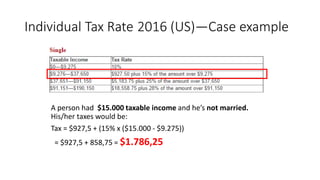
Individual Tax Rate 2016 (US)
Source: BLOOMBERG BNA 2016 PROJECTED U.S. TAX RATES
Individual Tax Rate 2016 (US)—Case example
A person had $15.000 taxable income and he’s not married.
His/her taxes would be:
Tax = $927,5 + (15% x ($15.000 - $9.275))
= $927,5 + 858,75 = $1.786,25
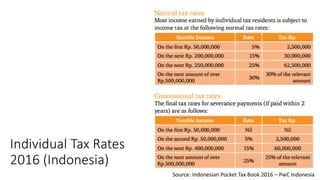
Individual Tax Rates
2016 (Indonesia)
Source: Indonesian Pocket Tax Book 2016 – PwC Indonesia
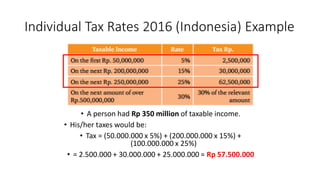
Individual Tax Rates 2016 (Indonesia) Example
• A person had Rp 350 million of taxable income.
• His/her taxes would be:
• Tax = (50.000.000 x 5%) + (200.000.000 x 15%) +
(100.000.000 x 25%)
• = 2.500.000 + 30.000.000 + 25.000.000 = Rp 57.500.000
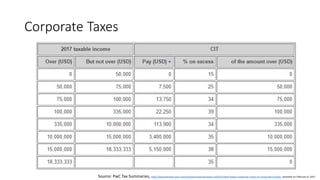
Corporate Taxes
Source: PwC Tax Summaries, http://taxsummaries.pwc.com/uk/taxsummaries/wwts.nsf/ID/United-States-Corporate-Taxes-on-corporate-income, accessed on February 6, 2017
Corporate Taxes Example
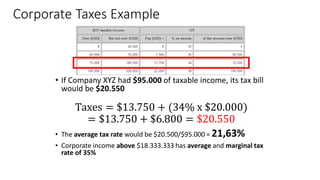
• If Company XYZ had $95.000 of taxable income, its tax bill
would be $20.550
Taxes = $13.750 + (34% x $20.000)
= $13.750 + $6.800 = $20.550
• The average tax rate would be $20.500/$95.000 = 21,63%
• Corporate income above $18.333.333 has average and marginal tax
rate of 35%
Taxes on Received Interest and Dividends
• Corporate can own securities and receive interest and dividend income.
• Interest income is taxed as ordinary income at regular corporate tax rates.
• 70% of dividends are excluded from taxable income, and the remaining 30% is
taxed at the ordinary tax rate.
Taxes on Bonds and Stock
A company had $200.000 to invest. If it could buy bonds that
paid 8% interest, or $16.000 per year, or stock that paid 7% in
dividends, or $14.000. This company is in the 40% federal-
plus-state tax bracket.
Its tax would be:
Bonds: 40% x $16.000 = $5.600,
so its after-tax income would be
$16.000 - $5.600 = $10.400
Stock: [30% x 40%] x $14.000 =
$1.680, so its after-tax income would
be $14.000 - $1.680 = $12.320
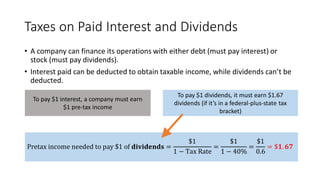
Taxes on Paid Interest and Dividends
• A company can finance its operations with either debt (must pay interest) or
stock (must pay dividends).
• Interest paid can be deducted to obtain taxable income, while dividends can’t be
deducted.
Pretax income needed to pay $1 of 𝐝𝐢𝐯𝐢𝐝𝐞𝐧𝐝𝐬 =
$1
1 − Tax Rate
=
$1
1 − 40%
=
$1
0.6
= $𝟏. 𝟔𝟕
To pay $1 interest, a company must earn
$1 pre-tax income
To pay $1 dividends, it must earn $1.67
dividends (if it’s in a federal-plus-state tax
bracket)
Taxation of Small Business: S Corporations
• S Corporations is a small corporation that taxed as a proprietorship or
partnership, yet retain limited liability and other benefit of corporate form of
organization.
• The income is taxed only once, which benefit the stockholders.
• Taxations of Limited Liability Companies are quite similar.
Taxation on Depreciation
The larger the depreciation, the lower the taxable income,
the lower the tax bill, and the higher the operating cash flow.
Ask & Question ?
Financial Statement, Cash Flow & Taxes

Introduction to Financial Management

  • 1.
    Introduction to FinancialManagement Financial Statement, Cash Flow & Taxes Presented by Ageng Cahya , Ardiaz Ajie, Ryan Zulqudsie
  • 2.
    Outline Section I • FinancialStatements & Reports • The Balance Sheet • The Income Statement Q A Section II • Statement of Cash Flow • Statement of Stockholder's Equity • Uses & Limitations of Financial Statements Q A Section III • Free Cash Flow • MVA & EVA • Income Taxes Q A
  • 3.
    Section I Financial Statements& Reports | The Balance Sheet | The Income Statement
  • 4.
    Financial statements, CashFlow, Taxes • Financial Statements and Reports • Balance Sheet • Income statement • Statement of cash flows • Uses and Limitation of Financial Statements • Free Cash Flow • MVA and EVA • Income taxes
  • 5.
    Financial Statement Financial Statement •Verbal Section • Financial Statement - Balance sheet - Income statement - Statement of cash flow - Statement of retained earnings
  • 7.
    The Balance Sheet •Left side: Asset • Right side: Liability and Equity Asset: Cash, account receivable, Inventory, equipment, etc. Liability: Wages, taxes, notes payable, etc. Liability: • Current liability • Long-term liability Asset: • Current asset • Long-term asset
  • 8.
  • 9.
    Pembuatan Balance Sheet Disusunberdasarkan tingkat likuiditasnya Net Working Capital (Modal Kerja Bersih) “Current assets– current liabilities” NWC = $1000 – $310 = $690
  • 10.
    Additional point ofbalance sheet • Cash vs other assets: cash, account receivable, inventory • Working Capital • Other sources of funds • Depreciation methods: IRS and GAAP • Market values vs book values • The time dimension
  • 11.
    Income Statement Report summarizinga firm’s revenues, expenses, and profits during a reporting period Monthly, quarterly, annualy “Net income = Net sales - operation costs interest – taxes”
  • 12.
    • EBIT (atauoperating income) • “Sales revenue – Operating costs” • Depreciation: Penyusutan aset proses produksi dan bukan pengeluaran kas • Amortization: Penyusutan pada intangible assets. • EBITDA: Earnings before I + T + D + A Interest Taxes Depreciation Amortization
  • 14.
    Section II Financial Statements& Reports | The Balance Sheet | The Income Statement
  • 15.
    Statement Of CashFlows Business
  • 16.
    Activities of CashFlow Operating The Daily activities of a business • Sales • Inventory • Employee • Rent • R & D Investing The activities that invest in the productive capacity of the business • Machine • Land • Building Financing The activities that finance the business • Getting Venture Capital • Borrowing Money • Paying Loan • Dividen
  • 17.
    How Business does FinancingInvesting Operating
  • 18.
  • 19.
    Example (in billions) OperatingInvesting Financing Exxon Mobile 45 -27,1 -17,9 Wal – Mart 23,3 -12,3 - 11 Coca Cola 10,6 -7,5 -3,6 *Capital Expanditure **Cash Cow
  • 20.
    Statement of CashFlow I. Operating Activities • Net Income $ 117,5 • Depreciation & Amortization 100,0 • Increase in Inventories (200,0) • Increase in accounts receivable (60,0) • Increase in accounts payable 30,0 • Increase in accrued wages and taxes 10,0 • Net Cash Provided by (used in) ($ 2,5) operating activities II. Long Term investing Activities • Additions to property, plant and equipment ($ 230,0) • Net Cash used in Investing Activities ($ 230,0) III Financing Activities • Increase in notes payable $50,0 • Increase in bonds 170,0 • Payment of dividends to stockholders (57,5) • Net cash provided by financing activities $162,5 IV Summary • Net decrease in cash (Net sum of I,II and III) ($ 70,0) • Cash and Equivalents at the beginning 80,0 • Cash and Equivalents at the end $ 10, 0
  • 21.
    Cash Flow PT. AkashaWira Int Tbk Industri air minum dalam kemasan (Ades, Ades Royal, Nestle Pure)
  • 22.
  • 23.
    Uses & Limitation Theuses are to both internal (managerial) and external (financial) users. External users take the information to make : • investment • Credit • Regulatory decisions.
  • 24.
    Section III Free CashFlow | MVA & EVA | Income Taxes
  • 25.
    Free Cash Flow •𝐹𝐶𝐹= 𝐸𝐵𝐼𝑇 1 − 𝑇 + 𝐷𝑒𝑝𝑟𝑒𝑐𝑖𝑎𝑡𝑖𝑜𝑛 & 𝑎𝑚𝑜𝑟𝑡𝑖𝑧𝑎𝑡𝑖𝑜𝑛 − 𝐶𝑎𝑝𝑖𝑡𝑎𝑙 𝐸𝑥𝑝𝑒𝑛𝑑𝑖𝑡𝑢𝑟𝑒𝑠 + ∆𝑁𝑒𝑡 𝑜𝑝𝑒𝑟𝑎𝑡𝑖𝑛𝑔 𝑤𝑜𝑟𝑘𝑖𝑛𝑔 𝑐𝑎𝑝𝑖𝑡𝑎𝑙 (𝑁𝑂𝑊𝐶) Free Cash Flow Amount of cash that could be withdrawn without harming firm’s operational or producing future cash flow. EBIT(1-T) or NOPAT Profits that generated if company had no debt and held only operating assets Depreciation Value reduction of a tangible assets. Capital Expenditures Money spent by business or organization for acquiring/maintaining assets. NOWC Current assets – current liabilities Amortization Spreading payments over multiple period; Value reduction of an intangible assets.
  • 26.
    Free Cash FlowExample • Free cash flow PT Akasha Wira International Tbk 2015 (millions of Rupiah) • Even this negative number is not good, it’s largely attributable to the Rp 30.356 million expenditure for new processing plant. 𝐹𝐶𝐹 = 𝐸𝐵𝐼𝑇 1 − 𝑇 + 𝐷𝑒𝑝𝑟𝑒𝑐𝑖𝑎𝑡𝑖𝑜𝑛 & 𝑎𝑚𝑜𝑟𝑡𝑖𝑧𝑎𝑡𝑖𝑜𝑛 − 𝐶𝑎𝑝𝑖𝑡𝑎𝑙 𝐸𝑥𝑝𝑒𝑛𝑑𝑖𝑡𝑢𝑟𝑒𝑠 + ∆𝑁𝑒𝑡 𝑜𝑝𝑒𝑟𝑎𝑡𝑖𝑛𝑔 𝑤𝑜𝑟𝑘𝑖𝑛𝑔 𝑐𝑎𝑝𝑖𝑡𝑎𝑙 (𝑁𝑂𝑊𝐶) 𝐹𝐶𝐹 = 48.691 1 − 0.25 + 50.318 − 30.356 + 76.959 𝐹𝐶𝐹 = 86.836,25 − 107.315 = −𝟐𝟎. 𝟒𝟕𝟖, 𝟐𝟓 Source: PT. Akasha Wira International Annual Report 2015
  • 27.
    Why is FCFan Important Determinant? o Accounting statements are primarily used by creditors or tax collectors. o For that reason, corporate decision makers/security analysts modify data to meet their needs. oThe most important modification is concept of Free Cash Flow (FCF).
  • 28.
    MVA & EVA oAccounting statements don’t reflect market values. Therefore, it can’t be used for evaluating managers’ performance. o MVA & EVA is used by analyst as additional performance measures. o Market Value Added (MVA) is the excess of the market value of equity over its book value. • If it’s positive, the company has added value. If it is negative, the company has destroyed value.
  • 29.
    MVA & EVA(cont.) • This positive value represents that the managers had added company’s value. A company had $1.200 market value of equity and $900 book value. MVA = Market Value – Book Value = $1.200 – $900 = $300
  • 30.
    MVA & EVA(cont.) • EVA, sometimes called economic profit, if the excess of NOPAT over capital costs. • EVA is an estimate of a business’ true economic profit for a given year. • If EVA is positive, company generate more that it needs
  • 31.
    Income Taxes • IndividualTaxes • Individual pay taxes on: • Wages and salaries • Investments income • Profits of proprietorship & partnership • Progressive tax: Higher income, higher tax rate • Marginal tax rate: Tax rate applicable to last unit of a person’s income • Average tax rate: Taxes paid Taxable income
  • 32.
    Individual Tax Rate2016 (US) Source: BLOOMBERG BNA 2016 PROJECTED U.S. TAX RATES
  • 33.
    Individual Tax Rate2016 (US)—Case example A person had $15.000 taxable income and he’s not married. His/her taxes would be: Tax = $927,5 + (15% x ($15.000 - $9.275)) = $927,5 + 858,75 = $1.786,25
  • 34.
    Individual Tax Rates 2016(Indonesia) Source: Indonesian Pocket Tax Book 2016 – PwC Indonesia
  • 35.
    Individual Tax Rates2016 (Indonesia) Example • A person had Rp 350 million of taxable income. • His/her taxes would be: • Tax = (50.000.000 x 5%) + (200.000.000 x 15%) + (100.000.000 x 25%) • = 2.500.000 + 30.000.000 + 25.000.000 = Rp 57.500.000
  • 36.
    Corporate Taxes Source: PwCTax Summaries, http://taxsummaries.pwc.com/uk/taxsummaries/wwts.nsf/ID/United-States-Corporate-Taxes-on-corporate-income, accessed on February 6, 2017
  • 37.
    Corporate Taxes Example •If Company XYZ had $95.000 of taxable income, its tax bill would be $20.550 Taxes = $13.750 + (34% x $20.000) = $13.750 + $6.800 = $20.550 • The average tax rate would be $20.500/$95.000 = 21,63% • Corporate income above $18.333.333 has average and marginal tax rate of 35%
  • 38.
    Taxes on ReceivedInterest and Dividends • Corporate can own securities and receive interest and dividend income. • Interest income is taxed as ordinary income at regular corporate tax rates. • 70% of dividends are excluded from taxable income, and the remaining 30% is taxed at the ordinary tax rate.
  • 39.
    Taxes on Bondsand Stock A company had $200.000 to invest. If it could buy bonds that paid 8% interest, or $16.000 per year, or stock that paid 7% in dividends, or $14.000. This company is in the 40% federal- plus-state tax bracket. Its tax would be: Bonds: 40% x $16.000 = $5.600, so its after-tax income would be $16.000 - $5.600 = $10.400 Stock: [30% x 40%] x $14.000 = $1.680, so its after-tax income would be $14.000 - $1.680 = $12.320
  • 40.
    Taxes on PaidInterest and Dividends • A company can finance its operations with either debt (must pay interest) or stock (must pay dividends). • Interest paid can be deducted to obtain taxable income, while dividends can’t be deducted. Pretax income needed to pay $1 of 𝐝𝐢𝐯𝐢𝐝𝐞𝐧𝐝𝐬 = $1 1 − Tax Rate = $1 1 − 40% = $1 0.6 = $𝟏. 𝟔𝟕 To pay $1 interest, a company must earn $1 pre-tax income To pay $1 dividends, it must earn $1.67 dividends (if it’s in a federal-plus-state tax bracket)
  • 41.
    Taxation of SmallBusiness: S Corporations • S Corporations is a small corporation that taxed as a proprietorship or partnership, yet retain limited liability and other benefit of corporate form of organization. • The income is taxed only once, which benefit the stockholders. • Taxations of Limited Liability Companies are quite similar.
  • 42.
    Taxation on Depreciation Thelarger the depreciation, the lower the taxable income, the lower the tax bill, and the higher the operating cash flow.
  • 43.
    Ask & Question? Financial Statement, Cash Flow & Taxes