INTRODUCTION
TO AN
EXCAVATOR
GROUP MEMBERS
•Ameer Hamza
•Ishfaq Khan
•Uzair Ahmed
•Kashif Ahmed
LECTURE COTENTS
•1) What is Excavator
•2) Parts of Excavator
•3) Fuctions of excavators
•4) Different Types of Excavator
WHAT IS EXCAVATOR
• An excavator is a machine that is used for construction
sites. It is a heavy duty equipment that can progressively
excavate various types of soils
• An Excavator is also called digger.
• Because an excavator uses hydraulics or a wire rope
pulley system to dig holes or trenches and is, therefore,
often called a digger.
• An excavator is a fascinating piece of machinery and is
essential to our line of work.
HOW DOES AN
EXCAVATOR WORK
• Excavators use diesel to power the engine because it
produces a higher horsepower. The three main features of
an excavator include:
• Control Cabin – Where the controls are located and the
operator uses pedals and levers to steer the excavator.
• Tracks – Excavators have rigid tracks that are fixed in
place. The tracks are operated by a series of gears that
are fused to the engine via the drive shaft. Excavators can
move forwards or backwards in a straight line
HOW DOES AN
EXCAVATOR WORK
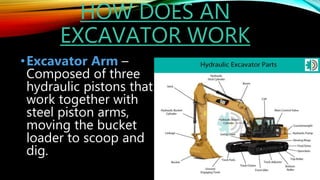
•Excavator Arm –
Composed of three
hydraulic pistons that
work together with
steel piston arms,
moving the bucket
loader to scoop and
dig.
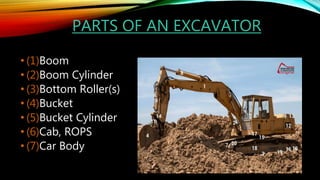
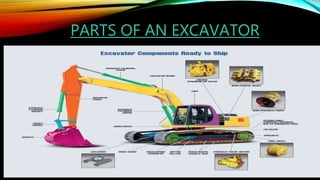
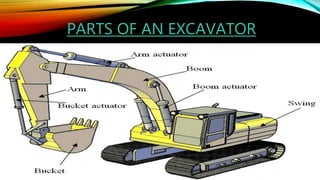
PARTS OF AN EXCAVATOR
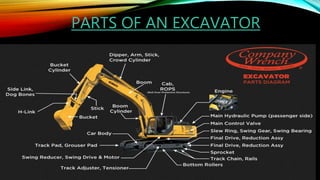
• (1)Boom
• (2)Boom Cylinder
• (3)Bottom Roller(s)
• (4)Bucket
• (5)Bucket Cylinder
• (6)Cab, ROPS
• (7)Car Body
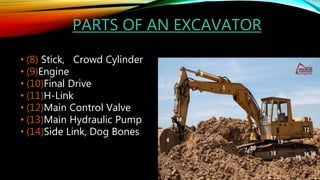
PARTS OF AN EXCAVATOR
• (8) Stick, Crowd Cylinder
• (9)Engine
• (10)Final Drive
• (11)H-Link
• (12)Main Control Valve
• (13)Main Hydraulic Pump
• (14)Side Link, Dog Bones
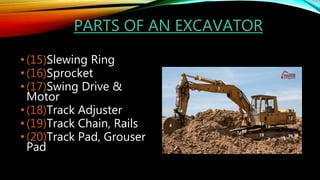
PARTS OF AN EXCAVATOR
•(15)Slewing Ring
•(16)Sprocket
•(17)Swing Drive &
Motor
•(18)Track Adjuster
•(19)Track Chain, Rails
•(20)Track Pad, Grouser
Pad
PARTS OF AN EXCAVATOR
DIFFERENT TYPES OF AN EXCAVATORS
•Crawler excavators
•Backhoe
•Suction excavators
•Dragline excavators
•Wheel excavator
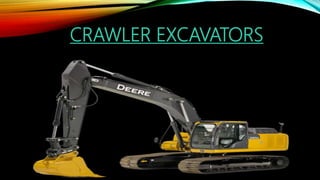
CRAWLER EXCAVATORS
•Crawler excavator runs on two endless tracks
(chain wheel system). These types of excavators
are used in hilly areas where risks of sliding of
machinery are on the verge. Crawler type
excavator has low ground pressure because of
spreading of load on large area. Therefore, it is
also used where soil support is weak
CRAWLER EXCAVATORS
BACKHOE
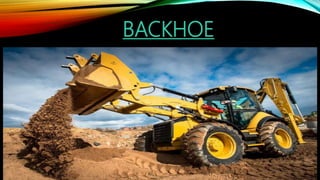
• Among all different types of excavators that are
available, backhoe is the most commonly used today. Its
effectiveness is widely applicable in areas that may not
be specific to excavation only. A backhoe excavator has
a bucket that faces the driver. The bucket extracts soil by
pulling it towards the driver before lifting. Backhoe
excavators are used to excavate soil in mining or
construction sites or unload waste in dumpsites. They
are small in size as compared to the other excavators
but they serve various purposes
BACKHOE
SUCTION EXCAVATORS
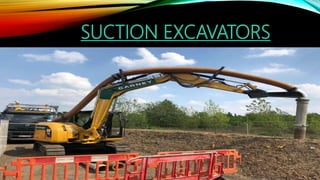
•Suction excavators are also known as vacuum
excavators. They come along with a suction pipe
that helps carry away loose soil and debris, cuts
using sharp teeth at the edge of the pipe. Before
the excavation begins, a water jet is used in order
to loosen the ground. These types of excavators
are used in places that require careful and safe
exploration of underground elements.
SUCTION EXCAVATORS
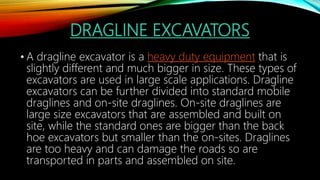
DRAGLINE EXCAVATORS
• A dragline excavator is a heavy duty equipment that is
slightly different and much bigger in size. These types of
excavators are used in large scale applications. Dragline
excavators can be further divided into standard mobile
draglines and on-site draglines. On-site draglines are
large size excavators that are assembled and built on
site, while the standard ones are bigger than the back
hoe excavators but smaller than the on-sites. Draglines
are too heavy and can damage the roads so are
transported in parts and assembled on site.
DRAGLINE EXCAVATORS
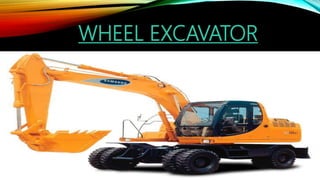
WHEEL EXCAVATOR
Wheel excavator runs on wheels and are
used for excavation and loading of dump
trucks and most of the time it is only used
for plain ground operations. Because of
wheel, it is not suitable for hilly areas due
to low grip value to the ground.
WHEEL EXCAVATOR
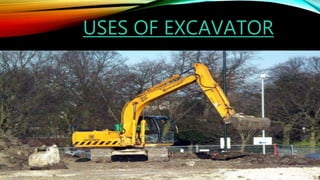
USES OF EXCAVATOR
•The following are some uses of excavators:
•Digging of trenches, holes, foundations
•Material handling
•Brush cutting with hydraulic saw and mower
attachments
•Forestry work
•Forestry mulching
•Construction
USES OF EXCAVATOR
•Demolition with hydraulic claw, cutter
and breaker attachments
•General grading/landscaping
•Mining, especially, but not only open-pit mining
•River dredging
•Driving piles, in conjunction with a pile driver
•Drilling shafts for footings and rock blasting, by use
of an auger or hydraulic drill attachment
•Snow removal with snowplow and snow
blower attachments
•
USES OF EXCAVATOR
“
”
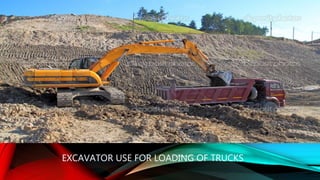
EXCAVATOR USE FOR LOADING OF TRUCKS
THE END

Introduction to excavator

  • 1.
  • 2.
    GROUP MEMBERS •Ameer Hamza •IshfaqKhan •Uzair Ahmed •Kashif Ahmed
  • 3.
    LECTURE COTENTS •1) Whatis Excavator •2) Parts of Excavator •3) Fuctions of excavators •4) Different Types of Excavator
  • 4.
    WHAT IS EXCAVATOR •An excavator is a machine that is used for construction sites. It is a heavy duty equipment that can progressively excavate various types of soils • An Excavator is also called digger. • Because an excavator uses hydraulics or a wire rope pulley system to dig holes or trenches and is, therefore, often called a digger. • An excavator is a fascinating piece of machinery and is essential to our line of work.
  • 5.
    HOW DOES AN EXCAVATORWORK • Excavators use diesel to power the engine because it produces a higher horsepower. The three main features of an excavator include: • Control Cabin – Where the controls are located and the operator uses pedals and levers to steer the excavator. • Tracks – Excavators have rigid tracks that are fixed in place. The tracks are operated by a series of gears that are fused to the engine via the drive shaft. Excavators can move forwards or backwards in a straight line
  • 6.
    HOW DOES AN EXCAVATORWORK •Excavator Arm – Composed of three hydraulic pistons that work together with steel piston arms, moving the bucket loader to scoop and dig.
  • 7.
    PARTS OF ANEXCAVATOR • (1)Boom • (2)Boom Cylinder • (3)Bottom Roller(s) • (4)Bucket • (5)Bucket Cylinder • (6)Cab, ROPS • (7)Car Body
  • 8.
    PARTS OF ANEXCAVATOR • (8) Stick, Crowd Cylinder • (9)Engine • (10)Final Drive • (11)H-Link • (12)Main Control Valve • (13)Main Hydraulic Pump • (14)Side Link, Dog Bones
  • 9.
    PARTS OF ANEXCAVATOR •(15)Slewing Ring •(16)Sprocket •(17)Swing Drive & Motor •(18)Track Adjuster •(19)Track Chain, Rails •(20)Track Pad, Grouser Pad
  • 10.
    PARTS OF ANEXCAVATOR
  • 11.
    PARTS OF ANEXCAVATOR
  • 12.
    PARTS OF ANEXCAVATOR
  • 13.
    DIFFERENT TYPES OFAN EXCAVATORS •Crawler excavators •Backhoe •Suction excavators •Dragline excavators •Wheel excavator
  • 14.
    CRAWLER EXCAVATORS •Crawler excavatorruns on two endless tracks (chain wheel system). These types of excavators are used in hilly areas where risks of sliding of machinery are on the verge. Crawler type excavator has low ground pressure because of spreading of load on large area. Therefore, it is also used where soil support is weak
  • 15.
  • 16.
    BACKHOE • Among alldifferent types of excavators that are available, backhoe is the most commonly used today. Its effectiveness is widely applicable in areas that may not be specific to excavation only. A backhoe excavator has a bucket that faces the driver. The bucket extracts soil by pulling it towards the driver before lifting. Backhoe excavators are used to excavate soil in mining or construction sites or unload waste in dumpsites. They are small in size as compared to the other excavators but they serve various purposes
  • 17.
  • 18.
    SUCTION EXCAVATORS •Suction excavatorsare also known as vacuum excavators. They come along with a suction pipe that helps carry away loose soil and debris, cuts using sharp teeth at the edge of the pipe. Before the excavation begins, a water jet is used in order to loosen the ground. These types of excavators are used in places that require careful and safe exploration of underground elements.
  • 19.
  • 20.
    DRAGLINE EXCAVATORS • Adragline excavator is a heavy duty equipment that is slightly different and much bigger in size. These types of excavators are used in large scale applications. Dragline excavators can be further divided into standard mobile draglines and on-site draglines. On-site draglines are large size excavators that are assembled and built on site, while the standard ones are bigger than the back hoe excavators but smaller than the on-sites. Draglines are too heavy and can damage the roads so are transported in parts and assembled on site.
  • 21.
  • 22.
    WHEEL EXCAVATOR Wheel excavatorruns on wheels and are used for excavation and loading of dump trucks and most of the time it is only used for plain ground operations. Because of wheel, it is not suitable for hilly areas due to low grip value to the ground.
  • 23.
  • 24.
    USES OF EXCAVATOR •Thefollowing are some uses of excavators: •Digging of trenches, holes, foundations •Material handling •Brush cutting with hydraulic saw and mower attachments •Forestry work •Forestry mulching •Construction
  • 25.
    USES OF EXCAVATOR •Demolitionwith hydraulic claw, cutter and breaker attachments •General grading/landscaping •Mining, especially, but not only open-pit mining •River dredging •Driving piles, in conjunction with a pile driver •Drilling shafts for footings and rock blasting, by use of an auger or hydraulic drill attachment •Snow removal with snowplow and snow blower attachments •
  • 26.
  • 27.
    “ ” EXCAVATOR USE FORLOADING OF TRUCKS
  • 28.