


INTRODUCTION TO E-COMMERCE Rizal Hari Magnadi Management Department Economics and Business Faculty Diponegoro University


Business Pressure :  Market and Economic Strong competition Global economy Regional trade agreement  Low labor cost in some countries Frequent and significant changes in markets Increased power of consumers
Business Pressure :  Societal Changing nature of workforce Government deregulation – more competition Shrinking government subsidies Increased importance of ethical and legal issues Increased social responsibility of organizations Rapid political changes
Business Pressures :  Technological Increasing innovations and new technologies Rapid technological obsolence Increases in information overload
Digital economy  an economy that is based on  digital technologies , including digital communication networks, computers, software, and other related information technologies (Turban, 2002) With digital networking and communications infrastructures provide a  global platform  over which people and organizations  interact ,  communicate ,  collaborate , and  search information
E-Commerce The process of buying, selling, transferring, or exchanging products, services, and/or information via computer networks, including the internet
Common E-Commerce’s Business Models Business-to-Business (B2B) Business-to-Consumer (B2C) Consumer-to-Consumer (C2C) Peer-of-peer aplications Mobile commerce
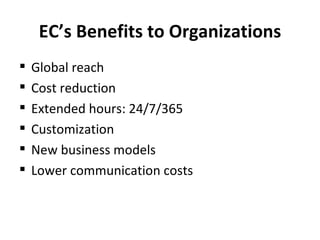
EC’s Benefits to Organizations Global reach  Cost reduction Extended hours: 24/7/365 Customization New business models Lower communication costs
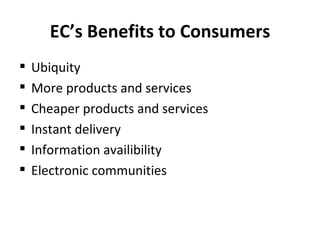
EC’s Benefits to Consumers Ubiquity More products and services Cheaper products and services Instant delivery Information availibility Electronic communities
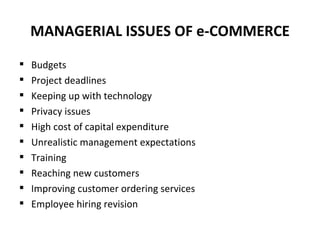
MANAGERIAL ISSUES OF e-COMMERCE Budgets Project deadlines Keeping up with technology Privacy issues High cost of capital expenditure Unrealistic management expectations Training Reaching new customers Improving customer ordering services Employee hiring revision

Introduction to e commerce

  • 1.
    INTRODUCTION TO E-COMMERCERizal Hari Magnadi Management Department Economics and Business Faculty Diponegoro University
  • 2.
  • 3.
  • 4.
  • 5.
    Business Pressure : Market and Economic Strong competition Global economy Regional trade agreement Low labor cost in some countries Frequent and significant changes in markets Increased power of consumers
  • 6.
    Business Pressure : Societal Changing nature of workforce Government deregulation – more competition Shrinking government subsidies Increased importance of ethical and legal issues Increased social responsibility of organizations Rapid political changes
  • 7.
    Business Pressures : Technological Increasing innovations and new technologies Rapid technological obsolence Increases in information overload
  • 8.
    Digital economy an economy that is based on digital technologies , including digital communication networks, computers, software, and other related information technologies (Turban, 2002) With digital networking and communications infrastructures provide a global platform over which people and organizations interact , communicate , collaborate , and search information
  • 9.
    E-Commerce The processof buying, selling, transferring, or exchanging products, services, and/or information via computer networks, including the internet
  • 10.
    Common E-Commerce’s BusinessModels Business-to-Business (B2B) Business-to-Consumer (B2C) Consumer-to-Consumer (C2C) Peer-of-peer aplications Mobile commerce
  • 11.
    EC’s Benefits toOrganizations Global reach Cost reduction Extended hours: 24/7/365 Customization New business models Lower communication costs
  • 12.
    EC’s Benefits toConsumers Ubiquity More products and services Cheaper products and services Instant delivery Information availibility Electronic communities
  • 13.
    MANAGERIAL ISSUES OFe-COMMERCE Budgets Project deadlines Keeping up with technology Privacy issues High cost of capital expenditure Unrealistic management expectations Training Reaching new customers Improving customer ordering services Employee hiring revision