History and
Nature of
Dance
Introduction
Dance is an
activity which can
take many forms
and fill many
different needs.
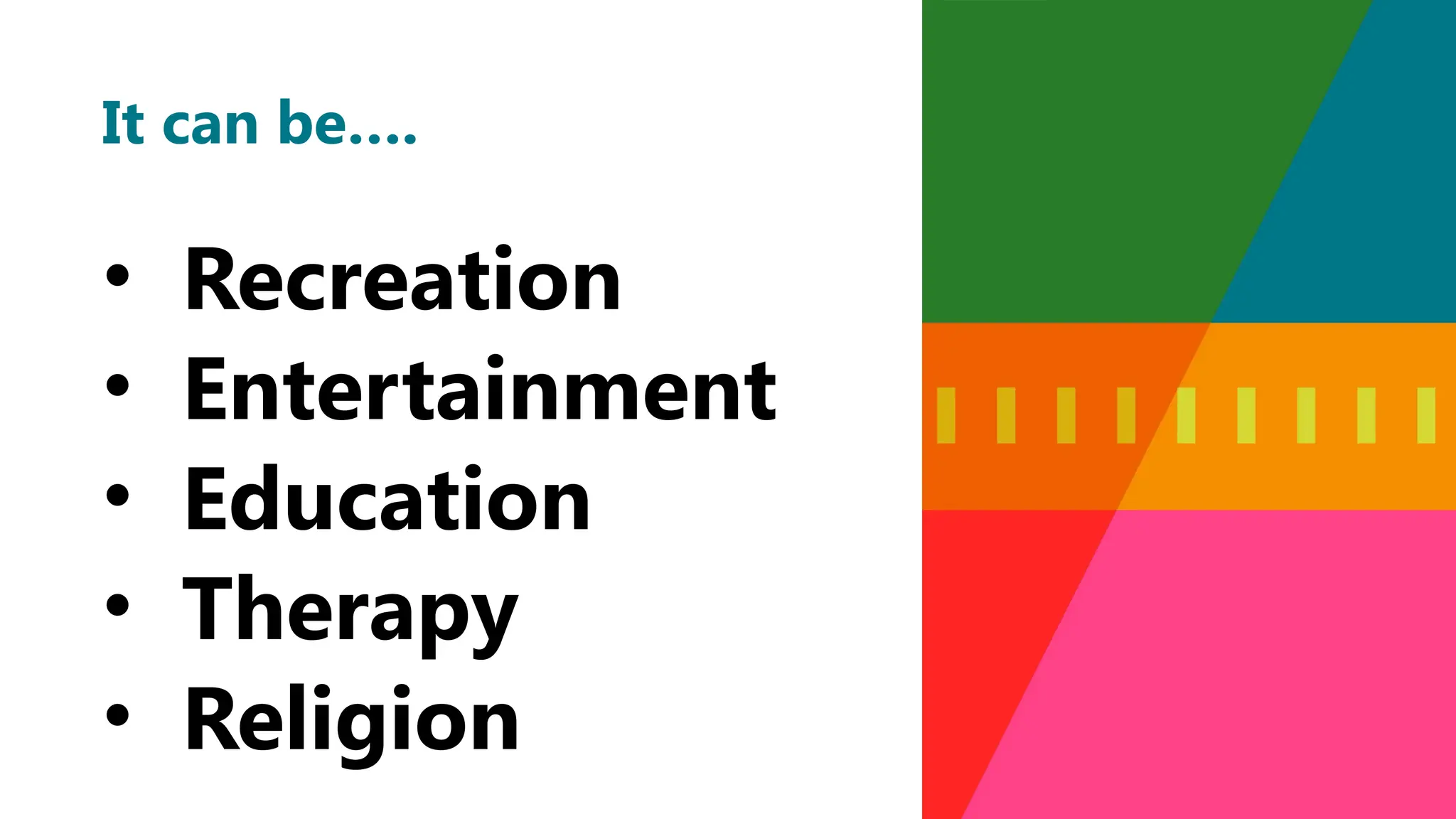
It can be….
• Recreation
• Entertainment
• Education
• Therapy
• Religion
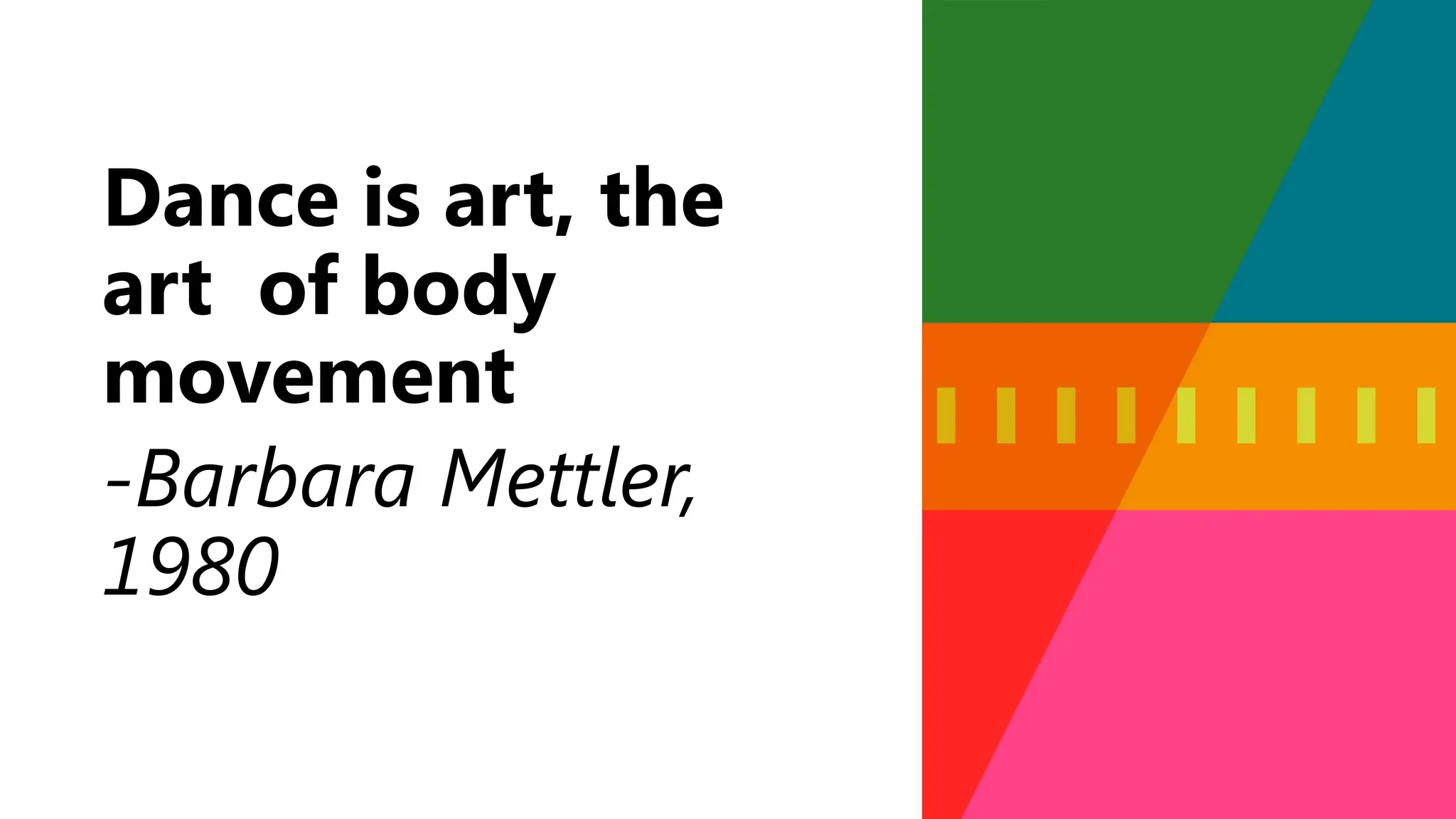
Dance is art, the
art of body
movement
-Barbara Mettler,
1980
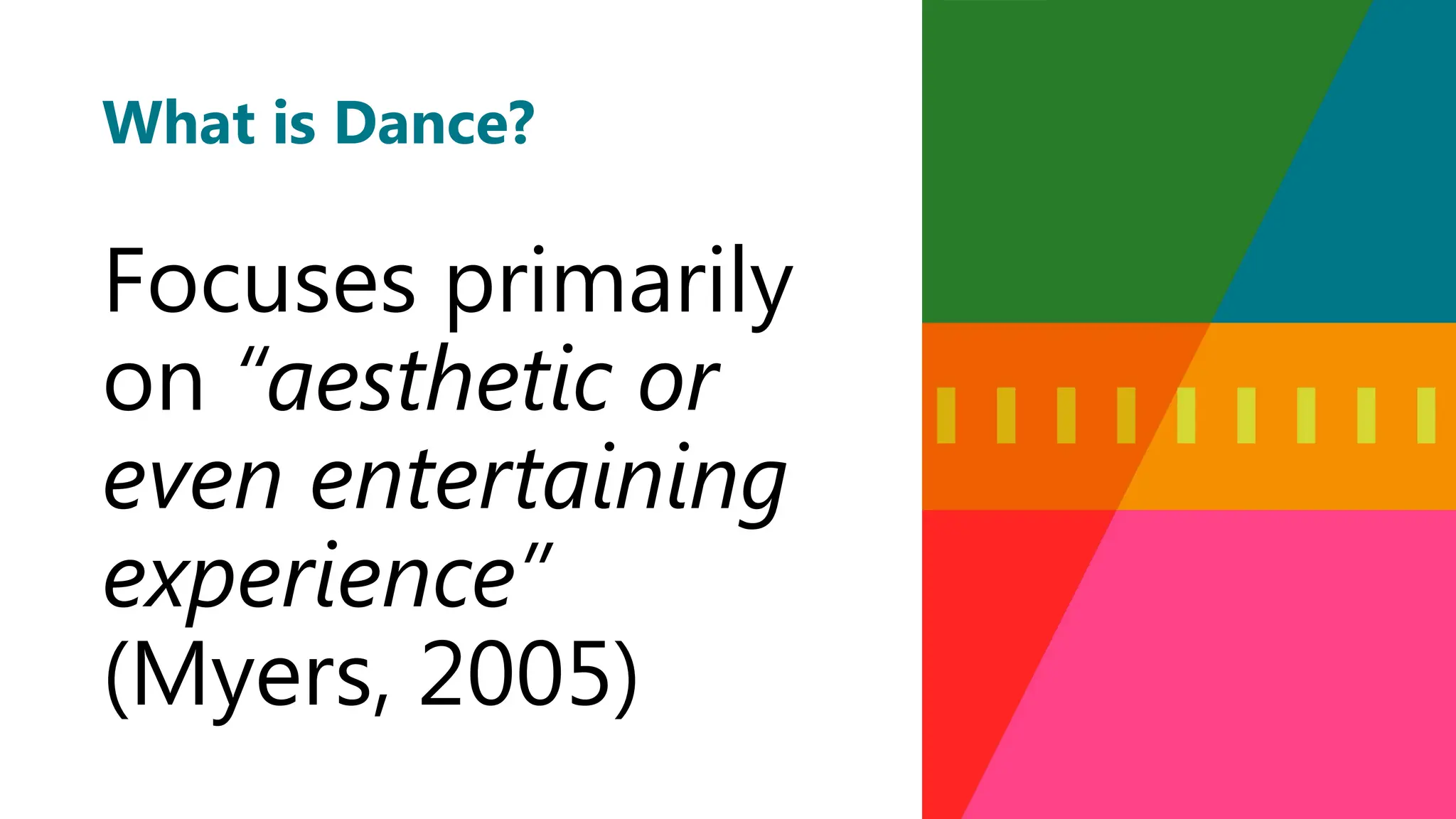
What is Dance?
Focuses primarily
on “aesthetic or
even entertaining
experience”
(Myers, 2005)
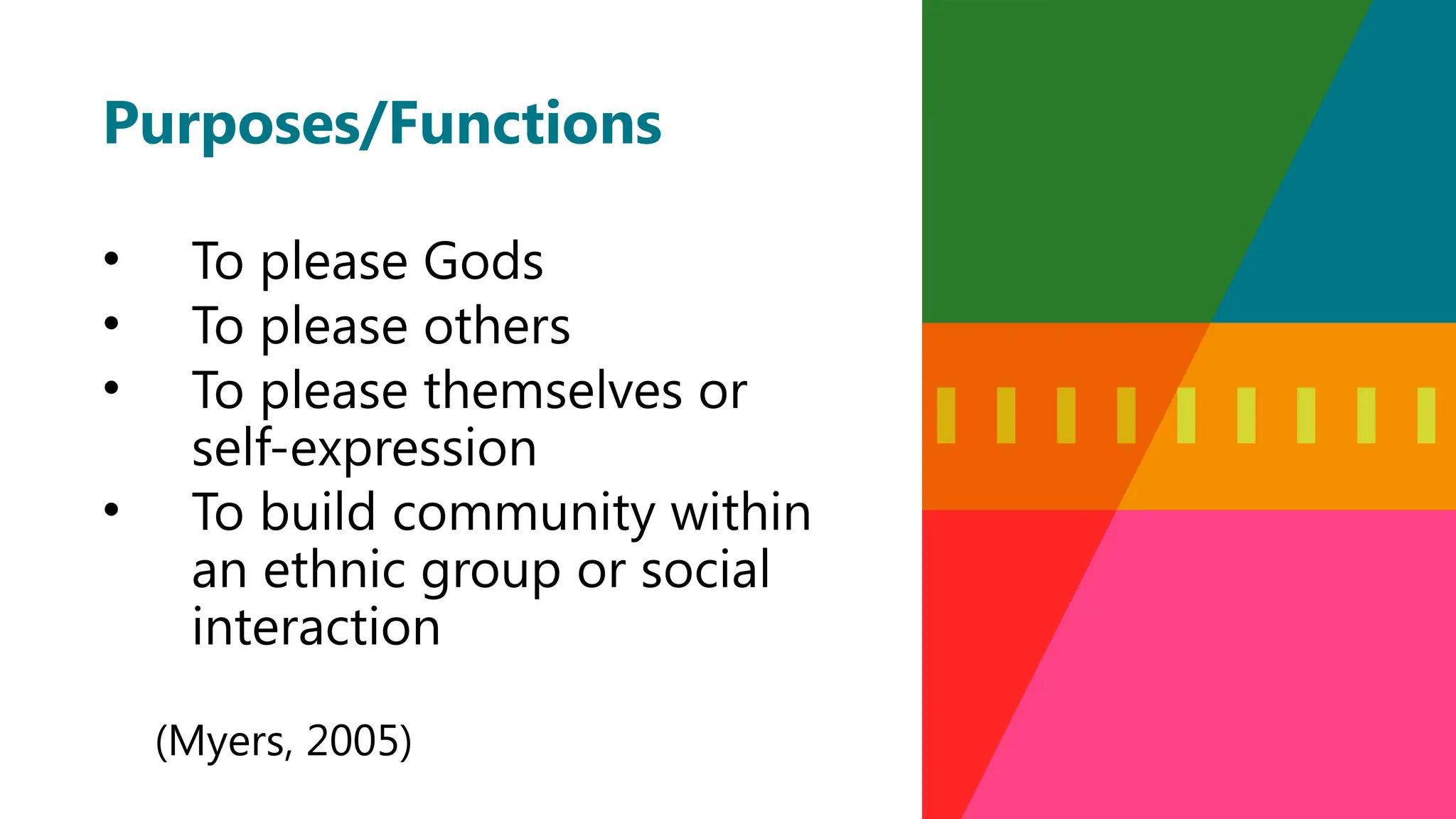
Purposes/Functions
• To please Gods
• To please others
• To please themselves or
self-expression
• To build community within
an ethnic group or social
interaction
(Myers, 2005)
BRIEF HISTORY
OF DANCE
HISTORY OF DANCE
Pre-Historic
Dance was used as a form of
expression and communication.
Early humans performed dances
during rituals and ceremonies related
to fertility, hunting, and religious rites.
HISTORY OF DANCE - Ancient Civilizations
Egypt
Dance was integral to religious and social ceremonies,
often depicting stories of gods and nature
Greece
Dance was part of Greek theater, combining drama with
movement to tell stories
India
Dance was deeply connected to religious rituals,
particularly in Hindu temples.
HISTORY OF DANCE - Medieval Period
Dance was often restricted by the Church
in Europe but survived in folk traditions
Court dances, such as the minuet, became
popular among the nobility.
HISTORY OF DANCE - Renaissance
Dance experienced a revival, with the
emergence of ballet in Italy and France
Court dances became more
sophisticated, leading to the
development of dance as an art form
HISTORY OF DANCE - Modern Era
The 20th century saw the rise of modern
dance, which emphasized self-expression
and broke away from classical forms
Dance became a key element in
entertainment, including musicals, movies,
and television.
NATURE OF
DANCE
NATURE OF DANCE
Artistic Expression
Dance is a form of artistic expression, using the
body to convey emotions, tell stories, and
reflect cultural values.
Cultural Significance
Dance is deeply rooted in cultural traditions,
often reflecting the history, beliefs, and values
of a community.
NATURE OF DANCE
Physical Activity
Dance is a physical activity that promotes
fitness, coordination, and flexibility
Social Interaction
Dance often serves as a means of social
interaction, bringing people together in
celebrations, rituals, and communal events
NATURE OF DANCE
Variety of Forms
Dance encompasses a wide range of styles,
from classical ballet to contemporary, folk,
and street dance
Educational Tool
Dance is used in education to teach rhythm,
coordination, and cultural appreciation.
SPECIFIC
BENEFITS OF
DANCE
• Develops cardiovascular
and muscular endurance
• Improves coordination,
balance, flexibility, and
body composition
• Lower risks of
cardiovascular disease
• Lowers Body Mass Index
• Lowers resting heart rate
PHYSICAL
• Lowers lipid metabolism
• Enables joint mobility (hip
motion and motion
flexibility)
• Helps improve and maintain
bone density, thus helps
prevent osteoporosis
• Helps recover coordination
and neuromuscular skills
after injury
• Helps keep the brain sharp
• Decrease incidence of dementia and
Alzheimer’s Disease
• Decrease depressive symptoms
• Increase self-esteem and improves body image
• Aids in releasing emotional and physical
tension
MENTAL
• Gives sense of togetherness within a
group
• Encourages positive social interaction
and interpersonal relationship in a group
• Contributes to the individual’s potential
for self-actualization in society
SOCIAL
•Promotes cultural values
CULTURAL
ELEMENTS OF
DANCE
1. SPACE
• The area the performers occupy
and where they move
• Can be divided into 4 different
aspects also known as spatial
elements
SPACE – Spatial Elements
a. Direction
• performers can go forward, backward,
diagonal, circular, and so on
• They may also face any direction while
executing a single movement or
several phrases
SPACE – Spatial Elements
b. size
• Movements can be varied by doing
larger or smaller actions
SPACE – Spatial Elements
c. level
• Movements can be done in a high,
medium, or low level
SPACE – Spatial Elements
d. focus
• Performers may change their focus
by looking at a different directions
2. TIMING
• Tempo (speed)
• Performers move with the tempo of
an underlying sound, known as beat
or pulse
2. TIMING
• Faster or slower than normal beat
• When sequence of a movement or
group of phrases is done in varying
tempos, they generate rhythmic
patterns
2. TIMING
• The addition of silences or pulse
also adds to rhythmic patterns
3. DANCE ENERGIES
• Movements here propelled by
energy or force
• A force can either initiate or stop an
action
Qualities of Dance Energies
a. Sustained
• Movements are done smoothly,
continuously, and with flow and
control
• It does not have a clear beginning
and ending
Qualities of Dance Energies
b. percussive
• movements are explosive or sharp
in contrast with sustained
movements
• Have a clear beginning and ending
Qualities of Dance Energies
c. vibratory
• Movements consists of trembling or
shaking
• Faster version of percussive
movements that produces jittery
effect
Qualities of Dance Energies
d. swinging
• Movements trace a curved line or an
arc in space
• The movements are relaxed
Qualities of Dance Energies
e. suspended
• Movements are perched in space or
hanging on the air
Qualities of Dance Energies
f. collapsing
• Movements are released in tension
and gradually or abruptly giving
into gravity, letting body descend to
the floor
4. BODILY SHAPES
• Refers to how the entire body is
molded in space or the
configuration of body parts
• Can be rounded, angular, or both
4. BODILY SHAPES
a. Symmetrical
• Balanced shaped
• Movements are practically identical
or similar on both sides
4. BODILY SHAPES
b. asymmetrical
• Unbalanced shaped
• Movements of two sides of the
body do not match or completely
different from each other
5. GROUP SHAPES
• Group of dancers perform
movements in different group
shapes
• Total picture or arrangement within
a picture frame (Minton, 2007)
Recreational Dance
• Social activity in which people of all
ages can participate
Dance Fitness
• Is a fun way to increase
cardiovascular endurance, strength,
and flexibility
WHAT MAKES A GOOD DANCE?
• It displays a significant meaning or conveys
message
• Portrays life experience
• Maybe presented abstractly and symbolically
but still convey emotion and meaning
(McGreevy-Nicholas et al. 2005)
WHAT MAKES A GOOD DANCE?
• Lifts and transports the audience from their
seats during the performance
• It has a beginning, middle, and end/conclusion
What is a form?
•The instrument by which ideas
and elements are arranged or
combined into a logical
sequence which results in unity
and consistency
What is a phrase?
•Smallest unit of form in the
whole dance (Blom and Chaplin,
1988)
What is a motif?
•A single movement or a short
phrase of movement that
embodies the style and intention
of the dance
CHARACTERISTICS
OF A GOOD DANCE
• Interconnected
phrases of the dance
are coherent and
flow smoothly
together
1. UNITY
• The phrases of the dance
that are organized
progressively, making each
movement phrase move
naturally into the next
2. CONTINUITY AND
DEVELOPMENT
• Introduces new material,
which is noticeably
different from anything
so far seen in the dance
(Rickett-Young, 1996)
3. VARIETY AND
CONTRAST
• The link between
movements, phrases,
and sections of the
dance
4. TRANSITION
• Emphasizes movements
and phrases that are
important to the dance
and gives a feeling of
closure to a work (Minton,
2007)
5. REPETITION
• This is where the
apex of energy in
the dance is reached
(Schrader, 1996)
6. CLIMAX
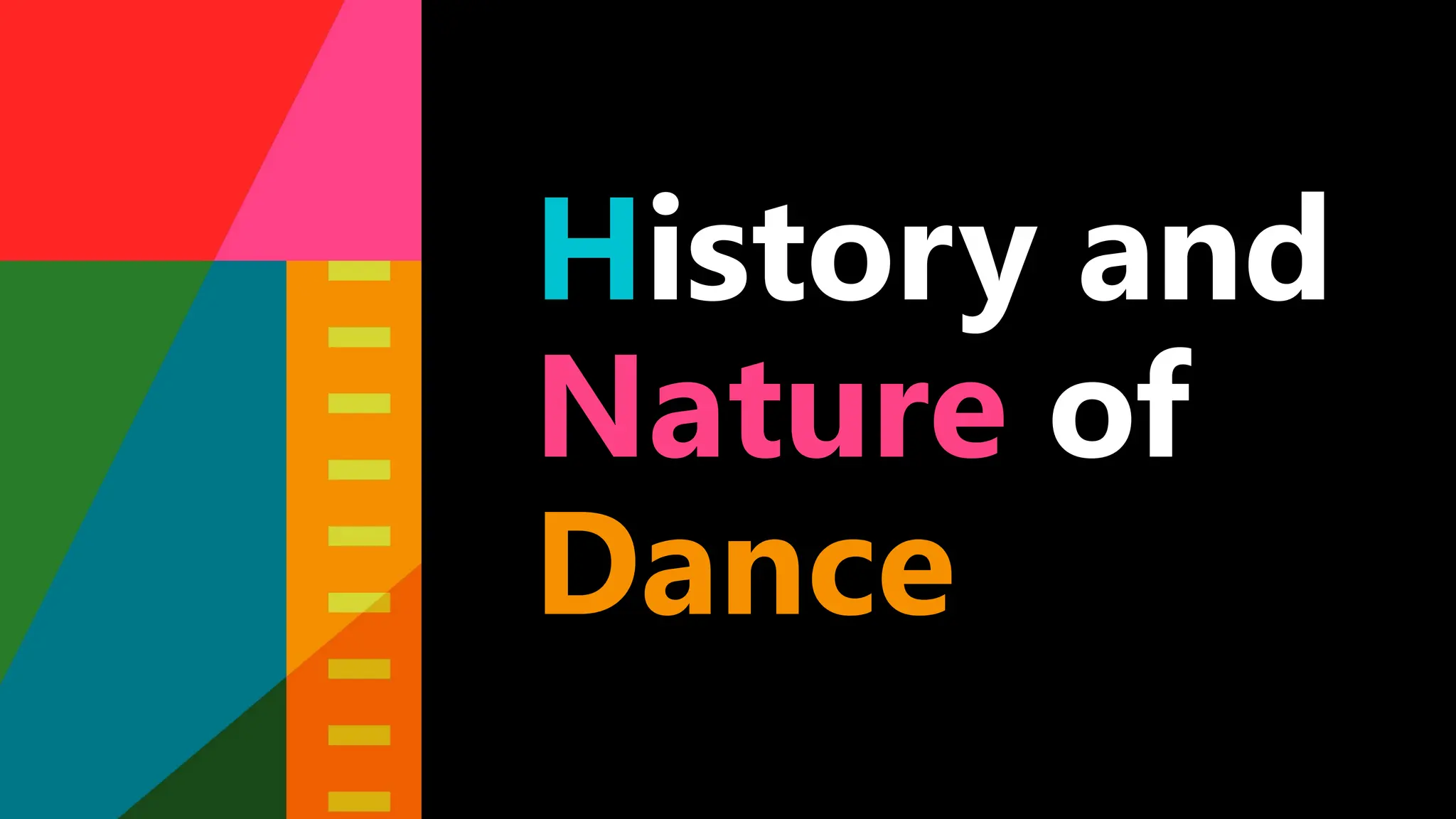
Activity 1: Dance Benefits
Directions: Based on your experience and observation. Give at least two
benefits of dance based on the following (write your answers in your notebook):
PHYSICAL
1. _____________________________________________________
2. _____________________________________________________
EMOTIONAL
1. ______________________________________________________
2. ______________________________________________________
MENTAL
1. ______________________________________________________
2. ______________________________________________________
SOCIAL
1. ______________________________________________________
2. ______________________________________________________
CULTURAL
1. ______________________________________________________
2. ______________________________________________________

introduction to dance - Physical Education 12

  • 1.
  • 2.
    Introduction Dance is an activitywhich can take many forms and fill many different needs.
  • 3.
    It can be…. •Recreation • Entertainment • Education • Therapy • Religion
  • 4.
    Dance is art,the art of body movement -Barbara Mettler, 1980
  • 5.
    What is Dance? Focusesprimarily on “aesthetic or even entertaining experience” (Myers, 2005)
  • 6.
    Purposes/Functions • To pleaseGods • To please others • To please themselves or self-expression • To build community within an ethnic group or social interaction (Myers, 2005)
  • 7.
  • 8.
    HISTORY OF DANCE Pre-Historic Dancewas used as a form of expression and communication. Early humans performed dances during rituals and ceremonies related to fertility, hunting, and religious rites.
  • 9.
    HISTORY OF DANCE- Ancient Civilizations Egypt Dance was integral to religious and social ceremonies, often depicting stories of gods and nature Greece Dance was part of Greek theater, combining drama with movement to tell stories India Dance was deeply connected to religious rituals, particularly in Hindu temples.
  • 10.
    HISTORY OF DANCE- Medieval Period Dance was often restricted by the Church in Europe but survived in folk traditions Court dances, such as the minuet, became popular among the nobility.
  • 11.
    HISTORY OF DANCE- Renaissance Dance experienced a revival, with the emergence of ballet in Italy and France Court dances became more sophisticated, leading to the development of dance as an art form
  • 12.
    HISTORY OF DANCE- Modern Era The 20th century saw the rise of modern dance, which emphasized self-expression and broke away from classical forms Dance became a key element in entertainment, including musicals, movies, and television.
  • 13.
  • 14.
    NATURE OF DANCE ArtisticExpression Dance is a form of artistic expression, using the body to convey emotions, tell stories, and reflect cultural values. Cultural Significance Dance is deeply rooted in cultural traditions, often reflecting the history, beliefs, and values of a community.
  • 15.
    NATURE OF DANCE PhysicalActivity Dance is a physical activity that promotes fitness, coordination, and flexibility Social Interaction Dance often serves as a means of social interaction, bringing people together in celebrations, rituals, and communal events
  • 16.
    NATURE OF DANCE Varietyof Forms Dance encompasses a wide range of styles, from classical ballet to contemporary, folk, and street dance Educational Tool Dance is used in education to teach rhythm, coordination, and cultural appreciation.
  • 17.
  • 18.
    • Develops cardiovascular andmuscular endurance • Improves coordination, balance, flexibility, and body composition • Lower risks of cardiovascular disease • Lowers Body Mass Index • Lowers resting heart rate PHYSICAL • Lowers lipid metabolism • Enables joint mobility (hip motion and motion flexibility) • Helps improve and maintain bone density, thus helps prevent osteoporosis • Helps recover coordination and neuromuscular skills after injury
  • 19.
    • Helps keepthe brain sharp • Decrease incidence of dementia and Alzheimer’s Disease • Decrease depressive symptoms • Increase self-esteem and improves body image • Aids in releasing emotional and physical tension MENTAL
  • 20.
    • Gives senseof togetherness within a group • Encourages positive social interaction and interpersonal relationship in a group • Contributes to the individual’s potential for self-actualization in society SOCIAL
  • 21.
  • 22.
  • 23.
    1. SPACE • Thearea the performers occupy and where they move • Can be divided into 4 different aspects also known as spatial elements
  • 24.
    SPACE – SpatialElements a. Direction • performers can go forward, backward, diagonal, circular, and so on • They may also face any direction while executing a single movement or several phrases
  • 25.
    SPACE – SpatialElements b. size • Movements can be varied by doing larger or smaller actions
  • 26.
    SPACE – SpatialElements c. level • Movements can be done in a high, medium, or low level
  • 27.
    SPACE – SpatialElements d. focus • Performers may change their focus by looking at a different directions
  • 28.
    2. TIMING • Tempo(speed) • Performers move with the tempo of an underlying sound, known as beat or pulse
  • 29.
    2. TIMING • Fasteror slower than normal beat • When sequence of a movement or group of phrases is done in varying tempos, they generate rhythmic patterns
  • 30.
    2. TIMING • Theaddition of silences or pulse also adds to rhythmic patterns
  • 31.
    3. DANCE ENERGIES •Movements here propelled by energy or force • A force can either initiate or stop an action
  • 32.
    Qualities of DanceEnergies a. Sustained • Movements are done smoothly, continuously, and with flow and control • It does not have a clear beginning and ending
  • 33.
    Qualities of DanceEnergies b. percussive • movements are explosive or sharp in contrast with sustained movements • Have a clear beginning and ending
  • 34.
    Qualities of DanceEnergies c. vibratory • Movements consists of trembling or shaking • Faster version of percussive movements that produces jittery effect
  • 35.
    Qualities of DanceEnergies d. swinging • Movements trace a curved line or an arc in space • The movements are relaxed
  • 36.
    Qualities of DanceEnergies e. suspended • Movements are perched in space or hanging on the air
  • 37.
    Qualities of DanceEnergies f. collapsing • Movements are released in tension and gradually or abruptly giving into gravity, letting body descend to the floor
  • 38.
    4. BODILY SHAPES •Refers to how the entire body is molded in space or the configuration of body parts • Can be rounded, angular, or both
  • 39.
    4. BODILY SHAPES a.Symmetrical • Balanced shaped • Movements are practically identical or similar on both sides
  • 40.
    4. BODILY SHAPES b.asymmetrical • Unbalanced shaped • Movements of two sides of the body do not match or completely different from each other
  • 41.
    5. GROUP SHAPES •Group of dancers perform movements in different group shapes • Total picture or arrangement within a picture frame (Minton, 2007)
  • 42.
    Recreational Dance • Socialactivity in which people of all ages can participate Dance Fitness • Is a fun way to increase cardiovascular endurance, strength, and flexibility
  • 43.
    WHAT MAKES AGOOD DANCE? • It displays a significant meaning or conveys message • Portrays life experience • Maybe presented abstractly and symbolically but still convey emotion and meaning (McGreevy-Nicholas et al. 2005)
  • 44.
    WHAT MAKES AGOOD DANCE? • Lifts and transports the audience from their seats during the performance • It has a beginning, middle, and end/conclusion
  • 45.
    What is aform? •The instrument by which ideas and elements are arranged or combined into a logical sequence which results in unity and consistency
  • 46.
    What is aphrase? •Smallest unit of form in the whole dance (Blom and Chaplin, 1988)
  • 47.
    What is amotif? •A single movement or a short phrase of movement that embodies the style and intention of the dance
  • 48.
  • 49.
    • Interconnected phrases ofthe dance are coherent and flow smoothly together 1. UNITY
  • 50.
    • The phrasesof the dance that are organized progressively, making each movement phrase move naturally into the next 2. CONTINUITY AND DEVELOPMENT
  • 51.
    • Introduces newmaterial, which is noticeably different from anything so far seen in the dance (Rickett-Young, 1996) 3. VARIETY AND CONTRAST
  • 52.
    • The linkbetween movements, phrases, and sections of the dance 4. TRANSITION
  • 53.
    • Emphasizes movements andphrases that are important to the dance and gives a feeling of closure to a work (Minton, 2007) 5. REPETITION
  • 54.
    • This iswhere the apex of energy in the dance is reached (Schrader, 1996) 6. CLIMAX
  • 55.
    Activity 1: DanceBenefits Directions: Based on your experience and observation. Give at least two benefits of dance based on the following (write your answers in your notebook): PHYSICAL 1. _____________________________________________________ 2. _____________________________________________________ EMOTIONAL 1. ______________________________________________________ 2. ______________________________________________________ MENTAL 1. ______________________________________________________ 2. ______________________________________________________ SOCIAL 1. ______________________________________________________ 2. ______________________________________________________ CULTURAL 1. ______________________________________________________ 2. ______________________________________________________