The
Element
s
of Dance
CHAPTER 2
Three (3)
Elements of
Dance
ELEMENTS OF DANCE
SPACE
ELEMENTS OF DANCE
SPACE
TIME
ELEMENTS OF DANCE
SPACE
TIME
ENERGY
SPACE
 Divided into four different aspects, also known as
spatial elements.
1. Direction
2. Size
3. Level
4. Focus
 This is the area the performers occupy and where
they move.
SPACE
1. Direction – dance movements can travel in any
direction. The performers can go forward, side,
backward, diagonal, circular, and so on. They
may also face any direction while executing a
single movement or several phrases.
 Divided into four different aspects, also known as
spatial elements.
SPACE
2. Size – movements can be varied by doing
larger or smaller actions.
3. Level – movements can be done in a high
medium or low level.
4. Focus – performers may change their focus by
looking at different directions.
 Divided into four different aspects, also known as
spatial elements.
 The movements in timing may be executed in varying
tempo (speed).
 Performers move with the tempo of an underlying
sound, known as beat or pulse.
 The timing can be varied by moving faster and slower
than the normal beat.
TIME/TIMING
 When a sequence of a movement or group of phrases is
done in varying tempos, they generate rhythmic patterns.
 The addition as silence or pauses also adds to rhythmic
patterns.
TIME/TIMING
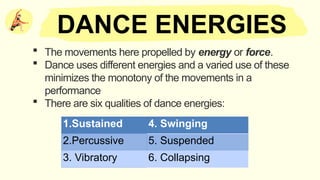
 The movements here propelled by energy or force.
 Dance uses different energies and a varied use of these
minimizes the monotony of the movements in a
performance
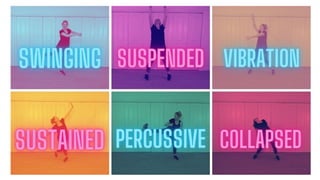
 There are six qualities of dance energies:
DANCE ENERGIES
1.Sustained 4. Swinging
2.Percussive 5. Suspended
3. Vibratory 6. Collapsing
There are six qualities of dance energies:
DANCE ENERGIES
1. Sustained – movements are done smoothly, continuously, and
with flow and control. It does not have clear beginning and ending.
2. Percussive – movements are explosive or sharp in contrast with
sustained movements. They are accepted with thrust of energy.
They have a clear beginning and ending.
3. Vibratory – movements consist of trembling or shaking. A faster
version of percussive movements that produces a jittery effect.
(Minton, 2007)
There are six qualities of dance energies:
DANCE ENERGIES
4. Swinging – movements trace a curved line or an arc in space.
The movements are relaxed and giving in to gravity on the
downward part on the motion, followed by an upward application of
energy.
5. Suspended – movements are perched in space or hanging on
air. Holding a raised leg in any direction is an example of a
suspended movement.
6. Collapsing – movements are released in tension and gradually
or abruptly giving in to gravity, letting the body descend to the floor.
 It refers to how the entire body is molded in space or the
configuration of body parts.
 The body can be rounded, angular, or a combination of two.
 Other body shapes can be from wide to narrow and from high to
low..
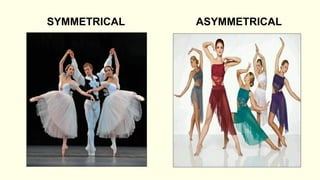
 They can be symmetrical and asymmetrical.
BODILY SHAPES
 Symmetrical – balanced shape; movements are practically
identical or similar on both sides.
 Asymmetrical - unbalanced shape; movements of two sides of
the body do not match or completely different from each other.
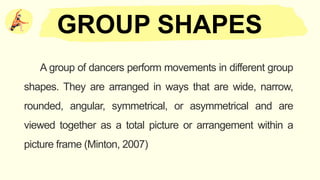
A group of dancers perform movements in different group
shapes. They are arranged in ways that are wide, narrow,
rounded, angular, symmetrical, or asymmetrical and are
viewed together as a total picture or arrangement within a
picture frame (Minton, 2007)
GROUP SHAPES
SYMMETRICAL ASYMMETRICAL
Thank You!

Elements of Dance.bpowerpoint presentation

  • 1.
  • 2.
  • 3.
  • 4.
  • 5.
  • 6.
    SPACE  Divided intofour different aspects, also known as spatial elements. 1. Direction 2. Size 3. Level 4. Focus  This is the area the performers occupy and where they move.
  • 7.
    SPACE 1. Direction –dance movements can travel in any direction. The performers can go forward, side, backward, diagonal, circular, and so on. They may also face any direction while executing a single movement or several phrases.  Divided into four different aspects, also known as spatial elements.
  • 8.
    SPACE 2. Size –movements can be varied by doing larger or smaller actions. 3. Level – movements can be done in a high medium or low level. 4. Focus – performers may change their focus by looking at different directions.  Divided into four different aspects, also known as spatial elements.
  • 9.
     The movementsin timing may be executed in varying tempo (speed).  Performers move with the tempo of an underlying sound, known as beat or pulse.  The timing can be varied by moving faster and slower than the normal beat. TIME/TIMING
  • 10.
     When asequence of a movement or group of phrases is done in varying tempos, they generate rhythmic patterns.  The addition as silence or pauses also adds to rhythmic patterns. TIME/TIMING
  • 11.
     The movementshere propelled by energy or force.  Dance uses different energies and a varied use of these minimizes the monotony of the movements in a performance  There are six qualities of dance energies: DANCE ENERGIES 1.Sustained 4. Swinging 2.Percussive 5. Suspended 3. Vibratory 6. Collapsing
  • 13.
    There are sixqualities of dance energies: DANCE ENERGIES 1. Sustained – movements are done smoothly, continuously, and with flow and control. It does not have clear beginning and ending. 2. Percussive – movements are explosive or sharp in contrast with sustained movements. They are accepted with thrust of energy. They have a clear beginning and ending. 3. Vibratory – movements consist of trembling or shaking. A faster version of percussive movements that produces a jittery effect. (Minton, 2007)
  • 14.
    There are sixqualities of dance energies: DANCE ENERGIES 4. Swinging – movements trace a curved line or an arc in space. The movements are relaxed and giving in to gravity on the downward part on the motion, followed by an upward application of energy. 5. Suspended – movements are perched in space or hanging on air. Holding a raised leg in any direction is an example of a suspended movement. 6. Collapsing – movements are released in tension and gradually or abruptly giving in to gravity, letting the body descend to the floor.
  • 15.
     It refersto how the entire body is molded in space or the configuration of body parts.  The body can be rounded, angular, or a combination of two.  Other body shapes can be from wide to narrow and from high to low..  They can be symmetrical and asymmetrical. BODILY SHAPES  Symmetrical – balanced shape; movements are practically identical or similar on both sides.  Asymmetrical - unbalanced shape; movements of two sides of the body do not match or completely different from each other.
  • 16.
    A group ofdancers perform movements in different group shapes. They are arranged in ways that are wide, narrow, rounded, angular, symmetrical, or asymmetrical and are viewed together as a total picture or arrangement within a picture frame (Minton, 2007) GROUP SHAPES
  • 17.
  • 18.