Content Marketing
A new introduction to an old
marketing idea
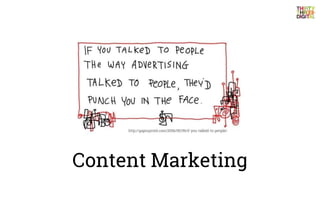
http://gapingvoid.com/2006/05/09/if-you-talked-to-people/
New! Content marketing
Source: http://books.google.com/ngrams/graph?content=content+marketing&year_start=1970&year_end=2008&corpus=15&smoothing=3&share=
New! Content marketing
“71% said they would be
increasing spend on content
marketing. Last October, 90%
said the discipline would
become more important over the
next 12 months.”
Source: http://econsultancy.com/uk/blog/61964-71-of-businesses-plan-to-increase-digital-marketing-budgets-this-year-report
…it’s the only marketing left.
Seth Godin
A BRIEF HISTORY OF CONTENT
MARKETING
But how new is it?
John Deere in 1895
John Deere launched The Furrow in 1895, with the aim of
gaining American farmers’ trust and helping them navigate
the complex world of agricultural technology.
•Print, web editions
•1.5 million circulation
•Distributed in over 40
countries
The Furrow
Source: http://contentmarketingworld.com/videos/john-deere-media-company/
McKinsey & Co in 1964
The McKinsey Quarterly, run for almost half a century. Known
as “Vainies”, the McKinsey proposition depends on persuading
clients to focus on both their culture and advice.
•Print, web editions
•55,000 print circulation
•Limited to CEOs, Top
Managers & Academics
McKinsey Quarterly
Source: http://gulib.georgetown.edu/newjour/m/msg02897.html
Red Bull in 2007
Red Bull Media House launched the Red Bulletin in 2007 to
bring a fresh focus to the quality of the content it produces to
sell energy drinks. It aims for under 40% branded content.
•Print, iPad, Android app
•3.1 million circulation
•English, German, French,
Spanish
Global Red Bulletin
Source: http://www.redbullmediahouse.com/products-brands/print/the-red-bulletin.html
ABC magazine stats (UK 2012)
• Top 10: half are customer mags
• Top 3: Tesco, Asda, National
Trust
• 9.5% circulation growth ‘12
Source: http://www.the-cma.com/news/customer-magazines-circulation-increases-by-95-whilst-consumer-magazines-circulation-sees-a-decline
Liggett & Myers Tobacco Co 1941
Companies and brands have understood the power of content
marketing for decades. Prior to government rules on tobacco
advertising, customer magazines were commonplace.
Media companies
It turns out one class of
businesses has been
particularly good at turning
out content that is designed
to foster loyalty, advocacy
and improved revenue per
user (RPU).
BBC Magazines published 40
titles aimed at six market
segments. This was spun off
as Immediate Media Co,
boasting 800 staff, 34
websites, 50 magazines
reaching 11 million
consumers in the UK alone.
Boundary-crossing content
Media companies have also been at the vanguard of those
turning on digital content streams in the past decade. CNN
joined YouTube in November 2006.
Interactive content
Some brands have invested
heavily in breaking down the
barriers between different
types of content, to great
effect:
• Static vs dynamic
• Branded vs UGC
• Education vs fun
Skittles has consistently
rewritten the rules and a
visit to the website is always
eye-opening.
Our lives as content
Nike+ has grown over seven
years to 6m users, who are
engaging with themselves
and their friends through the
medium of products and the
brand.
The Fuelband, launched in
2012, joins up a set of
connected services,
monitoring, measuring and
sharing your active life. This
is content built into the real
world via devices and apps
Source: http://vimeo.com/50167919
“Words are, of course, the
most powerful drug used by
mankind.”
Rudyard Kipling
Source: http://www.goodreads.com/quotes/tag/words
Content evolution
Content is a fluid concept.
No matter how much you
pay attention, it has the
capacity to wrong-foot you.
The nature of content has to
be driven by the audience.
Between 2006 and 2010,
social media gained traction
and written content came to
mean short bursts of
characters. Then came long
reads, which are now
classified as a specific type
of content.
Interest in: Long reads
2004 - 2013
We’re all media companies now
“Brands are continually
advised to start acting as
publishers online. That every
company is a media company
online is now a truism.”
Source: http://www.guardian.co.uk/media-network/media-network-blog/2013/mar/05/brands-hype-content-marketing
Getting content marketing right
Benefits: good
• Primary factor behind
50% of buying decisions
• Blogs on company
websites drive 50%
more visitors
• 70% of consumers
prefer getting to know
companies by articles
than ads
Risks: bad
• Content ≠ content
marketing
• Easy to slip into SEO
spam
• Curate content and you
risk becoming a
multiplier for other
people’s content
Source: http://contently.com/blog/2012/03/22/content-marketing-benefits-infographic/ Source: http://www.ragan.com/Main/Articles/8e1382eb-19bd-4ddf-9c99-88b7eb945939.aspx
7 content marketing tips
1. Know your customer. Spend time with
them, actively listen to them, speak
their language
Whether they are teens who love
make-up or grizzled IT BDMs, once you
get onto their wavelength, anything is
possible. But you must get them there.
7 content marketing tips
2. No hard sell. Content marketing is not
a short-term win, but a long-term
relationship
In a world of weak ties and fleeting
attention, the big winner is the one
who people recognise as trustworthy,
helpful, or simply pleasant.
7 content marketing tips
3. Commit to excellence. Great content
leads to great respect, nothing less will
do
Creating great content is increasingly
within reach on every budget. Ever
heard of thewritersforhire.com,
writingassist.com or copify.com?
7 content marketing tips
4. Email is still key. No matter how much
people like the idea of subscribing,
they love receiving a letter.
The role of email in a world of pull
marketing was unclear for a while.
Now it is back with a vengeance, and
the tools now exist to make it
fantastic!
7 content marketing tips
5. Make sharing easy. Increasingly, your
content will spread at the hands of
humans, so don’t hold them back
Sharing is a basic human behaviour
and it has driven the growth of social
media. {Contextual sharing tools take
that to the next level.}
7 content marketing tips
6. Stop obsessing about channels. You
don’t need a Facebook strategy, you
need a content strategy (Mark Ragan).
For two reasons:
a) great content transcends channels
b) the audience pick their favourite
channels anyway
7 content marketing tips
7. Plan measurement. Before you plan
content, consider how you will
measure performance.
You can measure almost anything.
Select channels and pick content that
give you a glimpse into the mind of the
audience. Then iterate.
Getting creative
Three main sources of creativity in
content marketing:
• The product: great storytelling is key
• The audience: you can reflect what they
say, how they say it
• The channel: photography, for example
Using the network
Search turned
us all into
professors.
Network
analysis turns
us all into nosy
neighbours.
Source: http://www.33-digital.com/
Challenges
Three things that often go wrong for
content marketing campaigns:
• Quarterly cadence: marathon, not sprint
• Corporate integration: no more siloes
• Bottom-up decision-making: be
prepared to make mistakes and amend
Recap
Take aways:
1. Know your audience
2. Create a story that could have come
from their mouth
3. Know how you’ll measure before you
start
How do you choose what type of content to create?
We’re here to help you decide

Content Marketing: new introduction to an old marketing idea

  • 1.
    Content Marketing A newintroduction to an old marketing idea http://gapingvoid.com/2006/05/09/if-you-talked-to-people/
  • 2.
    New! Content marketing Source:http://books.google.com/ngrams/graph?content=content+marketing&year_start=1970&year_end=2008&corpus=15&smoothing=3&share=
  • 3.
    New! Content marketing “71%said they would be increasing spend on content marketing. Last October, 90% said the discipline would become more important over the next 12 months.” Source: http://econsultancy.com/uk/blog/61964-71-of-businesses-plan-to-increase-digital-marketing-budgets-this-year-report
  • 4.
    …it’s the onlymarketing left. Seth Godin
  • 5.
    A BRIEF HISTORYOF CONTENT MARKETING But how new is it?
  • 6.
    John Deere in1895 John Deere launched The Furrow in 1895, with the aim of gaining American farmers’ trust and helping them navigate the complex world of agricultural technology.
  • 7.
    •Print, web editions •1.5million circulation •Distributed in over 40 countries The Furrow Source: http://contentmarketingworld.com/videos/john-deere-media-company/
  • 8.
    McKinsey & Coin 1964 The McKinsey Quarterly, run for almost half a century. Known as “Vainies”, the McKinsey proposition depends on persuading clients to focus on both their culture and advice.
  • 9.
    •Print, web editions •55,000print circulation •Limited to CEOs, Top Managers & Academics McKinsey Quarterly Source: http://gulib.georgetown.edu/newjour/m/msg02897.html
  • 10.
    Red Bull in2007 Red Bull Media House launched the Red Bulletin in 2007 to bring a fresh focus to the quality of the content it produces to sell energy drinks. It aims for under 40% branded content.
  • 11.
    •Print, iPad, Androidapp •3.1 million circulation •English, German, French, Spanish Global Red Bulletin Source: http://www.redbullmediahouse.com/products-brands/print/the-red-bulletin.html
  • 12.
    ABC magazine stats(UK 2012) • Top 10: half are customer mags • Top 3: Tesco, Asda, National Trust • 9.5% circulation growth ‘12 Source: http://www.the-cma.com/news/customer-magazines-circulation-increases-by-95-whilst-consumer-magazines-circulation-sees-a-decline
  • 13.
    Liggett & MyersTobacco Co 1941 Companies and brands have understood the power of content marketing for decades. Prior to government rules on tobacco advertising, customer magazines were commonplace.
  • 14.
    Media companies It turnsout one class of businesses has been particularly good at turning out content that is designed to foster loyalty, advocacy and improved revenue per user (RPU). BBC Magazines published 40 titles aimed at six market segments. This was spun off as Immediate Media Co, boasting 800 staff, 34 websites, 50 magazines reaching 11 million consumers in the UK alone.
  • 15.
    Boundary-crossing content Media companieshave also been at the vanguard of those turning on digital content streams in the past decade. CNN joined YouTube in November 2006.
  • 16.
    Interactive content Some brandshave invested heavily in breaking down the barriers between different types of content, to great effect: • Static vs dynamic • Branded vs UGC • Education vs fun Skittles has consistently rewritten the rules and a visit to the website is always eye-opening.
  • 17.
    Our lives ascontent Nike+ has grown over seven years to 6m users, who are engaging with themselves and their friends through the medium of products and the brand. The Fuelband, launched in 2012, joins up a set of connected services, monitoring, measuring and sharing your active life. This is content built into the real world via devices and apps Source: http://vimeo.com/50167919
  • 18.
    “Words are, ofcourse, the most powerful drug used by mankind.” Rudyard Kipling Source: http://www.goodreads.com/quotes/tag/words
  • 19.
    Content evolution Content isa fluid concept. No matter how much you pay attention, it has the capacity to wrong-foot you. The nature of content has to be driven by the audience. Between 2006 and 2010, social media gained traction and written content came to mean short bursts of characters. Then came long reads, which are now classified as a specific type of content. Interest in: Long reads 2004 - 2013
  • 20.
    We’re all mediacompanies now “Brands are continually advised to start acting as publishers online. That every company is a media company online is now a truism.” Source: http://www.guardian.co.uk/media-network/media-network-blog/2013/mar/05/brands-hype-content-marketing
  • 21.
    Getting content marketingright Benefits: good • Primary factor behind 50% of buying decisions • Blogs on company websites drive 50% more visitors • 70% of consumers prefer getting to know companies by articles than ads Risks: bad • Content ≠ content marketing • Easy to slip into SEO spam • Curate content and you risk becoming a multiplier for other people’s content Source: http://contently.com/blog/2012/03/22/content-marketing-benefits-infographic/ Source: http://www.ragan.com/Main/Articles/8e1382eb-19bd-4ddf-9c99-88b7eb945939.aspx
  • 22.
    7 content marketingtips 1. Know your customer. Spend time with them, actively listen to them, speak their language Whether they are teens who love make-up or grizzled IT BDMs, once you get onto their wavelength, anything is possible. But you must get them there.
  • 23.
    7 content marketingtips 2. No hard sell. Content marketing is not a short-term win, but a long-term relationship In a world of weak ties and fleeting attention, the big winner is the one who people recognise as trustworthy, helpful, or simply pleasant.
  • 24.
    7 content marketingtips 3. Commit to excellence. Great content leads to great respect, nothing less will do Creating great content is increasingly within reach on every budget. Ever heard of thewritersforhire.com, writingassist.com or copify.com?
  • 25.
    7 content marketingtips 4. Email is still key. No matter how much people like the idea of subscribing, they love receiving a letter. The role of email in a world of pull marketing was unclear for a while. Now it is back with a vengeance, and the tools now exist to make it fantastic!
  • 26.
    7 content marketingtips 5. Make sharing easy. Increasingly, your content will spread at the hands of humans, so don’t hold them back Sharing is a basic human behaviour and it has driven the growth of social media. {Contextual sharing tools take that to the next level.}
  • 27.
    7 content marketingtips 6. Stop obsessing about channels. You don’t need a Facebook strategy, you need a content strategy (Mark Ragan). For two reasons: a) great content transcends channels b) the audience pick their favourite channels anyway
  • 28.
    7 content marketingtips 7. Plan measurement. Before you plan content, consider how you will measure performance. You can measure almost anything. Select channels and pick content that give you a glimpse into the mind of the audience. Then iterate.
  • 29.
    Getting creative Three mainsources of creativity in content marketing: • The product: great storytelling is key • The audience: you can reflect what they say, how they say it • The channel: photography, for example
  • 30.
    Using the network Searchturned us all into professors. Network analysis turns us all into nosy neighbours. Source: http://www.33-digital.com/
  • 31.
    Challenges Three things thatoften go wrong for content marketing campaigns: • Quarterly cadence: marathon, not sprint • Corporate integration: no more siloes • Bottom-up decision-making: be prepared to make mistakes and amend
  • 32.
    Recap Take aways: 1. Knowyour audience 2. Create a story that could have come from their mouth 3. Know how you’ll measure before you start
  • 33.
    How do youchoose what type of content to create? We’re here to help you decide

Editor's Notes

  • #9 Vainies, brainies and Bainies (McKinsey & Co, BCG and Bain & Co)
  • #22 A true content marketing strategy includes concepts for content distribution, communication and interaction with the audience. You must have a clear idea about which goals and groups you want to reach.Depending on your strategy, you'll need an editorial calendar. You might also need to include other departments in your strategy for producing and distributing content.Real content marketing builds a market. Fake content marketing seeks links, conversions, visitors, traffic, etc.If you always know where to find great content, you're an excellent researcher and know the great content marketers in your field. But in the end, your views, ideas and concepts are part of your personality and expertise, and the most important assets of your content marketing.
  • #26 Tiny LettersMail Chimp