INTRODUCTION TO
COMPUTERISED ACCOUNTING
Explained By:
Sarbjit Kaur.
Lecturer, Department of Computer Application,
PGG.C.G., Sector: 42, Chandigarh
CONTENT
• MEANING OF COMPUTERISED ACCOUNTING
• TRADITIONAL/MANUAL SYSTEM OF ACCOUNTING
• PROCESS OF COMPUTERISED ACCOUNTING
• FEATUERES OF COMPUTERISED ACCOUNTING
• DIFFERENCE BETWEEN MANUAL ACCOUNTING SYSTEM AND
COMPUTERISED ACCOUNTING
• ADVANTAGES AND DISADVANTAGES OF COMPUTERISED
ACCOUNTING
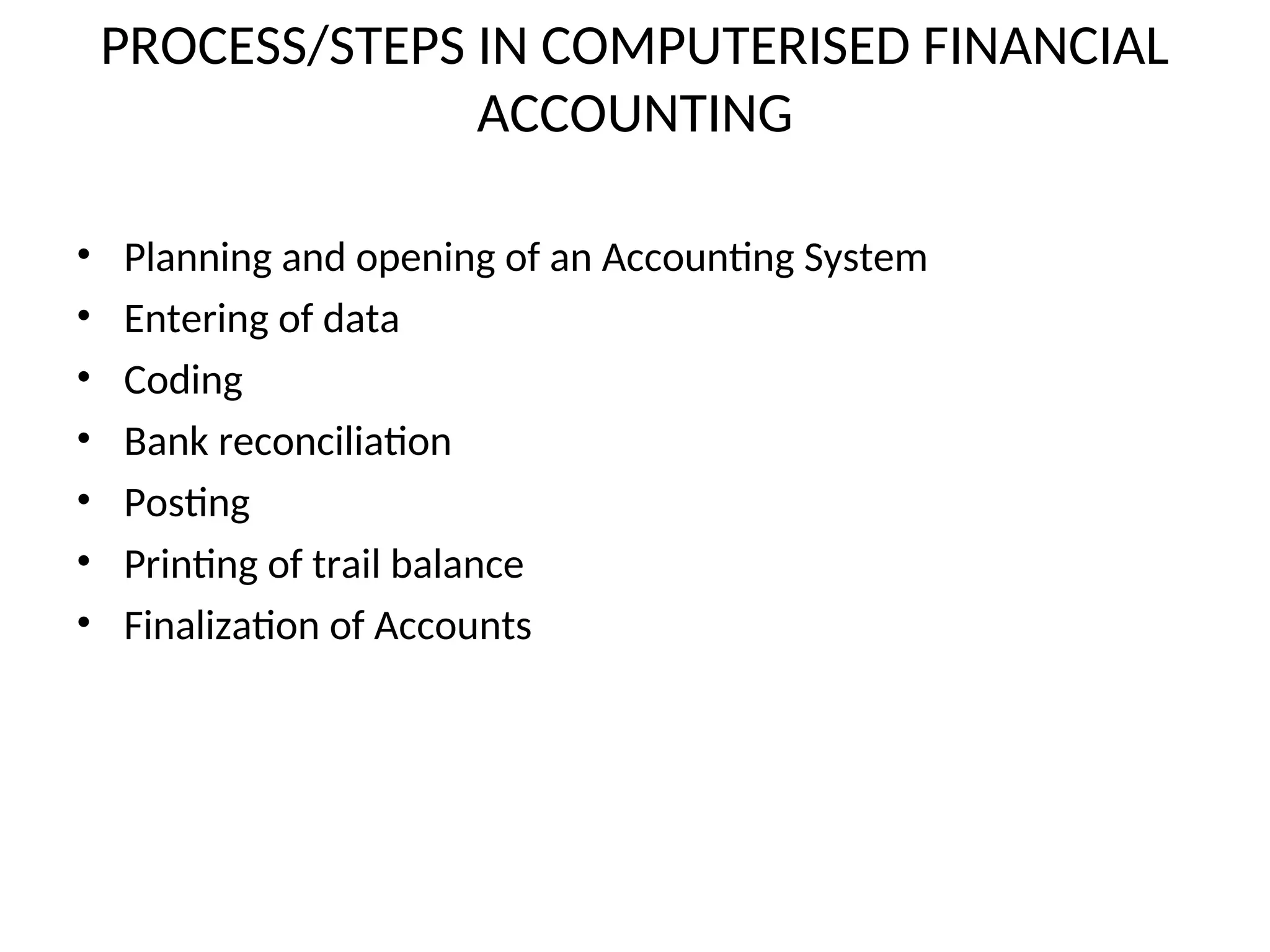
• PROCESS/STEPS IN COMPUTERISED FINANCIAL ACCOUNTING
• ADVANTAGES OF THE COMPUTERISED FINANCIAL
ACCOUNTING SYSTEM
• VARIOUS COMPONENTS OF A COMPUTERISED FINANCIAL
ACCOUNTING SYSTEM
MEANING OF COMPUTERISED ACCOUNTING
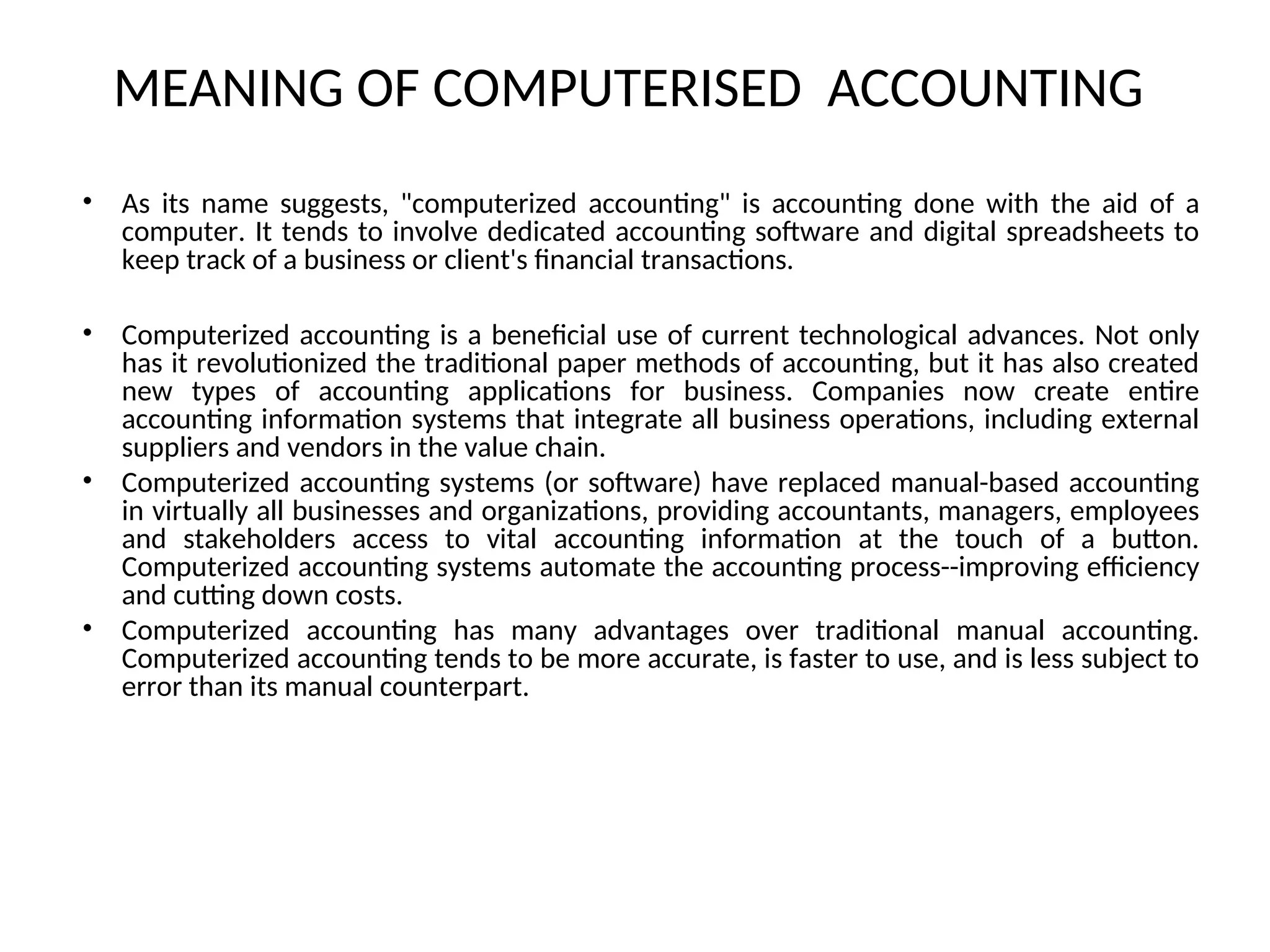
• As its name suggests, "computerized accounting" is accounting done with the aid of a
computer. It tends to involve dedicated accounting software and digital spreadsheets to
keep track of a business or client's financial transactions.
• Computerized accounting is a beneficial use of current technological advances. Not only
has it revolutionized the traditional paper methods of accounting, but it has also created
new types of accounting applications for business. Companies now create entire
accounting information systems that integrate all business operations, including external
suppliers and vendors in the value chain.
• Computerized accounting systems (or software) have replaced manual-based accounting
in virtually all businesses and organizations, providing accountants, managers, employees
and stakeholders access to vital accounting information at the touch of a button.
Computerized accounting systems automate the accounting process--improving efficiency
and cutting down costs.
• Computerized accounting has many advantages over traditional manual accounting.
Computerized accounting tends to be more accurate, is faster to use, and is less subject to
error than its manual counterpart.
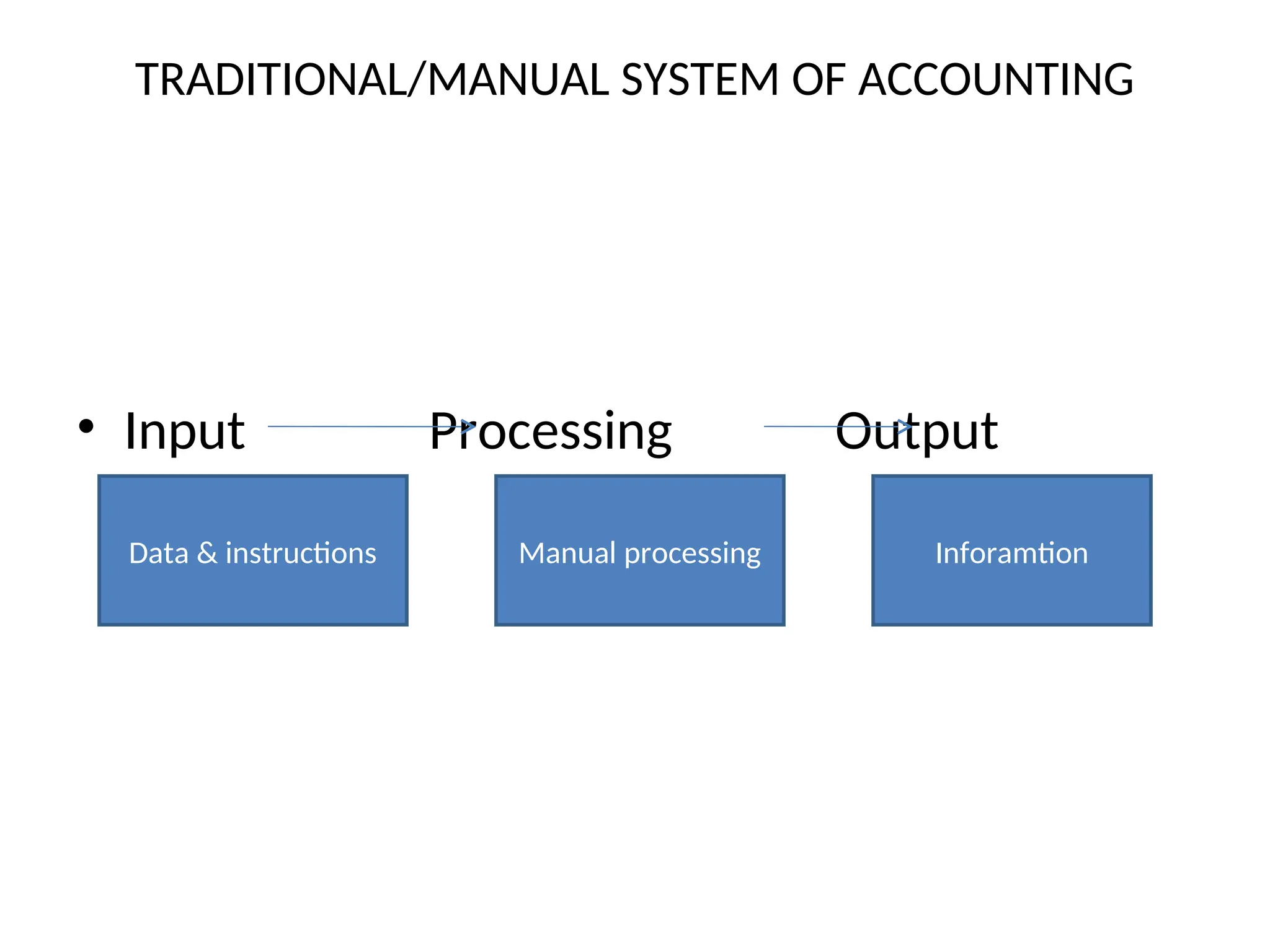
TRADITIONAL/MANUAL SYSTEM OF ACCOUNTING
• Input Processing Output
Data & instructions Manual processing Inforamtion
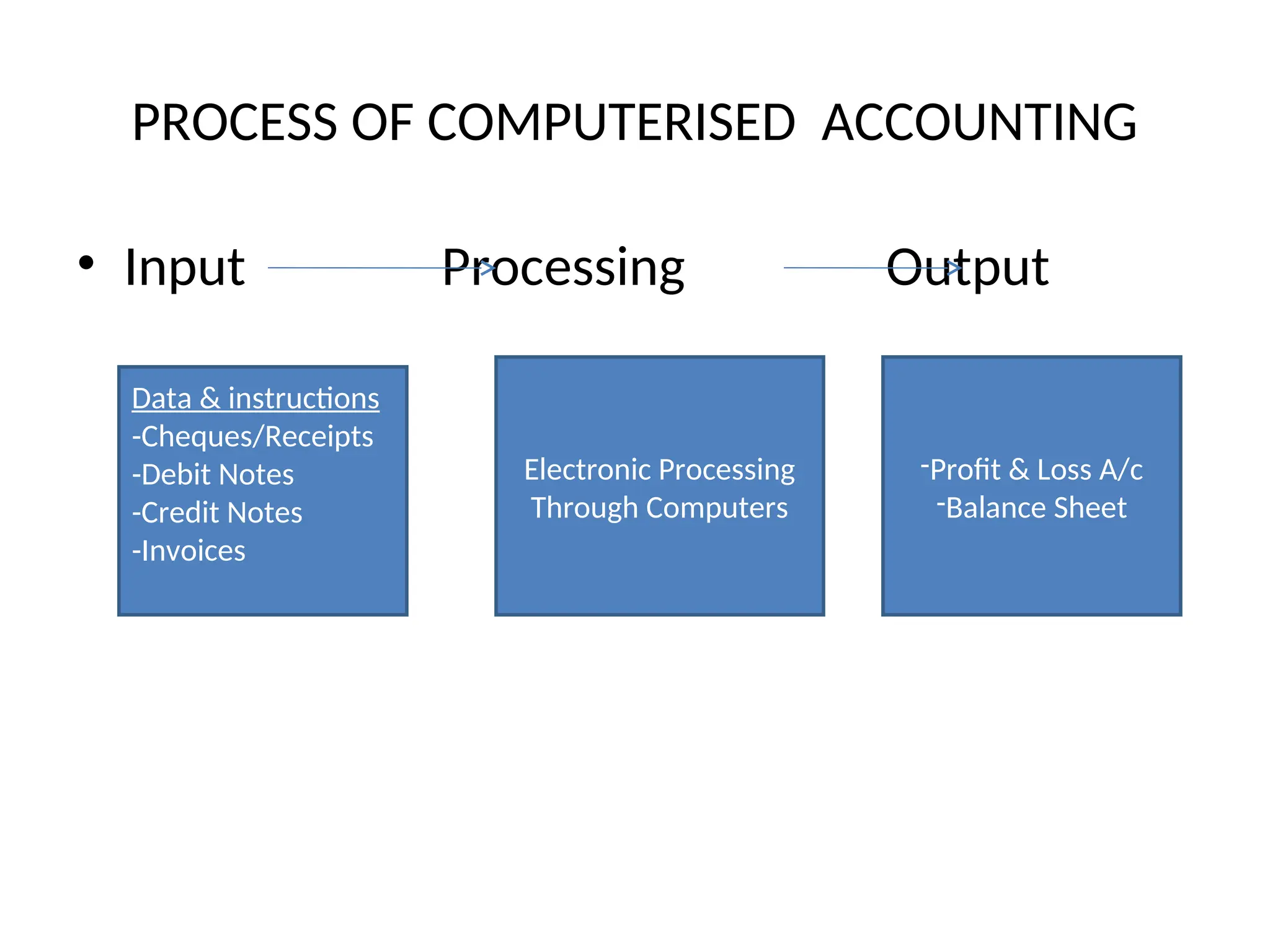
PROCESS OF COMPUTERISED ACCOUNTING
• Input Processing Output
Data & instructions
-Cheques/Receipts
-Debit Notes
-Credit Notes
-Invoices
Electronic Processing
Through Computers
-Profit & Loss A/c
-Balance Sheet
FEATUERES OF COMPUTERISED ACCOUNTING
1. Fast, Powerful, Simple and Integrated
2. Complete Visibility Enhanced User Experience
3. Accuracy
4. Speed
5. Scalability
6. Power
7. Improved Business Performance
8. Quick Decision Making
9. Complete Reliability
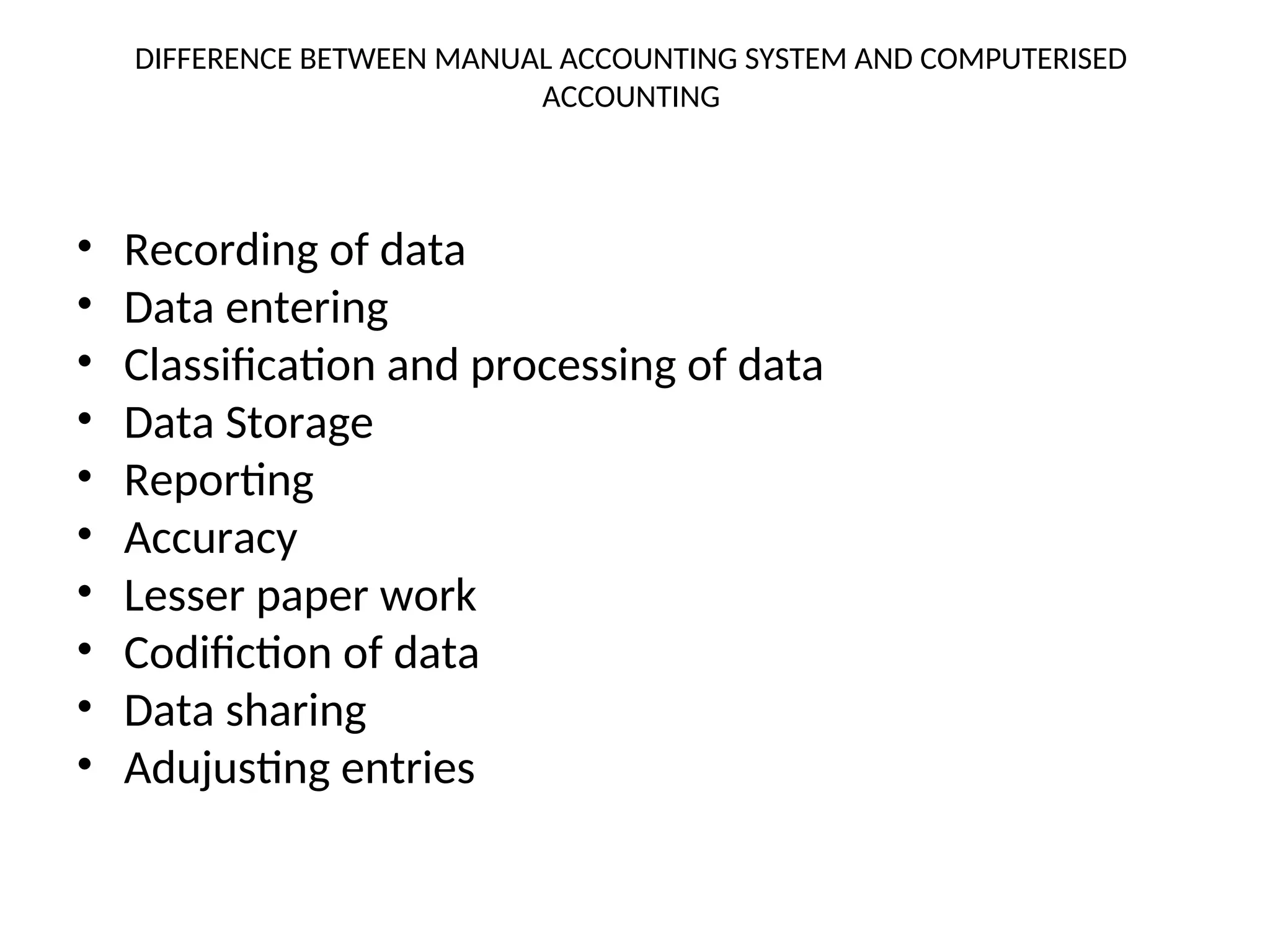
DIFFERENCE BETWEEN MANUAL ACCOUNTING SYSTEM AND COMPUTERISED
ACCOUNTING
• Recording of data
• Data entering
• Classification and processing of data
• Data Storage
• Reporting
• Accuracy
• Lesser paper work
• Codifiction of data
• Data sharing
• Adujusting entries
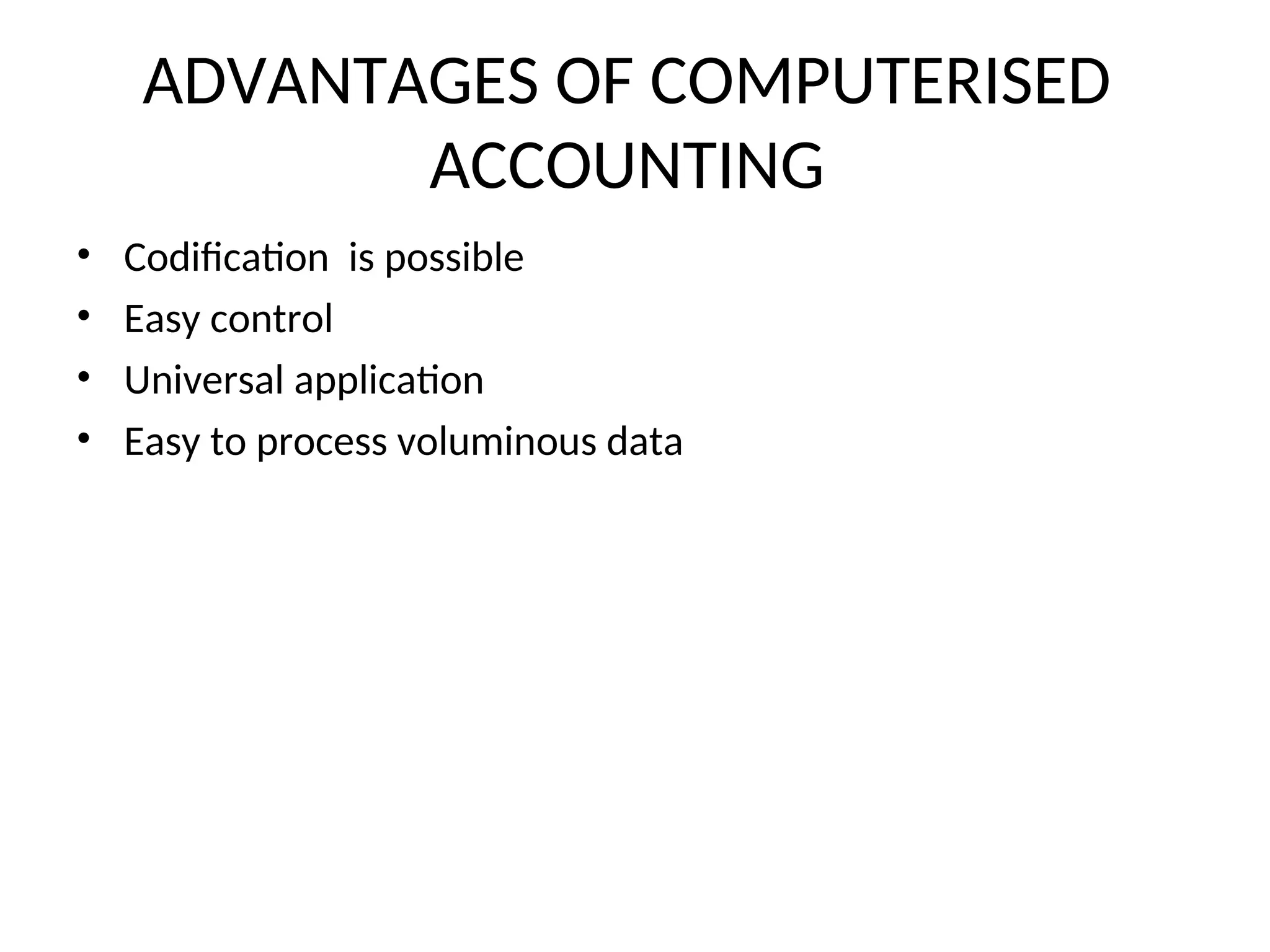
ADVANTAGES OF COMPUTERISED
ACCOUNTING
• Codification is possible
• Easy control
• Universal application
• Easy to process voluminous data
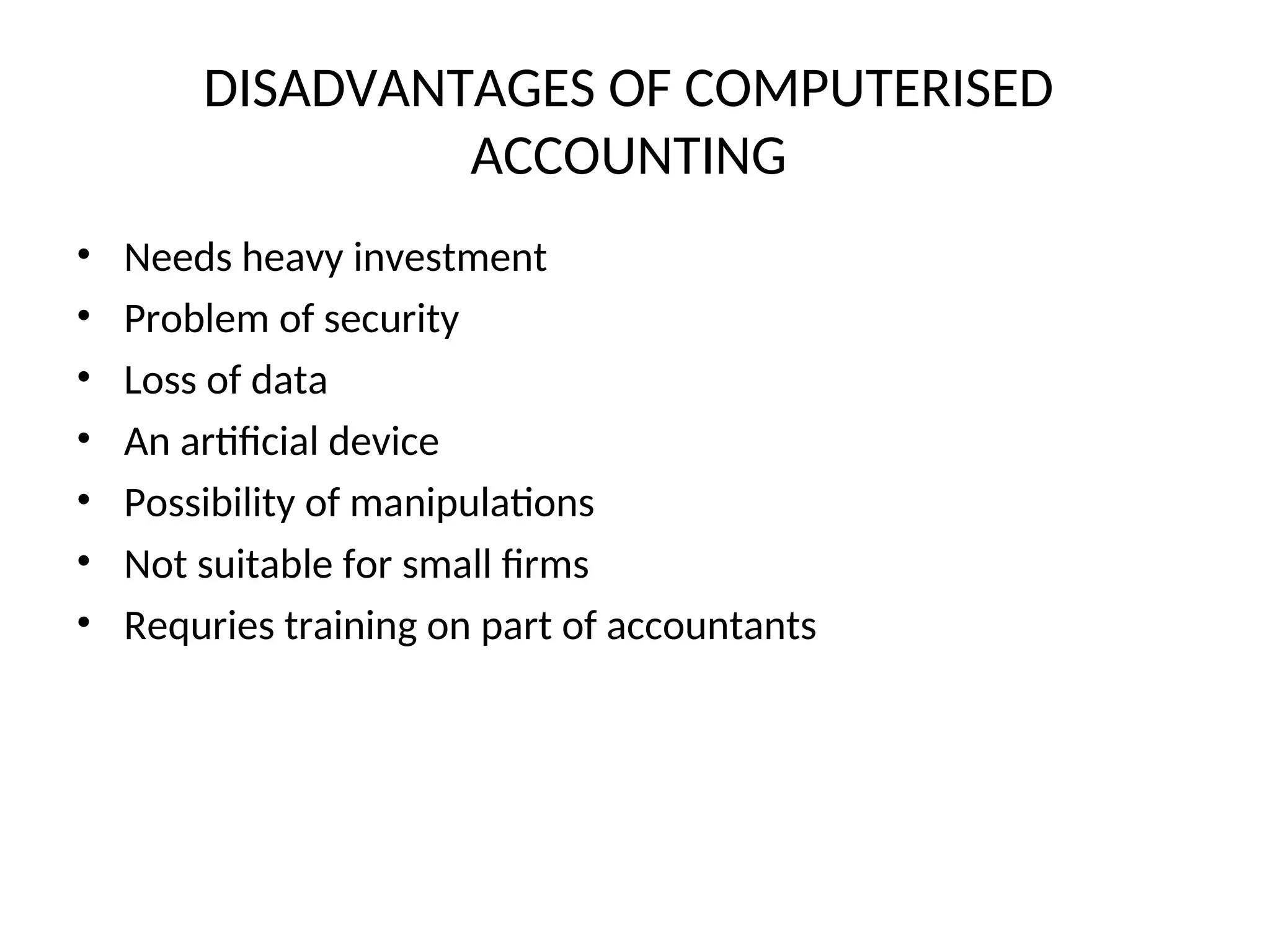
DISADVANTAGES OF COMPUTERISED
ACCOUNTING
• Needs heavy investment
• Problem of security
• Loss of data
• An artificial device
• Possibility of manipulations
• Not suitable for small firms
• Requries training on part of accountants
PROCESS/STEPS IN COMPUTERISED FINANCIAL
ACCOUNTING
• Planning and opening of an Accounting System
• Entering of data
• Coding
• Bank reconciliation
• Posting
• Printing of trail balance
• Finalization of Accounts
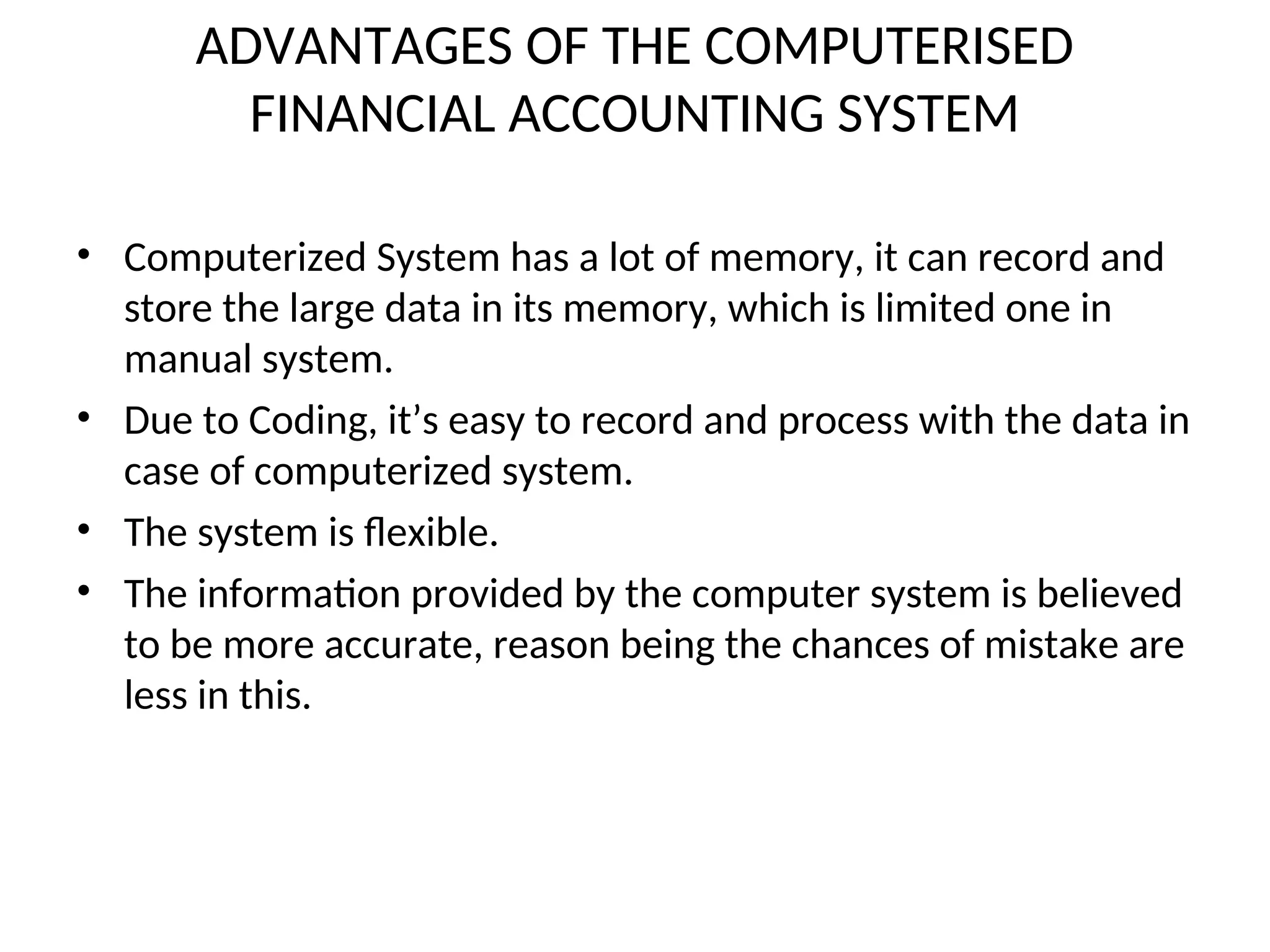
ADVANTAGES OF THE COMPUTERISED
FINANCIAL ACCOUNTING SYSTEM
• Computerized System has a lot of memory, it can record and
store the large data in its memory, which is limited one in
manual system.
• Due to Coding, it’s easy to record and process with the data in
case of computerized system.
• The system is flexible.
• The information provided by the computer system is believed
to be more accurate, reason being the chances of mistake are
less in this.
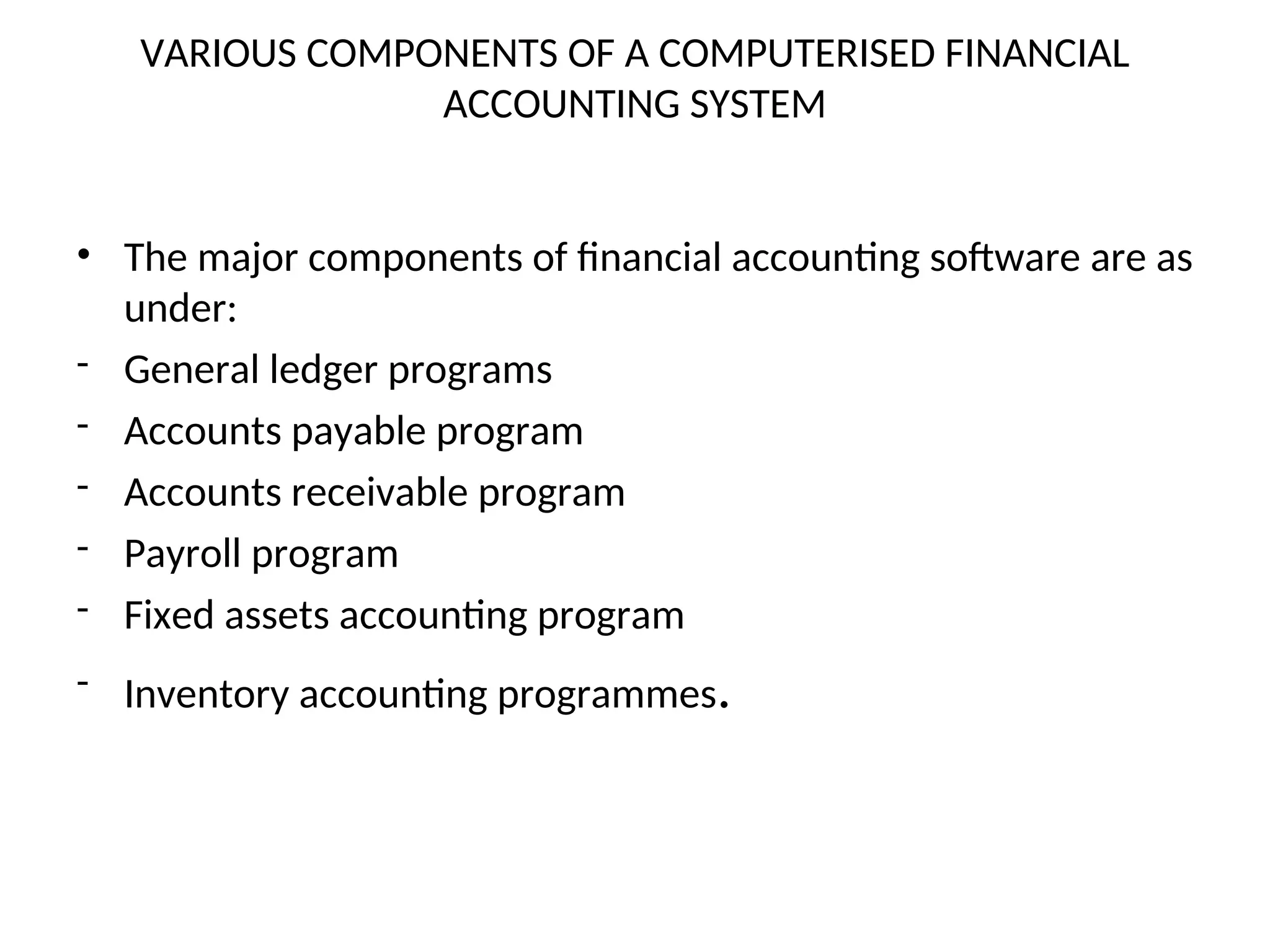
VARIOUS COMPONENTS OF A COMPUTERISED FINANCIAL
ACCOUNTING SYSTEM
• The major components of financial accounting software are as
under:
- General ledger programs
- Accounts payable program
- Accounts receivable program
- Payroll program
- Fixed assets accounting program
- Inventory accounting programmes.

introduction to computerized accountingI

  • 1.
    INTRODUCTION TO COMPUTERISED ACCOUNTING ExplainedBy: Sarbjit Kaur. Lecturer, Department of Computer Application, PGG.C.G., Sector: 42, Chandigarh
  • 2.
    CONTENT • MEANING OFCOMPUTERISED ACCOUNTING • TRADITIONAL/MANUAL SYSTEM OF ACCOUNTING • PROCESS OF COMPUTERISED ACCOUNTING • FEATUERES OF COMPUTERISED ACCOUNTING • DIFFERENCE BETWEEN MANUAL ACCOUNTING SYSTEM AND COMPUTERISED ACCOUNTING • ADVANTAGES AND DISADVANTAGES OF COMPUTERISED ACCOUNTING • PROCESS/STEPS IN COMPUTERISED FINANCIAL ACCOUNTING • ADVANTAGES OF THE COMPUTERISED FINANCIAL ACCOUNTING SYSTEM • VARIOUS COMPONENTS OF A COMPUTERISED FINANCIAL ACCOUNTING SYSTEM
  • 3.
    MEANING OF COMPUTERISEDACCOUNTING • As its name suggests, "computerized accounting" is accounting done with the aid of a computer. It tends to involve dedicated accounting software and digital spreadsheets to keep track of a business or client's financial transactions. • Computerized accounting is a beneficial use of current technological advances. Not only has it revolutionized the traditional paper methods of accounting, but it has also created new types of accounting applications for business. Companies now create entire accounting information systems that integrate all business operations, including external suppliers and vendors in the value chain. • Computerized accounting systems (or software) have replaced manual-based accounting in virtually all businesses and organizations, providing accountants, managers, employees and stakeholders access to vital accounting information at the touch of a button. Computerized accounting systems automate the accounting process--improving efficiency and cutting down costs. • Computerized accounting has many advantages over traditional manual accounting. Computerized accounting tends to be more accurate, is faster to use, and is less subject to error than its manual counterpart.
  • 4.
    TRADITIONAL/MANUAL SYSTEM OFACCOUNTING • Input Processing Output Data & instructions Manual processing Inforamtion
  • 5.
    PROCESS OF COMPUTERISEDACCOUNTING • Input Processing Output Data & instructions -Cheques/Receipts -Debit Notes -Credit Notes -Invoices Electronic Processing Through Computers -Profit & Loss A/c -Balance Sheet
  • 6.
    FEATUERES OF COMPUTERISEDACCOUNTING 1. Fast, Powerful, Simple and Integrated 2. Complete Visibility Enhanced User Experience 3. Accuracy 4. Speed 5. Scalability 6. Power 7. Improved Business Performance 8. Quick Decision Making 9. Complete Reliability
  • 7.
    DIFFERENCE BETWEEN MANUALACCOUNTING SYSTEM AND COMPUTERISED ACCOUNTING • Recording of data • Data entering • Classification and processing of data • Data Storage • Reporting • Accuracy • Lesser paper work • Codifiction of data • Data sharing • Adujusting entries
  • 8.
    ADVANTAGES OF COMPUTERISED ACCOUNTING •Codification is possible • Easy control • Universal application • Easy to process voluminous data
  • 9.
    DISADVANTAGES OF COMPUTERISED ACCOUNTING •Needs heavy investment • Problem of security • Loss of data • An artificial device • Possibility of manipulations • Not suitable for small firms • Requries training on part of accountants
  • 10.
    PROCESS/STEPS IN COMPUTERISEDFINANCIAL ACCOUNTING • Planning and opening of an Accounting System • Entering of data • Coding • Bank reconciliation • Posting • Printing of trail balance • Finalization of Accounts
  • 11.
    ADVANTAGES OF THECOMPUTERISED FINANCIAL ACCOUNTING SYSTEM • Computerized System has a lot of memory, it can record and store the large data in its memory, which is limited one in manual system. • Due to Coding, it’s easy to record and process with the data in case of computerized system. • The system is flexible. • The information provided by the computer system is believed to be more accurate, reason being the chances of mistake are less in this.
  • 12.
    VARIOUS COMPONENTS OFA COMPUTERISED FINANCIAL ACCOUNTING SYSTEM • The major components of financial accounting software are as under: - General ledger programs - Accounts payable program - Accounts receivable program - Payroll program - Fixed assets accounting program - Inventory accounting programmes.