UNIT-2
Image-to-Image Mapping
In this presentation, we will explore
the world of image-to-image
mapping. This technique allows us to
manipulate images in various ways,
such as stitching panoramas,
correcting distortions, and creating
special effects. We will delve into
three key subtopics: homographies,
warping images, and creating
panoramas
Homographies
2
•Homography: A mathematical transformation that
maps corresponding points between two images.
•Useful for tasks like image registration and stitching
panoramas.
•Assumes a planar relationship between the images.
Homography is a fundamental concept in image-to-
image mapping. It allows us to establish a relationship
between two images by mapping corresponding points.
This transformation assumes a planar relationship,
meaning the objects in the images are roughly flat.
Homography plays a crucial role in tasks like image
registration, where we align multiple images, and
stitching panoramas, where we combine multiple
images into a wider view
Warping Images
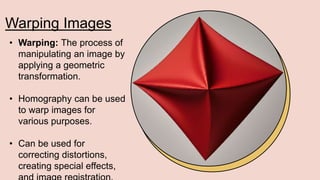
• Warping: The process of
manipulating an image by
applying a geometric
transformation.
• Homography can be used
to warp images for
various purposes.
• Can be used for
correcting distortions,
creating special effects,
Image warping is the process of applying a geometric
transformation to manipulate an image. Homography,
which we discussed in the previous slide, is a
powerful tool for warping images. We can use warping
for various purposes, such as correcting distortions
caused by camera lenses, creating special effects like
morphing or bending objects, and image registration,
where we align images that might be slightly skewed
or rotated
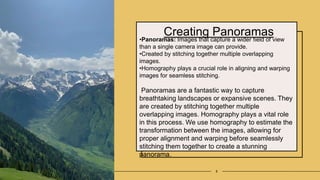
Creating Panoramas
5
•Panoramas: Images that capture a wider field of view
than a single camera image can provide.
•Created by stitching together multiple overlapping
images.
•Homography plays a crucial role in aligning and warping
images for seamless stitching.
Panoramas are a fantastic way to capture
breathtaking landscapes or expansive scenes. They
are created by stitching together multiple
overlapping images. Homography plays a vital role
in this process. We use homography to estimate the
transformation between the images, allowing for
proper alignment and warping before seamlessly
stitching them together to create a stunning
panorama.
Models and
Augmented Reality
• Models and augmented reality (AR)
converge.
• We will delve into the fundamental
concepts behind camera models,
calibration, pose estimation, and
how they all come together to
create the magic of AR.
• Buckle up and get ready to see the
real world enhanced by the power
of 3D models
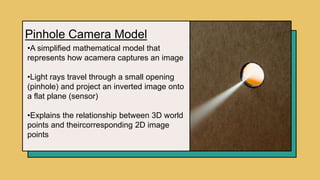
Pinhole Camera Model
•A simplified mathematical model that
represents how acamera captures an image
•Light rays travel through a small opening
(pinhole) and project an inverted image onto
a flat plane (sensor)
•Explains the relationship between 3D world
points and theircorresponding 2D image
points
The pinhole camera model is the foundation of
understanding how cameras work. Imagine a dark box
with a tiny hole in one side. Light rays from the
outside world pass through the hole and project an
inverted image of the scene onto the opposite wall.
This is essentially how a camera captures an image.
The pinhole camera model helps us understand the
mathematical relationship between points in the 3D
world and their corresponding locations in the 2D
image captured by the camera.
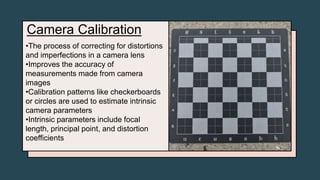
Camera Calibration
•The process of correcting for distortions
and imperfections in a camera lens
•Improves the accuracy of
measurements made from camera
images
•Calibration patterns like checkerboards
or circles are used to estimate intrinsic
camera parameters
•Intrinsic parameters include focal
length, principal point, and distortion
coefficients
Camera lenses are not perfect. They can introduce
distortions like barrel or pincushion effect, which can
affect the accuracy of measurements made from camera
images. Camera calibration is the process of correcting
for these distortions. We use special calibration patterns,
like checkerboards or circles, to capture images from
different viewpoints. By analyzing these images, we can
estimate the intrinsic parameters of the camera, such as
focal length, principal point, and distortion coefficients.
These parameters are then used to "un-distort" the image
and improve its accuracy.
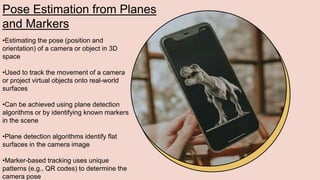
Pose Estimation from Planes
and Markers
•Estimating the pose (position and
orientation) of a camera or object in 3D
space
•Used to track the movement of a camera
or project virtual objects onto real-world
surfaces
•Can be achieved using plane detection
algorithms or by identifying known markers
in the scene
•Plane detection algorithms identify flat
surfaces in the camera image
•Marker-based tracking uses unique
patterns (e.g., QR codes) to determine the
camera pose
Pose estimation is a crucial step in AR applications. It allows
us to determine the precise position and orientation of a
camera or object in 3D space. This information is essential for
tracking camera movement and for accurately placing virtual
objects onto real-world surfaces. There are two main
approaches for pose estimation: plane detection and marker-
based tracking. Plane detection algorithms analyze the
camera image to identify flat surfaces like walls, floors, or
tables. Marker-based tracking, on the other hand, relies on
detecting pre-defined markers (like QR codes) in the scene.
These markers act as reference points that allow the system
to determine the camera pose relative to their known location
and orientation.
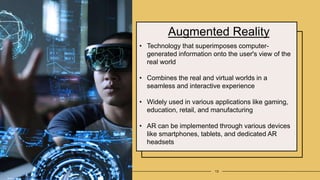
Augmented Reality
13
• Technology that superimposes computer-
generated information onto the user's view of the
real world
• Combines the real and virtual worlds in a
seamless and interactive experience
• Widely used in various applications like gaming,
education, retail, and manufacturing
• AR can be implemented through various devices
like smartphones, tablets, and dedicated AR
headsets
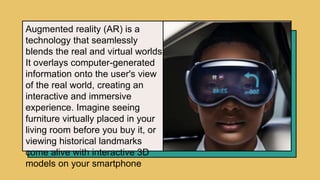
Augmented reality (AR) is a
technology that seamlessly
blends the real and virtual worlds.
It overlays computer-generated
information onto the user's view
of the real world, creating an
interactive and immersive
experience. Imagine seeing
furniture virtually placed in your
living room before you buy it, or
viewing historical landmarks
come alive with interactive 3D
models on your smartphone

INTRODUCTION TO COMPUTER VISION BASICS.pptx

  • 1.
    UNIT-2 Image-to-Image Mapping In thispresentation, we will explore the world of image-to-image mapping. This technique allows us to manipulate images in various ways, such as stitching panoramas, correcting distortions, and creating special effects. We will delve into three key subtopics: homographies, warping images, and creating panoramas
  • 2.
    Homographies 2 •Homography: A mathematicaltransformation that maps corresponding points between two images. •Useful for tasks like image registration and stitching panoramas. •Assumes a planar relationship between the images. Homography is a fundamental concept in image-to- image mapping. It allows us to establish a relationship between two images by mapping corresponding points. This transformation assumes a planar relationship, meaning the objects in the images are roughly flat. Homography plays a crucial role in tasks like image registration, where we align multiple images, and stitching panoramas, where we combine multiple images into a wider view
  • 3.
    Warping Images • Warping:The process of manipulating an image by applying a geometric transformation. • Homography can be used to warp images for various purposes. • Can be used for correcting distortions, creating special effects,
  • 4.
    Image warping isthe process of applying a geometric transformation to manipulate an image. Homography, which we discussed in the previous slide, is a powerful tool for warping images. We can use warping for various purposes, such as correcting distortions caused by camera lenses, creating special effects like morphing or bending objects, and image registration, where we align images that might be slightly skewed or rotated
  • 5.
    Creating Panoramas 5 •Panoramas: Imagesthat capture a wider field of view than a single camera image can provide. •Created by stitching together multiple overlapping images. •Homography plays a crucial role in aligning and warping images for seamless stitching. Panoramas are a fantastic way to capture breathtaking landscapes or expansive scenes. They are created by stitching together multiple overlapping images. Homography plays a vital role in this process. We use homography to estimate the transformation between the images, allowing for proper alignment and warping before seamlessly stitching them together to create a stunning panorama.
  • 6.
    Models and Augmented Reality •Models and augmented reality (AR) converge. • We will delve into the fundamental concepts behind camera models, calibration, pose estimation, and how they all come together to create the magic of AR. • Buckle up and get ready to see the real world enhanced by the power of 3D models
  • 7.
    Pinhole Camera Model •Asimplified mathematical model that represents how acamera captures an image •Light rays travel through a small opening (pinhole) and project an inverted image onto a flat plane (sensor) •Explains the relationship between 3D world points and theircorresponding 2D image points
  • 8.
    The pinhole cameramodel is the foundation of understanding how cameras work. Imagine a dark box with a tiny hole in one side. Light rays from the outside world pass through the hole and project an inverted image of the scene onto the opposite wall. This is essentially how a camera captures an image. The pinhole camera model helps us understand the mathematical relationship between points in the 3D world and their corresponding locations in the 2D image captured by the camera.
  • 9.
    Camera Calibration •The processof correcting for distortions and imperfections in a camera lens •Improves the accuracy of measurements made from camera images •Calibration patterns like checkerboards or circles are used to estimate intrinsic camera parameters •Intrinsic parameters include focal length, principal point, and distortion coefficients
  • 10.
    Camera lenses arenot perfect. They can introduce distortions like barrel or pincushion effect, which can affect the accuracy of measurements made from camera images. Camera calibration is the process of correcting for these distortions. We use special calibration patterns, like checkerboards or circles, to capture images from different viewpoints. By analyzing these images, we can estimate the intrinsic parameters of the camera, such as focal length, principal point, and distortion coefficients. These parameters are then used to "un-distort" the image and improve its accuracy.
  • 11.
    Pose Estimation fromPlanes and Markers •Estimating the pose (position and orientation) of a camera or object in 3D space •Used to track the movement of a camera or project virtual objects onto real-world surfaces •Can be achieved using plane detection algorithms or by identifying known markers in the scene •Plane detection algorithms identify flat surfaces in the camera image •Marker-based tracking uses unique patterns (e.g., QR codes) to determine the camera pose
  • 12.
    Pose estimation isa crucial step in AR applications. It allows us to determine the precise position and orientation of a camera or object in 3D space. This information is essential for tracking camera movement and for accurately placing virtual objects onto real-world surfaces. There are two main approaches for pose estimation: plane detection and marker- based tracking. Plane detection algorithms analyze the camera image to identify flat surfaces like walls, floors, or tables. Marker-based tracking, on the other hand, relies on detecting pre-defined markers (like QR codes) in the scene. These markers act as reference points that allow the system to determine the camera pose relative to their known location and orientation.
  • 13.
    Augmented Reality 13 • Technologythat superimposes computer- generated information onto the user's view of the real world • Combines the real and virtual worlds in a seamless and interactive experience • Widely used in various applications like gaming, education, retail, and manufacturing • AR can be implemented through various devices like smartphones, tablets, and dedicated AR headsets
  • 14.
    Augmented reality (AR)is a technology that seamlessly blends the real and virtual worlds. It overlays computer-generated information onto the user's view of the real world, creating an interactive and immersive experience. Imagine seeing furniture virtually placed in your living room before you buy it, or viewing historical landmarks come alive with interactive 3D models on your smartphone