Introduction to Business 
Policy
Nature of Business Policy 
• The study of the function and responsibilities of 
senior management , the crucial problems that 
effect success in the total enterprise and the 
decisions that determine the directions of 
organization and shape its future. 
• Policy is the study of functions and 
responsibilities of senior management related to 
those organizational problems which effect the 
success of total organization
• It deals with the future course of action 
that an organization has to adopt. 
• It is concerned with mobilization of 
resources so the organization can achieve 
its goals 
• Choosing between different alternatives 
available.
Who Comes Under Senior 
Management ?
Importance of Business Policy
For Learning 
• Integrate the knowledge and experience 
gained in various functional areas of 
management 
• Deals with constraints and complexities of 
real life business. 
• Can be applied to various fields of 
management
Understanding Business 
Environment 
• Internal Environment 
• External Environment 
• Adapting internally to external 
environment
For understanding the organization 
• Provides the basic framework for 
understanding strategic decision making 
• Understanding of business policy leads to 
improvement of job performance
For Personal Development 
• It is beneficial for an executive to 
understand the impact of policy shifts on 
the status of one department and on the 
position one occupies 
• Offers unique perspective to executives 
for understanding the macro factors and 
their impact on micro level 
• Offers unique perspective to executives 
for understand the senior management 
view.
Different levels of Strategy
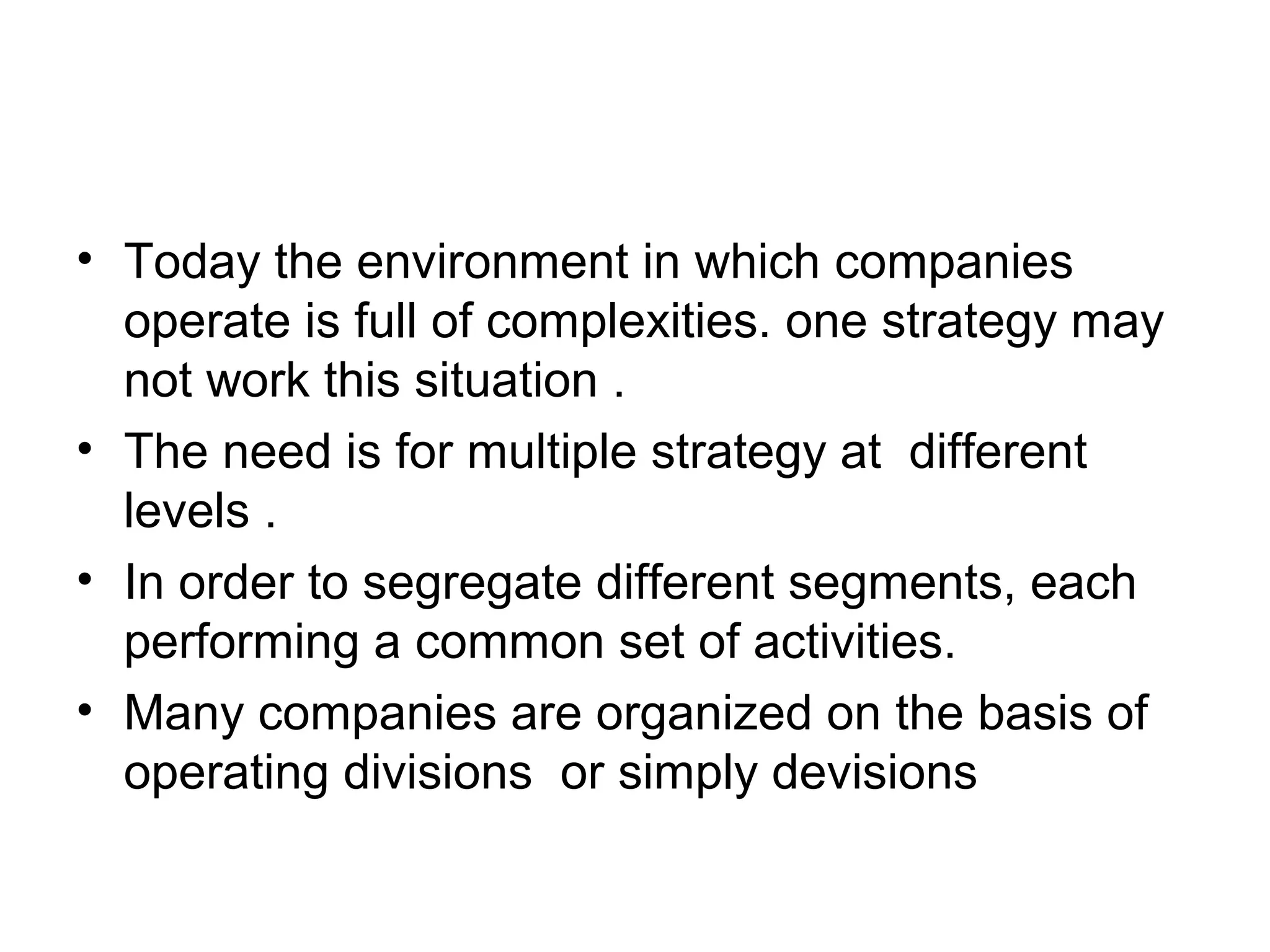
• Today the environment in which companies 
operate is full of complexities. one strategy may 
not work this situation . 
• The need is for multiple strategy at different 
levels . 
• In order to segregate different segments, each 
performing a common set of activities. 
• Many companies are organized on the basis of 
operating divisions or simply devisions
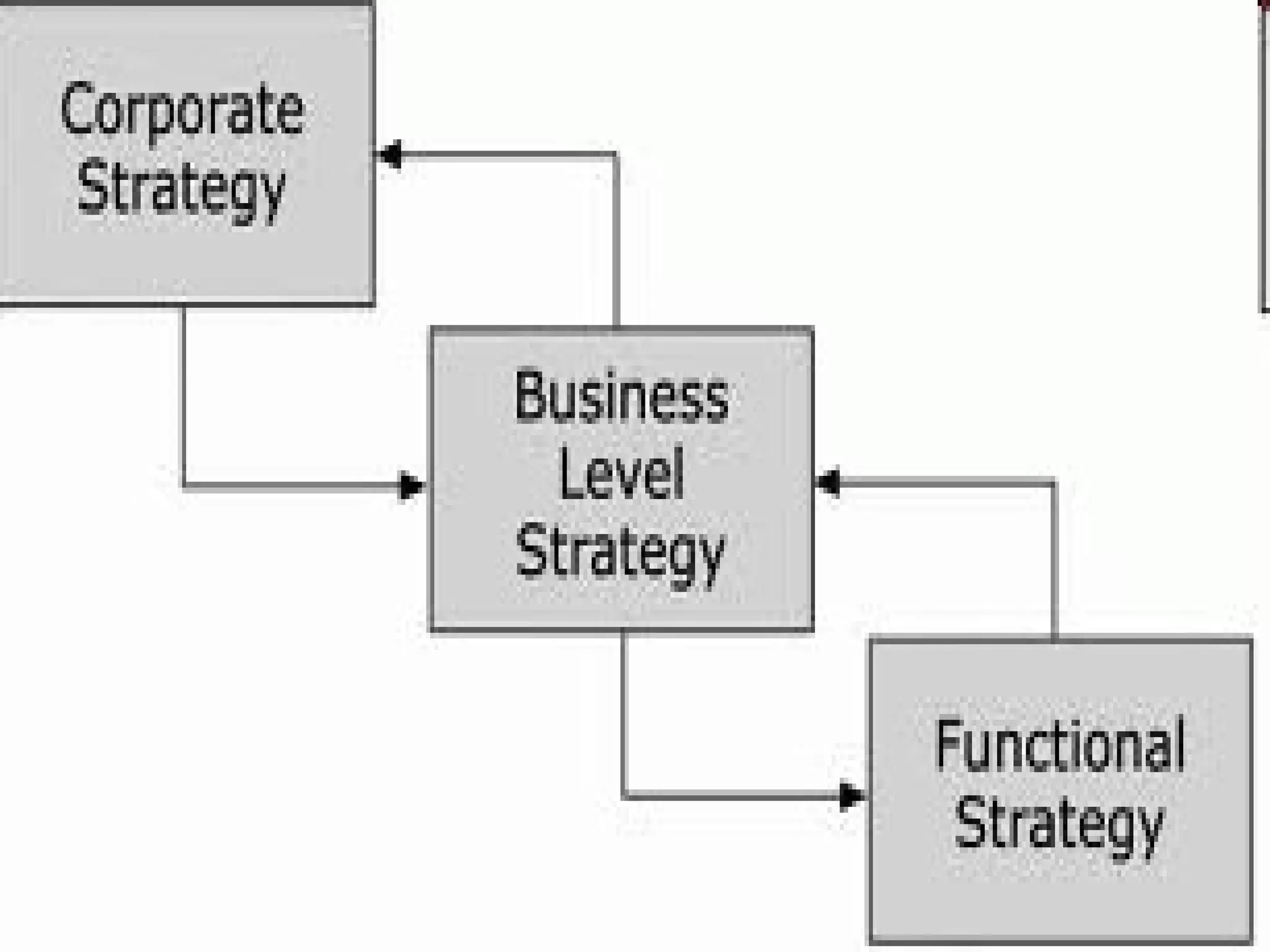
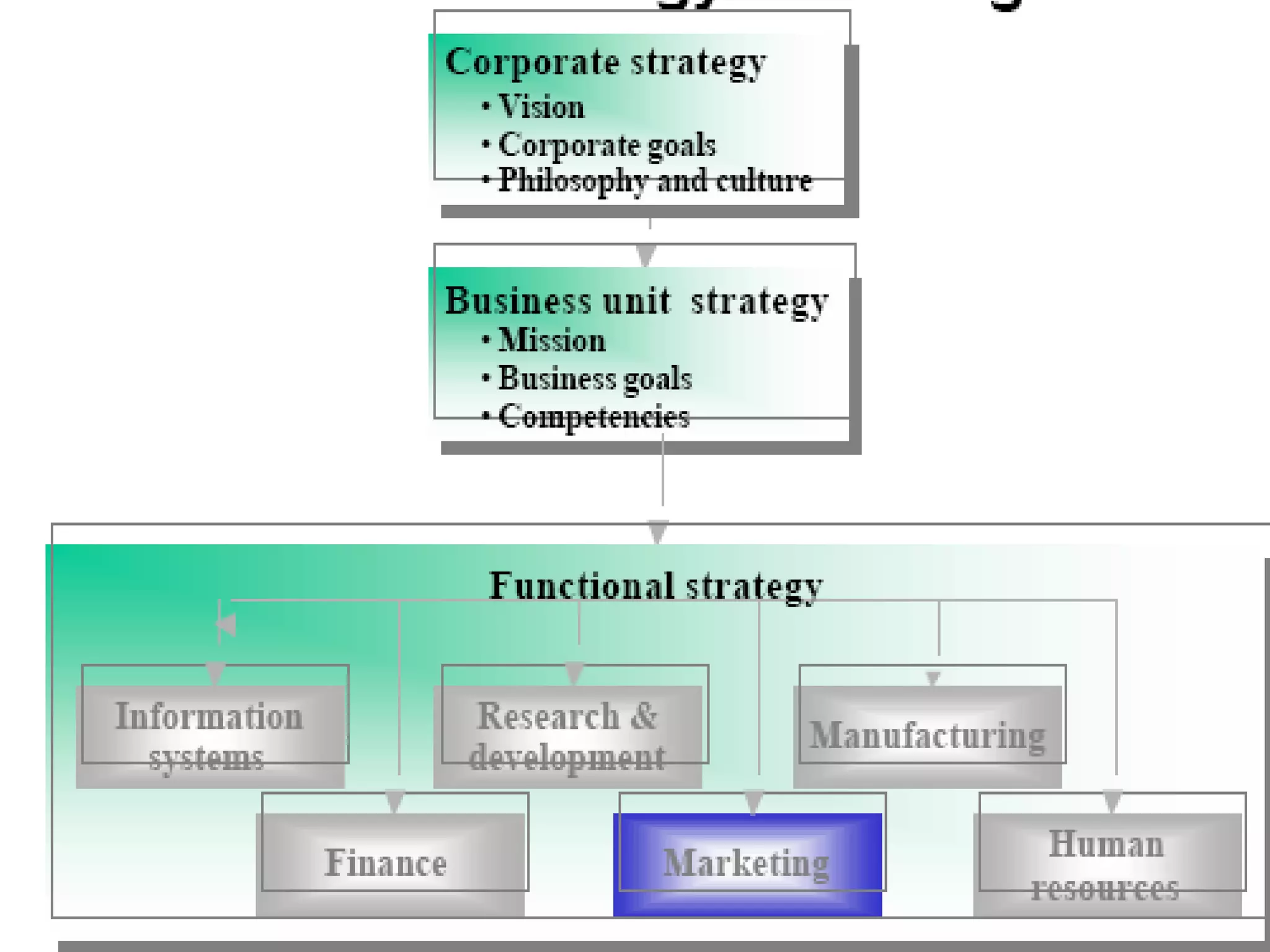
Corporate Level Strategy 
• The overall corporate level strategy is concerned with 
the broad scope of an organization’s strategic activities 
and the matching of these to the organization’s 
environment, its resources capabilities and the values 
and expectations of its various stakeholders. 
• It looks at the whole strategic scope of the enterprise. 
• This is the “large picture” view of the organization and 
includes deciding in which service or products markets to 
compete and in which geographic regions to operate.
Business Level Strategy 
• It is the comprehensive plan providing 
objectives for SBU, allocation of resources 
among functional areas and coordination 
between them for optimal contribution to 
the achievement of the corporate level 
objectives.
What is SBU 
• Operating Divisions are also known as 
profit centers or strategic business units 
(SBU) 
• It may also be termed as any part of 
business organization which is treated 
separately for strategic Management 
Process 
• Generally SBU are involved in a single line 
of business
Functional Strategies 
• These strategies deal with relatively 
restricted plan providing objectives for a 
specific function, allocation of resources 
among different operation and 
coordination between them for optimal 
contribution to SBU and corporate level 
objectives
Other Strategies 
• There are strategies which are at higher 
level than corporate strategies. These are 
known as societal strategies. 
• Based on a mission vision statement a 
societal strategy is the generalized view 
of how the corporation relates itself to 
society in terms of particular need or a set 
of needs that it strive to fulfill
• Eg. Suppose a corporation decides to 
provide alternative source of energy for 
society at an optimum prices and based 
on the latest technology. On the basis of 
its societal strategy it has no of 
alternatives it can be a manufacturer or 
nuclear power reactor, a maker of 
equipments used for tapping solar energy 
etc
• One step down the functional level 
strategies are operational level strategies 
• Each functional area could have a number 
of operational activities 
• They deal with the highly narrow or 
specific area
Centralization Vs Decentralization
Strategic Decision Making 
• One of the most important function of 
manager. 
• It is the prominent task of senior 
management also. 
• The difference lies in the level at which 
they operate
Conventional Decision making 
• Objectives to be achieved are determined 
• Alternatives ways of achieving the 
objectives are identified 
• Each alternative is evaluated in terms of 
its objective-achieving capability 
• The best alternative is chosen 
• The case of Pantaloon white shirts
Issues in Decision Making 
• Strategic decision-making is a complex 
process . 
• Decision makers are unable to describe 
the exact manner in which the decision is 
made.
Criteria for decision making 
• It requires objective setting. 
• Why we set objectives 
• The first is the concept of maximization. 
The behavior of organization is oriented 
towards achieving these objectives and 
maximizing returns 
• Second view is based on the concept of 
satisfying. This can be achieved by 
optimization.
• Rationality in decision making 
• Creativity in decision making 
• Variability in decision-making 
• Individual Vs group decision making

Introduction to business policy

  • 1.
  • 2.
    Nature of BusinessPolicy • The study of the function and responsibilities of senior management , the crucial problems that effect success in the total enterprise and the decisions that determine the directions of organization and shape its future. • Policy is the study of functions and responsibilities of senior management related to those organizational problems which effect the success of total organization
  • 3.
    • It dealswith the future course of action that an organization has to adopt. • It is concerned with mobilization of resources so the organization can achieve its goals • Choosing between different alternatives available.
  • 4.
    Who Comes UnderSenior Management ?
  • 5.
  • 6.
    For Learning •Integrate the knowledge and experience gained in various functional areas of management • Deals with constraints and complexities of real life business. • Can be applied to various fields of management
  • 7.
    Understanding Business Environment • Internal Environment • External Environment • Adapting internally to external environment
  • 8.
    For understanding theorganization • Provides the basic framework for understanding strategic decision making • Understanding of business policy leads to improvement of job performance
  • 9.
    For Personal Development • It is beneficial for an executive to understand the impact of policy shifts on the status of one department and on the position one occupies • Offers unique perspective to executives for understanding the macro factors and their impact on micro level • Offers unique perspective to executives for understand the senior management view.
  • 10.
  • 11.
    • Today theenvironment in which companies operate is full of complexities. one strategy may not work this situation . • The need is for multiple strategy at different levels . • In order to segregate different segments, each performing a common set of activities. • Many companies are organized on the basis of operating divisions or simply devisions
  • 14.
    Corporate Level Strategy • The overall corporate level strategy is concerned with the broad scope of an organization’s strategic activities and the matching of these to the organization’s environment, its resources capabilities and the values and expectations of its various stakeholders. • It looks at the whole strategic scope of the enterprise. • This is the “large picture” view of the organization and includes deciding in which service or products markets to compete and in which geographic regions to operate.
  • 15.
    Business Level Strategy • It is the comprehensive plan providing objectives for SBU, allocation of resources among functional areas and coordination between them for optimal contribution to the achievement of the corporate level objectives.
  • 16.
    What is SBU • Operating Divisions are also known as profit centers or strategic business units (SBU) • It may also be termed as any part of business organization which is treated separately for strategic Management Process • Generally SBU are involved in a single line of business
  • 17.
    Functional Strategies •These strategies deal with relatively restricted plan providing objectives for a specific function, allocation of resources among different operation and coordination between them for optimal contribution to SBU and corporate level objectives
  • 18.
    Other Strategies •There are strategies which are at higher level than corporate strategies. These are known as societal strategies. • Based on a mission vision statement a societal strategy is the generalized view of how the corporation relates itself to society in terms of particular need or a set of needs that it strive to fulfill
  • 19.
    • Eg. Supposea corporation decides to provide alternative source of energy for society at an optimum prices and based on the latest technology. On the basis of its societal strategy it has no of alternatives it can be a manufacturer or nuclear power reactor, a maker of equipments used for tapping solar energy etc
  • 20.
    • One stepdown the functional level strategies are operational level strategies • Each functional area could have a number of operational activities • They deal with the highly narrow or specific area
  • 21.
  • 22.
    Strategic Decision Making • One of the most important function of manager. • It is the prominent task of senior management also. • The difference lies in the level at which they operate
  • 23.
    Conventional Decision making • Objectives to be achieved are determined • Alternatives ways of achieving the objectives are identified • Each alternative is evaluated in terms of its objective-achieving capability • The best alternative is chosen • The case of Pantaloon white shirts
  • 24.
    Issues in DecisionMaking • Strategic decision-making is a complex process . • Decision makers are unable to describe the exact manner in which the decision is made.
  • 25.
    Criteria for decisionmaking • It requires objective setting. • Why we set objectives • The first is the concept of maximization. The behavior of organization is oriented towards achieving these objectives and maximizing returns • Second view is based on the concept of satisfying. This can be achieved by optimization.
  • 26.
    • Rationality indecision making • Creativity in decision making • Variability in decision-making • Individual Vs group decision making