

Introduction to BiologyEcology, Physiology, and Chemistry
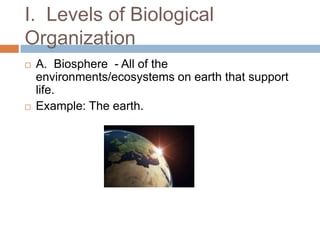
I.  Levels of Biological OrganizationA.  Biosphere  - All of the environments/ecosystems on earth that support life.  Example: The earth.
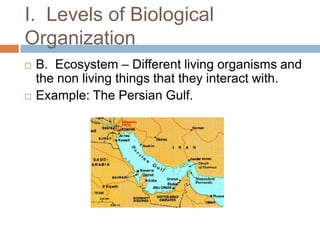
I.  Levels of Biological OrganizationB.  Ecosystem – Different living organisms and the non living things that they interact with.  Example: The Persian Gulf.
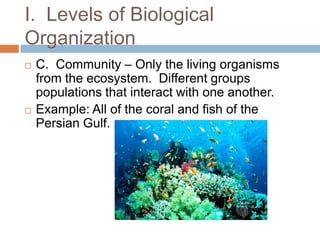
I.  Levels of Biological OrganizationC.  Community – Only the living organisms from the ecosystem.  Different groups populations that interact with one another.  Example: All of the coral and fish of the Persian Gulf.
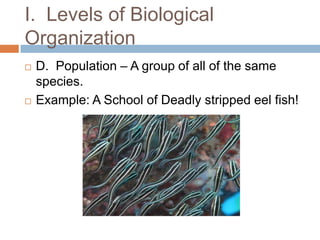
I.  Levels of Biological OrganizationD.  Population – A group of all of the same species.  Example: A School of Deadly stripped eel fish!
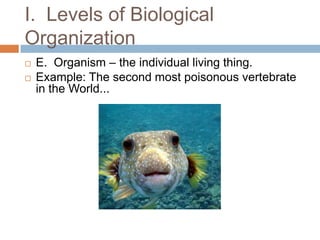
I.  Levels of Biological OrganizationE.  Organism – the individual living thing.  Example: The second most poisonous vertebrate in the World...
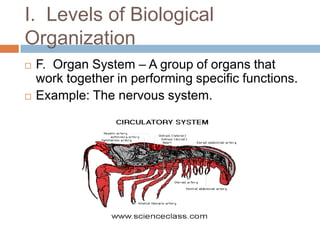
I.  Levels of Biological OrganizationF.  Organ System – A group of organs that work together in performing specific functions.  Example: The nervous system.
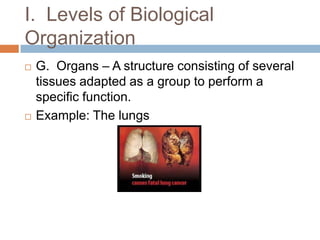
I.  Levels of Biological OrganizationG.  Organs – A structure consisting of several tissues adapted as a group to perform a specific function.  Example: The lungs
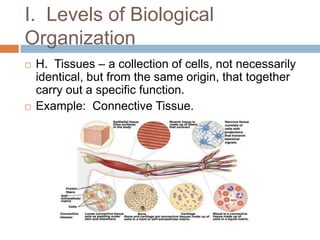
I.  Levels of Biological OrganizationH.  Tissues – a collection of cells, not necessarily identical, but from the same origin, that together carry out a specific function.  Example:  Connective Tissue.
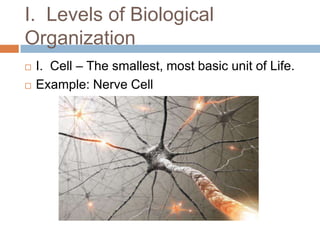
I.  Levels of Biological OrganizationI.  Cell – The smallest, most basic unit of Life.  Example: Nerve Cell
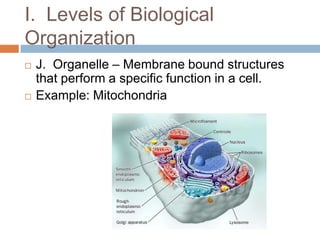
I.  Levels of Biological OrganizationJ.  Organelle – Membrane bound structures that perform a specific function in a cell.   Example: Mitochondria
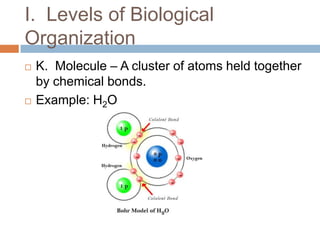
I.  Levels of Biological OrganizationK.  Molecule – A cluster of atoms held together by chemical bonds.  Example: H2O
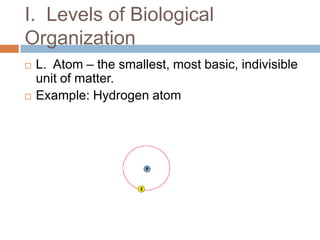
I.  Levels of Biological OrganizationL.  Atom – the smallest, most basic, indivisible unit of matter.  Example: Hydrogen atom
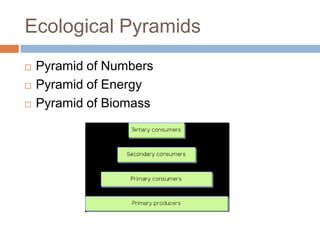
Ecological Pyramids	Pyramid of NumbersPyramid of EnergyPyramid of Biomass
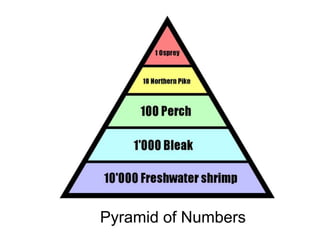
        Pyramid of Numbers
Perch, Pike, Ospreyhttp://www.youtube.com/watch?v=Uiu8wIgdsPkhttp://www.youtube.com/watch?v=5CEtxcOQwDY
Food chains and Webshttps://www.etap.org/demo/biology_files/lesson6/instruction6tutor.html
Introduction to biology

Introduction to biology

  • 1.
    Introduction to BiologyEcology,Physiology, and Chemistry
  • 2.
    I. Levelsof Biological OrganizationA. Biosphere - All of the environments/ecosystems on earth that support life. Example: The earth.
  • 3.
    I. Levelsof Biological OrganizationB. Ecosystem – Different living organisms and the non living things that they interact with. Example: The Persian Gulf.
  • 4.
    I. Levelsof Biological OrganizationC. Community – Only the living organisms from the ecosystem. Different groups populations that interact with one another. Example: All of the coral and fish of the Persian Gulf.
  • 5.
    I. Levelsof Biological OrganizationD. Population – A group of all of the same species. Example: A School of Deadly stripped eel fish!
  • 6.
    I. Levelsof Biological OrganizationE. Organism – the individual living thing. Example: The second most poisonous vertebrate in the World...
  • 7.
    I. Levelsof Biological OrganizationF. Organ System – A group of organs that work together in performing specific functions. Example: The nervous system.
  • 8.
    I. Levelsof Biological OrganizationG. Organs – A structure consisting of several tissues adapted as a group to perform a specific function. Example: The lungs
  • 9.
    I. Levelsof Biological OrganizationH. Tissues – a collection of cells, not necessarily identical, but from the same origin, that together carry out a specific function. Example: Connective Tissue.
  • 10.
    I. Levelsof Biological OrganizationI. Cell – The smallest, most basic unit of Life. Example: Nerve Cell
  • 11.
    I. Levelsof Biological OrganizationJ. Organelle – Membrane bound structures that perform a specific function in a cell. Example: Mitochondria
  • 12.
    I. Levelsof Biological OrganizationK. Molecule – A cluster of atoms held together by chemical bonds. Example: H2O
  • 13.
    I. Levelsof Biological OrganizationL. Atom – the smallest, most basic, indivisible unit of matter. Example: Hydrogen atom
  • 14.
    Ecological Pyramids Pyramid ofNumbersPyramid of EnergyPyramid of Biomass
  • 15.
    Pyramid of Numbers
  • 16.
  • 17.
    Food chains andWebshttps://www.etap.org/demo/biology_files/lesson6/instruction6tutor.html