The Future ofAI & Machine Learning
Transforming Tomorrow
with Intelligent Systems
2.
Introduction
Artificial Intelligence (AI)and Machine Learning (ML)
are redefining the technological landscape. These
advanced systems are not only enhancing
operational efficiency in various domains but also
creating new avenues for innovation. Understanding
their fundamentals, applications, and implications is
crucial in navigating the future of technology.
Definition of AIand its
Impact
Artificial Intelligence refers to the simulation of
human intelligence in machines, enabling them to
perform tasks that typically require human intellect.
AI's impact is profound, affecting decision-making
processes across numerous sectors, enhancing
productivity and innovation.
5.
Key Examples ofAI in Daily Life
AI is embedded in everyday technologies, making life more
convenient. From voice assistants like Siri to auto-piloting
systems in Tesla vehicles and interactive platforms such as
ChatGPT, AI is continually transforming user experiences and
increasing efficiency.
6.
Understanding Machine Learning
Fundamentals
MachineLearning, a subset of AI, focuses on algorithms that
enable computers to learn from data and improve over time
without explicit programming. The core process involves
transforming data into models that can predict outcomes,
facilitating intelligent decision-making.
Venn Diagram ofAI, ML, and Deep Learning
AI encompasses a broader spectrum of intelligent behavior,
while Machine Learning is specifically about data-driven
learning. Deep Learning, a subset of ML, employs neural
networks to analyze vast amounts of data, showcasing the
interrelationship among these fields.
9.
Simplicity in UnderstandingTerminology
Understanding the nuances between AI, ML, and Deep
Learning is essential for professionals. By simplifying these
concepts, organizations can foster better communication and
collaboration between technical and non-technical teams,
enhancing innovation and implementation success.
10.
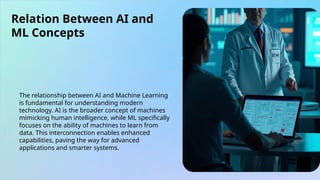
Relation Between AIand
ML Concepts
The relationship between AI and Machine Learning
is fundamental for understanding modern
technology. AI is the broader concept of machines
mimicking human intelligence, while ML specifically
focuses on the ability of machines to learn from
data. This interconnection enables enhanced
capabilities, paving the way for advanced
applications and smarter systems.
Breakdown of SupervisedLearning
Supervised Learning involves training an algorithm on a
labeled dataset, allowing it to make predictions based on
input-output pairs. This technique is prevalent in applications
such as image recognition and spam detection, providing
reliable outcomes through prior knowledge encapsulated in
the data.
13.
Explanation of UnsupervisedLearning
Unsupervised Learning aims to find hidden patterns or
intrinsic structures in input data without labels. It is useful in
clustering tasks, such as customer segmentation and market
basket analysis, enabling businesses to discover insights and
relationships that drive strategic decisions.
14.
Overview of Reinforcement
Learning
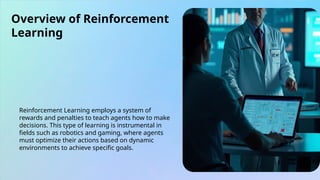
ReinforcementLearning employs a system of
rewards and penalties to teach agents how to make
decisions. This type of learning is instrumental in
fields such as robotics and gaming, where agents
must optimize their actions based on dynamic
environments to achieve specific goals.
Real-World Examples in
VariousIndustries
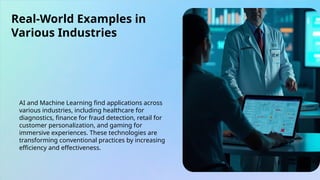
AI and Machine Learning find applications across
various industries, including healthcare for
diagnostics, finance for fraud detection, retail for
customer personalization, and gaming for
immersive experiences. These technologies are
transforming conventional practices by increasing
efficiency and effectiveness.
17.
Identifying Ethical Challengesin AI
As AI technologies advance, ethical challenges emerge,
including bias in algorithms, privacy concerns, and the
potential for job displacement. Addressing these challenges
is crucial for advancing AI responsibly and ensuring equitable
outcomes for society.
18.
The Future ofAI: Opportunities and Risks
The future of AI presents vast opportunities for innovation
but also risks that must be navigated carefully. Balancing
technological advancement with ethical standards and
regulatory frameworks will be essential for maximizing
benefits and minimizing adverse effects on society.
19.
Conclusions
AI and MachineLearning are at the forefront of
technological innovation, offering transformative
potential across numerous sectors. However, it is
vital to approach their development and
implementation with a strong ethical framework to
ensure a balanced and beneficial outcome for all
stakeholders involved.