P. Abhinaya
IV-CSE
Seminar on Artificial Intelligence
What is AI?
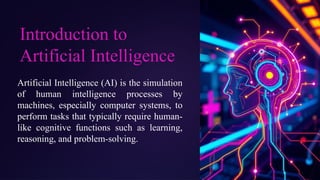
Artificial Intelligence (AI) is the simulation
of human intelligence processes by
machines, especially computer systems, to
perform tasks that typically require human-
like cognitive functions such as learning,
reasoning, and problem-solving.
Introduction to
Artificial Intelligence
The term artificial intelligence was
first coined decades ago in the year
by John McCarty at the Dartmouth
conference he defined "Artificial
intelligence as a science and
engineering of making intelligent
machines in a sense Al is a
technique of getting machines to
work and behave like human."
History of AI
AI simulates human intelligence to perform tasks and
make decisions.
ML is a subset of AI that uses algorithms to learn
patterns from data and the ability to learn without
being explicitly programmed.
DL is a subset of ML that employs artificial neural
networks for complex tasks.
Venn Diagram
Machine Learning
Fundamental Concepts of AI
•ML is a subset of AI that focuses on the development of algorithms that allow machines to learn from and make
decisions based on data. It doesn’t follow explicit programming instructions but learns patterns from the data.
•Types of Learning:
•Supervised Learning
•Unsupervised Learning
•Reinforcement Learning
•Examples: Spam filtering in emails, predictive maintenance in industries, recommendation systems like Netflix.
•Why Fundamental: It serves as the backbone of many AI applications, allowing systems to make informed
decisions, predictions, or classifications based on past experiences.
Fundamental Concepts of AI (Cont..)
•DL is a subset of ML that uses neural networks with many layers (often referred to as deep neural networks) to
model complex patterns in large datasets.
•Neural Networks
•Convolutional Neural Networks (CNNs)
•Recurrent Neural Networks (RNNs)
•High Data Requirements
•Example: Self-driving cars rely on deep learning for understanding the environment and making real-time
decisions.
•Why Fundamental: Deep Learning has led to breakthroughs in fields like image recognition, speech recognition,
and autonomous systems.
Deep Learning
Natural Language Processing
Fundamental Concepts of AI (Cont..)
•NLP is the field of AI that focuses on the interaction between computers and humans through natural language.
•Key Concepts:
• Text Processing
• Speech Recognition
• Machine Translation
• Sentiment Analysis
• Language Generation
•Why Fundamental: NLP enables machines to understand and respond to human languages, making it essential
for tasks like virtual assistants (e.g., Siri, Alexa), language translation, and automated customer service.
Computer Vision
Fundamental Concepts of AI (Cont..)
•Definition: CV is the field of AI that enables machines to interpret and make decisions based on visual data (e.g.,
images, videos).
•Key Concepts:
•Image Classification
•Object Detection
•Segmentation
•Facial Recognition
•Example: Medical imaging (detecting tumors), security systems (facial recognition).
•Why Fundamental: CV is crucial for machines to interact with and interpret the visual world, which is essential
for robotics, augmented reality, surveillance, and autonomous vehicles
Narrow AI
Narrow AI, also known as weak AI, is
designed to perform specific tasks.
Examples include image recognition
systems, spam filters, and virtual
assistants.
General AI
General AI, or strong AI, aims to
create systems with human-level
intelligence capable of solving a wide
range of problems. This is a highly
ambitious goal that remains a topic of
ongoing research.
Super AI
Super AI surpasses human
intelligence in all aspects.
Hypothetical in nature, this type of AI
could potentially possess capabilities
beyond human comprehension.
Types of Artificial Intelligence
Data Collection
AI systems require vast
amounts of data to learn
and improve their
performance.
Data Processing
Algorithms process the
collected data, extracting
patterns and
relationships.
Model Training
AI models are trained
using the processed data
to learn from examples
and improve their ability
to make predictions.
Decision Making
Once trained, AI systems
can use their knowledge
to make informed
decisions or predictions.
How AI works?
1 Healthcare
AI is transforming healthcare by assisting in diagnosis,
drug discovery, and personalized medicine.
2 Finance
AI powers fraud detection, algorithmic trading, and
customer service in financial institutions.
3 Transportation
Self-driving cars and traffic management systems are
powered by AI, improving safety and efficiency.
4 Manufacturing
AI is used in robotics, predictive maintenance, and
quality control in manufacturing industries.
Applications of AI
AI in Industry
Industry Applications of AI Benefits
Agriculture
Precision farming,
crop monitoring,
predictive analytics
Increased yield,
resource efficiency
Manufacturing
Predictive
maintenance,
robotics, quality
control
Increased efficiency,
reduced downtime
Healthcare
Diagnostics,
personalized
medicine, drug
discovery
Improved patient
outcomes, cost
reduction
Finance
Fraud detection,
risk management,
automated trading
Improved security,
better decision-
making
Activity
•Sorting Game:
•Question: Can you sort these toys into
categories (e.g., cars, dolls, puzzles)?
•How would a robot sort them?
•Purpose: Demonstrates classification, a
fundamental AI task.
•Guess the Animal:
•Question: I will describe an animal. Can you
guess what it is?
•How do you think AI can learn to recognize
animals?
•Purpose: Introduces concepts of recognition
and learning.
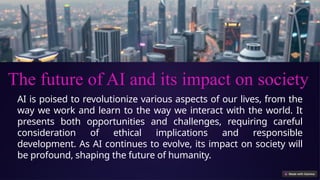
AI is poised to revolutionize various aspects of our lives, from the
way we work and learn to the way we interact with the world. It
presents both opportunities and challenges, requiring careful
consideration of ethical implications and responsible
development. As AI continues to evolve, its impact on society will
be profound, shaping the future of humanity.
The future of AI and its impact on society
Thank You..

Artificial Intelligence Seminar for Second Year

  • 1.
    P. Abhinaya IV-CSE Seminar onArtificial Intelligence
  • 2.
  • 3.
    Artificial Intelligence (AI)is the simulation of human intelligence processes by machines, especially computer systems, to perform tasks that typically require human- like cognitive functions such as learning, reasoning, and problem-solving. Introduction to Artificial Intelligence
  • 4.
    The term artificialintelligence was first coined decades ago in the year by John McCarty at the Dartmouth conference he defined "Artificial intelligence as a science and engineering of making intelligent machines in a sense Al is a technique of getting machines to work and behave like human." History of AI
  • 5.
    AI simulates humanintelligence to perform tasks and make decisions. ML is a subset of AI that uses algorithms to learn patterns from data and the ability to learn without being explicitly programmed. DL is a subset of ML that employs artificial neural networks for complex tasks. Venn Diagram
  • 6.
    Machine Learning Fundamental Conceptsof AI •ML is a subset of AI that focuses on the development of algorithms that allow machines to learn from and make decisions based on data. It doesn’t follow explicit programming instructions but learns patterns from the data. •Types of Learning: •Supervised Learning •Unsupervised Learning •Reinforcement Learning •Examples: Spam filtering in emails, predictive maintenance in industries, recommendation systems like Netflix. •Why Fundamental: It serves as the backbone of many AI applications, allowing systems to make informed decisions, predictions, or classifications based on past experiences.
  • 7.
    Fundamental Concepts ofAI (Cont..) •DL is a subset of ML that uses neural networks with many layers (often referred to as deep neural networks) to model complex patterns in large datasets. •Neural Networks •Convolutional Neural Networks (CNNs) •Recurrent Neural Networks (RNNs) •High Data Requirements •Example: Self-driving cars rely on deep learning for understanding the environment and making real-time decisions. •Why Fundamental: Deep Learning has led to breakthroughs in fields like image recognition, speech recognition, and autonomous systems. Deep Learning
  • 8.
    Natural Language Processing FundamentalConcepts of AI (Cont..) •NLP is the field of AI that focuses on the interaction between computers and humans through natural language. •Key Concepts: • Text Processing • Speech Recognition • Machine Translation • Sentiment Analysis • Language Generation •Why Fundamental: NLP enables machines to understand and respond to human languages, making it essential for tasks like virtual assistants (e.g., Siri, Alexa), language translation, and automated customer service.
  • 9.
    Computer Vision Fundamental Conceptsof AI (Cont..) •Definition: CV is the field of AI that enables machines to interpret and make decisions based on visual data (e.g., images, videos). •Key Concepts: •Image Classification •Object Detection •Segmentation •Facial Recognition •Example: Medical imaging (detecting tumors), security systems (facial recognition). •Why Fundamental: CV is crucial for machines to interact with and interpret the visual world, which is essential for robotics, augmented reality, surveillance, and autonomous vehicles
  • 10.
    Narrow AI Narrow AI,also known as weak AI, is designed to perform specific tasks. Examples include image recognition systems, spam filters, and virtual assistants. General AI General AI, or strong AI, aims to create systems with human-level intelligence capable of solving a wide range of problems. This is a highly ambitious goal that remains a topic of ongoing research. Super AI Super AI surpasses human intelligence in all aspects. Hypothetical in nature, this type of AI could potentially possess capabilities beyond human comprehension. Types of Artificial Intelligence
  • 11.
    Data Collection AI systemsrequire vast amounts of data to learn and improve their performance. Data Processing Algorithms process the collected data, extracting patterns and relationships. Model Training AI models are trained using the processed data to learn from examples and improve their ability to make predictions. Decision Making Once trained, AI systems can use their knowledge to make informed decisions or predictions. How AI works?
  • 12.
    1 Healthcare AI istransforming healthcare by assisting in diagnosis, drug discovery, and personalized medicine. 2 Finance AI powers fraud detection, algorithmic trading, and customer service in financial institutions. 3 Transportation Self-driving cars and traffic management systems are powered by AI, improving safety and efficiency. 4 Manufacturing AI is used in robotics, predictive maintenance, and quality control in manufacturing industries. Applications of AI
  • 13.
    AI in Industry IndustryApplications of AI Benefits Agriculture Precision farming, crop monitoring, predictive analytics Increased yield, resource efficiency Manufacturing Predictive maintenance, robotics, quality control Increased efficiency, reduced downtime Healthcare Diagnostics, personalized medicine, drug discovery Improved patient outcomes, cost reduction Finance Fraud detection, risk management, automated trading Improved security, better decision- making
  • 14.
    Activity •Sorting Game: •Question: Canyou sort these toys into categories (e.g., cars, dolls, puzzles)? •How would a robot sort them? •Purpose: Demonstrates classification, a fundamental AI task. •Guess the Animal: •Question: I will describe an animal. Can you guess what it is? •How do you think AI can learn to recognize animals? •Purpose: Introduces concepts of recognition and learning.
  • 15.
    AI is poisedto revolutionize various aspects of our lives, from the way we work and learn to the way we interact with the world. It presents both opportunities and challenges, requiring careful consideration of ethical implications and responsible development. As AI continues to evolve, its impact on society will be profound, shaping the future of humanity. The future of AI and its impact on society
  • 16.