1
Introduction to
Pharmacy
By
Chhavi Gupta
M.Pharm
2
Who is pharmacist?
Pharmacists are health professionals who
practice the science of pharmacy. In their
traditional role, pharmacists typically take a
request formedicines from a prescribing health
care provider in the form of a medical
prescription, evaluate the appropriateness of the
prescription, dispense the medication to
the patient and counsel them on the proper use
and adverse effects of that medication.
K.SAMINATHAN. M.pharm, M.B.A,( P.hD)
Allianze college of medical sciences 3
K.SAMINATHAN. M.pharm, M.B.A,( P.hD)
Allianze college of medical sciences 4
K.SAMINATHAN. M.pharm, M.B.A,( P.hD)
Allianze college of medical sciences 5
6
What is drug?
In pharmacology, a drug is "a chemical substance
used in the treatment, cure, prevention, or
diagnosis of disease or used to otherwise enhance
physical or mental well-being.“
A pharmaceutical drug, also referred to
as medicine, medication or medicament, can be
loosely defined as any chemical substance intended
for use in the medical diagnosis,cure, treatment,
or prevention of disease
K.SAMINATHAN. M.pharm, M.B.A,( P.hD)
Allianze college of medical sciences 7
8
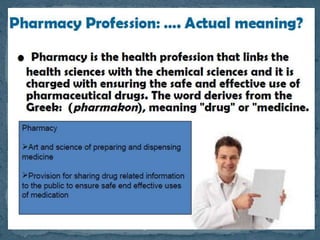
Pharmacy
(from the Greek 'pharmakon' = drug/medicine)
It is the health profession that links
the health sciences with the
chemical sciences, and it is charged
with ensuring the safe and effective
use of pharmaceutical drugs.
K.SAMINATHAN. M.pharm, M.B.A,( P.hD)
Allianze college of medical sciences 9
10
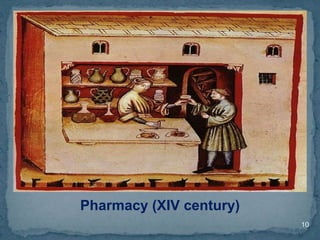
Pharmacy (XIV century)
11
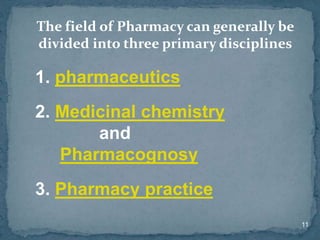
The field of Pharmacy can generally be
divided into three primary disciplines
1. pharmaceutics
2. Medicinal chemistry
and
Pharmacognosy
3. Pharmacy practice
12
13
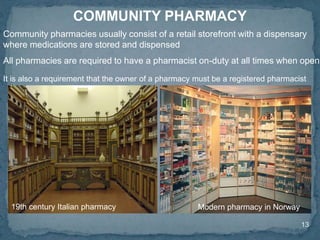
COMMUNITY PHARMACY
Community pharmacies usually consist of a retail storefront with a dispensary
where medications are stored and dispensed
All pharmacies are required to have a pharmacist on-duty at all times when open.
It is also a requirement that the owner of a pharmacy must be a registered pharmacist
19th century Italian pharmacy Modern pharmacy in Norway
14
15
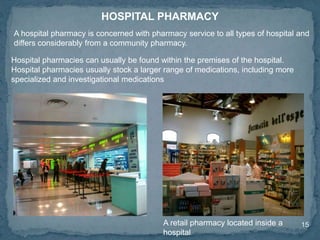
HOSPITAL PHARMACY
A hospital pharmacy is concerned with pharmacy service to all types of hospital and
differs considerably from a community pharmacy.
Hospital pharmacies can usually be found within the premises of the hospital.
Hospital pharmacies usually stock a larger range of medications, including more
specialized and investigational medications
A retail pharmacy located inside a
hospital
16
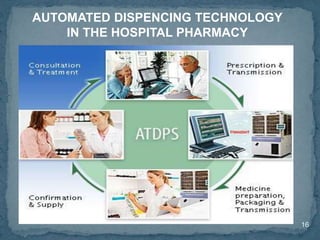
AUTOMATED DISPENCING TECHNOLOGY
IN THE HOSPITAL PHARMACY
17
Clinical pharmacists provide direct patient care services that
optimizes the use of medication and promotes health,
wellness, and disease prevention
CLINICAL PHARMACY
Clinical pharmacy is the branch of Pharmacy where
pharmacists provide patient care that optimizes the use of
medication and promotes health, wellness and disease
prevention
Clinical pharmacy is the branch of pharmacy which deals with
various aspect of patient care, dispensing of drugs and
advising patient on the safe and rational use of drug.
18
Basic components of clinical pharmacy practice:
Prescribing drugs
Dispensing and administering drugs
Documenting professional services
Reviewing drug use
Communication
Counseling
Consulting
Scope of clinical pharmacy:
Drug Distribution Systems
Drug Information
Drug Utilization
Drug Evaluation and Selection
Medication Therapy Management
Formal Education and Training Program
Disease State Management
19
COMPOUNDING PHARMACY
Compounding is the mixing of drugs by a
pharmacist, physician, or veterinarian to fit the
unique needs of a patient.
This may be done for medically necessary reasons,
such as to change the form of the medication from a
solid pill to a liquid
It may also be done for voluntary reasons, such as
adding favorite flavors to a medication
Compounding is the practice of preparing drugs in
new forms.
20
A consultant pharmacist is a specialized
pharmacist. The main principle of consultant
pharmacy is Pharmaceutical care.
CONSULTANT PHARMACIST
particularly those in institutional settings such as
nursing homes. Term developed by Hepler and
Strand in 1990.
21
Online pharmacies are pharmacies which operate
over the Internet.
Many such pharmacies are, in some ways, similar to
community pharmacies;
INTERNET PHARMACY
OR
ONLINE PHARMACY
The primary difference is the method by which the
medications are requested and received.
Some customers consider this to be more
convenient than traveling to a community drugstore.
22
VETERINARY PHARMACY
Veterinary pharmacies, sometimes called animal
pharmacies may fall in the category of hospital pharmacy,
retail pharmacy or mail-order pharmacy.
Veterinary pharmacies stock different varieties and different
strengths of medications to fulfill the pharmaceutical needs of
animals
Because the needs of animals as well as the regulations
on veterinary medicine are often very different from those
related to people, veterinary pharmacy is often kept
separate from regular pharmacies.
23
NUCLEAR PHARMACY
Nuclear Pharmacy involves the preparation of
radioactive materials that will be used to diagnose
and treat specific diseases.
It was the first pharmacy specialty established in
1978 by the Board of Pharmaceutical Specialties.
Nuclear pharmacy seeks to improve and promote
health through the safe and effective use of
radioactive drugs for not only diagnosis but also
therapy.
24
Military pharmacy is an entirely different
working environment due to the fact that
technicians perform most duties that in a
civilian sector would be illegal.
MILITARY PHARMACY
State laws of Technician patient counseling
and medication checking by a pharmacist do
not apply.
25
PHARMACY INFORMATICS
Pharmacy informatics is the combination of pharmacy
practice science and applied information science.
As a practice area and specialist domain, pharmacy
informatics is growing quickly to meet the needs of major
national and international patient information projects and
health system interoperability goals. Pharmacists are well
trained to participate in medication management system
development, deployment and optimization.
Pharmacy informaticists work in many practice areas of
pharmacy, however, they may also work in information
technology departments or for healthcare information
technology vendor companies.
26
Separation of prescribing from dispensing
These jurisdictions also usually specify that
only pharmacists may supply scheduled
pharmaceuticals to the public, and that
pharmacists cannot form business
partnerships with physicians or give them
"kickback" payments.
In most jurisdictions (such as the United
States), pharmacists are regulated separately
from physicians.
27
However, the American Medical Association
(AMA) Code of Ethics provides that physicians
may dispense drugs within their office
practices as long as there is no patient
exploitation and patients have the right to a
written prescription that can be filled
elsewhere.
7 to 10 percent of American physicians
practices reportedly dispense drugs on their
own.
28
In other jurisdictions (particularly in Asian
countries such as China, Malaysia, and
Singapore), doctors are allowed to dispense
drugs themselves..
In Canada it is common for a medical clinic
and a pharmacy to be located together and for
the ownership in both enterprises to be
common, but licensed separately
The practice of pharmacy is sometimes
integrated with that of the physician,
particularly in traditional Chinese medicine.
29
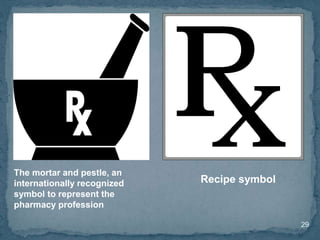
The mortar and pestle, an
internationally recognized
symbol to represent the
pharmacy profession
Recipe symbol
30
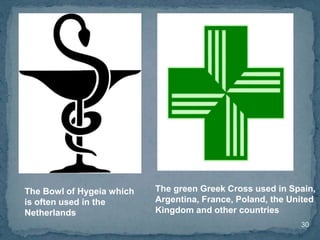
The Bowl of Hygeia which
is often used in the
Netherlands
The green Greek Cross used in Spain,
Argentina, France, Poland, the United
Kingdom and other countries
31
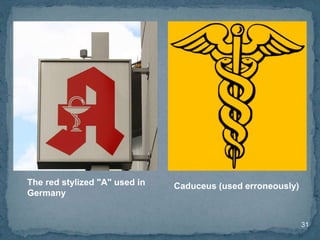
The red stylized "A" used in
Germany
Caduceus (used erroneously)
32
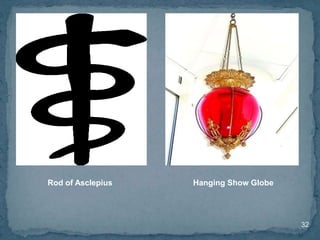
Rod of Asclepius Hanging Show Globe
33
Health science or biomedical
science is the applied science
dealing with health
(Applied science is the application of
scientific knowledge transferred into a
physical environment)
34
Chemical science is the
science concerned with the
composition, behavior,
structure, and properties of
matter, as well as the changes
it undergoes during chemical
reactions
35
Pharmaceutics deals with the
formulation of a pure drug
substance into a dosage form
A dosage form (DF) is the physical
form of a dose of a chemical
compound used as a drug or
medication intended for
administration or consumption
36
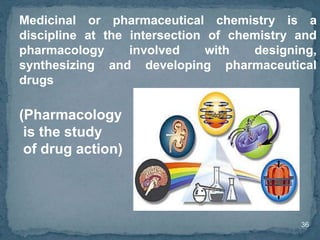
Medicinal or pharmaceutical chemistry is a
discipline at the intersection of chemistry and
pharmacology involved with designing,
synthesizing and developing pharmaceutical
drugs
(Pharmacology
is the study
of drug action)
37
Pharmacy practice is the discipline of pharmacy which
involves developing the professional roles of
pharmacists.
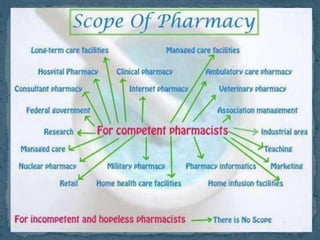
Types of pharmacy practice areas
1 Community pharmacy
2 Hospital pharmacy
3 Clinical pharmacy
4 Compounding pharmacy
5 Consultant pharmacy
6 Internet pharmacy
7 Veterinary pharmacy
8 Nuclear pharmacy
9 Military pharmacy
10 Pharmacy informatics
K.SAMINATHAN. M.pharm, M.B.A,( P.hD)
Allianze college of medical sciences 38

Introduction to pharmacy profession (CG)

  • 1.
  • 2.
    2 Who is pharmacist? Pharmacistsare health professionals who practice the science of pharmacy. In their traditional role, pharmacists typically take a request formedicines from a prescribing health care provider in the form of a medical prescription, evaluate the appropriateness of the prescription, dispense the medication to the patient and counsel them on the proper use and adverse effects of that medication.
  • 3.
    K.SAMINATHAN. M.pharm, M.B.A,(P.hD) Allianze college of medical sciences 3
  • 4.
    K.SAMINATHAN. M.pharm, M.B.A,(P.hD) Allianze college of medical sciences 4
  • 5.
    K.SAMINATHAN. M.pharm, M.B.A,(P.hD) Allianze college of medical sciences 5
  • 6.
    6 What is drug? Inpharmacology, a drug is "a chemical substance used in the treatment, cure, prevention, or diagnosis of disease or used to otherwise enhance physical or mental well-being.“ A pharmaceutical drug, also referred to as medicine, medication or medicament, can be loosely defined as any chemical substance intended for use in the medical diagnosis,cure, treatment, or prevention of disease
  • 7.
    K.SAMINATHAN. M.pharm, M.B.A,(P.hD) Allianze college of medical sciences 7
  • 8.
    8 Pharmacy (from the Greek'pharmakon' = drug/medicine) It is the health profession that links the health sciences with the chemical sciences, and it is charged with ensuring the safe and effective use of pharmaceutical drugs.
  • 9.
    K.SAMINATHAN. M.pharm, M.B.A,(P.hD) Allianze college of medical sciences 9
  • 10.
  • 11.
    11 The field ofPharmacy can generally be divided into three primary disciplines 1. pharmaceutics 2. Medicinal chemistry and Pharmacognosy 3. Pharmacy practice
  • 12.
  • 13.
    13 COMMUNITY PHARMACY Community pharmaciesusually consist of a retail storefront with a dispensary where medications are stored and dispensed All pharmacies are required to have a pharmacist on-duty at all times when open. It is also a requirement that the owner of a pharmacy must be a registered pharmacist 19th century Italian pharmacy Modern pharmacy in Norway
  • 14.
  • 15.
    15 HOSPITAL PHARMACY A hospitalpharmacy is concerned with pharmacy service to all types of hospital and differs considerably from a community pharmacy. Hospital pharmacies can usually be found within the premises of the hospital. Hospital pharmacies usually stock a larger range of medications, including more specialized and investigational medications A retail pharmacy located inside a hospital
  • 16.
  • 17.
    17 Clinical pharmacists providedirect patient care services that optimizes the use of medication and promotes health, wellness, and disease prevention CLINICAL PHARMACY Clinical pharmacy is the branch of Pharmacy where pharmacists provide patient care that optimizes the use of medication and promotes health, wellness and disease prevention Clinical pharmacy is the branch of pharmacy which deals with various aspect of patient care, dispensing of drugs and advising patient on the safe and rational use of drug.
  • 18.
    18 Basic components ofclinical pharmacy practice: Prescribing drugs Dispensing and administering drugs Documenting professional services Reviewing drug use Communication Counseling Consulting Scope of clinical pharmacy: Drug Distribution Systems Drug Information Drug Utilization Drug Evaluation and Selection Medication Therapy Management Formal Education and Training Program Disease State Management
  • 19.
    19 COMPOUNDING PHARMACY Compounding isthe mixing of drugs by a pharmacist, physician, or veterinarian to fit the unique needs of a patient. This may be done for medically necessary reasons, such as to change the form of the medication from a solid pill to a liquid It may also be done for voluntary reasons, such as adding favorite flavors to a medication Compounding is the practice of preparing drugs in new forms.

  • 20.
    20 A consultant pharmacistis a specialized pharmacist. The main principle of consultant pharmacy is Pharmaceutical care. CONSULTANT PHARMACIST particularly those in institutional settings such as nursing homes. Term developed by Hepler and Strand in 1990.
  • 21.
    21 Online pharmacies arepharmacies which operate over the Internet. Many such pharmacies are, in some ways, similar to community pharmacies; INTERNET PHARMACY OR ONLINE PHARMACY The primary difference is the method by which the medications are requested and received. Some customers consider this to be more convenient than traveling to a community drugstore.
  • 22.
    22 VETERINARY PHARMACY Veterinary pharmacies,sometimes called animal pharmacies may fall in the category of hospital pharmacy, retail pharmacy or mail-order pharmacy. Veterinary pharmacies stock different varieties and different strengths of medications to fulfill the pharmaceutical needs of animals Because the needs of animals as well as the regulations on veterinary medicine are often very different from those related to people, veterinary pharmacy is often kept separate from regular pharmacies.
  • 23.
    23 NUCLEAR PHARMACY Nuclear Pharmacyinvolves the preparation of radioactive materials that will be used to diagnose and treat specific diseases. It was the first pharmacy specialty established in 1978 by the Board of Pharmaceutical Specialties. Nuclear pharmacy seeks to improve and promote health through the safe and effective use of radioactive drugs for not only diagnosis but also therapy.
  • 24.
    24 Military pharmacy isan entirely different working environment due to the fact that technicians perform most duties that in a civilian sector would be illegal. MILITARY PHARMACY State laws of Technician patient counseling and medication checking by a pharmacist do not apply.
  • 25.
    25 PHARMACY INFORMATICS Pharmacy informaticsis the combination of pharmacy practice science and applied information science. As a practice area and specialist domain, pharmacy informatics is growing quickly to meet the needs of major national and international patient information projects and health system interoperability goals. Pharmacists are well trained to participate in medication management system development, deployment and optimization. Pharmacy informaticists work in many practice areas of pharmacy, however, they may also work in information technology departments or for healthcare information technology vendor companies.
  • 26.
    26 Separation of prescribingfrom dispensing These jurisdictions also usually specify that only pharmacists may supply scheduled pharmaceuticals to the public, and that pharmacists cannot form business partnerships with physicians or give them "kickback" payments. In most jurisdictions (such as the United States), pharmacists are regulated separately from physicians.
  • 27.
    27 However, the AmericanMedical Association (AMA) Code of Ethics provides that physicians may dispense drugs within their office practices as long as there is no patient exploitation and patients have the right to a written prescription that can be filled elsewhere. 7 to 10 percent of American physicians practices reportedly dispense drugs on their own.
  • 28.
    28 In other jurisdictions(particularly in Asian countries such as China, Malaysia, and Singapore), doctors are allowed to dispense drugs themselves.. In Canada it is common for a medical clinic and a pharmacy to be located together and for the ownership in both enterprises to be common, but licensed separately The practice of pharmacy is sometimes integrated with that of the physician, particularly in traditional Chinese medicine.
  • 29.
    29 The mortar andpestle, an internationally recognized symbol to represent the pharmacy profession Recipe symbol
  • 30.
    30 The Bowl ofHygeia which is often used in the Netherlands The green Greek Cross used in Spain, Argentina, France, Poland, the United Kingdom and other countries
  • 31.
    31 The red stylized"A" used in Germany Caduceus (used erroneously)
  • 32.
    32 Rod of AsclepiusHanging Show Globe
  • 33.
    33 Health science orbiomedical science is the applied science dealing with health (Applied science is the application of scientific knowledge transferred into a physical environment)
  • 34.
    34 Chemical science isthe science concerned with the composition, behavior, structure, and properties of matter, as well as the changes it undergoes during chemical reactions
  • 35.
    35 Pharmaceutics deals withthe formulation of a pure drug substance into a dosage form A dosage form (DF) is the physical form of a dose of a chemical compound used as a drug or medication intended for administration or consumption
  • 36.
    36 Medicinal or pharmaceuticalchemistry is a discipline at the intersection of chemistry and pharmacology involved with designing, synthesizing and developing pharmaceutical drugs (Pharmacology is the study of drug action)
  • 37.
    37 Pharmacy practice isthe discipline of pharmacy which involves developing the professional roles of pharmacists. Types of pharmacy practice areas 1 Community pharmacy 2 Hospital pharmacy 3 Clinical pharmacy 4 Compounding pharmacy 5 Consultant pharmacy 6 Internet pharmacy 7 Veterinary pharmacy 8 Nuclear pharmacy 9 Military pharmacy 10 Pharmacy informatics
  • 38.
    K.SAMINATHAN. M.pharm, M.B.A,(P.hD) Allianze college of medical sciences 38