Analiza Perez-Amurao
Humanities and Languages Division
MUIC
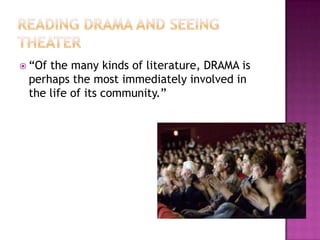
 “Of the many kinds of literature, DRAMA is
perhaps the most immediately involved in
the life of its community.”
 “Of the many kinds of literature, DRAMA is
perhaps the most immediately involved in
the life of its community.”
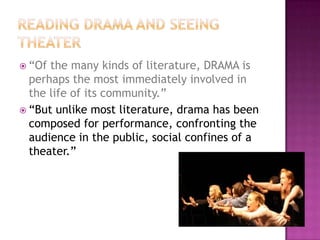
 “But unlike most literature, drama has been
composed for performance, confronting the
audience in the public, social confines of a
theater.”
 “Of the many kinds of literature, DRAMA is
perhaps the most immediately involved in
the life of its community.”
 “But unlike most literature, drama has been
composed for performance, confronting the
audience in the public, social confines of a
theater.”
 “To understand drama, we need to
understand THEATER, because the theater
forges the active interplay between drama &
its community.”
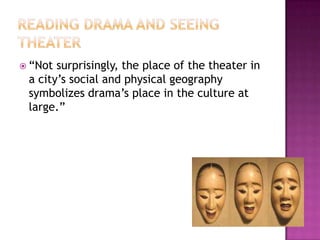
 “Not surprisingly, the place of the theater in
a city’s social and physical geography
symbolizes drama’s place in the culture at
large.”
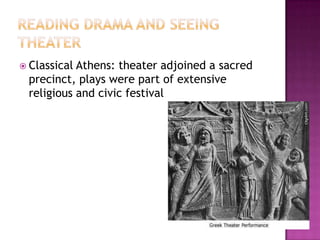
 Classical Athens: theater adjoined a sacred
precinct, plays were part of extensive
religious and civic festival
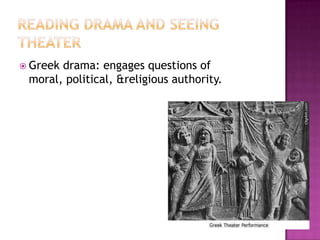
 Greek drama: engages questions of
moral, political, &religious authority.
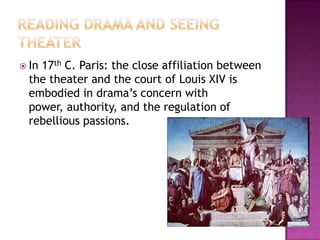
 In 17th C. Paris: the close affiliation between
the theater and the court of Louis XIV is
embodied in drama’s concern with
power, authority, and the regulation of
rebellious passions.
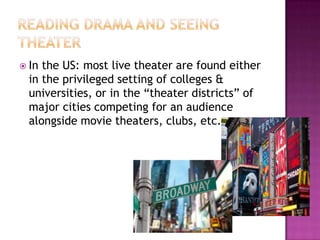
 In the US: most live theater are found either
in the privileged setting of colleges &
universities, or in the “theater districts” of
major cities competing for an audience
alongside movie theaters, clubs, etc.
 “Staging a play puts it immediately into a
dynamic social exchange: the interaction
between dramatic characters, between
characters and the actors who play
them, between the performers and the
audience, between the drama onstage and
the drama of life outside the theater.
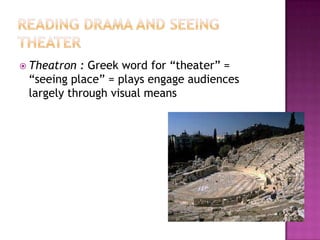
 Theatron : Greek word for “theater” =
“seeing place” = plays engage audiences
largely through visual means
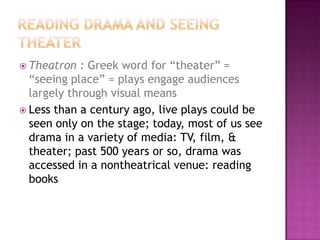
 Theatron : Greek word for “theater” =
“seeing place” = plays engage audiences
largely through visual means
 Less than a century ago, live plays could be
seen only on the stage; today, most of us see
drama in a variety of media: TV, film, &
theater; past 500 years or so, drama was
accessed in a nontheatrical venue: reading
books
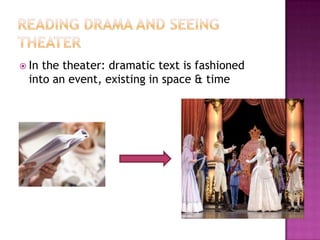
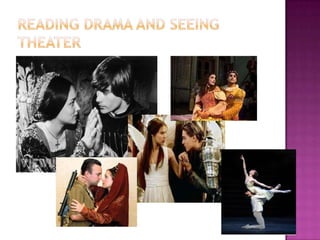
 In the theater: dramatic text is fashioned
into an event, existing in space & time
 In the theater: dramatic text is fashioned
into an event, existing in space & time
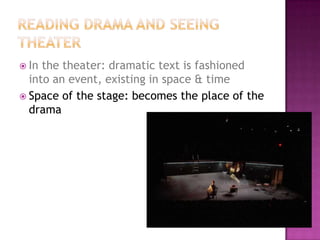
 Space of the stage: becomes the place of the
drama
 In the theater: dramatic text is fashioned
into an event, existing in space & time
 Space of the stage: becomes the place of the
drama
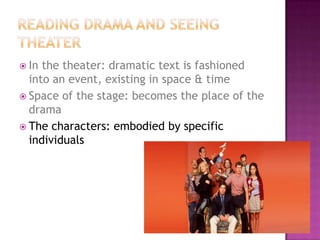
 The characters: embodied by specific
individuals
 In the theater: dramatic text is fashioned
into an event, existing in space & time
 Space of the stage: becomes the place of the
drama
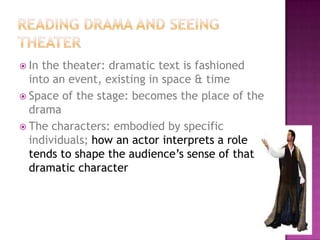
 The characters: embodied by specific
individuals; how an actor interprets a role
tends to shape the audience’s sense of that
dramatic character
 THE DRAMA ONSTAGE is bound by the
temporal exigencies of performance.
 THE DRAMA ONSTAGE is bound by the
temporal exigencies of performance.
 THE PROCESS OF PERFORMANCE is
irreversible.
 THE DRAMA ONSTAGE is bound by the
temporal exigencies of performance.
 THE PROCESS OF PERFORMANCE is
irreversible.
 EACH MOMENT becomes significant yet
unrecoverable.
 THE DRAMA ONSTAGE is bound by the
temporal exigencies of performance.
 THE PROCESS OF PERFORMANCE is
irreversible.
 EACH MOMENT becomes significant yet
unrecoverable.
 A THEATER COMPANY inevitably confronts
material facts of the theater: a specific cast
of actors
 THE DRAMA ONSTAGE is bound by the
temporal exigencies of performance.
 THE PROCESS OF PERFORMANCE is
irreversible.
 EACH MOMENT becomes significant yet
unrecoverable.
 A THEATER COMPANY inevitably confronts
material facts of the theater: a specific cast
of actors, a given theatrical space,
 THE DRAMA ONSTAGE is bound by the
temporal exigencies of performance.
 THE PROCESS OF PERFORMANCE is
irreversible.
 EACH MOMENT becomes significant yet
unrecoverable.
 A THEATER COMPANY inevitably confronts
material facts of the theater: a specific cast
of actors, a given theatrical space, a certain
amount of money,
 THE DRAMA ONSTAGE is bound by the
temporal exigencies of performance.
 THE PROCESS OF PERFORMANCE is
irreversible.
 EACH MOMENT becomes significant yet
unrecoverable.
 A THEATER COMPANY inevitably confronts
material facts of the theater: a specific cast
of actors, a given theatrical space, a certain
amount of money, & the necessity to
transform the rich possibilities offered by the
play into a clear & meaningful performance.
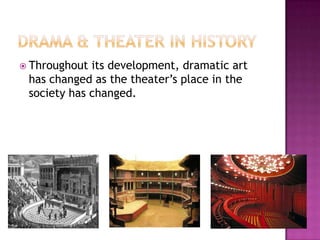
 Throughout its development, dramatic art
has changed as the theater’s place in the
society has changed.
 Throughout its development, dramatic art
has changed as the theater’s place in the
society has changed.
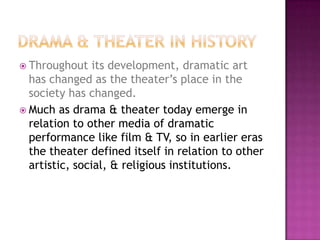
 Much as drama & theater today emerge in
relation to other media of dramatic
performance like film & TV, so in earlier eras
the theater defined itself in relation to other
artistic, social, & religious institutions.
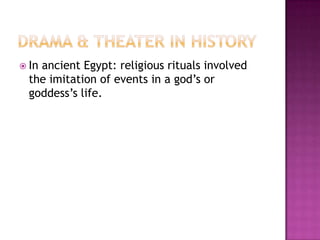
 In ancient Egypt: religious rituals involved
the imitation of events in a god’s or
goddess’s life.
 In ancient Egypt: religious rituals involved
the imitation of events in a god’s or
goddess’s life.
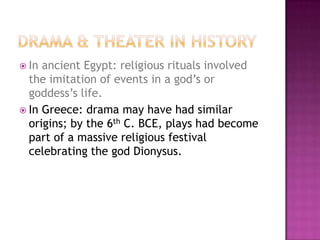
 In Greece: drama may have had similar
origins; by the 6th C. BCE, plays had become
part of a massive religious festival
celebrating the god Dionysus.
 In ancient Egypt: religious rituals involved the
imitation of events in a god’s or goddess’s life.
 In Greece: drama may have had similar origins;
by the 6th C. BCE, plays had become part of a
massive religious festival celebrating the god
Dionysus.
 In Europe: theater waned with the decline of the
Roman Empire & the systematic efforts of the
Catholic church to prevent theatrical
performance. Yet, emerged with the church
support when revived in the late Middle Ages.
 In feudal Japan: the Buddhists developed a
form of theater to illustrate the central
concepts of their faith(12th through 13th
centuries).
 In feudal Japan: the Buddhists developed a
form of theater to illustrate the central
concepts of their faith(12th through 13th
centuries).
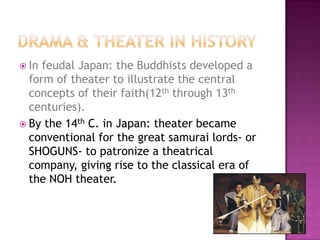
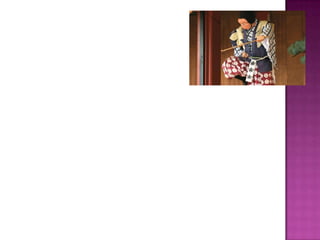
 By the 14th C. in Japan: theater became
conventional for the great samurai lords- or
SHOGUNS- to patronize a theatrical
company, giving rise to the classical era of
the NOH theater.
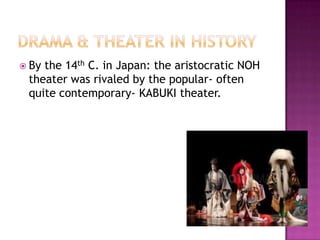
 By the 14th C. in Japan: the aristocratic NOH
theater was rivaled by the popular- often
quite contemporary- KABUKI theater.
 In classical & medieval Europe: secular
performance also took place.
 In classical & medieval Europe: secular
performance also took place.
 Many plays were performed only on religious
occasions, though, and their performers were
usually itinerant, lacking the social and
institutional support that would provide
them with lasting & continuous existence.
 In classical & medieval Europe: secular
performance also took place.
 Many plays were performed only on religious
occasions, though, and their performers were
usually itinerant, lacking the social and
institutional support that would provide
them with lasting & continuous existence.
 In the Renaissance of the 15th & 16th C.: the
Western theater became a fully
secular, profit-making, & commercial
enterprise.
 In the 16th C.: the European theater was part
of a secular entertainment
market, competing with bear-baiting, animal
shows, athletic contests, public
executions, royal & civic pageants, public
preaching, & many other attractions to draw
a paying public.
 In the 16th C.: the European theater was part
of a secular entertainment
market, competing with bear-baiting, animal
shows, athletic contests, public
executions, royal & civic pageants, public
preaching, & many other attractions to draw
a paying public.
 Also, the theater in this period emerged as a
distinct institution, supported by its own
income;
 In the 16th C.: the European theater was part
of a secular entertainment market,
competing with bear-baiting, animal shows,
athletic contests, public executions, royal &
civic pageants, public preaching, & many
other attractions to draw a paying public.
 Also, the theater in this period emerged as a
distinct institution, supported by its own
income; the theater became a trade, a
profession, a business, rather than a
necessary function of the state or religious
worship.
 In other words, plays were not considered
serious, permanent literature.
 In other words, plays were not considered
serious, permanent literature.
 HOWEVER, there was also the desire to
transform drama from ephemeral theatrical
“entertainment” into permanent literary
“art” and it began to be registered in the
Renaissance.
 In other words, plays were not considered
serious, permanent literature.
 HOWEVER, there was also the desire to
transform drama from ephemeral theatrical
“entertainment” into permanent literary
“art” and it began to be registered in the
Renaissance.
 HOWEVER, there was also the desire to transform drama
from ephemeral theatrical “entertainment” into
permanent literary “art” and it began to be registered in
the Renaissance.
 In the 1616: edition of Works by the poet &
playwright Ben Jonson, he insisted on
publishing the importance of the volume by
publishing it in the large, FOLIO format
generally reserved for classical authors.
 HOWEVER, there was also the desire to transform drama
from ephemeral theatrical “entertainment” into
permanent literary “art” and it began to be registered in
the Renaissance.
 In the 1616: edition of Works by the poet & playwright Ben
Jonson, he insisted on publishing the importance of the
volume by publishing it in the large, FOLIO format
generally reserved for classical authors.
 In 1623: seven years after W. Shakespeare’s
death, his friends & colleagues published a
similar, folio-sized collection of his plays.
 By the 1660s & 1670s: writers at the court of
Louis XIV in Paris achieved both literary &
social distinction as dramatists.
 By the 1660s & 1670s: writers at the court of
Louis XIV in Paris achieved both literary &
social distinction as dramatists.
 Yet, despite many notable exceptions, the
theatrical origins of drama prevented
contemporary plays from being regarded as
“literature”- although plays from earlier eras
were increasingly republished & gradually
seen to have achieved “literary” merit.
 By the 1660s & 1670s: writers at the court of
Louis XIV in Paris achieved both literary &
social distinction as dramatists.
 Yet, despite many notable exceptions, the
theatrical origins of drama prevented
contemporary plays from being regarded as
“literature”- although plays from earlier eras
were increasingly republished & gradually
seen to have achieved “literary” merit.
 By the 19th C.: contemporary plays achieved
“literary” recognition by avoiding the
theater altogether.
 In the late 19th C.: great playwrights carved a
space for themselves as dramatists by writing
plays that were unstageable.
 In the late 19th C.: great playwrights carved a
space for themselves as dramatists by writing
plays that were unstageable.
 20th-century drama & theater: there was a
split between “literary drama” & the
“popular theater.”
 In the late 19th C.: great playwrights carved a
space for themselves as dramatists by writing
plays that were unstageable.
 20th-century drama & theater: there was a
split between “literary drama” & the
“popular theater.”
 Plays of the artistic AVANT-GARDE were more
readily absorbed into the CANON of
literature, while more conventional
entertainments-TV screenplays, for instance-
remained outside of it.
 Dramatic GENRES are kinds of drama, each
with its own identifying formal structure &
typical themes.
 Dramatic GENRES are kinds of drama, each
with its own identifying formal structure &
typical themes.
 TRAGEDY: usually considered to concern the
fate of an individual hero, singled out from
the community through circumstances and
through his or her own actions.
 Dramatic GENRES are kinds of drama, each
with its own identifying formal structure &
typical themes.
 TRAGEDY: usually considered to concern the
fate of an individual hero, singled out from
the community through circumstances and
through his or her own actions.
 TRAGEDY: the hero’s course of action
entwines with events & circumstances
beyond his or her own control.
 TRAGEDY: as a result, the hero’s final
downfall-usually, but not always involving
death-seems at once both chosen and
inevitable.
 TRAGEDY: as a result, the hero’s final
downfall-usually, but not always involving
death-seems at once both chosen and
inevitable.
 COMEDY: focuses on the fortunes of the
community itself.
 TRAGEDY: as a result, the hero’s final
downfall-usually, but not always involving
death-seems at once both chosen and
inevitable.
 COMEDY: focuses on the fortunes of the
community itself.
 COMEDY: while the hero of tragedy is usually
unique, the heroes of comedy often come in
pairs: the lovers who triumph over their
parents in romantic comedies, the dupe &
the trickster at the center of more ironic or
satirical comic modes.
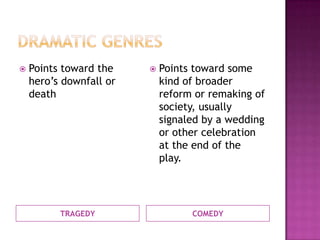
TRAGEDY COMEDY
 Points toward the
hero’s downfall or
death
 Points toward some
kind of broader
reform or remaking of
society, usually
signaled by a wedding
or other celebration
at the end of the
play.
 OTHER GENRES:
 Melodrama
 Tragicomedy
 Farce
 Neoclassical drama
 Theater of the absurd
 Revenge tragedy
 In about 335 BCE: Aristotle’s Poetics set
down the formal elements of drama through
MUSIC & SPECTACLE
 In about 335 BCE: Aristotle’s Poetics set
down the formal elements of drama through
MUSIC & SPECTACLE
 Modern elements: plot, characters, dialogue,
theme, convention, genre, & audience
Reference:
Worthen, W. B. (2000). The Harcourt Brace anthology of
drama, 3rd edition. USA: Thomson Heinle.

introductiontodramatheaterandculture-130110024029-phpapp02.pdf

  • 1.
    Analiza Perez-Amurao Humanities andLanguages Division MUIC
  • 2.
     “Of themany kinds of literature, DRAMA is perhaps the most immediately involved in the life of its community.”
  • 3.
     “Of themany kinds of literature, DRAMA is perhaps the most immediately involved in the life of its community.”  “But unlike most literature, drama has been composed for performance, confronting the audience in the public, social confines of a theater.”
  • 4.
     “Of themany kinds of literature, DRAMA is perhaps the most immediately involved in the life of its community.”  “But unlike most literature, drama has been composed for performance, confronting the audience in the public, social confines of a theater.”  “To understand drama, we need to understand THEATER, because the theater forges the active interplay between drama & its community.”
  • 5.
     “Not surprisingly,the place of the theater in a city’s social and physical geography symbolizes drama’s place in the culture at large.”
  • 6.
     Classical Athens:theater adjoined a sacred precinct, plays were part of extensive religious and civic festival
  • 7.
     Greek drama:engages questions of moral, political, &religious authority.
  • 8.
     In 17thC. Paris: the close affiliation between the theater and the court of Louis XIV is embodied in drama’s concern with power, authority, and the regulation of rebellious passions.
  • 9.
     In theUS: most live theater are found either in the privileged setting of colleges & universities, or in the “theater districts” of major cities competing for an audience alongside movie theaters, clubs, etc.
  • 10.
     “Staging aplay puts it immediately into a dynamic social exchange: the interaction between dramatic characters, between characters and the actors who play them, between the performers and the audience, between the drama onstage and the drama of life outside the theater.
  • 11.
     Theatron :Greek word for “theater” = “seeing place” = plays engage audiences largely through visual means
  • 12.
     Theatron :Greek word for “theater” = “seeing place” = plays engage audiences largely through visual means  Less than a century ago, live plays could be seen only on the stage; today, most of us see drama in a variety of media: TV, film, & theater; past 500 years or so, drama was accessed in a nontheatrical venue: reading books
  • 13.
     In thetheater: dramatic text is fashioned into an event, existing in space & time
  • 14.
     In thetheater: dramatic text is fashioned into an event, existing in space & time  Space of the stage: becomes the place of the drama
  • 15.
     In thetheater: dramatic text is fashioned into an event, existing in space & time  Space of the stage: becomes the place of the drama  The characters: embodied by specific individuals
  • 16.
     In thetheater: dramatic text is fashioned into an event, existing in space & time  Space of the stage: becomes the place of the drama  The characters: embodied by specific individuals; how an actor interprets a role tends to shape the audience’s sense of that dramatic character
  • 17.
     THE DRAMAONSTAGE is bound by the temporal exigencies of performance.
  • 18.
     THE DRAMAONSTAGE is bound by the temporal exigencies of performance.  THE PROCESS OF PERFORMANCE is irreversible.
  • 19.
     THE DRAMAONSTAGE is bound by the temporal exigencies of performance.  THE PROCESS OF PERFORMANCE is irreversible.  EACH MOMENT becomes significant yet unrecoverable.
  • 20.
     THE DRAMAONSTAGE is bound by the temporal exigencies of performance.  THE PROCESS OF PERFORMANCE is irreversible.  EACH MOMENT becomes significant yet unrecoverable.  A THEATER COMPANY inevitably confronts material facts of the theater: a specific cast of actors
  • 21.
     THE DRAMAONSTAGE is bound by the temporal exigencies of performance.  THE PROCESS OF PERFORMANCE is irreversible.  EACH MOMENT becomes significant yet unrecoverable.  A THEATER COMPANY inevitably confronts material facts of the theater: a specific cast of actors, a given theatrical space,
  • 22.
     THE DRAMAONSTAGE is bound by the temporal exigencies of performance.  THE PROCESS OF PERFORMANCE is irreversible.  EACH MOMENT becomes significant yet unrecoverable.  A THEATER COMPANY inevitably confronts material facts of the theater: a specific cast of actors, a given theatrical space, a certain amount of money,
  • 23.
     THE DRAMAONSTAGE is bound by the temporal exigencies of performance.  THE PROCESS OF PERFORMANCE is irreversible.  EACH MOMENT becomes significant yet unrecoverable.  A THEATER COMPANY inevitably confronts material facts of the theater: a specific cast of actors, a given theatrical space, a certain amount of money, & the necessity to transform the rich possibilities offered by the play into a clear & meaningful performance.
  • 25.
     Throughout itsdevelopment, dramatic art has changed as the theater’s place in the society has changed.
  • 26.
     Throughout itsdevelopment, dramatic art has changed as the theater’s place in the society has changed.  Much as drama & theater today emerge in relation to other media of dramatic performance like film & TV, so in earlier eras the theater defined itself in relation to other artistic, social, & religious institutions.
  • 27.
     In ancientEgypt: religious rituals involved the imitation of events in a god’s or goddess’s life.
  • 28.
     In ancientEgypt: religious rituals involved the imitation of events in a god’s or goddess’s life.  In Greece: drama may have had similar origins; by the 6th C. BCE, plays had become part of a massive religious festival celebrating the god Dionysus.
  • 29.
     In ancientEgypt: religious rituals involved the imitation of events in a god’s or goddess’s life.  In Greece: drama may have had similar origins; by the 6th C. BCE, plays had become part of a massive religious festival celebrating the god Dionysus.  In Europe: theater waned with the decline of the Roman Empire & the systematic efforts of the Catholic church to prevent theatrical performance. Yet, emerged with the church support when revived in the late Middle Ages.
  • 30.
     In feudalJapan: the Buddhists developed a form of theater to illustrate the central concepts of their faith(12th through 13th centuries).
  • 31.
     In feudalJapan: the Buddhists developed a form of theater to illustrate the central concepts of their faith(12th through 13th centuries).  By the 14th C. in Japan: theater became conventional for the great samurai lords- or SHOGUNS- to patronize a theatrical company, giving rise to the classical era of the NOH theater.
  • 33.
     By the14th C. in Japan: the aristocratic NOH theater was rivaled by the popular- often quite contemporary- KABUKI theater.
  • 34.
     In classical& medieval Europe: secular performance also took place.
  • 35.
     In classical& medieval Europe: secular performance also took place.  Many plays were performed only on religious occasions, though, and their performers were usually itinerant, lacking the social and institutional support that would provide them with lasting & continuous existence.
  • 36.
     In classical& medieval Europe: secular performance also took place.  Many plays were performed only on religious occasions, though, and their performers were usually itinerant, lacking the social and institutional support that would provide them with lasting & continuous existence.  In the Renaissance of the 15th & 16th C.: the Western theater became a fully secular, profit-making, & commercial enterprise.
  • 37.
     In the16th C.: the European theater was part of a secular entertainment market, competing with bear-baiting, animal shows, athletic contests, public executions, royal & civic pageants, public preaching, & many other attractions to draw a paying public.
  • 38.
     In the16th C.: the European theater was part of a secular entertainment market, competing with bear-baiting, animal shows, athletic contests, public executions, royal & civic pageants, public preaching, & many other attractions to draw a paying public.  Also, the theater in this period emerged as a distinct institution, supported by its own income;
  • 39.
     In the16th C.: the European theater was part of a secular entertainment market, competing with bear-baiting, animal shows, athletic contests, public executions, royal & civic pageants, public preaching, & many other attractions to draw a paying public.  Also, the theater in this period emerged as a distinct institution, supported by its own income; the theater became a trade, a profession, a business, rather than a necessary function of the state or religious worship.
  • 40.
     In otherwords, plays were not considered serious, permanent literature.
  • 41.
     In otherwords, plays were not considered serious, permanent literature.  HOWEVER, there was also the desire to transform drama from ephemeral theatrical “entertainment” into permanent literary “art” and it began to be registered in the Renaissance.
  • 42.
     In otherwords, plays were not considered serious, permanent literature.  HOWEVER, there was also the desire to transform drama from ephemeral theatrical “entertainment” into permanent literary “art” and it began to be registered in the Renaissance.
  • 43.
     HOWEVER, therewas also the desire to transform drama from ephemeral theatrical “entertainment” into permanent literary “art” and it began to be registered in the Renaissance.  In the 1616: edition of Works by the poet & playwright Ben Jonson, he insisted on publishing the importance of the volume by publishing it in the large, FOLIO format generally reserved for classical authors.
  • 44.
     HOWEVER, therewas also the desire to transform drama from ephemeral theatrical “entertainment” into permanent literary “art” and it began to be registered in the Renaissance.  In the 1616: edition of Works by the poet & playwright Ben Jonson, he insisted on publishing the importance of the volume by publishing it in the large, FOLIO format generally reserved for classical authors.  In 1623: seven years after W. Shakespeare’s death, his friends & colleagues published a similar, folio-sized collection of his plays.
  • 45.
     By the1660s & 1670s: writers at the court of Louis XIV in Paris achieved both literary & social distinction as dramatists.
  • 46.
     By the1660s & 1670s: writers at the court of Louis XIV in Paris achieved both literary & social distinction as dramatists.  Yet, despite many notable exceptions, the theatrical origins of drama prevented contemporary plays from being regarded as “literature”- although plays from earlier eras were increasingly republished & gradually seen to have achieved “literary” merit.
  • 47.
     By the1660s & 1670s: writers at the court of Louis XIV in Paris achieved both literary & social distinction as dramatists.  Yet, despite many notable exceptions, the theatrical origins of drama prevented contemporary plays from being regarded as “literature”- although plays from earlier eras were increasingly republished & gradually seen to have achieved “literary” merit.  By the 19th C.: contemporary plays achieved “literary” recognition by avoiding the theater altogether.
  • 48.
     In thelate 19th C.: great playwrights carved a space for themselves as dramatists by writing plays that were unstageable.
  • 49.
     In thelate 19th C.: great playwrights carved a space for themselves as dramatists by writing plays that were unstageable.  20th-century drama & theater: there was a split between “literary drama” & the “popular theater.”
  • 50.
     In thelate 19th C.: great playwrights carved a space for themselves as dramatists by writing plays that were unstageable.  20th-century drama & theater: there was a split between “literary drama” & the “popular theater.”  Plays of the artistic AVANT-GARDE were more readily absorbed into the CANON of literature, while more conventional entertainments-TV screenplays, for instance- remained outside of it.
  • 51.
     Dramatic GENRESare kinds of drama, each with its own identifying formal structure & typical themes.
  • 52.
     Dramatic GENRESare kinds of drama, each with its own identifying formal structure & typical themes.  TRAGEDY: usually considered to concern the fate of an individual hero, singled out from the community through circumstances and through his or her own actions.
  • 53.
     Dramatic GENRESare kinds of drama, each with its own identifying formal structure & typical themes.  TRAGEDY: usually considered to concern the fate of an individual hero, singled out from the community through circumstances and through his or her own actions.  TRAGEDY: the hero’s course of action entwines with events & circumstances beyond his or her own control.
  • 54.
     TRAGEDY: asa result, the hero’s final downfall-usually, but not always involving death-seems at once both chosen and inevitable.
  • 55.
     TRAGEDY: asa result, the hero’s final downfall-usually, but not always involving death-seems at once both chosen and inevitable.  COMEDY: focuses on the fortunes of the community itself.
  • 56.
     TRAGEDY: asa result, the hero’s final downfall-usually, but not always involving death-seems at once both chosen and inevitable.  COMEDY: focuses on the fortunes of the community itself.  COMEDY: while the hero of tragedy is usually unique, the heroes of comedy often come in pairs: the lovers who triumph over their parents in romantic comedies, the dupe & the trickster at the center of more ironic or satirical comic modes.
  • 57.
    TRAGEDY COMEDY  Pointstoward the hero’s downfall or death  Points toward some kind of broader reform or remaking of society, usually signaled by a wedding or other celebration at the end of the play.
  • 58.
     OTHER GENRES: Melodrama  Tragicomedy  Farce  Neoclassical drama  Theater of the absurd  Revenge tragedy
  • 59.
     In about335 BCE: Aristotle’s Poetics set down the formal elements of drama through MUSIC & SPECTACLE
  • 60.
     In about335 BCE: Aristotle’s Poetics set down the formal elements of drama through MUSIC & SPECTACLE  Modern elements: plot, characters, dialogue, theme, convention, genre, & audience
  • 61.
    Reference: Worthen, W. B.(2000). The Harcourt Brace anthology of drama, 3rd edition. USA: Thomson Heinle.