Introduction Class
• MODULE 1 PRINCIPLES OF ENERGY CONVERSION
Faraday's law of electromagnetic induction -singly and doubly
excited magnetic field systems -EMF and torque production in
rotating machines.
• MODULE 2 DC GENERATORS
Construction – Windings – Principle of operation – Types –
Characteristics. Armature reaction and commutation - parallel
operation-Applications
• MODULE 3 DC MOTORS
Principle of operation – Types – Characteristics – Starting and
Speed control –Various testing- Applications
• MODULE 4 TRANSFORMERS
Construction – Principle of operation – Types – phasor diagram
of practical transformer on no load and load – Equivalent circuit –
Voltage regulation and efficiency- Auto transformer.-Applications
• MODULE 5 TRANSFORMER TESTING
Testing of transformers –Polarity, open circuit, short circuit and
Sumpner‟s test –Three phase transformers connections- Parallel
operation
Syllabus
19UEE303 - Electrical Machines – I 2
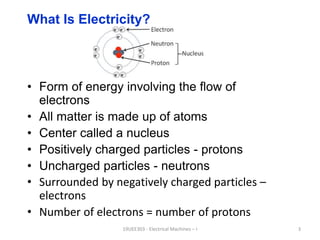
What Is Electricity?
• Form of energy involving the flow of
electrons
• All matter is made up of atoms
• Center called a nucleus
• Positively charged particles - protons
• Uncharged particles - neutrons
• Surrounded by negatively charged particles –
electrons
• Number of electrons = number of protons
19UEE303 - Electrical Machines – I 3
What is an Electromotive Force?
• Force that acts on the electrons to make them move
in a certain direction - voltage
• Work done on a unit electric charge
• Unit : volts (joules/ coulombs)
Electrical power - Rate at which energy is being
used or generated
• Unit: watts
Energy - rate at which work is being done
• Unit: joules (J) (watt-second)
Direct current (DC) - does not change direction
AC current - charges continually change direction
19UEE303 - Electrical Machines – I 4
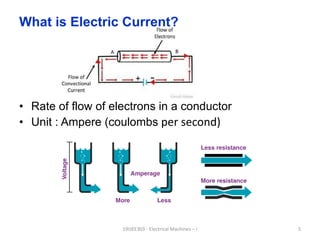
What is Electric Current?
• Rate of flow of electrons in a conductor
• Unit : Ampere (coulombs per second)
19UEE303 - Electrical Machines – I 5
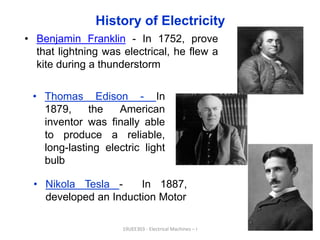
History of Electricity
• Benjamin Franklin - In 1752, prove
that lightning was electrical, he flew a
kite during a thunderstorm
6
19UEE303 - Electrical Machines – I
• Thomas Edison - In
1879, the American
inventor was finally able
to produce a reliable,
long-lasting electric light
bulb
• Nikola Tesla - In 1887,
developed an Induction Motor
19UEE303 - Electrical Machines – I 7
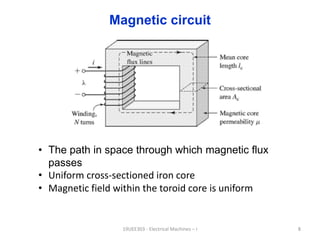
Magnetic circuit
19UEE303 - Electrical Machines – I 8
• The path in space through which magnetic flux
passes
• Uniform cross-sectioned iron core
• Magnetic field within the toroid core is uniform
Terms involved in Magnetic Circuits
• Magnetomotive force F = N I
• Magnetic flux φ
• Reluctance R
• Permeability µ
• Magnetic flux density B
• Magnetic field intensity H
19UEE303 - Electrical Machines – I 9

Introduction about the electrical machines

  • 1.
  • 2.
    • MODULE 1PRINCIPLES OF ENERGY CONVERSION Faraday's law of electromagnetic induction -singly and doubly excited magnetic field systems -EMF and torque production in rotating machines. • MODULE 2 DC GENERATORS Construction – Windings – Principle of operation – Types – Characteristics. Armature reaction and commutation - parallel operation-Applications • MODULE 3 DC MOTORS Principle of operation – Types – Characteristics – Starting and Speed control –Various testing- Applications • MODULE 4 TRANSFORMERS Construction – Principle of operation – Types – phasor diagram of practical transformer on no load and load – Equivalent circuit – Voltage regulation and efficiency- Auto transformer.-Applications • MODULE 5 TRANSFORMER TESTING Testing of transformers –Polarity, open circuit, short circuit and Sumpner‟s test –Three phase transformers connections- Parallel operation Syllabus 19UEE303 - Electrical Machines – I 2
  • 3.
    What Is Electricity? •Form of energy involving the flow of electrons • All matter is made up of atoms • Center called a nucleus • Positively charged particles - protons • Uncharged particles - neutrons • Surrounded by negatively charged particles – electrons • Number of electrons = number of protons 19UEE303 - Electrical Machines – I 3
  • 4.
    What is anElectromotive Force? • Force that acts on the electrons to make them move in a certain direction - voltage • Work done on a unit electric charge • Unit : volts (joules/ coulombs) Electrical power - Rate at which energy is being used or generated • Unit: watts Energy - rate at which work is being done • Unit: joules (J) (watt-second) Direct current (DC) - does not change direction AC current - charges continually change direction 19UEE303 - Electrical Machines – I 4
  • 5.
    What is ElectricCurrent? • Rate of flow of electrons in a conductor • Unit : Ampere (coulombs per second) 19UEE303 - Electrical Machines – I 5
  • 6.
    History of Electricity •Benjamin Franklin - In 1752, prove that lightning was electrical, he flew a kite during a thunderstorm 6 19UEE303 - Electrical Machines – I • Thomas Edison - In 1879, the American inventor was finally able to produce a reliable, long-lasting electric light bulb • Nikola Tesla - In 1887, developed an Induction Motor
  • 7.
    19UEE303 - ElectricalMachines – I 7
  • 8.
    Magnetic circuit 19UEE303 -Electrical Machines – I 8 • The path in space through which magnetic flux passes • Uniform cross-sectioned iron core • Magnetic field within the toroid core is uniform
  • 9.
    Terms involved inMagnetic Circuits • Magnetomotive force F = N I • Magnetic flux φ • Reluctance R • Permeability µ • Magnetic flux density B • Magnetic field intensity H 19UEE303 - Electrical Machines – I 9