Introducing the
Civil Infrastructure Platform
Jan Kiszka and Yoshitake Kobayashi
LinuxCon Japan, 13-15 July, 2016
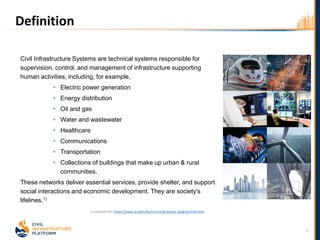
Civil Infrastructure Systems are technical systems responsible for
supervision, control, and management of infrastructure supporting
human activities, including, for example,
 Electric power generation
 Energy distribution
 Oil and gas
 Water and wastewater
 Healthcare
 Communications
 Transportation
 Collections of buildings that make up urban & rural
communities.
These networks deliver essential services, provide shelter, and support
social interactions and economic development. They are society's
lifelines.1)
2
Definition
1) adapted from https://www.ce.udel.edu/current/graduate_program/civil.html
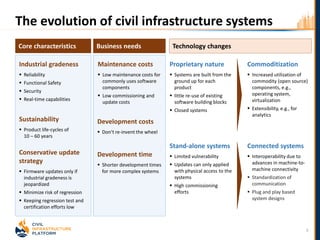
The evolution of civil infrastructure systems
Core characteristics
Industrial gradeness
 Reliability
 Functional Safety
 Security
 Real-time capabilities
Sustainability
 Product life-cycles of
10 – 60 years
Conservative update
strategy
 Firmware updates only if
industrial gradeness is
jeopardized
 Minimize risk of regression
 Keeping regression test and
certification efforts low
Connected systems
 Interoperability due to
advances in machine-to-
machine connectivity
 Standardization of
communication
 Plug and play based
system designs
Stand-alone systems
 Limited vulnerability
 Updates can only applied
with physical access to the
systems
 High commissioning
efforts
Proprietary nature
 Systems are built from the
ground up for each
product
 little re-use of existing
software building blocks
 Closed systems
Commoditization
 Increased utilization of
commodity (open source)
components, e.g.,
operating system,
virtualization
 Extensibility, e.g., for
analytics
Technology changes
Development time
 Shorter development times
for more complex systems
Maintenance costs
 Low maintenance costs for
commonly uses software
components
 Low commissioning and
update costs
Business needs
Development costs
 Don‘t re-invent the wheel
3
Things to be done
• Join forces for commodity components
• Ensure industrial gradeness for the operating system
platform focusing on reliability, security, and functional
safety.
• Increase upstream work in order to increase quality
and to avoid maintenance of patches
• Share maintenance costs
• Long-term availability and long-term support are
crucial
• Innovate for future technology
• Support industrial IoT architectures and
state-of-the art machine-to-machine connectivity
4
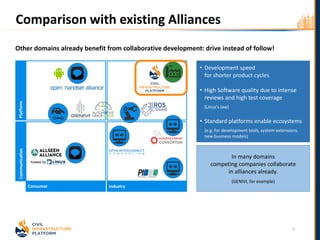
Comparison with existing Alliances
Other domains already benefit from collaborative development: drive instead of follow!
5
In many domains
competing companies collaborate
in alliances already.
(GENIVI, for example)
• Development speed
for shorter product cycles
• High Software quality due to intense
reviews and high test coverage
(Linus’s law)
• Standard platforms enable ecosystems
(e.g. for development tools, system extensions,
new business models)
Consumer Industry
PlatformCommunication
hosted by
Civil Infrastructure Platform to provide software building blocks that support
reliable transportation, power, oil and gas, and healthcare infrastructure
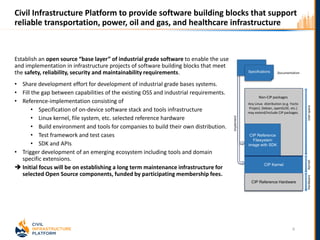
Establish an open source “base layer” of industrial grade software to enable the use
and implementation in infrastructure projects of software building blocks that meet
the safety, reliability, security and maintainability requirements.
• Share development effort for development of industrial grade bases systems.
• Fill the gap between capabilities of the existing OSS and industrial requirements.
• Reference-implementation consisting of
• Specification of on-device software stack and tools infrastructure
• Linux kernel, file system, etc. selected reference hardware
• Build environment and tools for companies to build their own distribution.
• Test framework and test cases
• SDK and APIs
• Trigger development of an emerging ecosystem including tools and domain
specific extensions.
 Initial focus will be on establishing a long term maintenance infrastructure for
selected Open Source components, funded by participating membership fees.
6
CIP Reference Hardware
CIP Reference
Filesystem
image with SDK
CIP Kernel
UserspaceKernel
Non-CIP packages
Any Linux distribution (e.g. Yocto
Project, Debian, openSUSE, etc.)
may extend/include CIP packages.
Hardware
Specifications Documentation
Implement
7
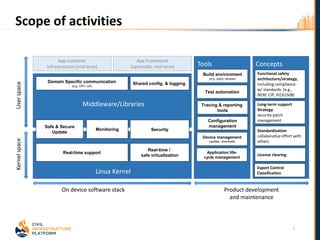
Scope of activitiesUserspaceKernelspace
Linux Kernel
App container
infrastructure (mid-term)
App Framework
(optionally, mid-term)
Middleware/Libraries
Safe & Secure
Update
Monitoring
Domain Specific communication
(e.g. OPC UA)
Shared config. & logging
Real-time support
Real-time /
safe virtualization
Tools Concepts
Build environment
(e.g. yocto recipes)
Test automation
Tracing & reporting
tools
Configuration
management
Device management
(update, download)
Functional safety
architecture/strategy,
including compliance
w/ standards (e.g.,
NERC CIP, IEC61508)
Long-term support
Strategy:
security patch
management
Standardization
collaborative effort with
others
License clearing
Export Control
Classification
On device software stack Product development
and maintenance
Application life-
cycle management
Security
8
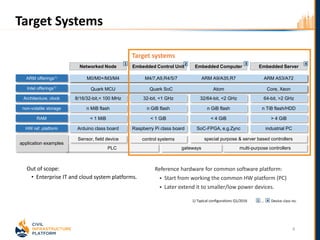
Target Systems
Out of scope:
• Enterprise IT and cloud system platforms.
… Device class no.
ARM M0/M0+/M3/M4
8/16/32-bit,< 100 MHz 32-bit, <1 GHz 32/64-bit, <2 GHz 64-bit, >2 GHz
n MiB flash n GiB flash n GiB flash n TiB flash/HDD
< 1 MiB < 1 GiB < 4 GiB > 4 GiB
Arduino class board Raspberry Pi class board SoC-FPGA, e.g.Zync industrial PC
ARM M4/7,A9,R4/5/7
Networked Node Embedded ServerEmbedded ComputerEmbedded Control Unit
special purpose & server based controllerscontrol systems
multi-purpose controllersPLC gateways
Sensor, field device
1 2 3 4
ARM A9/A35,R7,Intel Atom
Architecture, clock
non-volatile storage
HW ref. platform
ARM offerings1)
RAM
application examples
ARM A53/A72,Core,Xeon
Intel offerings1)
M0/M0+/M3/M4 M4/7,A9,R4/5/7 ARM A9/A35,R7 ARM A53/A72
ARM M0/M0+/M3/M4 ARM M4/7,A9,R4/5/7 ARM A9/A35,R7,Intel Atom ARM A53/A72,Core,XeonQuark MCU Quark SoC Atom Core, Xeon
Target systems
Reference hardware for common software platform:
 Start from working the common HW platform (PC)
 Later extend it to smaller/low power devices.
1 41) Typical configurations Q1/2016
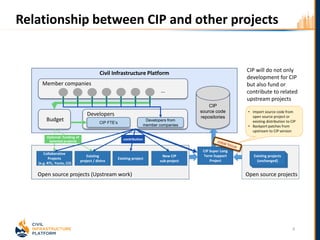
Relationship between CIP and other projects
9
Civil Infrastructure Platform
Collaborative
Projects
(e.g. RTL, Yocto, CII)
Existing
project / distro
New CIP
sub-project
Developers
CIP FTE’s
Developers from
member companies
Budget
Member companies
…
Existing project
CIP
source code
repositories
Open source projects (Upstream work)
contribution
Optional: funding of
selected projects
CIP will do not only
development for CIP
but also fund or
contribute to related
upstream projects
Existing projects
(unchanged)
Open source projects
CIP Super Long
Term Support
Project
• Import source code from
open source project or
existing distribution to CIP
• Backport patches from
upstream to CIP version
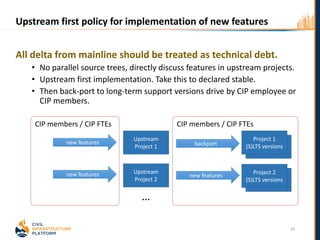
Upstream first policy for implementation of new features
All delta from mainline should be treated as technical debt.
• No parallel source trees, directly discuss features in upstream projects.
• Upstream first implementation. Take this to declared stable.
• Then back-port to long-term support versions drive by CIP employee or
CIP members.
10
Upstream
Project 1
Upstream
Project 2
Project 1
(S)LTS versions
Project 2
(S)LTS versions
new features
new features
backport
new features
CIP members / CIP FTEs CIP members / CIP FTEs
…
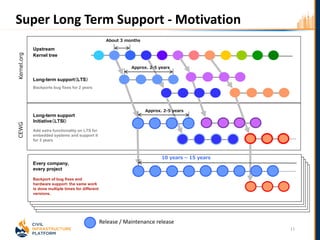
Super Long Term Support - Motivation
11
Upstream
Kernel tree
Long-term support(LTS)
Backports bug fixes for 2 years
Long-term support
Initiative(LTSI)
Add extra functionality on LTS for
embedded systems and support it
for 2 years
About 3 months
Approx. 2-5 years
Approx. 2-5 years
Kernel.orgCEWG
Every company,
every project
10 years – 15 years
Backport of bug fixes and
hardware support: the same work
is done multiple times for different
versions.
Release / Maintenance release
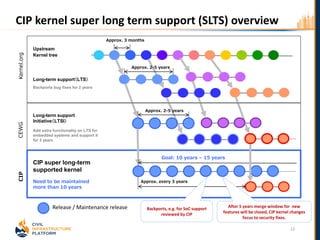
CIP kernel super long term support (SLTS) overview
12
Long-term support(LTS)
Backports bug fixes for 2 years
Long-term support
Initiative(LTSI)
Add extra functionality on LTS for
embedded systems and support it
for 2 years
CIP super long-term
supported kernel
Approx. 3 months
Approx. 2-5 years
Approx. 2-5 years
Goal: 10 years – 15 years
Need to be maintained
more than 10 years
Kernel.orgCEWGCIP
Approx. every 3 years
Release / Maintenance release After 5 years merge window for new
features will be closed, CIP kernel changes
focus to security fixes.
Backports, e.g. for SoC support
reviewed by CIP
Upstream
Kernel tree
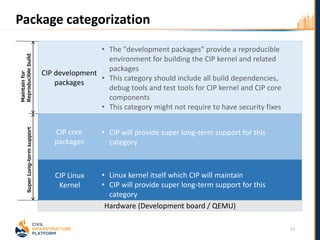
Package categorization
13
CIP development
packages
CIP core
packages
SuperLong-termsupport
Maintainfor
Reproduciblebuild
CIP Linux
Kernel
• Linux kernel itself which CIP will maintain
• CIP will provide super long-term support for this
category
• The "development packages" provide a reproducible
environment for building the CIP kernel and related
packages
• This category should include all build dependencies,
debug tools and test tools for CIP kernel and CIP core
components
• This category might not require to have security fixes
• CIP will provide super long-term support for this
category
Hardware (Development board / QEMU)
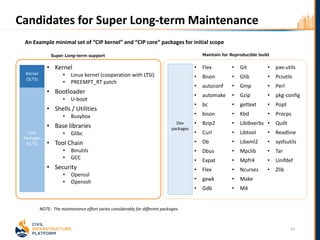
Candidates for Super Long-term Maintenance
• Flex
• Bison
• autoconf
• automake
• bc
• bison
• Bzip2
• Curl
• Db
• Dbus
• Expat
• Flex
• gawk
• Gdb
• Kernel
• Linux kernel (cooperation with LTSI)
• PREEMPT_RT patch
• Bootloader
• U-boot
• Shells / Utilities
• Busybox
• Base libraries
• Glibc
• Tool Chain
• Binutils
• GCC
• Security
• Openssl
• Openssh
14
• Git
• Glib
• Gmp
• Gzip
• gettext
• Kbd
• Libibverbs
• Libtool
• Libxml2
• Mpclib
• Mpfr4
• Ncurses
• Make
• M4
• pax-utils
• Pciutils
• Perl
• pkg-config
• Popt
• Procps
• Quilt
• Readline
• sysfsutils
• Tar
• Unifdef
• Zlib
An Example minimal set of “CIP kernel” and “CIP core” packages for initial scope
NOTE: The maintenance effort varies considerably for different packages.
Core
Packages
(SLTS)
Kernel
(SLTS)
Dev
packages
Super Long-term support Maintain for Reproducible build
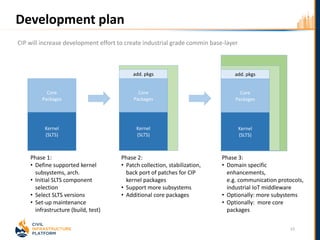
Development plan
CIP will increase development effort to create industrial grade commin base-layer
15
Phase 1:
• Define supported kernel
subsystems, arch.
• Initial SLTS component
selection
• Select SLTS versions
• Set-up maintenance
infrastructure (build, test)
Phase 2:
• Patch collection, stabilization,
back port of patches for CIP
kernel packages
• Support more subsystems
• Additional core packages
Phase 3:
• Domain specific
enhancements,
e.g. communication protocols,
industrial IoT middleware
• Optionally: more subystems
• Optionally: more core
packages
Core
Packages
Kernel
(SLTS)
add. pkgs
Core
Packages
Kernel
(SLTS)
add. pkgs
Core
Packages
Kernel
(SLTS)
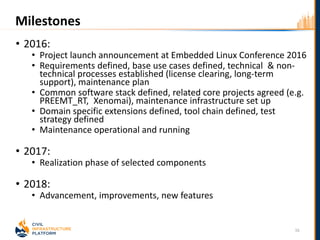
• 2016:
• Project launch announcement at Embedded Linux Conference 2016
• Requirements defined, base use cases defined, technical & non-
technical processes established (license clearing, long-term
support), maintenance plan
• Common software stack defined, related core projects agreed (e.g.
PREEMT_RT, Xenomai), maintenance infrastructure set up
• Domain specific extensions defined, tool chain defined, test
strategy defined
• Maintenance operational and running
• 2017:
• Realization phase of selected components
• 2018:
• Advancement, improvements, new features
16
Milestones
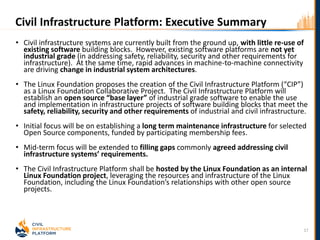
• Civil infrastructure systems are currently built from the ground up, with little re-use of
existing software building blocks. However, existing software platforms are not yet
industrial grade (in addressing safety, reliability, security and other requirements for
infrastructure). At the same time, rapid advances in machine-to-machine connectivity
are driving change in industrial system architectures.
• The Linux Foundation proposes the creation of the Civil Infrastructure Platform (“CIP”)
as a Linux Foundation Collaborative Project. The Civil Infrastructure Platform will
establish an open source “base layer” of industrial grade software to enable the use
and implementation in infrastructure projects of software building blocks that meet the
safety, reliability, security and other requirements of industrial and civil infrastructure.
• Initial focus will be on establishing a long term maintenance infrastructure for selected
Open Source components, funded by participating membership fees.
• Mid-term focus will be extended to filling gaps commonly agreed addressing civil
infrastructure systems’ requirements.
• The Civil Infrastructure Platform shall be hosted by the Linux Foundation as an internal
Linux Foundation project, leveraging the resources and infrastructure of the Linux
Foundation, including the Linux Foundation’s relationships with other open source
projects.
17
Civil Infrastructure Platform: Executive Summary
Contact Information and Resources
To get the latest information, please contact:
• Urs Gleim urs.gleim@siemens.com
• Yoshitake Kobayashi yoshitake.kobayashi@toshiba.co.jp
Other resources
• CIP Web site https://www.cip-project.org
• CIP Mailing list cip-dev@lists.cip-project.org
18
Questions?
Thank you!
21
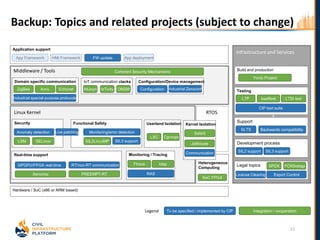
Backup: Topics and related projects (subject to change)
To be specified / implemented by CIP Integration / cooperationLegend
w
Linux Kernel
Userland Isolation
LXC Cgroups
Heterogeneous
Computing
SoC FPGA
Middleware / Tools
Application support
App Framework HMI Framework FW update App deployment
Configuration/Device management
Configuration Industrial Zeroconf
Domain specific communication
ZigBee Avnu Echonet
Industrial special-purpose protocols
Functional Safety
SIL3 supportSIL2LinuxMP
Monitoring/error detection
RTOS
IoT communication stacks
AllJoyn IoTivity OM2M
Security
LSM
Anomaly detection
SELinux
Kernel Isolation
Communication
Jailhouse
SafeG
Real-time support
PREEMPT-RT
GPGPU/FPGA real-time
Xenomai
RT/non-RT communication
Live patching
Monitoring / Tracing
RAS
Ftrace ktap
Coherent Security Mechanisms
Hardware / SoC (x86 or ARM based)
`I
Testing
kselftest
CIP test suite
LTSI testLTP
Infrastructure and Services
Support
SLTS
Development process
SIL3 supportSIL2 support
Legal topics SPDX
Export ControlLicense Clearing
FOSSology
Backwards compatibility
Build and production
Yocto Project

Introducing the Civil Infrastructure Platform Project

  • 1.
    Introducing the Civil InfrastructurePlatform Jan Kiszka and Yoshitake Kobayashi LinuxCon Japan, 13-15 July, 2016
  • 2.
    Civil Infrastructure Systemsare technical systems responsible for supervision, control, and management of infrastructure supporting human activities, including, for example,  Electric power generation  Energy distribution  Oil and gas  Water and wastewater  Healthcare  Communications  Transportation  Collections of buildings that make up urban & rural communities. These networks deliver essential services, provide shelter, and support social interactions and economic development. They are society's lifelines.1) 2 Definition 1) adapted from https://www.ce.udel.edu/current/graduate_program/civil.html
  • 3.
    The evolution ofcivil infrastructure systems Core characteristics Industrial gradeness  Reliability  Functional Safety  Security  Real-time capabilities Sustainability  Product life-cycles of 10 – 60 years Conservative update strategy  Firmware updates only if industrial gradeness is jeopardized  Minimize risk of regression  Keeping regression test and certification efforts low Connected systems  Interoperability due to advances in machine-to- machine connectivity  Standardization of communication  Plug and play based system designs Stand-alone systems  Limited vulnerability  Updates can only applied with physical access to the systems  High commissioning efforts Proprietary nature  Systems are built from the ground up for each product  little re-use of existing software building blocks  Closed systems Commoditization  Increased utilization of commodity (open source) components, e.g., operating system, virtualization  Extensibility, e.g., for analytics Technology changes Development time  Shorter development times for more complex systems Maintenance costs  Low maintenance costs for commonly uses software components  Low commissioning and update costs Business needs Development costs  Don‘t re-invent the wheel 3
  • 4.
    Things to bedone • Join forces for commodity components • Ensure industrial gradeness for the operating system platform focusing on reliability, security, and functional safety. • Increase upstream work in order to increase quality and to avoid maintenance of patches • Share maintenance costs • Long-term availability and long-term support are crucial • Innovate for future technology • Support industrial IoT architectures and state-of-the art machine-to-machine connectivity 4
  • 5.
    Comparison with existingAlliances Other domains already benefit from collaborative development: drive instead of follow! 5 In many domains competing companies collaborate in alliances already. (GENIVI, for example) • Development speed for shorter product cycles • High Software quality due to intense reviews and high test coverage (Linus’s law) • Standard platforms enable ecosystems (e.g. for development tools, system extensions, new business models) Consumer Industry PlatformCommunication hosted by
  • 6.
    Civil Infrastructure Platformto provide software building blocks that support reliable transportation, power, oil and gas, and healthcare infrastructure Establish an open source “base layer” of industrial grade software to enable the use and implementation in infrastructure projects of software building blocks that meet the safety, reliability, security and maintainability requirements. • Share development effort for development of industrial grade bases systems. • Fill the gap between capabilities of the existing OSS and industrial requirements. • Reference-implementation consisting of • Specification of on-device software stack and tools infrastructure • Linux kernel, file system, etc. selected reference hardware • Build environment and tools for companies to build their own distribution. • Test framework and test cases • SDK and APIs • Trigger development of an emerging ecosystem including tools and domain specific extensions.  Initial focus will be on establishing a long term maintenance infrastructure for selected Open Source components, funded by participating membership fees. 6 CIP Reference Hardware CIP Reference Filesystem image with SDK CIP Kernel UserspaceKernel Non-CIP packages Any Linux distribution (e.g. Yocto Project, Debian, openSUSE, etc.) may extend/include CIP packages. Hardware Specifications Documentation Implement
  • 7.
    7 Scope of activitiesUserspaceKernelspace LinuxKernel App container infrastructure (mid-term) App Framework (optionally, mid-term) Middleware/Libraries Safe & Secure Update Monitoring Domain Specific communication (e.g. OPC UA) Shared config. & logging Real-time support Real-time / safe virtualization Tools Concepts Build environment (e.g. yocto recipes) Test automation Tracing & reporting tools Configuration management Device management (update, download) Functional safety architecture/strategy, including compliance w/ standards (e.g., NERC CIP, IEC61508) Long-term support Strategy: security patch management Standardization collaborative effort with others License clearing Export Control Classification On device software stack Product development and maintenance Application life- cycle management Security
  • 8.
    8 Target Systems Out ofscope: • Enterprise IT and cloud system platforms. … Device class no. ARM M0/M0+/M3/M4 8/16/32-bit,< 100 MHz 32-bit, <1 GHz 32/64-bit, <2 GHz 64-bit, >2 GHz n MiB flash n GiB flash n GiB flash n TiB flash/HDD < 1 MiB < 1 GiB < 4 GiB > 4 GiB Arduino class board Raspberry Pi class board SoC-FPGA, e.g.Zync industrial PC ARM M4/7,A9,R4/5/7 Networked Node Embedded ServerEmbedded ComputerEmbedded Control Unit special purpose & server based controllerscontrol systems multi-purpose controllersPLC gateways Sensor, field device 1 2 3 4 ARM A9/A35,R7,Intel Atom Architecture, clock non-volatile storage HW ref. platform ARM offerings1) RAM application examples ARM A53/A72,Core,Xeon Intel offerings1) M0/M0+/M3/M4 M4/7,A9,R4/5/7 ARM A9/A35,R7 ARM A53/A72 ARM M0/M0+/M3/M4 ARM M4/7,A9,R4/5/7 ARM A9/A35,R7,Intel Atom ARM A53/A72,Core,XeonQuark MCU Quark SoC Atom Core, Xeon Target systems Reference hardware for common software platform:  Start from working the common HW platform (PC)  Later extend it to smaller/low power devices. 1 41) Typical configurations Q1/2016
  • 9.
    Relationship between CIPand other projects 9 Civil Infrastructure Platform Collaborative Projects (e.g. RTL, Yocto, CII) Existing project / distro New CIP sub-project Developers CIP FTE’s Developers from member companies Budget Member companies … Existing project CIP source code repositories Open source projects (Upstream work) contribution Optional: funding of selected projects CIP will do not only development for CIP but also fund or contribute to related upstream projects Existing projects (unchanged) Open source projects CIP Super Long Term Support Project • Import source code from open source project or existing distribution to CIP • Backport patches from upstream to CIP version
  • 10.
    Upstream first policyfor implementation of new features All delta from mainline should be treated as technical debt. • No parallel source trees, directly discuss features in upstream projects. • Upstream first implementation. Take this to declared stable. • Then back-port to long-term support versions drive by CIP employee or CIP members. 10 Upstream Project 1 Upstream Project 2 Project 1 (S)LTS versions Project 2 (S)LTS versions new features new features backport new features CIP members / CIP FTEs CIP members / CIP FTEs …
  • 11.
    Super Long TermSupport - Motivation 11 Upstream Kernel tree Long-term support(LTS) Backports bug fixes for 2 years Long-term support Initiative(LTSI) Add extra functionality on LTS for embedded systems and support it for 2 years About 3 months Approx. 2-5 years Approx. 2-5 years Kernel.orgCEWG Every company, every project 10 years – 15 years Backport of bug fixes and hardware support: the same work is done multiple times for different versions. Release / Maintenance release
  • 12.
    CIP kernel superlong term support (SLTS) overview 12 Long-term support(LTS) Backports bug fixes for 2 years Long-term support Initiative(LTSI) Add extra functionality on LTS for embedded systems and support it for 2 years CIP super long-term supported kernel Approx. 3 months Approx. 2-5 years Approx. 2-5 years Goal: 10 years – 15 years Need to be maintained more than 10 years Kernel.orgCEWGCIP Approx. every 3 years Release / Maintenance release After 5 years merge window for new features will be closed, CIP kernel changes focus to security fixes. Backports, e.g. for SoC support reviewed by CIP Upstream Kernel tree
  • 13.
    Package categorization 13 CIP development packages CIPcore packages SuperLong-termsupport Maintainfor Reproduciblebuild CIP Linux Kernel • Linux kernel itself which CIP will maintain • CIP will provide super long-term support for this category • The "development packages" provide a reproducible environment for building the CIP kernel and related packages • This category should include all build dependencies, debug tools and test tools for CIP kernel and CIP core components • This category might not require to have security fixes • CIP will provide super long-term support for this category Hardware (Development board / QEMU)
  • 14.
    Candidates for SuperLong-term Maintenance • Flex • Bison • autoconf • automake • bc • bison • Bzip2 • Curl • Db • Dbus • Expat • Flex • gawk • Gdb • Kernel • Linux kernel (cooperation with LTSI) • PREEMPT_RT patch • Bootloader • U-boot • Shells / Utilities • Busybox • Base libraries • Glibc • Tool Chain • Binutils • GCC • Security • Openssl • Openssh 14 • Git • Glib • Gmp • Gzip • gettext • Kbd • Libibverbs • Libtool • Libxml2 • Mpclib • Mpfr4 • Ncurses • Make • M4 • pax-utils • Pciutils • Perl • pkg-config • Popt • Procps • Quilt • Readline • sysfsutils • Tar • Unifdef • Zlib An Example minimal set of “CIP kernel” and “CIP core” packages for initial scope NOTE: The maintenance effort varies considerably for different packages. Core Packages (SLTS) Kernel (SLTS) Dev packages Super Long-term support Maintain for Reproducible build
  • 15.
    Development plan CIP willincrease development effort to create industrial grade commin base-layer 15 Phase 1: • Define supported kernel subsystems, arch. • Initial SLTS component selection • Select SLTS versions • Set-up maintenance infrastructure (build, test) Phase 2: • Patch collection, stabilization, back port of patches for CIP kernel packages • Support more subsystems • Additional core packages Phase 3: • Domain specific enhancements, e.g. communication protocols, industrial IoT middleware • Optionally: more subystems • Optionally: more core packages Core Packages Kernel (SLTS) add. pkgs Core Packages Kernel (SLTS) add. pkgs Core Packages Kernel (SLTS)
  • 16.
    • 2016: • Projectlaunch announcement at Embedded Linux Conference 2016 • Requirements defined, base use cases defined, technical & non- technical processes established (license clearing, long-term support), maintenance plan • Common software stack defined, related core projects agreed (e.g. PREEMT_RT, Xenomai), maintenance infrastructure set up • Domain specific extensions defined, tool chain defined, test strategy defined • Maintenance operational and running • 2017: • Realization phase of selected components • 2018: • Advancement, improvements, new features 16 Milestones
  • 17.
    • Civil infrastructuresystems are currently built from the ground up, with little re-use of existing software building blocks. However, existing software platforms are not yet industrial grade (in addressing safety, reliability, security and other requirements for infrastructure). At the same time, rapid advances in machine-to-machine connectivity are driving change in industrial system architectures. • The Linux Foundation proposes the creation of the Civil Infrastructure Platform (“CIP”) as a Linux Foundation Collaborative Project. The Civil Infrastructure Platform will establish an open source “base layer” of industrial grade software to enable the use and implementation in infrastructure projects of software building blocks that meet the safety, reliability, security and other requirements of industrial and civil infrastructure. • Initial focus will be on establishing a long term maintenance infrastructure for selected Open Source components, funded by participating membership fees. • Mid-term focus will be extended to filling gaps commonly agreed addressing civil infrastructure systems’ requirements. • The Civil Infrastructure Platform shall be hosted by the Linux Foundation as an internal Linux Foundation project, leveraging the resources and infrastructure of the Linux Foundation, including the Linux Foundation’s relationships with other open source projects. 17 Civil Infrastructure Platform: Executive Summary
  • 18.
    Contact Information andResources To get the latest information, please contact: • Urs Gleim urs.gleim@siemens.com • Yoshitake Kobayashi yoshitake.kobayashi@toshiba.co.jp Other resources • CIP Web site https://www.cip-project.org • CIP Mailing list cip-dev@lists.cip-project.org 18
  • 19.
  • 20.
  • 21.
    21 Backup: Topics andrelated projects (subject to change) To be specified / implemented by CIP Integration / cooperationLegend w Linux Kernel Userland Isolation LXC Cgroups Heterogeneous Computing SoC FPGA Middleware / Tools Application support App Framework HMI Framework FW update App deployment Configuration/Device management Configuration Industrial Zeroconf Domain specific communication ZigBee Avnu Echonet Industrial special-purpose protocols Functional Safety SIL3 supportSIL2LinuxMP Monitoring/error detection RTOS IoT communication stacks AllJoyn IoTivity OM2M Security LSM Anomaly detection SELinux Kernel Isolation Communication Jailhouse SafeG Real-time support PREEMPT-RT GPGPU/FPGA real-time Xenomai RT/non-RT communication Live patching Monitoring / Tracing RAS Ftrace ktap Coherent Security Mechanisms Hardware / SoC (x86 or ARM based) `I Testing kselftest CIP test suite LTSI testLTP Infrastructure and Services Support SLTS Development process SIL3 supportSIL2 support Legal topics SPDX Export ControlLicense Clearing FOSSology Backwards compatibility Build and production Yocto Project