Software – Role in Systems andSoftware – Role in Systems and 
their Architectures
Talk at Software Architects Meetup 
1 Oct 20161 Oct 2016
Abhilash Gopalakrishnan
Principal EngineerPrincipal Engineer,
Electrical Products Distribution Automation, 
India Development Center
ABB Global Industries & Services Pvt. Ltd.ABB Global Industries & Services Pvt. Ltd.
AgendaAgenda
• Re‐inventing the Role of Software Architect
• Systems and Increasing Software IntensitySystems and Increasing Software Intensity
• IEEE 42010 standard 
• Architecture Business Cycle
• Problem Space and Solutions spaceProblem Space and Solutions space
• Architecture Definition
Re inventing the RoleRe‐inventing the Role
Courtesy: Facebook comCourtesy: Facebook.com
 Evolution of Programming Languages indicate
increasing levels of abstraction.
 Software Defined Everything!
 Significance moves to structures and organize
them :- Architecture
 Architecture plays a key role in Innovations
 Multi-skilled and Ability to bring experience to Multi skilled and Ability to bring experience to
table.
12 Essential Skills [1]
SystemsSystems
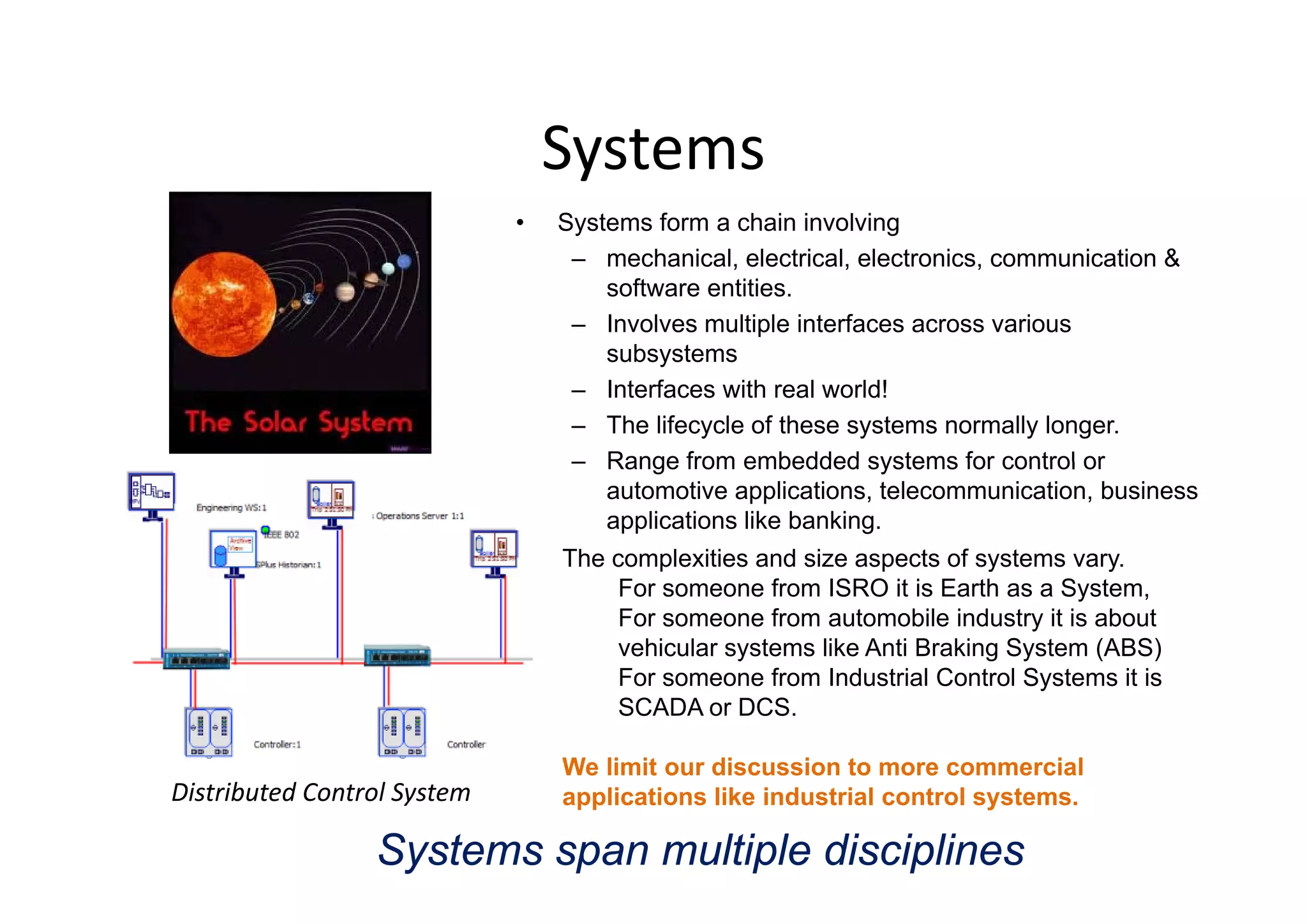
• Systems form a chain involving
h i l l t i l l t i i ti &– mechanical, electrical, electronics, communication &
software entities.
– Involves multiple interfaces across various
subsystemssubsystems
– Interfaces with real world!
– The lifecycle of these systems normally longer.
Range from embedded systems for control or– Range from embedded systems for control or
automotive applications, telecommunication, business
applications like banking.
The complexities and size aspects of systems vary.The complexities and size aspects of systems vary.
For someone from ISRO it is Earth as a System,
For someone from automobile industry it is about
vehicular systems like Anti Braking System (ABS)
F f I d t i l C t l S t it iFor someone from Industrial Control Systems it is
SCADA or DCS.
We limit our discussion to more commercial
Distributed Control System applications like industrial control systems.
Systems span multiple disciplines
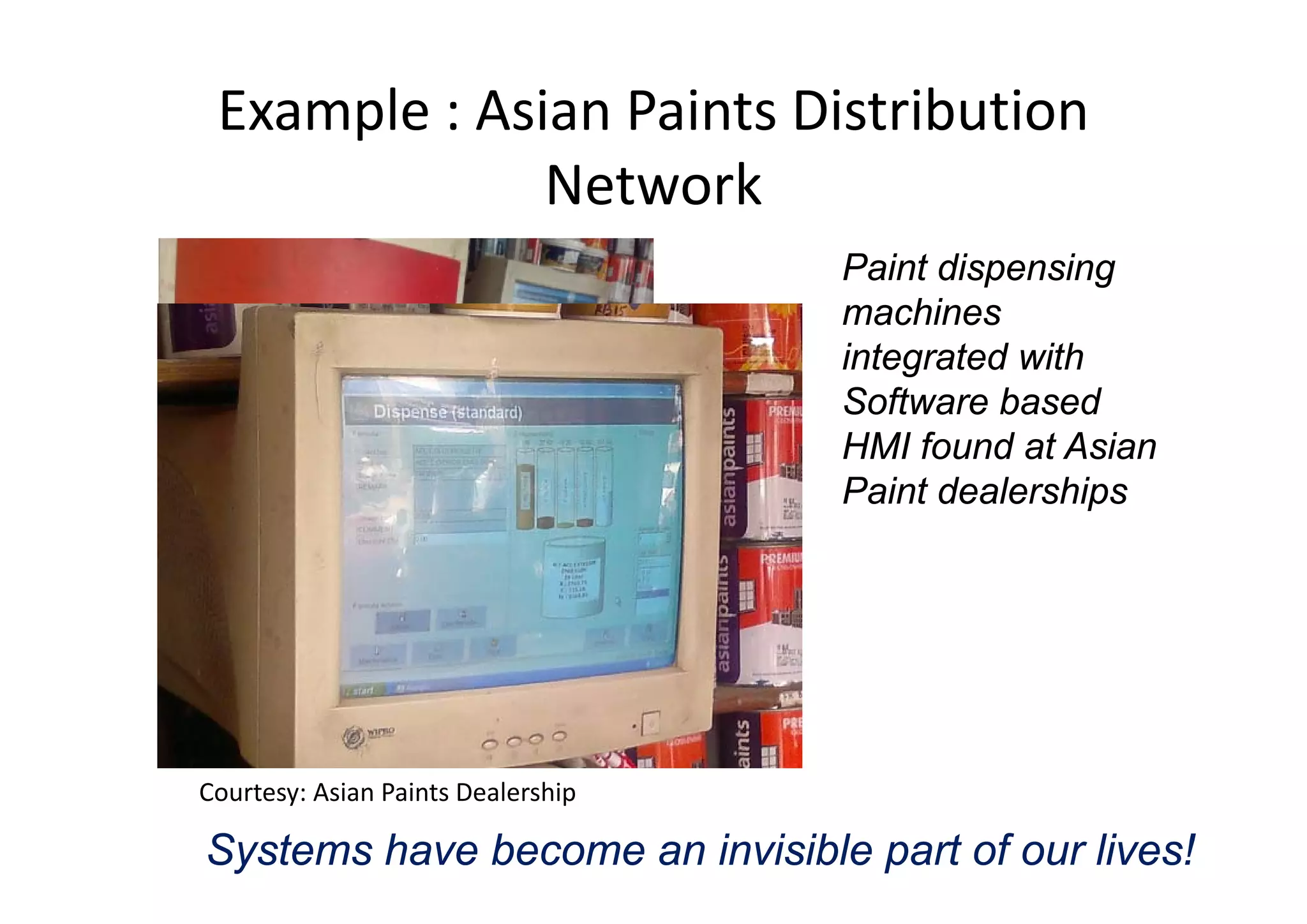
Example : Asian Paints Distribution 
Network
Paint dispensing
machines
integrated withintegrated with
Software based
HMI found at Asian
Paint dealerships
Courtesy: Asian Paints Dealership
Systems have become an invisible part of our lives!
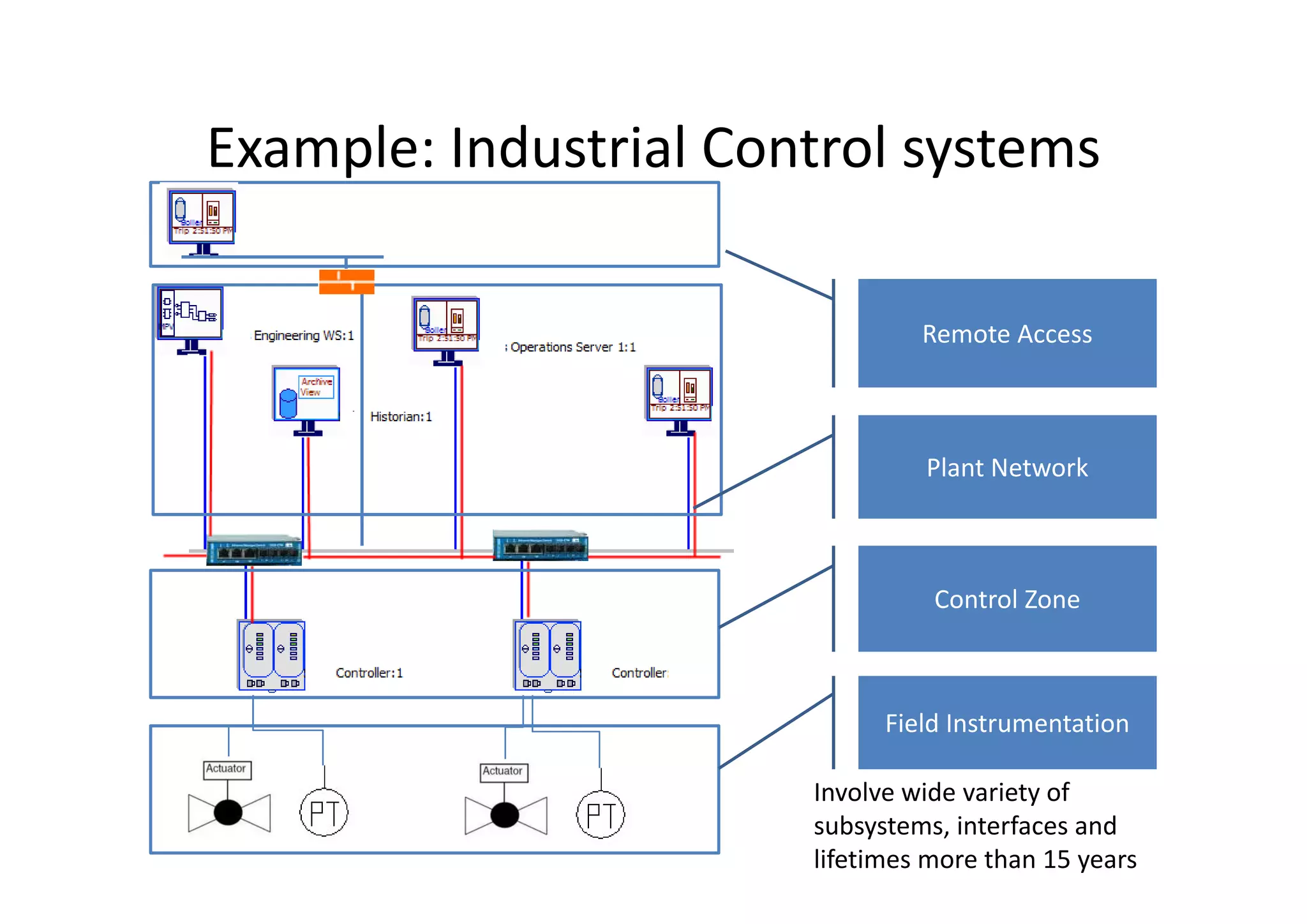
Example: Industrial Control systemsExample: Industrial Control systems
Remote Access
Pl t N t kPlant Network
Control Zone
Field Instrumentation
Involve wide variety of 
subsystems, interfaces and 
lifetimes more than 15 years
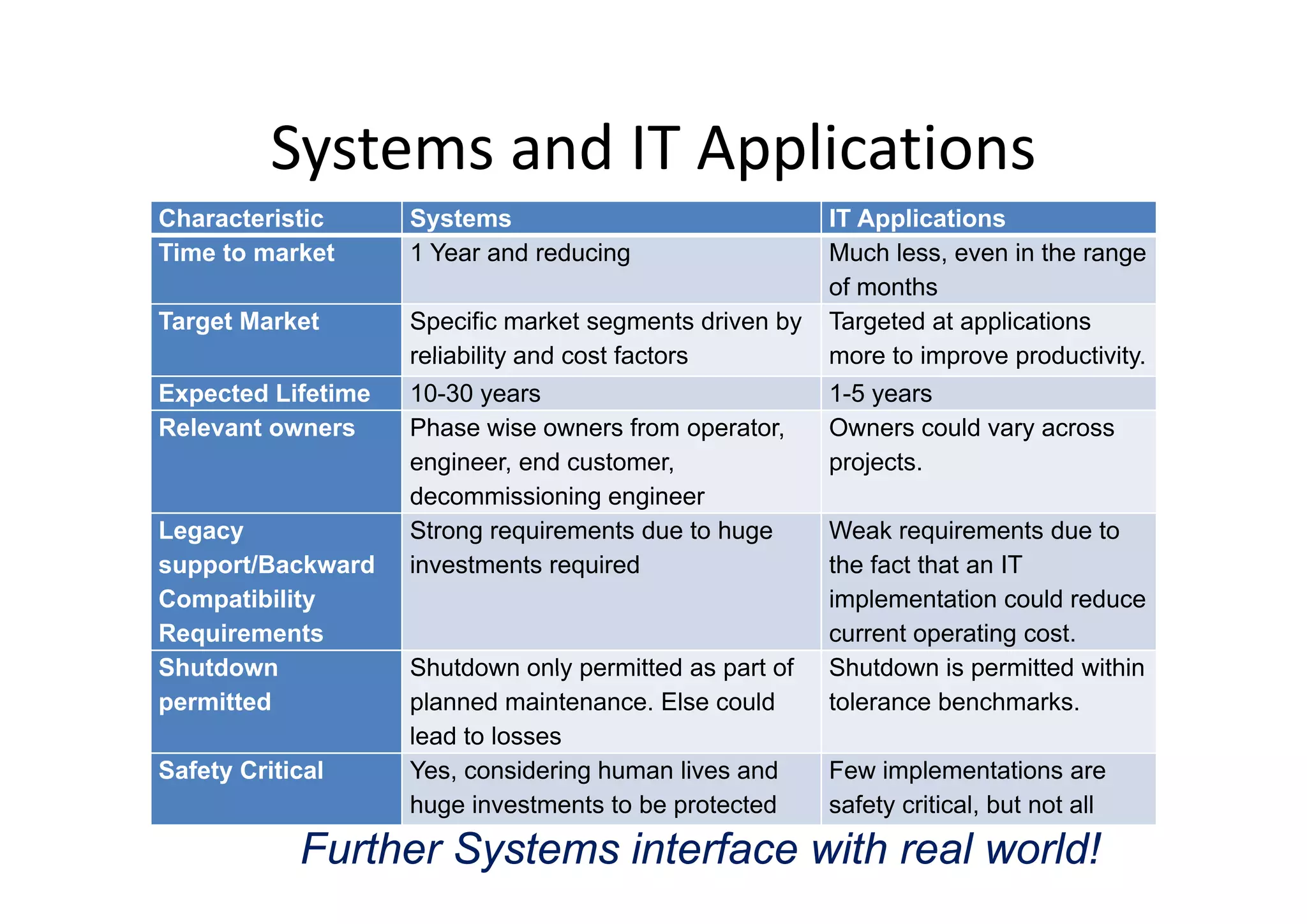
Systems and IT ApplicationsSystems and IT Applications
Characteristic Systems IT Applications
Time to market 1 Year and reducing Much less even in the rangeTime to market 1 Year and reducing Much less, even in the range
of months
Target Market Specific market segments driven by
reliability and cost factors
Targeted at applications
more to improve productivityreliability and cost factors more to improve productivity.
Expected Lifetime 10-30 years 1-5 years
Relevant owners Phase wise owners from operator,
engineer end customer
Owners could vary across
projectsengineer, end customer,
decommissioning engineer
projects.
Legacy
support/Backward
Strong requirements due to huge
investments required
Weak requirements due to
the fact that an ITsupport/Backward
Compatibility
Requirements
investments required the fact that an IT
implementation could reduce
current operating cost.
Shutdown Shutdown only permitted as part of Shutdown is permitted withinShutdown
permitted
Shutdown only permitted as part of
planned maintenance. Else could
lead to losses
Shutdown is permitted within
tolerance benchmarks.
Safety Critical Yes considering human lives and Few implementations areSafety Critical Yes, considering human lives and
huge investments to be protected
Few implementations are
safety critical, but not all
Further Systems interface with real world!
AgendaAgenda
• Alignment to the Program
• Systems and Increasing Software IntensitySystems and Increasing Software Intensity
• IEEE 42010 standard 
• Architecture Business Cycle
• Problem Space and Solutions spaceProblem Space and Solutions space
• Architecture Definition
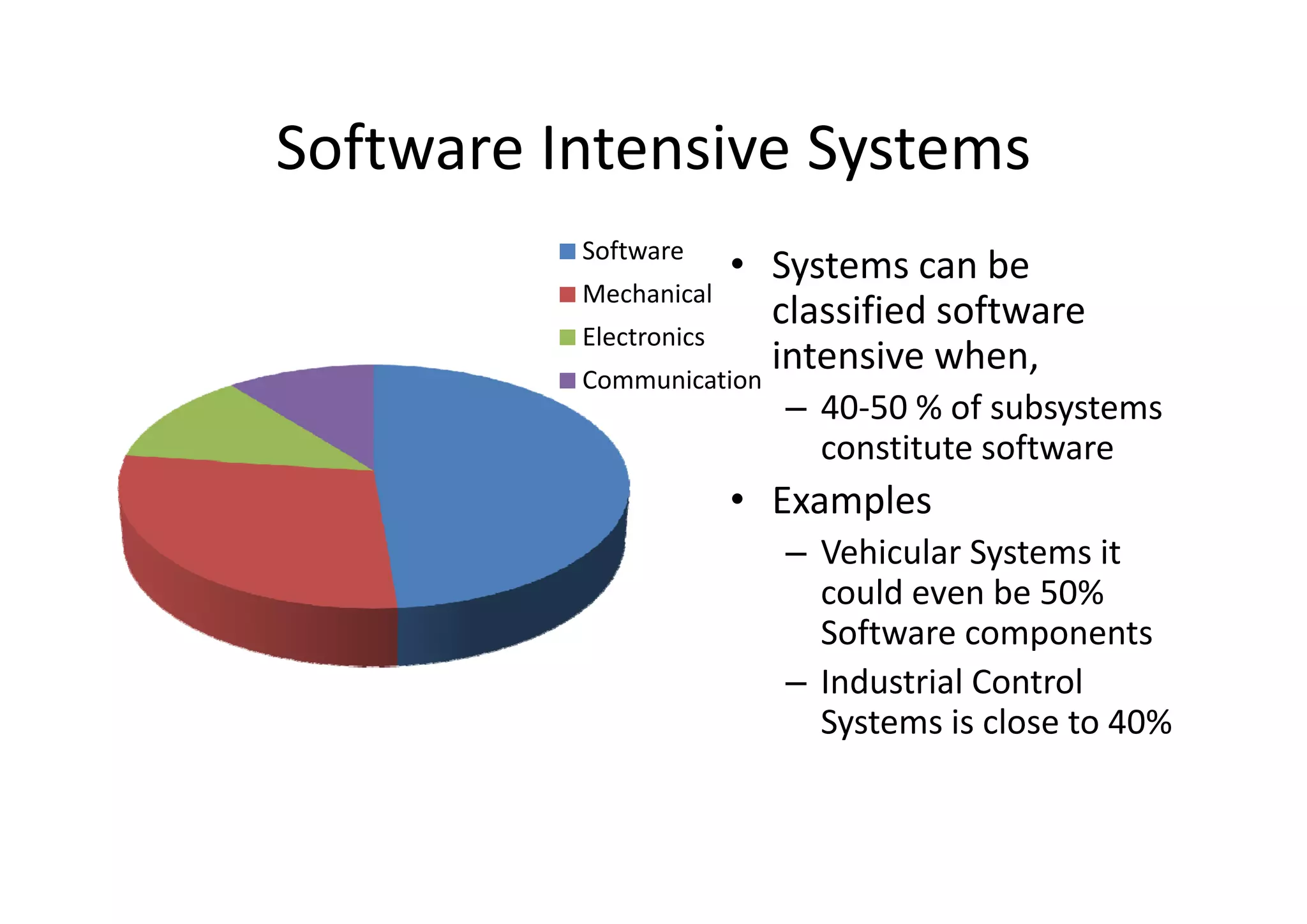
Software Intensive SystemsSoftware Intensive Systems
S bSoftware
• Systems can be 
classified software 
intensive when
Software
Mechanical
Electronics
intensive when,
– 40‐50 % of subsystems 
constitute software
Communication
• Examples
– Vehicular Systems it y
could even be 50% 
Software components
I d i l C l– Industrial Control 
Systems is close to 40%
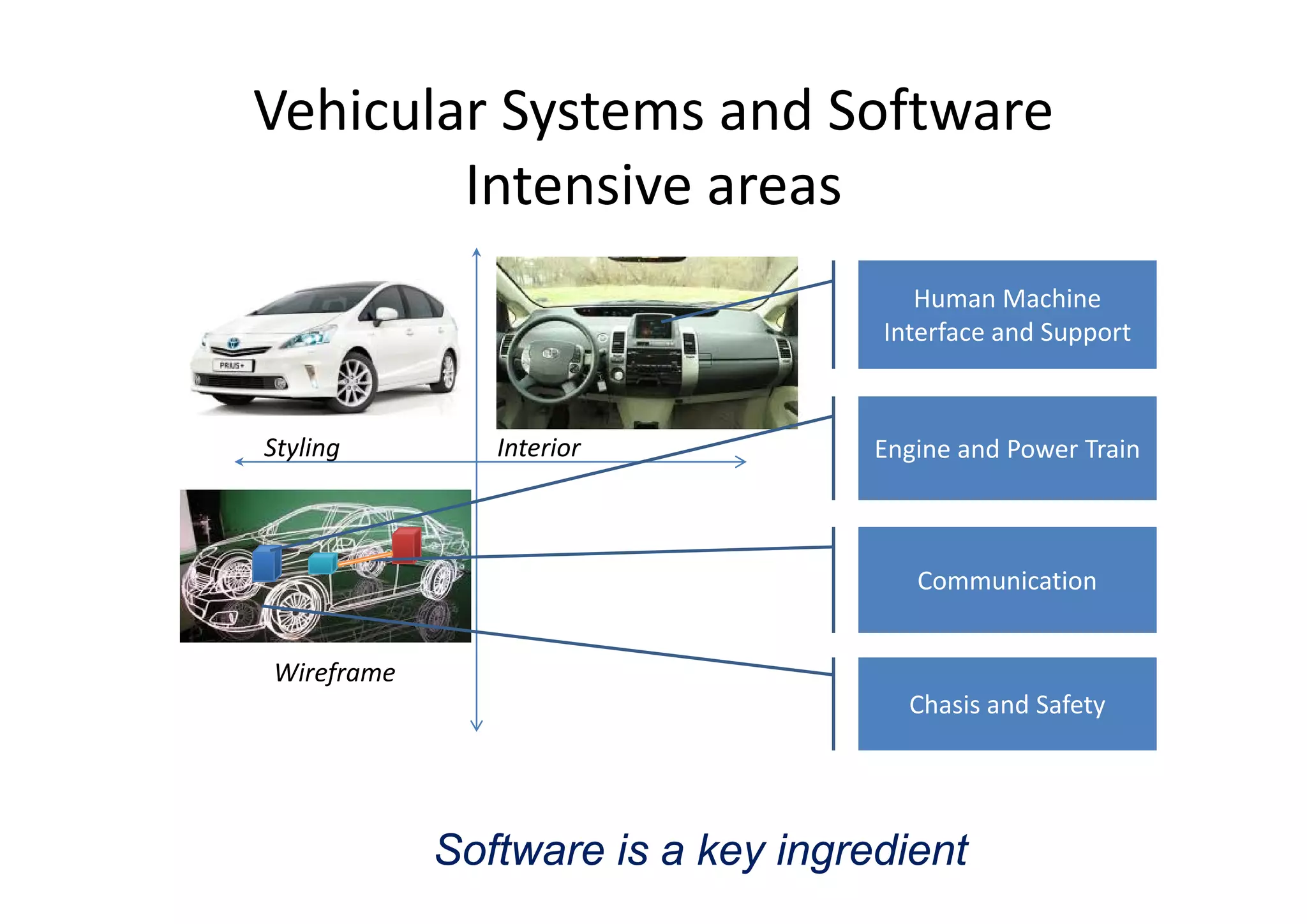
Vehicular Systems and Software 
Intensive areas
Human Machine 
Interface and Support
Styling Interior Engine and Power Traing
Wireframe
Communication
Wireframe
Chasis and Safety
Software is a key ingredient
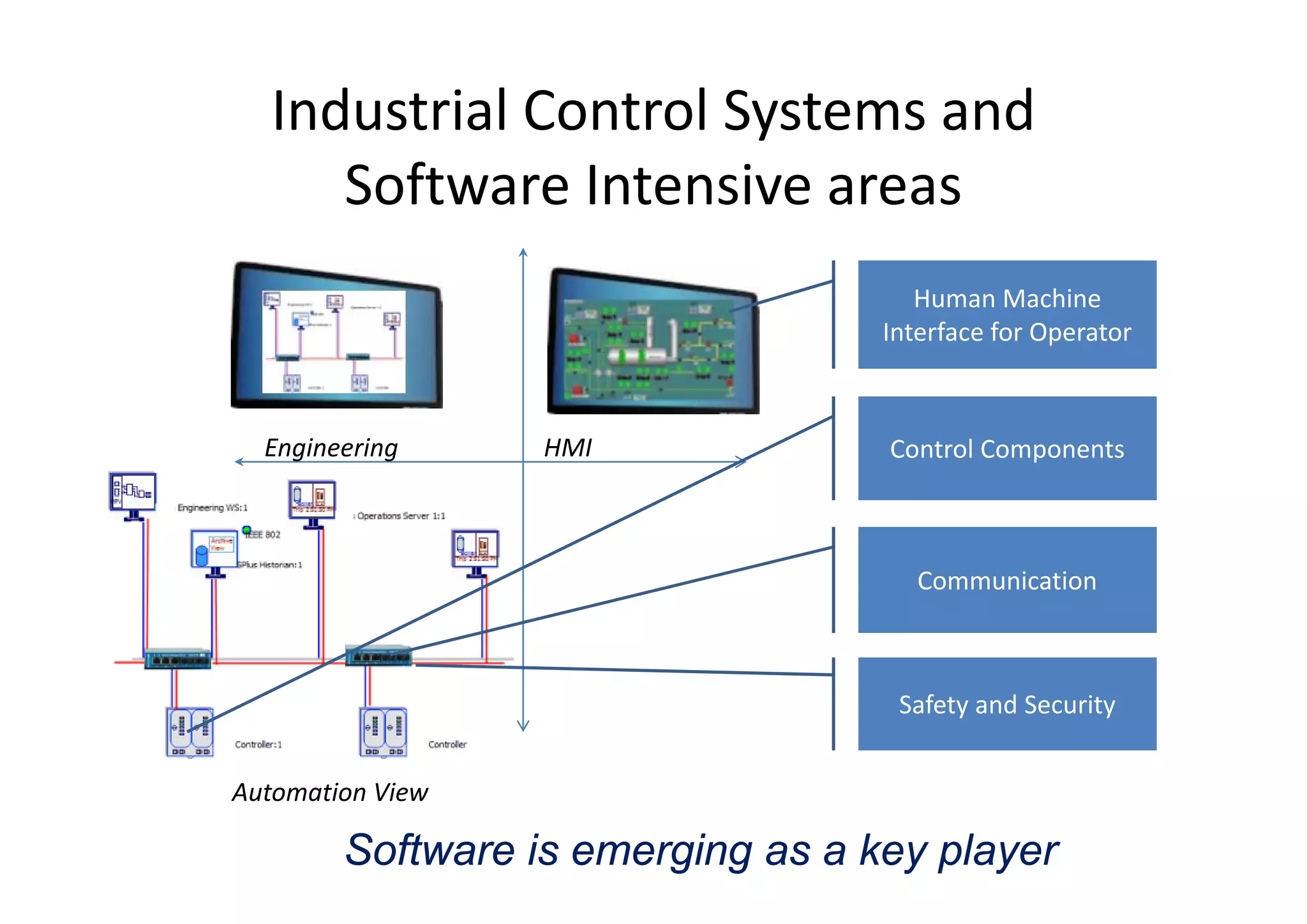
Industrial Control Systems and 
Software Intensive areas
Human Machine 
Interface for Operator
Engineering HMI Control Componentsp
Wireframe
Communication
Wireframe
Safety and Security
Automation View
Software is emerging as a key player
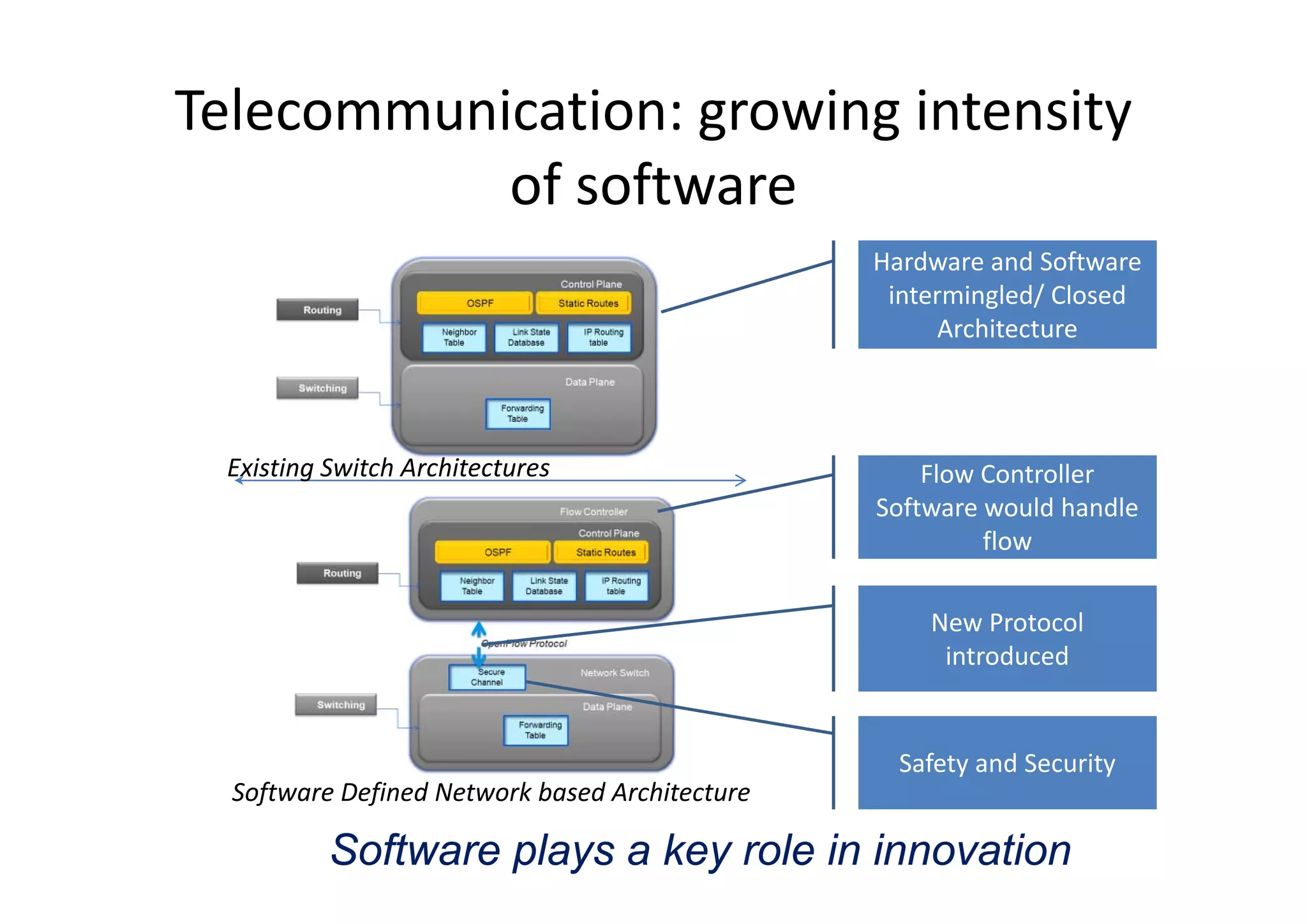
Telecommunication: growing intensity 
of software
d d fHardware and Software 
intermingled/ Closed 
Architecture
E i ti S it h A hit tExisting Switch Architectures Flow Controller 
Software would handle 
flow
New Protocol 
introduced
Safety and Security
Software Defined Network based Architecture
y y
Software plays a key role in innovation
AgendaAgenda
• Alignment to the Program
• Systems and Increasing Software IntensitySystems and Increasing Software Intensity
• IEEE 42010 standard 
• Architecture Business Cycle
• Problem Space and Solutions spaceProblem Space and Solutions space
• Architecture Definition
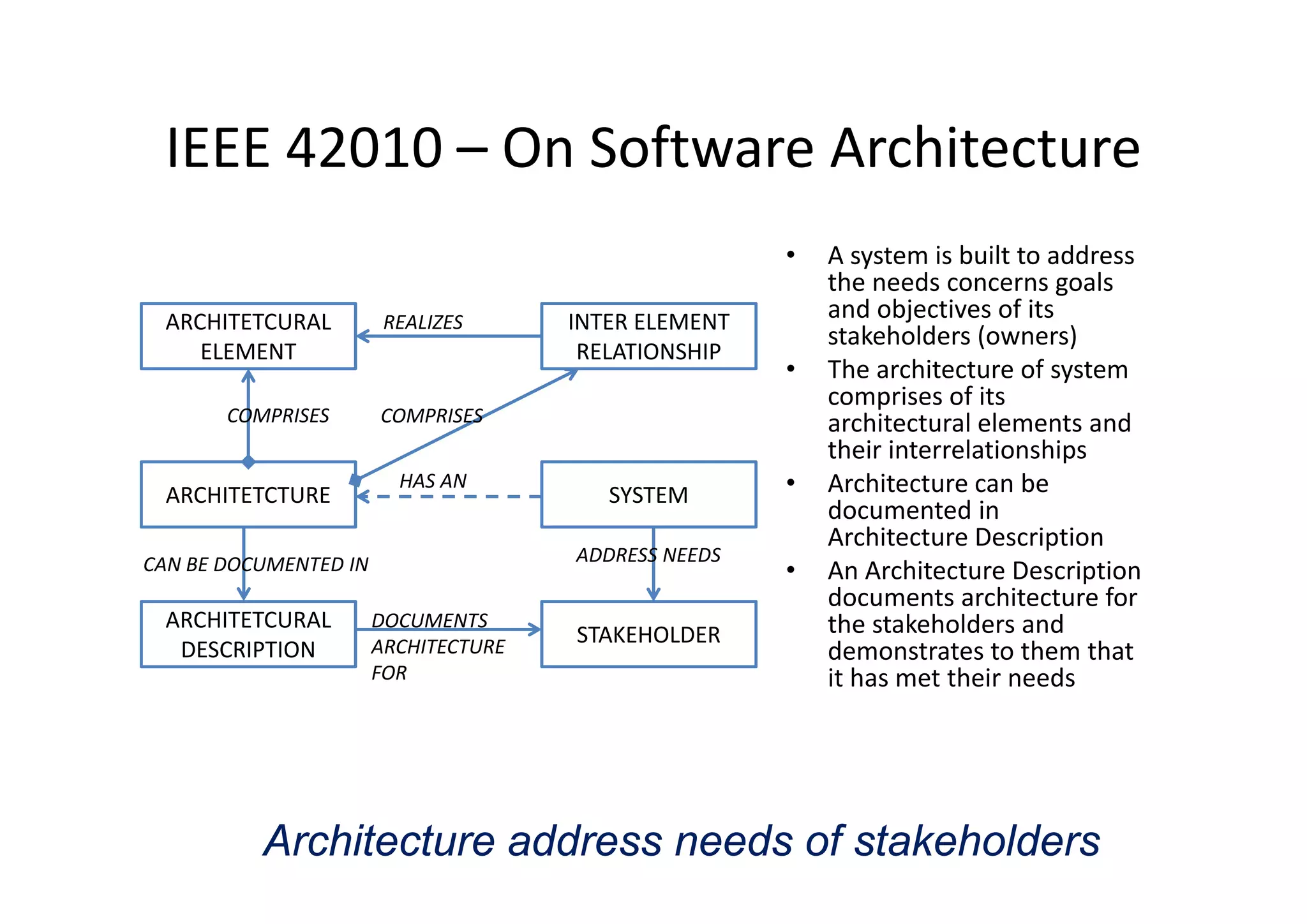
IEEE 42010 On Software ArchitectureIEEE 42010 – On Software Architecture
• A system is built to address• A system is built to address 
the needs concerns goals 
and objectives of its 
stakeholders (owners)
ARCHITETCURAL 
ELEMENT
INTER ELEMENT 
RELATIONSHIP
REALIZES
• The architecture of system 
comprises of its 
architectural elements and 
their interrelationships
ELEMENT RELATIONSHIP
COMPRISES COMPRISES
p
• Architecture can be 
documented in 
Architecture Description
• An Architecture Description
ARCHITETCTURE SYSTEM
HAS AN
ADDRESS NEEDSCAN BE DOCUMENTED IN • An Architecture Description 
documents architecture for 
the stakeholders and 
demonstrates to them that 
it h t th i d
ARCHITETCURAL 
DESCRIPTION
STAKEHOLDER
CAN BE DOCUMENTED IN
DOCUMENTS 
ARCHITECTURE 
FOR it has met their needsFOR
Architecture address needs of stakeholders
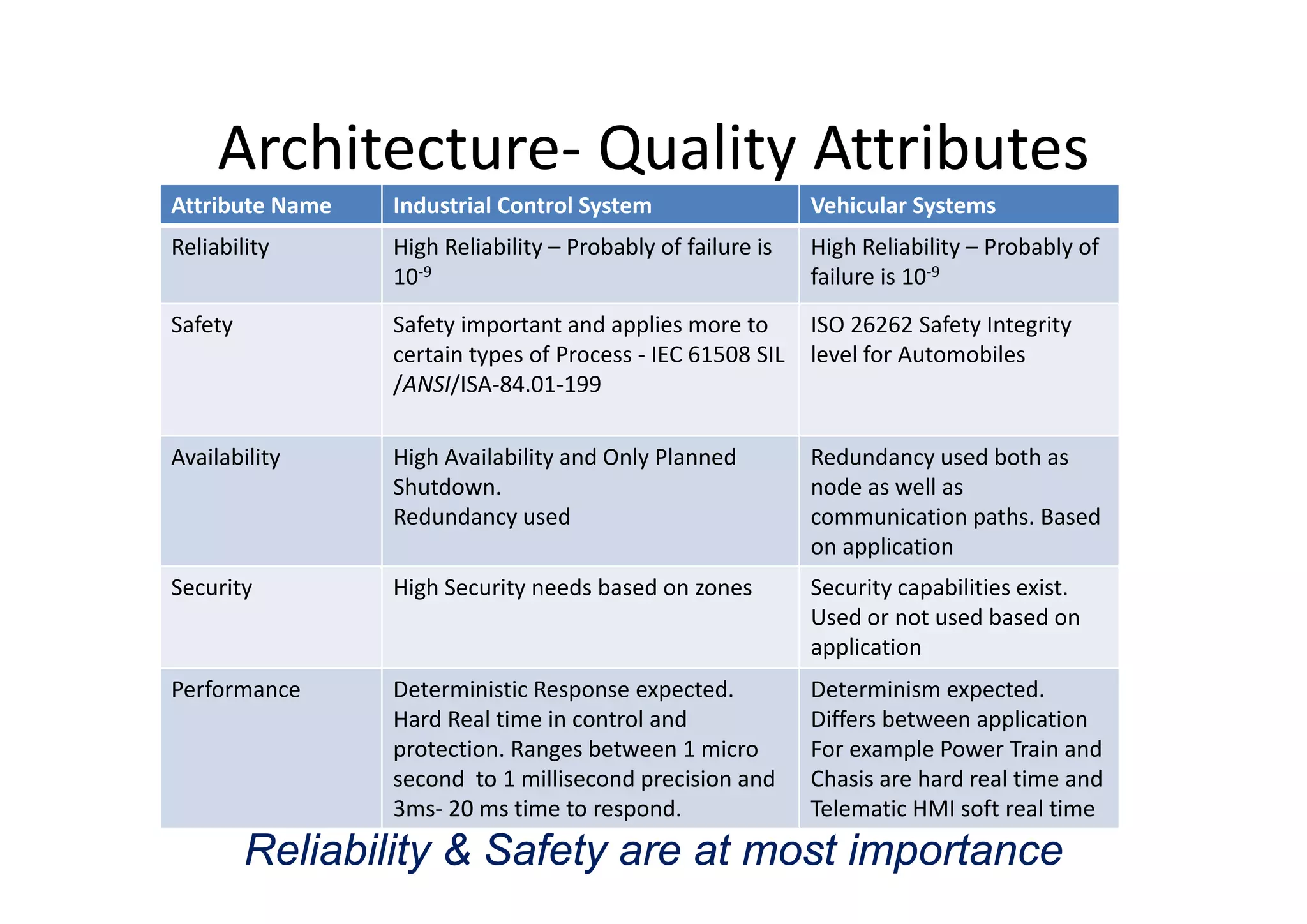
Architecture Quality AttributesArchitecture‐ Quality Attributes
Attribute Name Industrial Control System Vehicular Systems
Reliability High Reliability – Probably of failure is High Reliability – Probably ofReliability High Reliability  Probably of failure is 
10‐9
High Reliability  Probably of
failure is 10‐9
Safety Safety important and applies more to 
certain types of Process ‐ IEC 61508 SIL
ISO 26262 Safety Integrity 
level for Automobilescertain types of Process  IEC 61508 SIL 
/ANSI/ISA‐84.01‐199
level for Automobiles
Availability High Availability and Only Planned Redundancy used both asAvailability High Availability and Only Planned 
Shutdown. 
Redundancy used
Redundancy used both as 
node as well as 
communication paths. Based 
on application
Security High Security needs based on zones Security capabilities exist.
Used or not used based on 
application
Performance Deterministic Response expected. 
Hard Real time in control and 
protection. Ranges between 1 micro 
second to 1 millisecond precision and
Determinism expected. 
Differs between application 
For example Power Train and 
Chasis are hard real time andsecond  to 1 millisecond precision and 
3ms‐ 20 ms time to respond.
Chasis are hard real time and 
Telematic HMI soft real time
Reliability & Safety are at most importance
AgendaAgenda
• Alignment to the Program
• Systems and Increasing Software IntensitySystems and Increasing Software Intensity
• IEEE 42010 standard 
• Architecture Business Cycle
• Problem Space and Solutions spaceProblem Space and Solutions space
• Architecture Definition
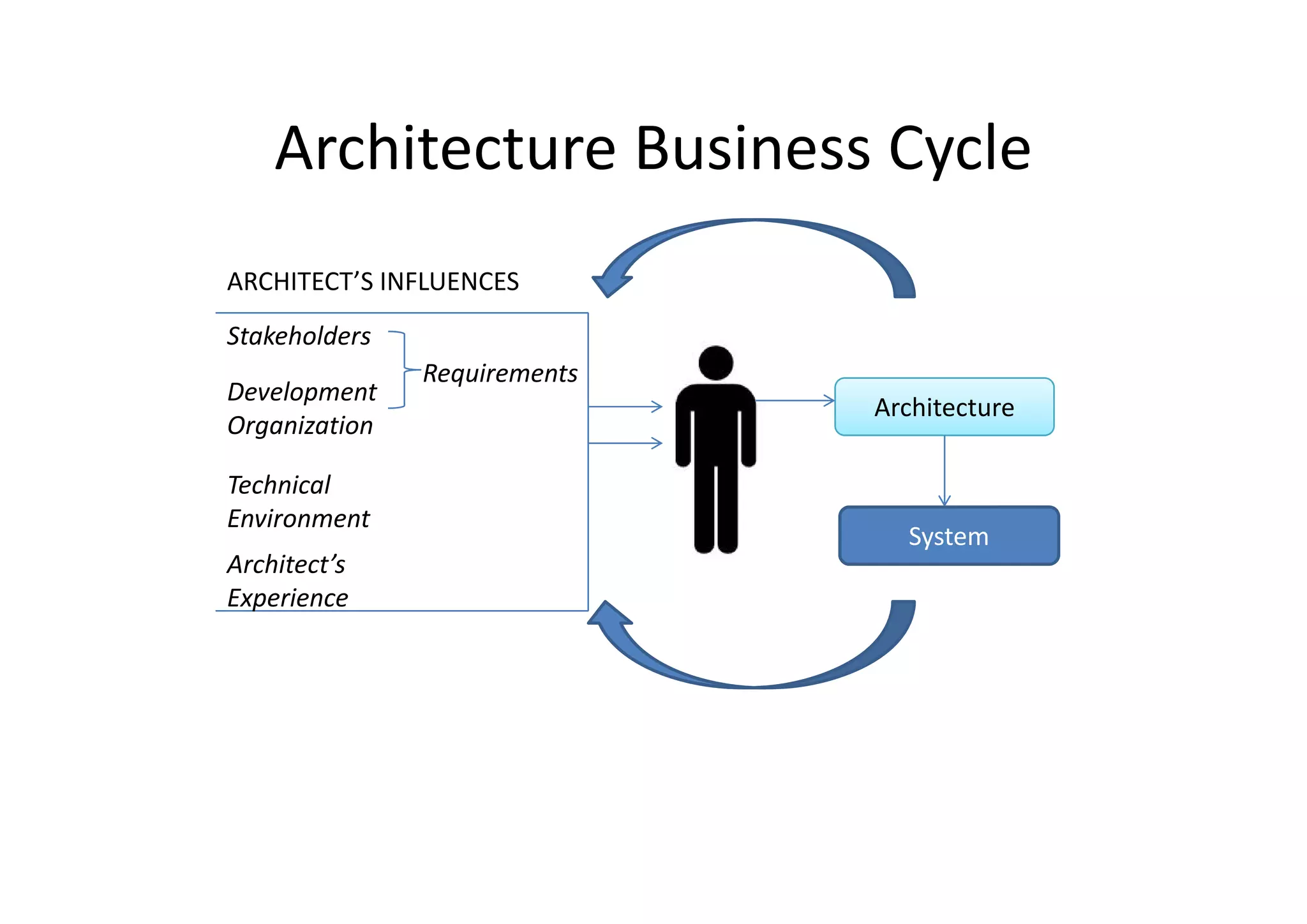
Architecture Business CycleArchitecture Business Cycle
Stakeholders
ARCHITECT’S INFLUENCES
Development 
Organization
Architecture
Requirements
Technical 
Environment
Architect’s
System
Architect s 
Experience
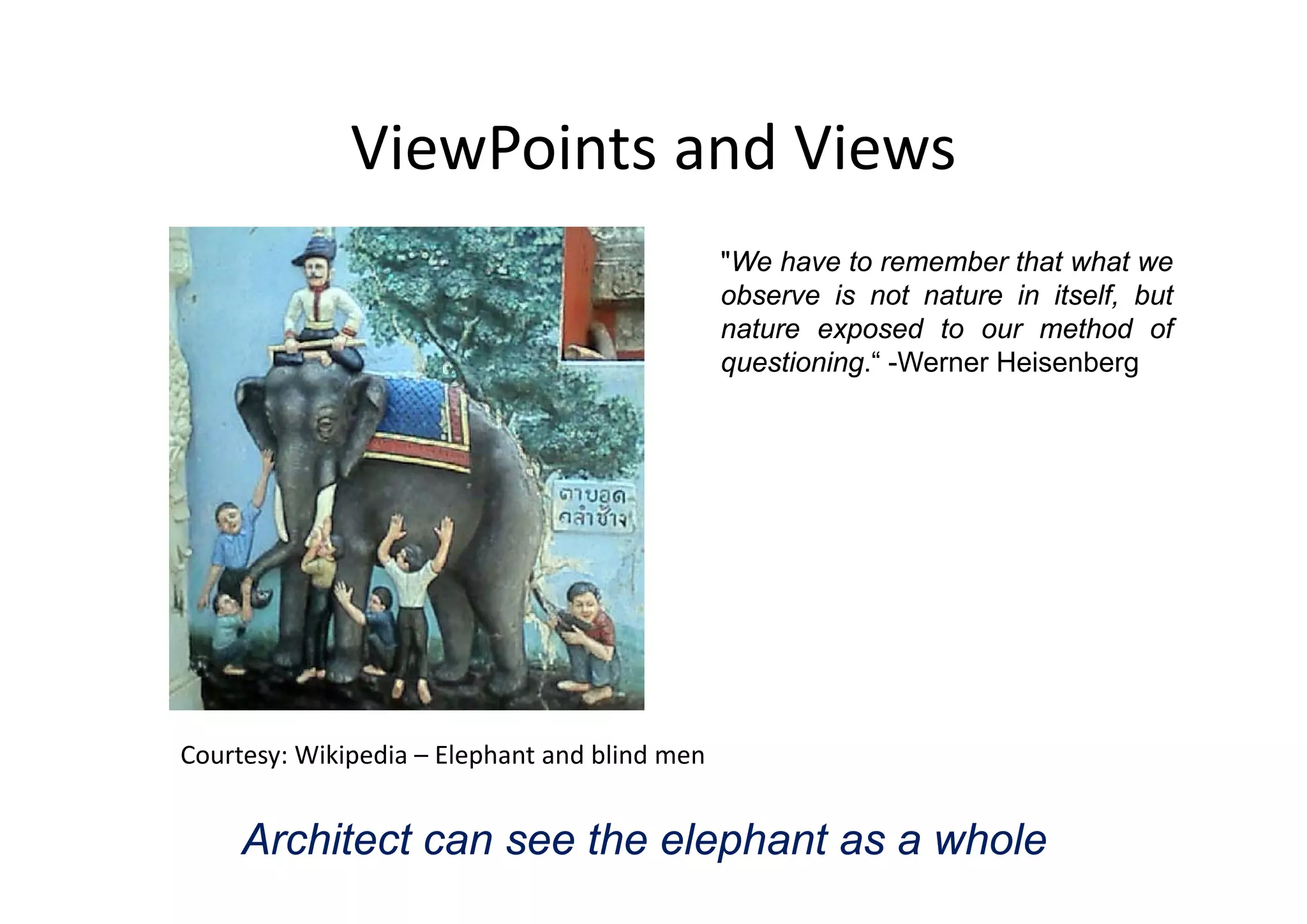
ViewPoints and ViewsViewPoints and Views
"W h t b th t h t"We have to remember that what we
observe is not nature in itself, but
nature exposed to our method of
q estioning “ Werner Heisenbergquestioning.“ -Werner Heisenberg
Courtesy: Wikipedia – Elephant and blind men
Architect can see the elephant as a whole
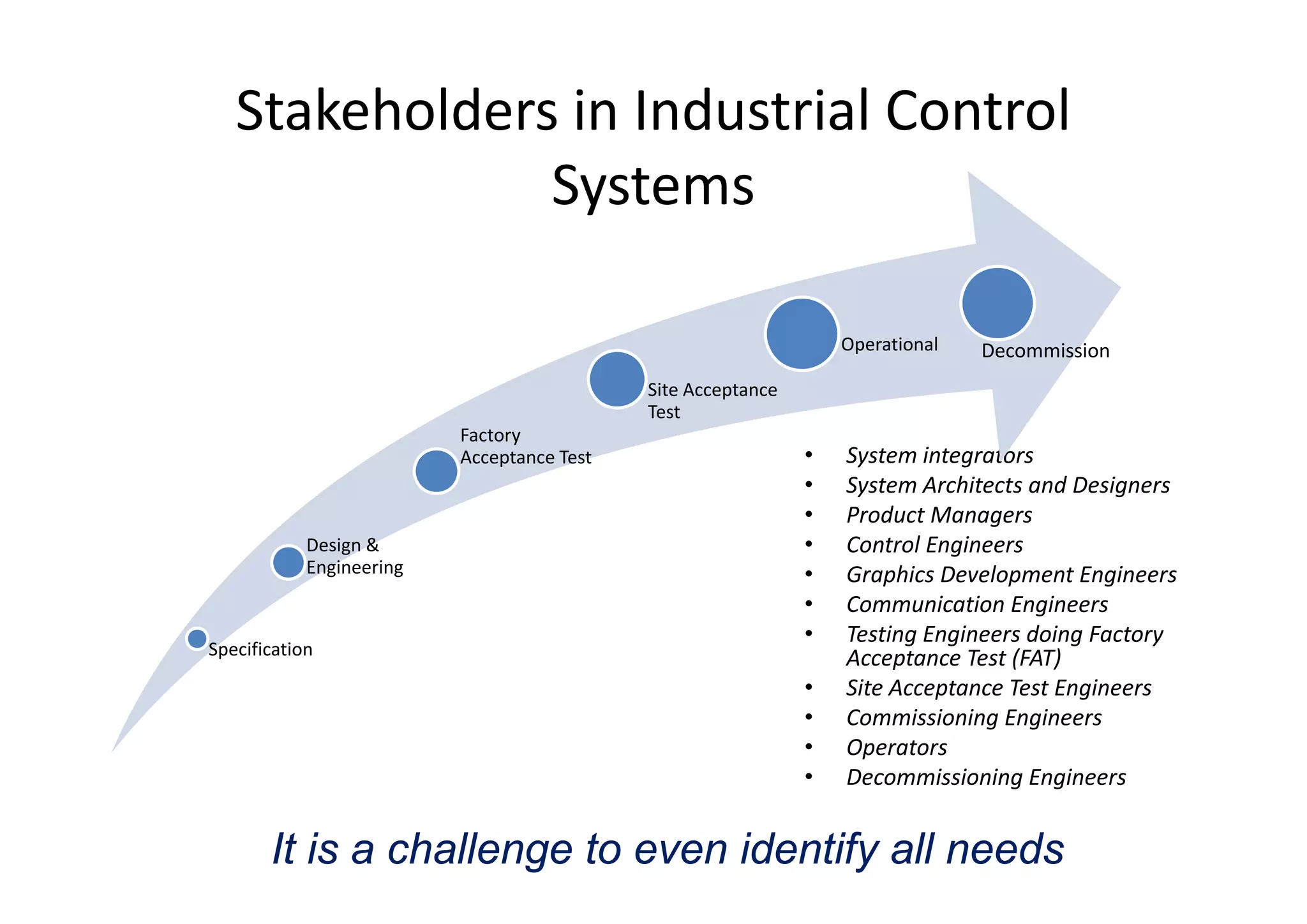
Stakeholders in Industrial Control 
Systems
Operational Decommission
• System integrators
Factory 
Acceptance Test
Site Acceptance 
Test
Decommission
System integrators
• System Architects and Designers
• Product Managers
• Control Engineers
G hi D l E i
Design & 
Engineering
Acceptance Test
• Graphics Development Engineers
• Communication Engineers
• Testing Engineers doing Factory 
Acceptance Test (FAT)Specification
Engineering
• Site Acceptance Test Engineers
• Commissioning Engineers
• Operators
• Decommissioning Engineers• Decommissioning Engineers
It is a challenge to even identify all needs
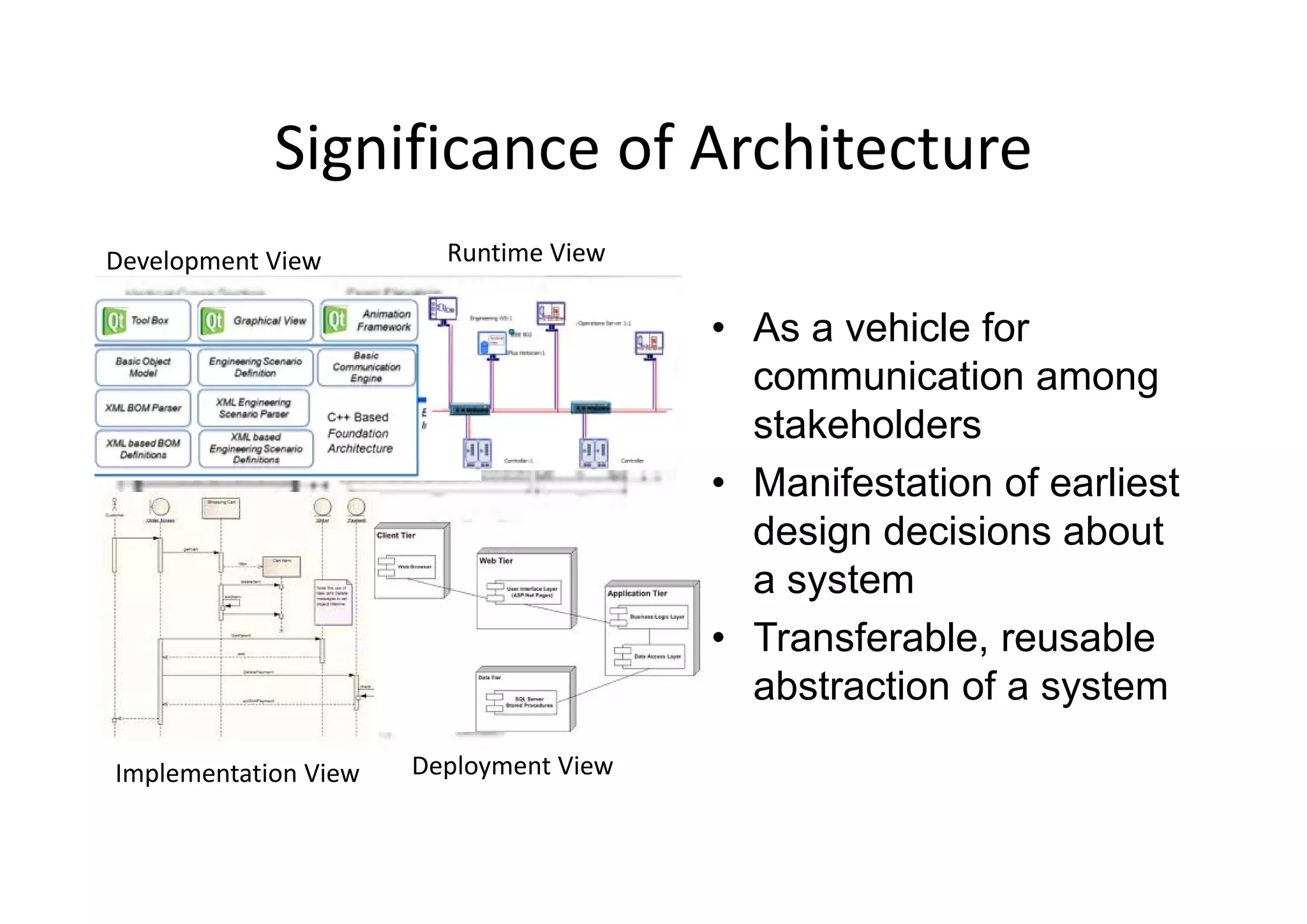
Significance of ArchitectureSignificance of Architecture
Runtime ViewD l Vi
• As a vehicle for
Runtime ViewDevelopment View
communication among
stakeholders
• Manifestation of earliest
design decisions about
ta system
• Transferable, reusable
b i fabstraction of a system
Implementation View Deployment ViewImplementation View p y
AgendaAgenda
• Alignment to the Program
• Systems and Increasing Software IntensitySystems and Increasing Software Intensity
• IEEE 42010 standard 
• Architecture Business Cycle
• Problem Space and Solutions spaceProblem Space and Solutions space
• Architecture Definition
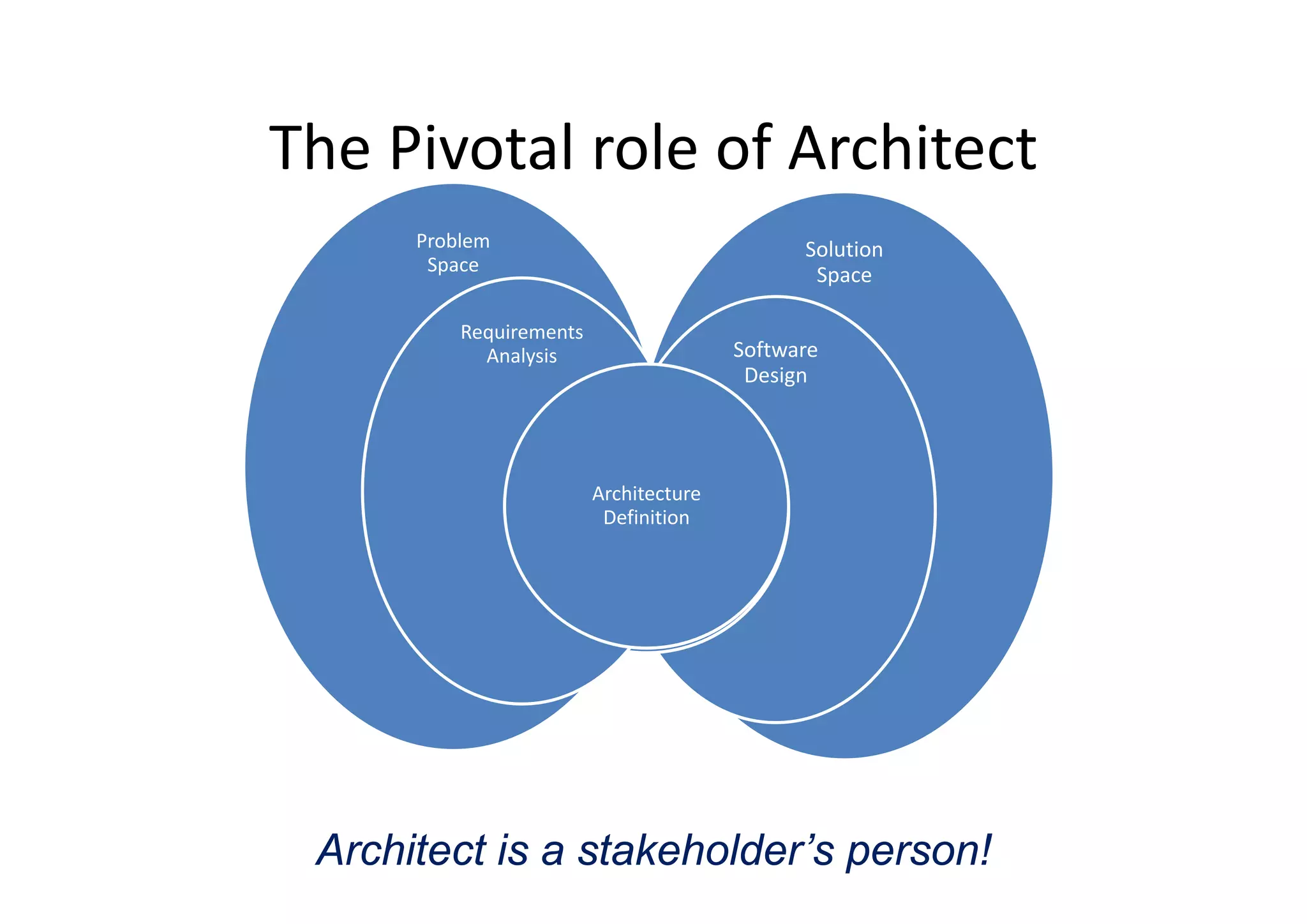
The Pivotal role of Architect
Solution
The Pivotal role of Architect
Problem  Solution 
Space
Software 
Space
Requirements 
Analysis So t a e
Design
Analysis
Architecture 
Definition
Architecture 
Definition
Architect is a stakeholder’s person!
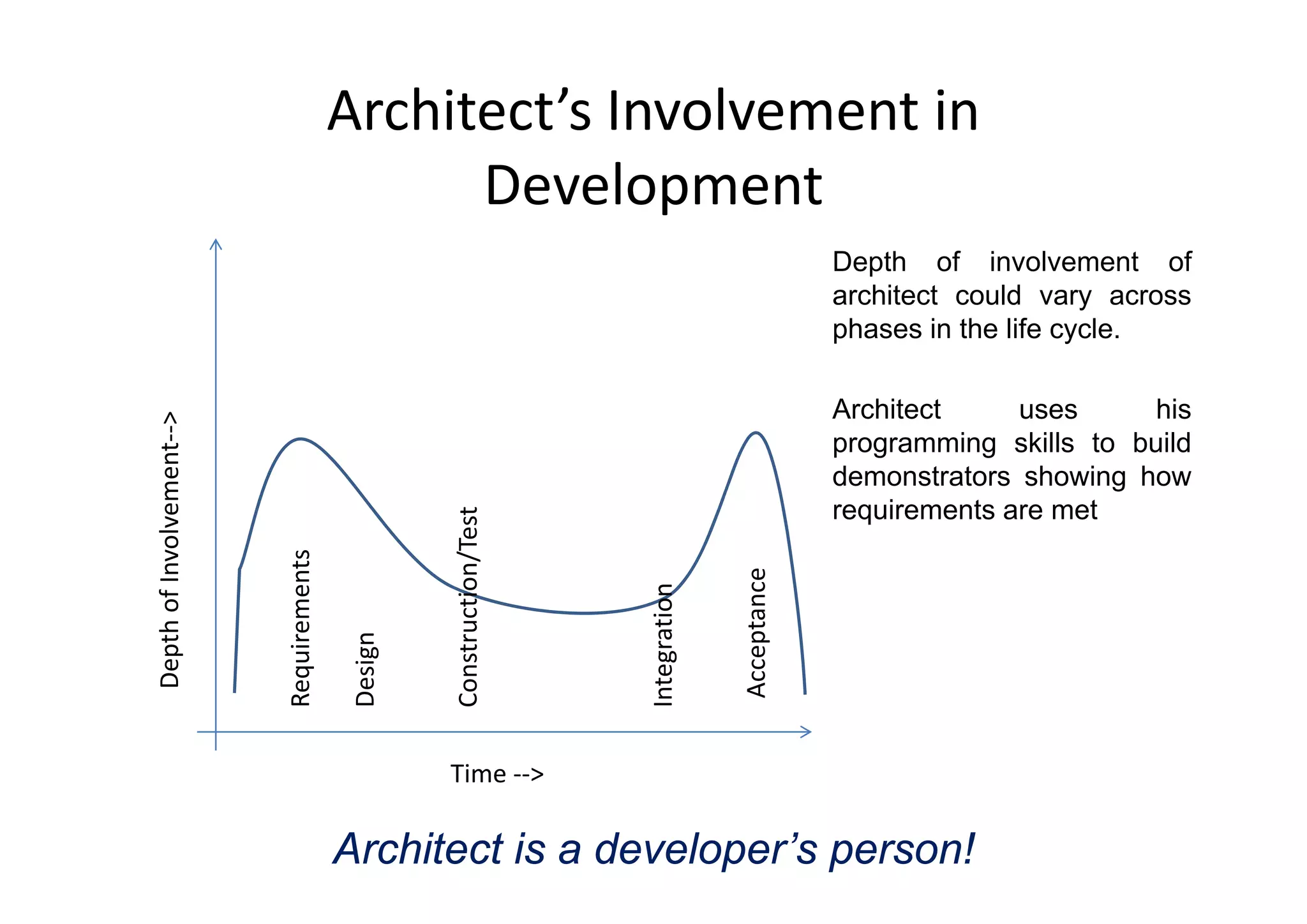
Architect’s Involvement in 
Development
D th f i l t fDepth of involvement of
architect could vary across
phases in the life cycle.
Architect uses his
programming skills to build
nt‐‐>
demonstrators showing how
requirements are met
nvolvemen
ts
n/Test
epth of In
quirement
sign
nstruction
egration
cceptance
Time ‐‐>
D
Req
Des
Con
Inte
Ac
Time ‐‐>
Architect is a developer’s person!
AgendaAgenda
• Alignment to the Program
• Systems and Increasing Software IntensitySystems and Increasing Software Intensity
• IEEE 42010 standard 
• Architecture Business Cycle
• Problem Space and Solutions spaceProblem Space and Solutions space
• Architecture Definition
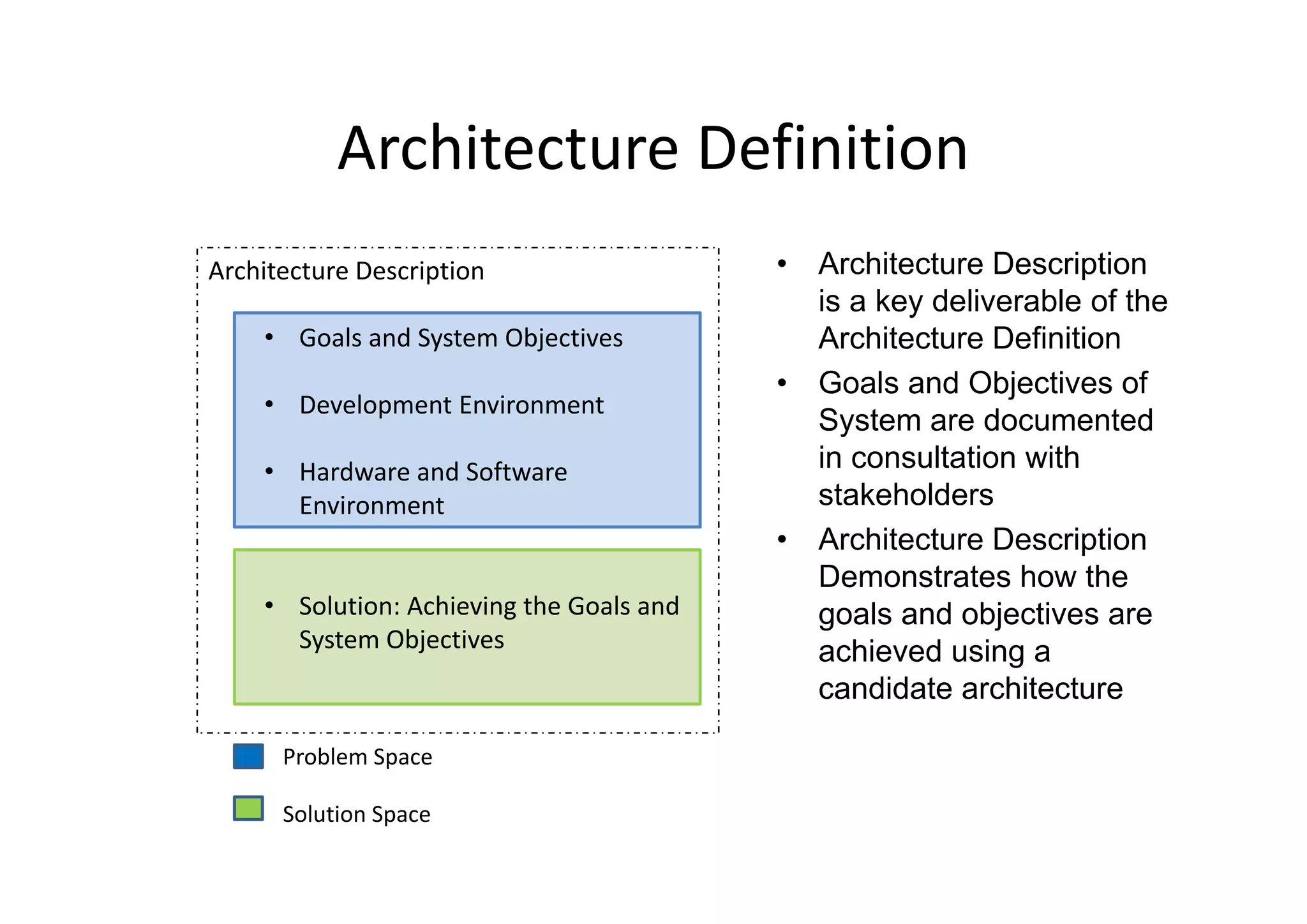
Architecture DefinitionArchitecture Definition
A hi D i i• Architecture Description
is a key deliverable of the
Architecture Definition
Architecture Description
• Goals and System Objectives
• Goals and Objectives of
System are documented
in consultation with
• Development Environment
d d f in consultation with
stakeholders
• Architecture Description
D t t h th
• Hardware and Software 
Environment
Demonstrates how the
goals and objectives are
achieved using a
• Solution: Achieving the Goals and 
System Objectives
candidate architecture
Problem Space
Solution Space
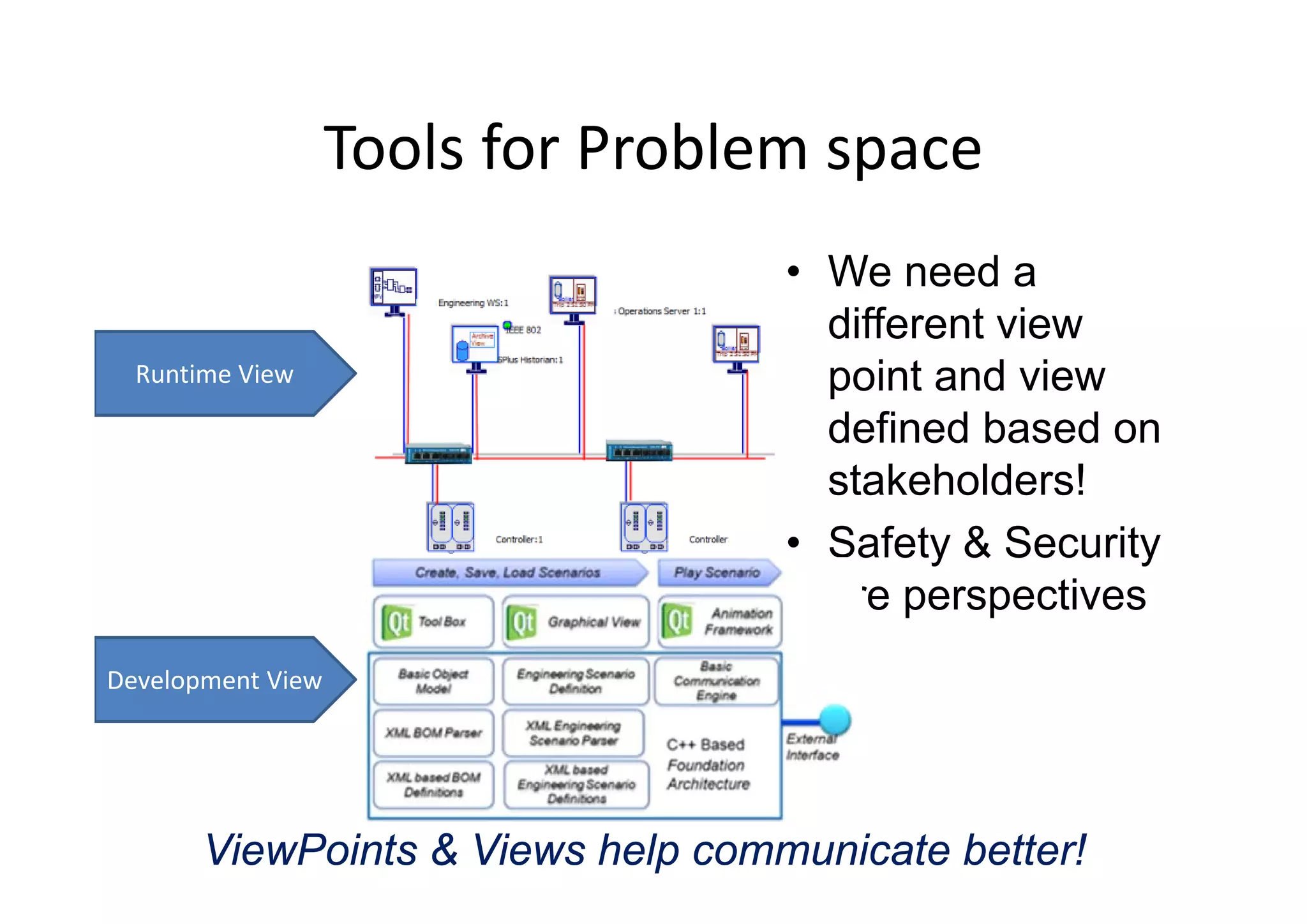
Tools for Problem spaceTools for Problem space
• We need a
different view
point and view
defined based on
Runtime View
stakeholders!
• Safety & Security
are perspectives
D l ViDevelopment View
ViewPoints & Views help communicate better!
Tools for solution spaceTools for solution space
Architecture Patterns – POSA 1 and 2 [2]  
Architecture Tactics – Software Architecture in 
Practice [3]
Design Patterns – GoF Design Patterns [4]
Estimation
Data structures and Algorithms in STL [5]
Is the solution
stimation
Open Source /COTS/Reuse from within
Is the solution 
suitable for the 
problem
Reference ArchitecturesYESNO YESNO
A Case Study of Architecture DefinitionA Case Study of Architecture Definition
Systems Visualization Platform
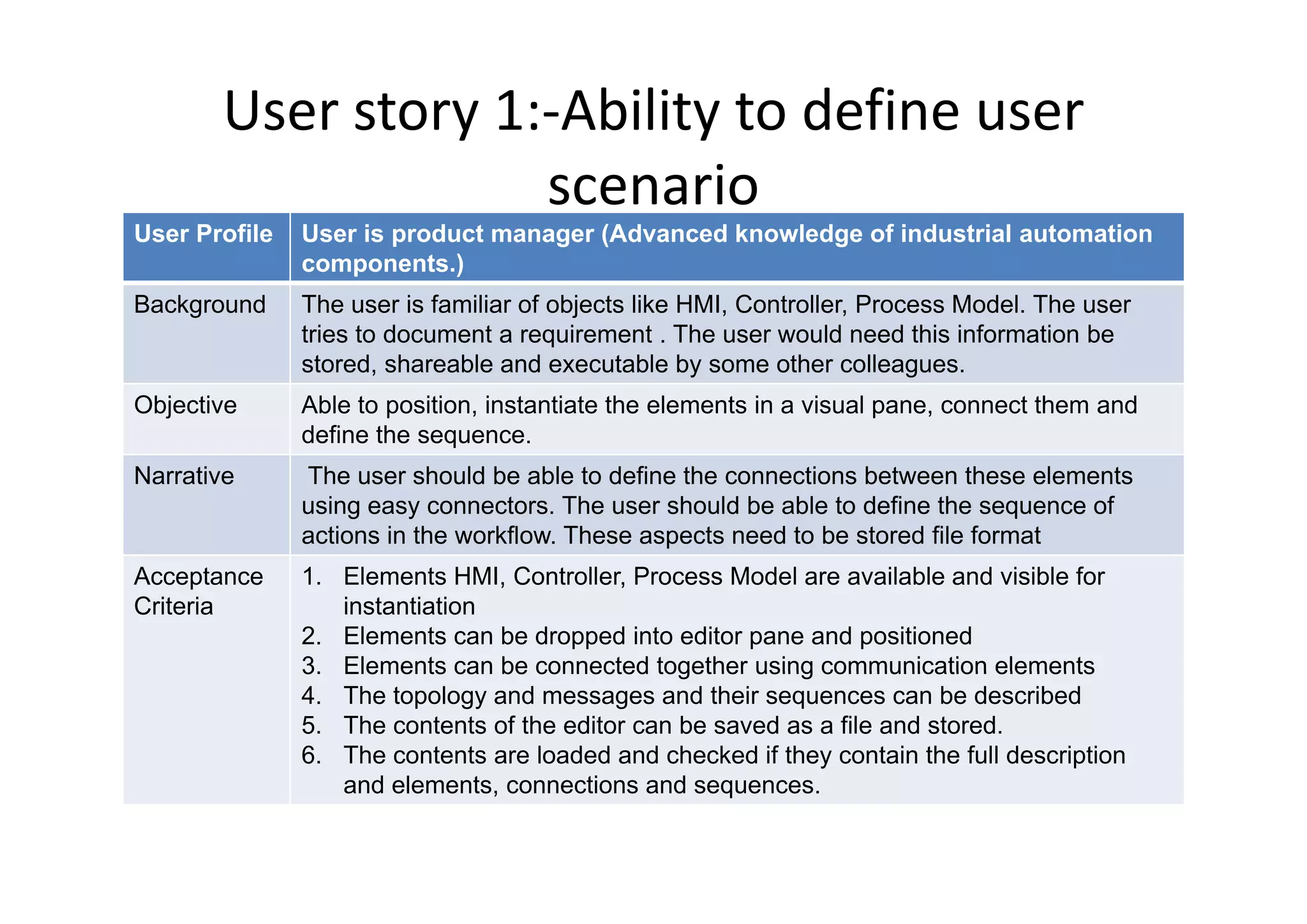
User story 1:‐Ability to define user 
scenario
User Profile User is product manager (Advanced knowledge of industrial automation
components.)
Background The user is familiar of objects like HMI, Controller, Process Model. The user
tries to document a requirement . The user would need this information be
t d h bl d t bl b th llstored, shareable and executable by some other colleagues.
Objective Able to position, instantiate the elements in a visual pane, connect them and
define the sequence.
Narrative The user should be able to define the connections between these elements
using easy connectors. The user should be able to define the sequence of
actions in the workflow. These aspects need to be stored file format
C fAcceptance
Criteria
1. Elements HMI, Controller, Process Model are available and visible for
instantiation
2. Elements can be dropped into editor pane and positioned
3 Elements can be connected together using communication elements3. Elements can be connected together using communication elements
4. The topology and messages and their sequences can be described
5. The contents of the editor can be saved as a file and stored.
6. The contents are loaded and checked if they contain the full description
d l t ti dand elements, connections and sequences.
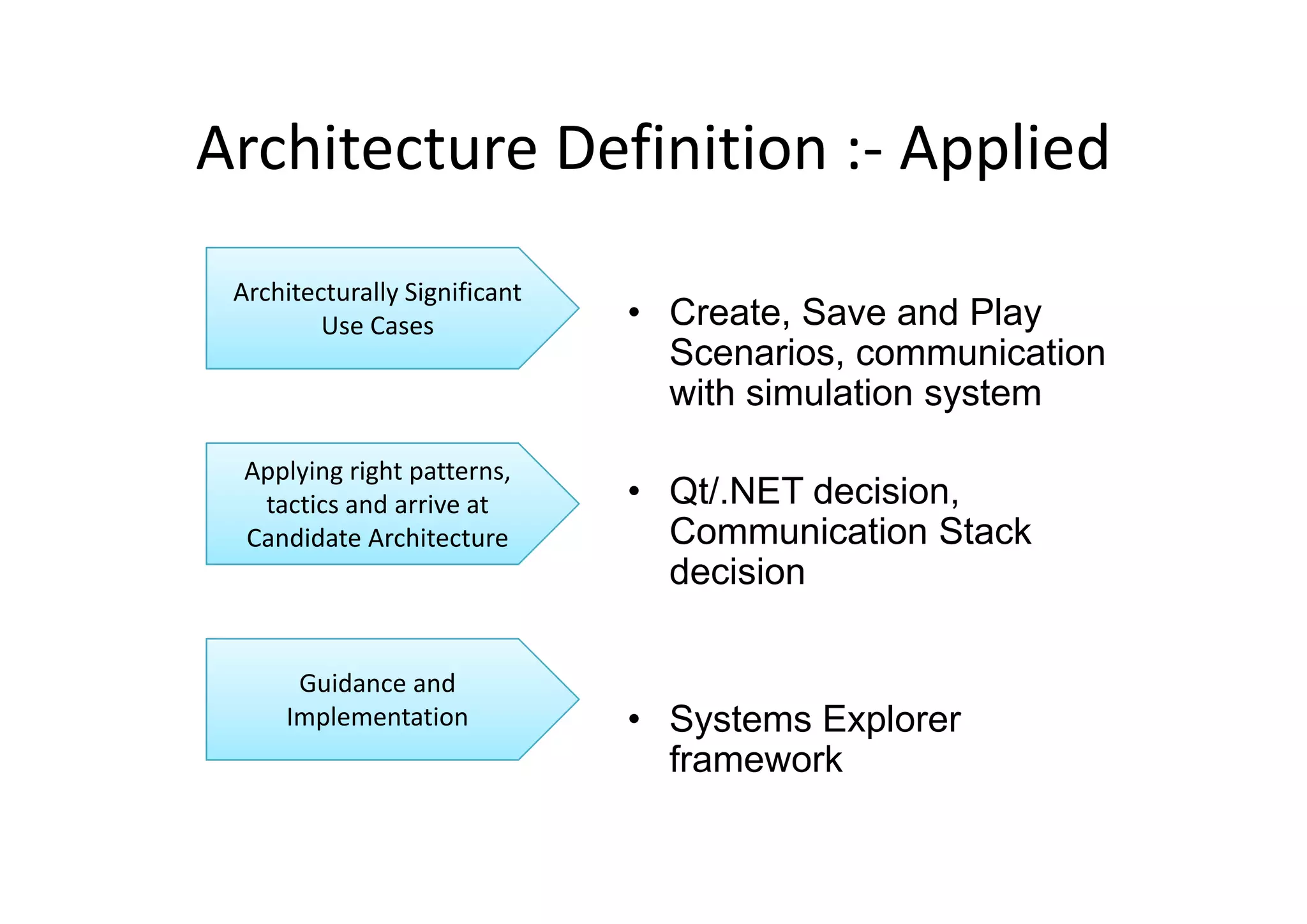
Architecture Definition : AppliedArchitecture Definition :‐ Applied
• Create, Save and Play
Scenarios communication
Architecturally Significant 
Use Cases
Scenarios, communication
with simulation system
l i i h
• Qt/.NET decision,
Communication Stack
decision
Applying right patterns, 
tactics and arrive at 
Candidate Architecture
decision
• Systems Explorer
framework
Guidance and 
Implementation
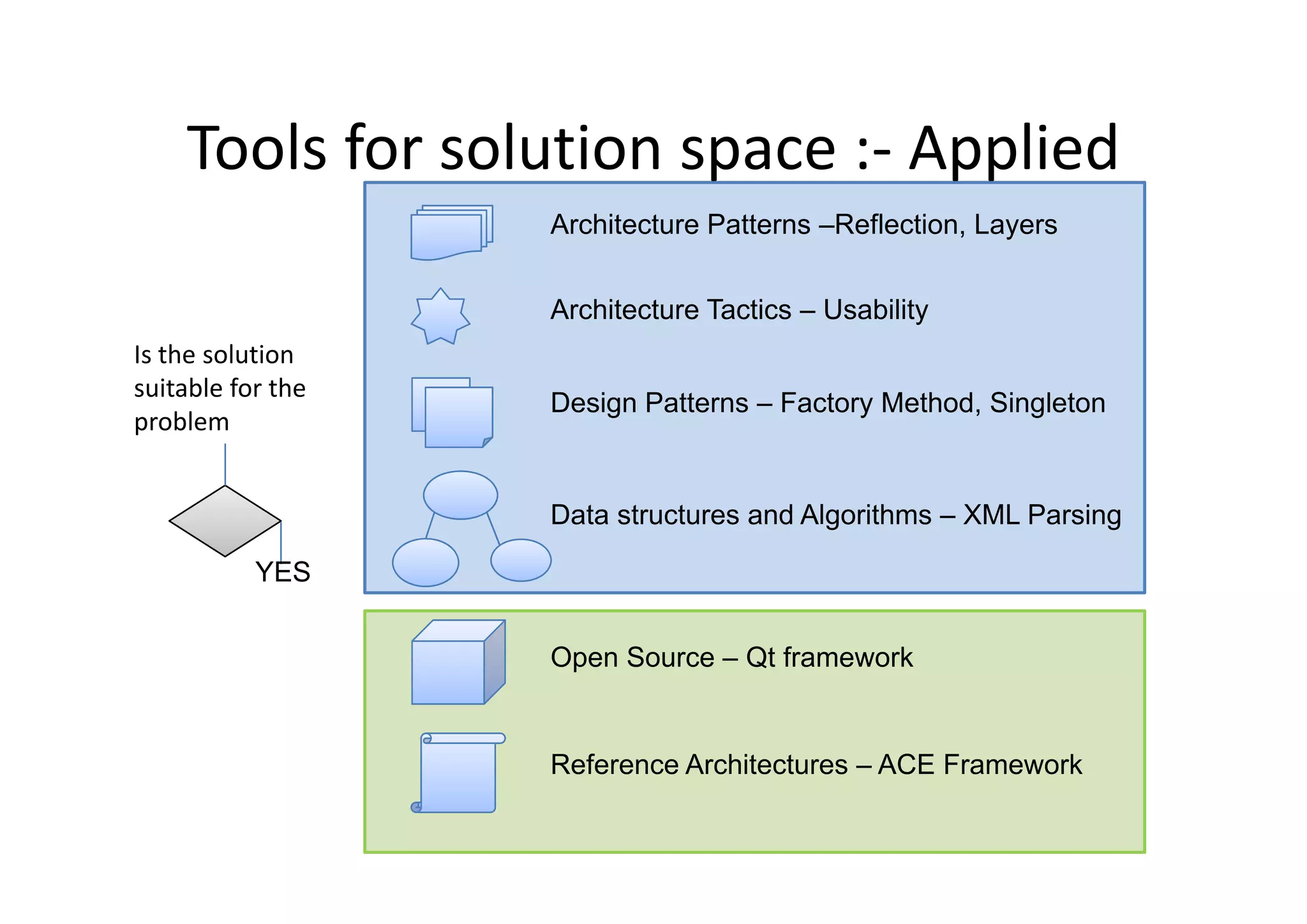
Tools for solution space : AppliedTools for solution space :‐ Applied
Architecture Patterns –Reflection, Layers
Architecture Tactics – Usability
Is the solution
Design Patterns – Factory Method, Singleton
Is the solution 
suitable for the 
problem
Data structures and Algorithms – XML Parsing
YES
Open Source – Qt framework
YES
p
Reference Architectures – ACE Framework
Architecture Description – Addressing 
View Point of Development Team
1. Object Model &
Toolbox
2 Engineering2. Engineering
scenario
definition and
view
3
3. Animation
Framework for
scene play
4
4. Basic
communication
engine to
interface withLayered View : Describes the decomposition 
1 2
interface with
external
simulation
y p
at a public level and interfaces
The  principles based on SISO standards, the graphical layer, and the 
player layer BOM Base Object Model [13]player layer. BOM – Base Object Model [13]
Detailed description of Architecture and Design [14] and Source Code 
[15]
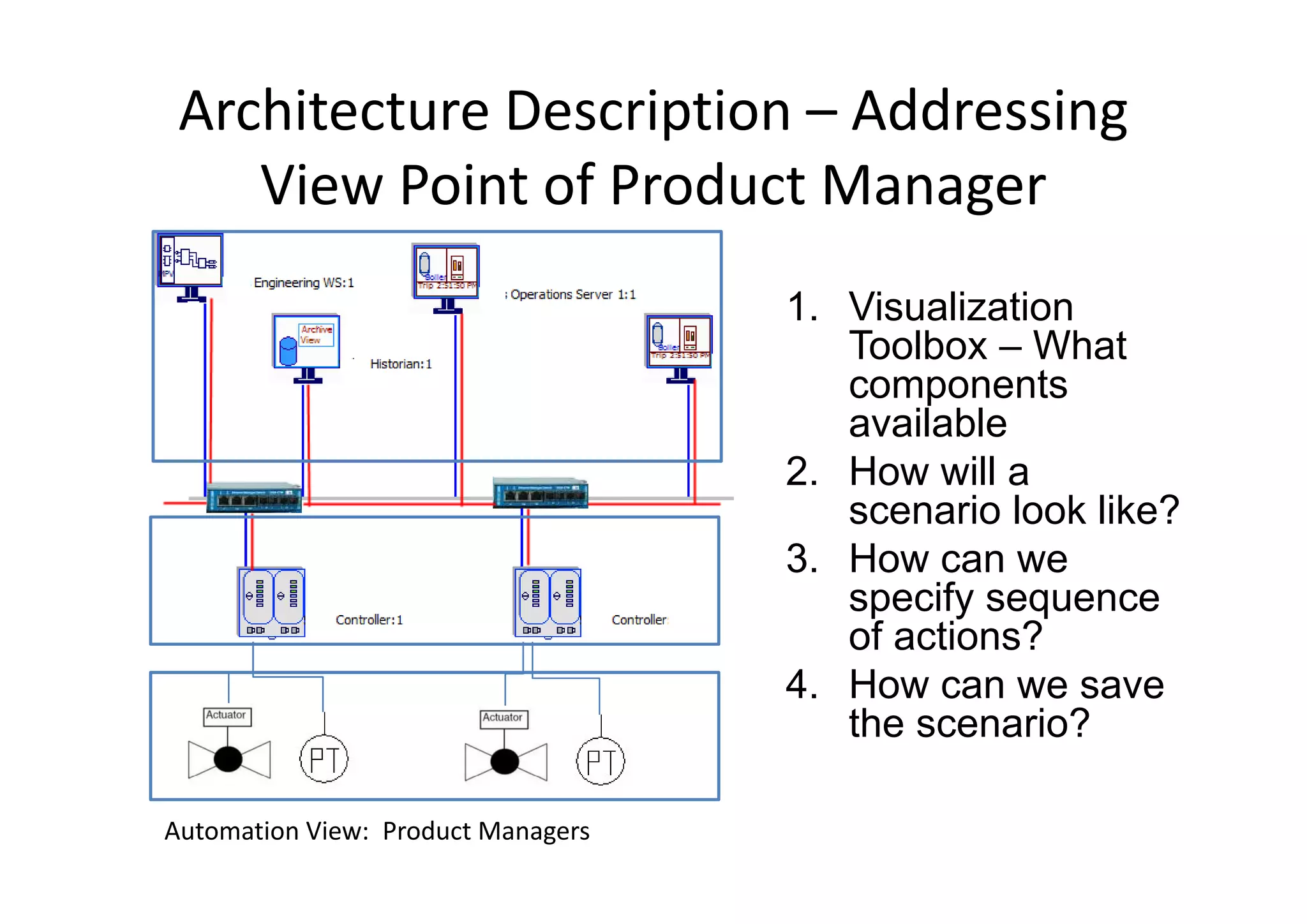
Architecture Description – Addressing 
View Point of Product Manager
1. Visualization
Toolbox – WhatToolbox What
components
available
2 H ill2. How will a
scenario look like?
3 How can we3. How can we
specify sequence
of actions?
4 H4. How can we save
the scenario?
Automation View:  Product Managers
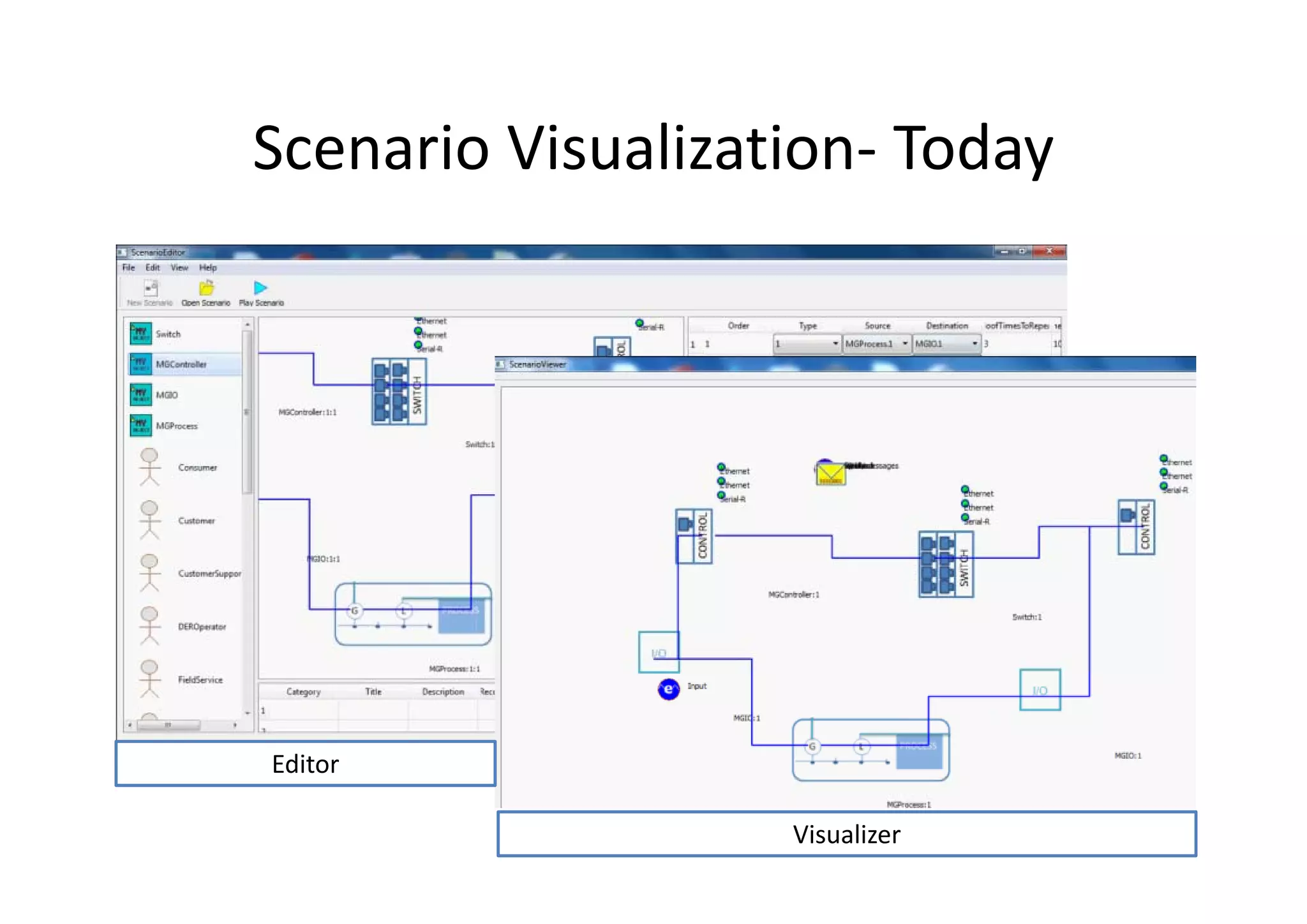
Scenario Visualization TodayScenario Visualization‐ Today
Editor
Visualizer
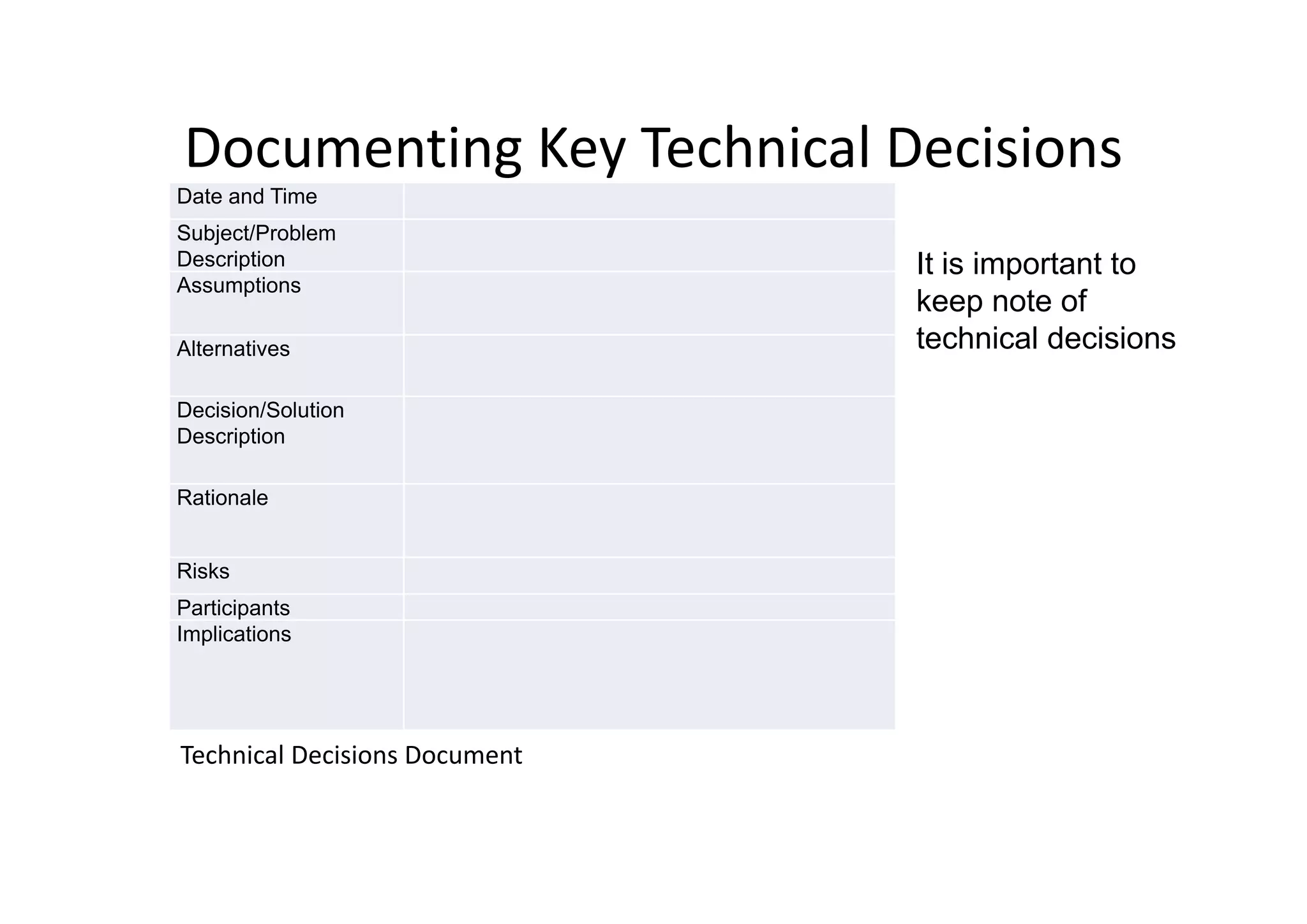
Documenting Key Technical DecisionsDocumenting Key Technical Decisions
I i i
Date and Time
Subject/Problem
D i ti It is important to
keep note of
technical decisions
Description
Assumptions
Alternatives
Decision/Solution
Description
Rationale
Ri kRisks
Participants
Implications
Technical Decisions Document
Thank you!Thank you!
Good Programmers know what to write. Great Ones 
know what to rewrite (and Reuse).
Eric S. Raymond in ‘The Cathedral and the Bazaar’.
Be the change you want to see in this world!
ReferencesReferences
1. Dave Hendricksen, "12 Essential Skills for Software Architects", 2011
2. Pattern Oriented Software Architecture Volume 1 and 2 (POSA)
3 A hit t f O S A li ti3. Architecture of Open Source Applications
4. Len Bass , Paul Clements , Rick Kazman “Software Architecture In Practice” –
Second Edition Apr 19, 2003
5. Erich Gamma , Richard Helm , Ralph Johnson, John Vlissides “Design Patterns:
El t f R bl Obj t O i t d S ft ” N b 10 1994Elements of Reusable Object-Oriented Software” November 10, 1994
6. Mark Nelson, "C++ Programmer's Guide to the Standard Template Library"
December 1995
7. Nick Rozanski and Eóin Woods “Software Systems Architecture: Working With
Stakeholders Using Viewpoints and Perspectives (2nd Edition)” Nov 4, 2011
8. Erich Gamma , Richard Helm , Ralph Johnson, John Vlissides “Design Patterns:
Elements of Reusable Object-Oriented Software” November 10, 1994 ,ISBN978-
0201633610
9. NIST SP 800-82, Guide to Industrial Control Systems (ICS) Security
10. European Commission & US National Science Foundation "Workshop Report and
Recommendations - Engineering Software -Intensive Systems” –22-23 May 2004
11. Dr TV Gopal “Systems Engineering Essentials” , 27 March 2012Gopa Sys e s g ee g sse a s , a c 0
12. IEEE Magazine, “NextGen Vehicular Systems” , June 2012
13. Applications of Software Defined Networks in Industrial Automation – An
Architectural analysis – Abhilash Gopalakrishnan
14 Requirements Engineering Visualization Platform Architecture and Experiences14. Requirements Engineering Visualization Platform- Architecture and Experiences –
Abhilash Gopalakrishnan, Abhinna Biswal, Ashoka Shyamaprasad 2012.
15. SISO Standards
16. Scenario Visualization Source Code or in GitHub
ViewpublicationstatsViewpublicationstats

Software - Role in Systems and Architectures

  • 1.
    Software – Rolein Systems andSoftware – Role in Systems and  their Architectures Talk at Software Architects Meetup  1 Oct 20161 Oct 2016 Abhilash Gopalakrishnan Principal EngineerPrincipal Engineer, Electrical Products Distribution Automation,  India Development Center ABB Global Industries & Services Pvt. Ltd.ABB Global Industries & Services Pvt. Ltd.
  • 2.
    AgendaAgenda • Re‐inventing the Role of Software Architect • Systemsand Increasing Software IntensitySystems and Increasing Software Intensity • IEEE 42010 standard  • Architecture Business Cycle • Problem Space and Solutions spaceProblem Space and Solutions space • Architecture Definition
  • 3.
    Re inventing theRoleRe‐inventing the Role Courtesy: Facebook comCourtesy: Facebook.com  Evolution of Programming Languages indicate increasing levels of abstraction.  Software Defined Everything!  Significance moves to structures and organize them :- Architecture  Architecture plays a key role in Innovations  Multi-skilled and Ability to bring experience to Multi skilled and Ability to bring experience to table. 12 Essential Skills [1]
  • 4.
    SystemsSystems • Systems forma chain involving h i l l t i l l t i i ti &– mechanical, electrical, electronics, communication & software entities. – Involves multiple interfaces across various subsystemssubsystems – Interfaces with real world! – The lifecycle of these systems normally longer. Range from embedded systems for control or– Range from embedded systems for control or automotive applications, telecommunication, business applications like banking. The complexities and size aspects of systems vary.The complexities and size aspects of systems vary. For someone from ISRO it is Earth as a System, For someone from automobile industry it is about vehicular systems like Anti Braking System (ABS) F f I d t i l C t l S t it iFor someone from Industrial Control Systems it is SCADA or DCS. We limit our discussion to more commercial Distributed Control System applications like industrial control systems. Systems span multiple disciplines
  • 5.
    Example : Asian Paints Distribution  Network Paint dispensing machines integrated withintegratedwith Software based HMI found at Asian Paint dealerships Courtesy: Asian Paints Dealership Systems have become an invisible part of our lives!
  • 6.
    Example: Industrial ControlsystemsExample: Industrial Control systems Remote Access Pl t N t kPlant Network Control Zone Field Instrumentation Involve wide variety of  subsystems, interfaces and  lifetimes more than 15 years
  • 7.
    Systems and ITApplicationsSystems and IT Applications Characteristic Systems IT Applications Time to market 1 Year and reducing Much less even in the rangeTime to market 1 Year and reducing Much less, even in the range of months Target Market Specific market segments driven by reliability and cost factors Targeted at applications more to improve productivityreliability and cost factors more to improve productivity. Expected Lifetime 10-30 years 1-5 years Relevant owners Phase wise owners from operator, engineer end customer Owners could vary across projectsengineer, end customer, decommissioning engineer projects. Legacy support/Backward Strong requirements due to huge investments required Weak requirements due to the fact that an ITsupport/Backward Compatibility Requirements investments required the fact that an IT implementation could reduce current operating cost. Shutdown Shutdown only permitted as part of Shutdown is permitted withinShutdown permitted Shutdown only permitted as part of planned maintenance. Else could lead to losses Shutdown is permitted within tolerance benchmarks. Safety Critical Yes considering human lives and Few implementations areSafety Critical Yes, considering human lives and huge investments to be protected Few implementations are safety critical, but not all Further Systems interface with real world!
  • 8.
    AgendaAgenda • Alignment to the Program • Systemsand Increasing Software IntensitySystems and Increasing Software Intensity • IEEE 42010 standard  • Architecture Business Cycle • Problem Space and Solutions spaceProblem Space and Solutions space • Architecture Definition
  • 9.
    Software Intensive SystemsSoftware Intensive Systems SbSoftware • Systems can be  classified software  intensive when Software Mechanical Electronics intensive when, – 40‐50 % of subsystems  constitute software Communication • Examples – Vehicular Systems it y could even be 50%  Software components I d i l C l– Industrial Control  Systems is close to 40%
  • 10.
  • 11.
  • 12.
    Telecommunication: growing intensity  of software d d fHardware and Software  intermingled/ Closed  Architecture Ei ti S it h A hit tExisting Switch Architectures Flow Controller  Software would handle  flow New Protocol  introduced Safety and Security Software Defined Network based Architecture y y Software plays a key role in innovation
  • 13.
    AgendaAgenda • Alignment to the Program • Systemsand Increasing Software IntensitySystems and Increasing Software Intensity • IEEE 42010 standard  • Architecture Business Cycle • Problem Space and Solutions spaceProblem Space and Solutions space • Architecture Definition
  • 14.
    IEEE 42010 OnSoftware ArchitectureIEEE 42010 – On Software Architecture • A system is built to address• A system is built to address  the needs concerns goals  and objectives of its  stakeholders (owners) ARCHITETCURAL  ELEMENT INTER ELEMENT  RELATIONSHIP REALIZES • The architecture of system  comprises of its  architectural elements and  their interrelationships ELEMENT RELATIONSHIP COMPRISES COMPRISES p • Architecture can be  documented in  Architecture Description • An Architecture Description ARCHITETCTURE SYSTEM HAS AN ADDRESS NEEDSCAN BE DOCUMENTED IN • An Architecture Description  documents architecture for  the stakeholders and  demonstrates to them that  it h t th i d ARCHITETCURAL  DESCRIPTION STAKEHOLDER CAN BE DOCUMENTED IN DOCUMENTS  ARCHITECTURE  FOR it has met their needsFOR Architecture address needs of stakeholders
  • 15.
    Architecture Quality AttributesArchitecture‐Quality Attributes Attribute Name Industrial Control System Vehicular Systems Reliability High Reliability – Probably of failure is High Reliability – Probably ofReliability High Reliability  Probably of failure is  10‐9 High Reliability  Probably of failure is 10‐9 Safety Safety important and applies more to  certain types of Process ‐ IEC 61508 SIL ISO 26262 Safety Integrity  level for Automobilescertain types of Process  IEC 61508 SIL  /ANSI/ISA‐84.01‐199 level for Automobiles Availability High Availability and Only Planned Redundancy used both asAvailability High Availability and Only Planned  Shutdown.  Redundancy used Redundancy used both as  node as well as  communication paths. Based  on application Security High Security needs based on zones Security capabilities exist. Used or not used based on  application Performance Deterministic Response expected.  Hard Real time in control and  protection. Ranges between 1 micro  second to 1 millisecond precision and Determinism expected.  Differs between application  For example Power Train and  Chasis are hard real time andsecond  to 1 millisecond precision and  3ms‐ 20 ms time to respond. Chasis are hard real time and  Telematic HMI soft real time Reliability & Safety are at most importance
  • 16.
    AgendaAgenda • Alignment to the Program • Systemsand Increasing Software IntensitySystems and Increasing Software Intensity • IEEE 42010 standard  • Architecture Business Cycle • Problem Space and Solutions spaceProblem Space and Solutions space • Architecture Definition
  • 17.
  • 18.
    ViewPoints and ViewsViewPointsand Views "W h t b th t h t"We have to remember that what we observe is not nature in itself, but nature exposed to our method of q estioning “ Werner Heisenbergquestioning.“ -Werner Heisenberg Courtesy: Wikipedia – Elephant and blind men Architect can see the elephant as a whole
  • 19.
    Stakeholders in Industrial Control  Systems Operational Decommission • Systemintegrators Factory  Acceptance Test Site Acceptance  Test Decommission System integrators • System Architects and Designers • Product Managers • Control Engineers G hi D l E i Design &  Engineering Acceptance Test • Graphics Development Engineers • Communication Engineers • Testing Engineers doing Factory  Acceptance Test (FAT)Specification Engineering • Site Acceptance Test Engineers • Commissioning Engineers • Operators • Decommissioning Engineers• Decommissioning Engineers It is a challenge to even identify all needs
  • 20.
    Significance of ArchitectureSignificance of Architecture RuntimeViewD l Vi • As a vehicle for Runtime ViewDevelopment View communication among stakeholders • Manifestation of earliest design decisions about ta system • Transferable, reusable b i fabstraction of a system Implementation View Deployment ViewImplementation View p y
  • 21.
    AgendaAgenda • Alignment to the Program • Systemsand Increasing Software IntensitySystems and Increasing Software Intensity • IEEE 42010 standard  • Architecture Business Cycle • Problem Space and Solutions spaceProblem Space and Solutions space • Architecture Definition
  • 22.
    The Pivotal roleof Architect Solution The Pivotal role of Architect Problem  Solution  Space Software  Space Requirements  Analysis So t a e Design Analysis Architecture  Definition Architecture  Definition Architect is a stakeholder’s person!
  • 23.
    Architect’s Involvement in  Development D th fi l t fDepth of involvement of architect could vary across phases in the life cycle. Architect uses his programming skills to build nt‐‐> demonstrators showing how requirements are met nvolvemen ts n/Test epth of In quirement sign nstruction egration cceptance Time ‐‐> D Req Des Con Inte Ac Time ‐‐> Architect is a developer’s person!
  • 24.
    AgendaAgenda • Alignment to the Program • Systemsand Increasing Software IntensitySystems and Increasing Software Intensity • IEEE 42010 standard  • Architecture Business Cycle • Problem Space and Solutions spaceProblem Space and Solutions space • Architecture Definition
  • 25.
    Architecture DefinitionArchitecture Definition A hiD i i• Architecture Description is a key deliverable of the Architecture Definition Architecture Description • Goals and System Objectives • Goals and Objectives of System are documented in consultation with • Development Environment d d f in consultation with stakeholders • Architecture Description D t t h th • Hardware and Software  Environment Demonstrates how the goals and objectives are achieved using a • Solution: Achieving the Goals and  System Objectives candidate architecture Problem Space Solution Space
  • 26.
    Tools for ProblemspaceTools for Problem space • We need a different view point and view defined based on Runtime View stakeholders! • Safety & Security are perspectives D l ViDevelopment View ViewPoints & Views help communicate better!
  • 27.
    Tools for solutionspaceTools for solution space Architecture Patterns – POSA 1 and 2 [2]   Architecture Tactics – Software Architecture in  Practice [3] Design Patterns – GoF Design Patterns [4] Estimation Data structures and Algorithms in STL [5] Is the solution stimation Open Source /COTS/Reuse from within Is the solution  suitable for the  problem Reference ArchitecturesYESNO YESNO
  • 28.
    A Case Studyof Architecture DefinitionA Case Study of Architecture Definition Systems Visualization Platform
  • 29.
    User story 1:‐Ability to define user  scenario User Profile Useris product manager (Advanced knowledge of industrial automation components.) Background The user is familiar of objects like HMI, Controller, Process Model. The user tries to document a requirement . The user would need this information be t d h bl d t bl b th llstored, shareable and executable by some other colleagues. Objective Able to position, instantiate the elements in a visual pane, connect them and define the sequence. Narrative The user should be able to define the connections between these elements using easy connectors. The user should be able to define the sequence of actions in the workflow. These aspects need to be stored file format C fAcceptance Criteria 1. Elements HMI, Controller, Process Model are available and visible for instantiation 2. Elements can be dropped into editor pane and positioned 3 Elements can be connected together using communication elements3. Elements can be connected together using communication elements 4. The topology and messages and their sequences can be described 5. The contents of the editor can be saved as a file and stored. 6. The contents are loaded and checked if they contain the full description d l t ti dand elements, connections and sequences.
  • 30.
    Architecture Definition :AppliedArchitecture Definition :‐ Applied • Create, Save and Play Scenarios communication Architecturally Significant  Use Cases Scenarios, communication with simulation system l i i h • Qt/.NET decision, Communication Stack decision Applying right patterns,  tactics and arrive at  Candidate Architecture decision • Systems Explorer framework Guidance and  Implementation
  • 31.
    Tools for solutionspace : AppliedTools for solution space :‐ Applied Architecture Patterns –Reflection, Layers Architecture Tactics – Usability Is the solution Design Patterns – Factory Method, Singleton Is the solution  suitable for the  problem Data structures and Algorithms – XML Parsing YES Open Source – Qt framework YES p Reference Architectures – ACE Framework
  • 32.
    Architecture Description – Addressing  View Point of Development Team 1. ObjectModel & Toolbox 2 Engineering2. Engineering scenario definition and view 3 3. Animation Framework for scene play 4 4. Basic communication engine to interface withLayered View : Describes the decomposition  1 2 interface with external simulation y p at a public level and interfaces The  principles based on SISO standards, the graphical layer, and the  player layer BOM Base Object Model [13]player layer. BOM – Base Object Model [13] Detailed description of Architecture and Design [14] and Source Code  [15]
  • 33.
    Architecture Description – Addressing  View Point of Product Manager 1. Visualization Toolbox– WhatToolbox What components available 2 H ill2. How will a scenario look like? 3 How can we3. How can we specify sequence of actions? 4 H4. How can we save the scenario? Automation View:  Product Managers
  • 34.
  • 35.
    Documenting Key TechnicalDecisionsDocumenting Key Technical Decisions I i i Date and Time Subject/Problem D i ti It is important to keep note of technical decisions Description Assumptions Alternatives Decision/Solution Description Rationale Ri kRisks Participants Implications Technical Decisions Document
  • 36.
  • 37.
    ReferencesReferences 1. Dave Hendricksen,"12 Essential Skills for Software Architects", 2011 2. Pattern Oriented Software Architecture Volume 1 and 2 (POSA) 3 A hit t f O S A li ti3. Architecture of Open Source Applications 4. Len Bass , Paul Clements , Rick Kazman “Software Architecture In Practice” – Second Edition Apr 19, 2003 5. Erich Gamma , Richard Helm , Ralph Johnson, John Vlissides “Design Patterns: El t f R bl Obj t O i t d S ft ” N b 10 1994Elements of Reusable Object-Oriented Software” November 10, 1994 6. Mark Nelson, "C++ Programmer's Guide to the Standard Template Library" December 1995 7. Nick Rozanski and Eóin Woods “Software Systems Architecture: Working With Stakeholders Using Viewpoints and Perspectives (2nd Edition)” Nov 4, 2011 8. Erich Gamma , Richard Helm , Ralph Johnson, John Vlissides “Design Patterns: Elements of Reusable Object-Oriented Software” November 10, 1994 ,ISBN978- 0201633610 9. NIST SP 800-82, Guide to Industrial Control Systems (ICS) Security 10. European Commission & US National Science Foundation "Workshop Report and Recommendations - Engineering Software -Intensive Systems” –22-23 May 2004 11. Dr TV Gopal “Systems Engineering Essentials” , 27 March 2012Gopa Sys e s g ee g sse a s , a c 0 12. IEEE Magazine, “NextGen Vehicular Systems” , June 2012 13. Applications of Software Defined Networks in Industrial Automation – An Architectural analysis – Abhilash Gopalakrishnan 14 Requirements Engineering Visualization Platform Architecture and Experiences14. Requirements Engineering Visualization Platform- Architecture and Experiences – Abhilash Gopalakrishnan, Abhinna Biswal, Ashoka Shyamaprasad 2012. 15. SISO Standards 16. Scenario Visualization Source Code or in GitHub ViewpublicationstatsViewpublicationstats