© Sun Technologies Inc. 1
DevOps
Agenda
• Why DevOps?
• What is DevOps?
• Challenges.
• DevOps and Agile.
• Benefits.
• DevOps tools.
• When to adopt and when not to.
© Sun Technologies Inc. 2
© Sun Technologies Inc.
3
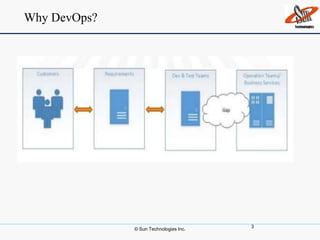
Why DevOps?
© Sun Technologies Inc. 4
DevOps
 A software development method which is a combination
of Development and Operations(IT professionals).
 It involves the aspects like:
• Communication.
• Collaboration.
• Integration.
 It leads in the following outcomes:
• Rapid evolution of products or services.
• Reduces cost/Cost effective.
• Improves quality.
• Reduces the risk of the project.
© Sun Technologies Inc. 5
DevOps
 DevOps integration targets at product delivery , quality testing,
maintenance etc., which helps in faster development and security
factors and also in faster deployment cycles.
 DevOps is driven by factors such as:
• Use of the agile and other methodologies.
• Increase in production releases by the project/stakeholders.
• Wide availability of cloud infrastructure.
• Increased usage of data center automation and also
configuration management tools.
© Sun Technologies Inc. 6
Principles of DevOps
• Develop and test the application in an environment similar
to that of production environment.
• Deploying the builds frequently.
• Validation of the quality continuously or rigorously.
© Sun Technologies Inc. 7
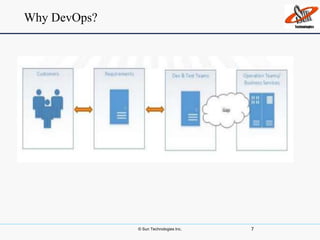
Why DevOps?
© Sun Technologies Inc.
8
Why Gap?
 Development perspective view:
• Delivery of the application after testing in
development systems.
• Mismatch in the systems environment i.e.,
development system is not same as production
environment.
• Developers will have faster turn around time with
respect to the application/project.
• Not much concerned on infrastructure and also the
code changes on deploying the production.
© Sun Technologies Inc. 9© Sun Technologies Inc.
Why Gap?
 Operations perspective view:
• Worries more about PSR.
• Lesser turn around time with respect to the
deployment and testing(Builds).
• Very much concerned on infrastructure and also the
code changes on deploying the production.
© Sun Technologies Inc. 10
• Dev work with Ops to understand the impact of
code changes.
• Developers will work closely to the production
environment.
• Focus on the Ops requirement like PSR.
• More clarity on the infrastructure needs.
• Monitoring of the Dev-Test-Ops pipeline and
deployment which leads in getting immediate
feedback.
• Better collaboration and communication.
Solution
© Sun Technologies Inc. 11
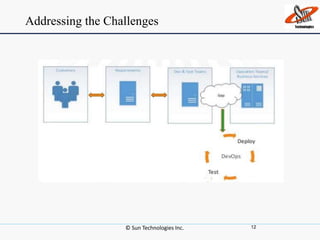
 Release Management.
 Release/Deployment co-ordination.
 Release/Deployment automation.
 Release management is with respect to understanding
risks, dependencies, issues.
 Release co-ordination is in terms of activities,
documentation and reporting etc.
 Flexibility of automation scripts with respect to the
production environment.
Challenges
Addressing the Challenges
© Sun Technologies Inc. 12
DevOps and Agile
DevOps
Addresses the gap between dev + testing and ops.
Automated release management process.
Focus is on functional, non-functional, operational and
business.
 Reusability.
Agile
Addresses the gap between customer requirements and
dev + testing .
Teams to design, develop and test features prioritized by
the customer.
Focus is on functional and non-functional, operational.
© Sun Technologies Inc. 13
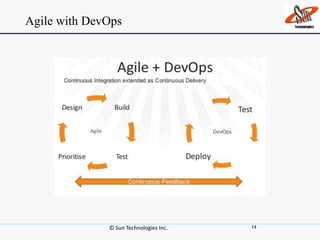
Agile with DevOps
© Sun Technologies Inc. 14
Continuous Integration and Continuous Delivery
• Continuous integration (CI) is a software engineering
practice in which isolated changes are immediately tested and
reported on when they are added to a larger code base.
• Continuous integration software tools can be used to
automate the testing and build a document trail.
• Continuous delivery (CD) is a software engineering
approach in which teams produce software in short cycles,
ensuring that the software can be reliably released at any
time.
• It aims at building, testing, and releasing software faster and
more frequently.
© Sun Technologies Inc. 15
Benefits of DevOps
• Increased service quality.
• Increased reliability of service delivery.
• Increased customer value through responsiveness to change.
• Better usability increases customer satisfaction
• Efficient operations
• Value creation increases employee satisfaction
• Collaboration improves employee attitude
• Constant learning and improvement
© Sun Technologies Inc. 16
© Sun Technologies Inc.
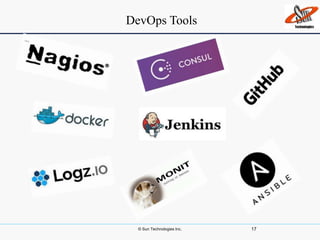
DevOps Tools
17
When and when not to adopt
To adopt:
• Ecommerce projects.
• Website projects.
• Cloud Platform.
Not to adopt:
• Mission critical platforms(Banks , Power Systems).
© Sun Technologies Inc. 18
© Sun Technologies Inc. 19
Learning Never Ends!!!

Devops

  • 1.
    © Sun TechnologiesInc. 1 DevOps
  • 2.
    Agenda • Why DevOps? •What is DevOps? • Challenges. • DevOps and Agile. • Benefits. • DevOps tools. • When to adopt and when not to. © Sun Technologies Inc. 2
  • 3.
    © Sun TechnologiesInc. 3 Why DevOps?
  • 4.
    © Sun TechnologiesInc. 4 DevOps  A software development method which is a combination of Development and Operations(IT professionals).  It involves the aspects like: • Communication. • Collaboration. • Integration.  It leads in the following outcomes: • Rapid evolution of products or services. • Reduces cost/Cost effective. • Improves quality. • Reduces the risk of the project.
  • 5.
    © Sun TechnologiesInc. 5 DevOps  DevOps integration targets at product delivery , quality testing, maintenance etc., which helps in faster development and security factors and also in faster deployment cycles.  DevOps is driven by factors such as: • Use of the agile and other methodologies. • Increase in production releases by the project/stakeholders. • Wide availability of cloud infrastructure. • Increased usage of data center automation and also configuration management tools.
  • 6.
    © Sun TechnologiesInc. 6 Principles of DevOps • Develop and test the application in an environment similar to that of production environment. • Deploying the builds frequently. • Validation of the quality continuously or rigorously.
  • 7.
    © Sun TechnologiesInc. 7 Why DevOps?
  • 8.
    © Sun TechnologiesInc. 8 Why Gap?  Development perspective view: • Delivery of the application after testing in development systems. • Mismatch in the systems environment i.e., development system is not same as production environment. • Developers will have faster turn around time with respect to the application/project. • Not much concerned on infrastructure and also the code changes on deploying the production.
  • 9.
    © Sun TechnologiesInc. 9© Sun Technologies Inc. Why Gap?  Operations perspective view: • Worries more about PSR. • Lesser turn around time with respect to the deployment and testing(Builds). • Very much concerned on infrastructure and also the code changes on deploying the production.
  • 10.
    © Sun TechnologiesInc. 10 • Dev work with Ops to understand the impact of code changes. • Developers will work closely to the production environment. • Focus on the Ops requirement like PSR. • More clarity on the infrastructure needs. • Monitoring of the Dev-Test-Ops pipeline and deployment which leads in getting immediate feedback. • Better collaboration and communication. Solution
  • 11.
    © Sun TechnologiesInc. 11  Release Management.  Release/Deployment co-ordination.  Release/Deployment automation.  Release management is with respect to understanding risks, dependencies, issues.  Release co-ordination is in terms of activities, documentation and reporting etc.  Flexibility of automation scripts with respect to the production environment. Challenges
  • 12.
    Addressing the Challenges ©Sun Technologies Inc. 12
  • 13.
    DevOps and Agile DevOps Addressesthe gap between dev + testing and ops. Automated release management process. Focus is on functional, non-functional, operational and business.  Reusability. Agile Addresses the gap between customer requirements and dev + testing . Teams to design, develop and test features prioritized by the customer. Focus is on functional and non-functional, operational. © Sun Technologies Inc. 13
  • 14.
    Agile with DevOps ©Sun Technologies Inc. 14
  • 15.
    Continuous Integration andContinuous Delivery • Continuous integration (CI) is a software engineering practice in which isolated changes are immediately tested and reported on when they are added to a larger code base. • Continuous integration software tools can be used to automate the testing and build a document trail. • Continuous delivery (CD) is a software engineering approach in which teams produce software in short cycles, ensuring that the software can be reliably released at any time. • It aims at building, testing, and releasing software faster and more frequently. © Sun Technologies Inc. 15
  • 16.
    Benefits of DevOps •Increased service quality. • Increased reliability of service delivery. • Increased customer value through responsiveness to change. • Better usability increases customer satisfaction • Efficient operations • Value creation increases employee satisfaction • Collaboration improves employee attitude • Constant learning and improvement © Sun Technologies Inc. 16
  • 17.
    © Sun TechnologiesInc. DevOps Tools 17
  • 18.
    When and whennot to adopt To adopt: • Ecommerce projects. • Website projects. • Cloud Platform. Not to adopt: • Mission critical platforms(Banks , Power Systems). © Sun Technologies Inc. 18
  • 19.
    © Sun TechnologiesInc. 19 Learning Never Ends!!!