Downloaded 110 times


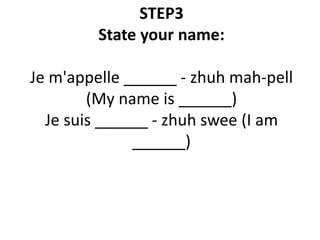
![Steps 1
Decide if the situation is formal or informal.
Formal speech should be used when
speaking to strangers, or anyone older than
yourself.
STEP2
Say a salutation
Some common ones are:Bonjour - bon-jshor
(Hello/Good day)
Bonsoir - bon-swah (Good evening)
Bonne nuit - bun-nwee (Goodnight)
Salut - sa-loo (Hi [informal])](https://image.slidesharecdn.com/introduceyourselfinfrench-141117043957-conversion-gate01/85/Introduce-yourself-in-french-3-320.jpg)
![So, a good introduction would probably be:
• Bonjour, je m'appelle [your name]. J'ai [your
age] ans et j'habite à [your town].](https://image.slidesharecdn.com/introduceyourselfinfrench-141117043957-conversion-gate01/85/Introduce-yourself-in-french-7-320.jpg)

![• First impressions are important — they can start a friendship or set the
tone for your interaction with someone.
• Start with a greeting.
• The simplest greeting is Bonjour, which means Hello or Good Morning.
• Introduce yourself.
• The two most common ways to introduce yourself are to say Je
m’appelle Name (My name isName) or Je suis Name (I'm Name).
• Since you are meeting the person for the first time, you should use the
formal form of you.
• When you’re meeting someone for the first time, it’s always more polite
to use the vous, which is more formal. Of course, you can use the tu form
when speaking to children even if you’re meeting them for the first time.
The following questions are posed in both the tu and vous forms.
• Comment t’appelles-tu? (What’s your name? [Informal])
• Comment vous appelez-vous? (What’s your name? [Formal])
• After they tell you their name you should respond.
• It’s customary to acknowledge the introduction by making an expression
of pleasure. Common ways to express this are:
• Enchanté (Delighted).
• C’est un plaisir de vous rencontrer. (It’s a pleasure to meet you.)](https://image.slidesharecdn.com/introduceyourselfinfrench-141117043957-conversion-gate01/85/Introduce-yourself-in-french-9-320.jpg)
![• Don't stop at basic introductions. You could also
talk about where each of you is from or introduce
someone else. ITo ask where the person is from,
you can say:
• De quel pays es-tu? (What country are you from?
[Informal])
• De quel pays êtes-vous? (What country are you
from? [Formal])
• If you want to talk about where you live on the
other hand, you can use the
verbs habiter or vivre, both of which mean to
live.](https://image.slidesharecdn.com/introduceyourselfinfrench-141117043957-conversion-gate01/85/Introduce-yourself-in-french-10-320.jpg)

This document provides instructions for introducing yourself in French. It begins with choosing between formal and informal speech depending on the situation. Key phrases are provided like "Bonjour, je m'appelle [name]" to introduce yourself, as well as questions you may be asked like "Quelle est votre profession?". Context-appropriate responses are given. Proper greetings, acknowledging the other person's name, and asking follow-up questions about location are covered to have a full introduction.


