Project One
Introductions and Greetings
’
Learning Objectives
 making introductions and greetings
 making introductions to other people in
accordance with business etiquette
Learning Focus
1. to know how to initiate a conversation
2.to master the way to establish relations
Task 1 Making self-introductions
Part 1 Discussion
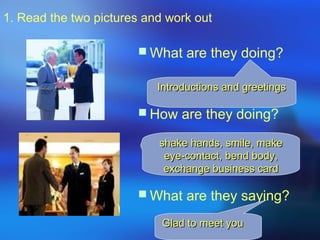
1. Read the two pictures and work out
 What are they doing?
 How are they doing?
 What are they saying?
Introductions and greetingsIntroductions and greetings
shake hands, smile, makeshake hands, smile, make
eye-contact, bend body,eye-contact, bend body,
exchange business cardexchange business card
Glad to meet youGlad to meet you
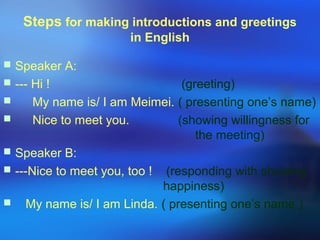
Steps for making introductions and greetings
in English
 Speaker A:
 --- Hi ! (greeting)
 My name is/ I am Meimei. ( presenting one’s name)
 Nice to meet you. (showing willingness for
the meeting)
 Speaker B:
 ---Nice to meet you, too ! (responding with showing
happiness)
 My name is/ I am Linda. ( presenting one’s name )
Ways to greet each other
 Good morning! (afternoon, evening)
 How do you do? /How are you?
 Good/Nice/Glad/Pleased to see/meet you!
 What a pleasant surprise!
 Haven’t seen you for some time.
 Long time no see!
How are you?
 How are you doing?
 How are things with you?
 How is everything (going with you)?
 How are you getting on?
 How are you keeping?
 How have you been?
Responses to greetings
 Fine, thank you. And you?
 Very well, thanks. And you?
 Not too bad, thanks.
 All right, thanks.
 Just so so.
 Same as usual.
 Not very well , I’m afraid.
 Can’t complain. ( 还过得去 )
Part 2. Role play
Practice with partners as you are at a
business meeting, where you are strangers to
each other.
Part 3. Demonstration
Part 4. Discussion on demonstration with
such questions:
1) Is there any room for improving ?
2) What suggestion would you make?
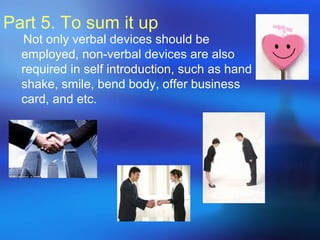
Part 5. To sum it up
Not only verbal devices should be
employed, non-verbal devices are also
required in self introduction, such as hand
shake, smile, bend body, offer business
card, and etc.
Part 2 Listening
1. Listen to the recording and then finish the1. Listen to the recording and then finish the
conversation on Page 5.conversation on Page 5.
2. Useful expression:2. Useful expression:
Excuse me. Are you XXX?/ is your name XXX?Excuse me. Are you XXX?/ is your name XXX?
Sorry for interruption.Sorry for interruption.
That’s alright.That’s alright.
Task 2 Saying where you are from
Part 1. Reading
 1. Read the advertisement on the book,
and answer the following question.
 Are the statements true or false?
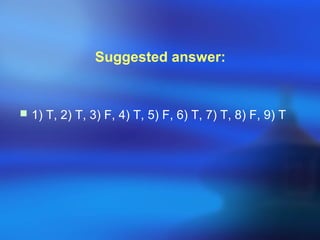
Suggested answer:
 1) T, 2) T, 3) F, 4) T, 5) F, 6) T, 7) T, 8) F, 9) T
Background information
 Bogota( 波哥大 )[′bəugətə]: capital and largest city
of Colombia, which is located in central Colombia
on a high fertile plain.
 Abu Dhabi( 阿布扎比 ) [′æbu: ′ðæbi:] : is the
capital and second most populous city in the
United Arab Emirates(UAE) after Dubai( 迪拜 ).
One of the world's largest producers of oil, Abu
Dhabi has actively attempted to diversify its
economy in recent years through investments in
financial services and tourism.
 Tehran (or Teheran) [teə′ræn /-′r :n] is the capitalɑ
and largest city of Iran, and the administrative
center of Tehran Province. Tehran is famous for
its numerous ski resorts on the Alborz slopes,
large museums, art centers, and palace
complexes. Tehran is the largest city in the Middle
East and is the most populated city in South
Western Asia with a population of 7,404,515 and
approximately 15 million in Greater Tehran.
 Brussels [′br slz]: is the capital of Belgium and theʌ
administrative centre of the European Union. This
has earned the city the title of the Capital of
Europe. Brussels has been given its character by
the coexistence of French and Flemish culture,
and it is nowadays home to nationalities around
the world, adding a cosmopolitan flavour to its
atmosphere. The vibrant atmosphere of Brussels
is further enhanced by picturesque medieval
streets, lively squares, beautiful boulevards,
impressive monuments, spacious parks, cosy
cafés, interesting restaurants and an active
cultural life.
 Munich [′mju:nik]: is the capital city of
Bavaria, Germany. It is the third largest city
in Germany, after Berlin and Hamburg.
There are approximately 1.35 million
inhabitants within Munich. The city's motto
is "München mag Dich" ("Munich Likes
You"), before 2006, it was "Weltstadt mit
Herz" (world city with heart)
 Kuala Lumpur [′kw :lə ′lumpuə]: oftenɑ
abbreviated as K.L. is the capital and the
largest city of Malaysia [mə′lei ə].ʒ
 Harare [hə’r :rei]: Harare (before 1982ɑ
known as Salisbury) is the largest city and
capital of Zimbabwe. 哈拉雷 ( 津巴布韦首
都 )( 旧称索尔兹伯里 )
 Amman / :′m :n/ is the capital and largestɑ ɑ
city of Jordan. It is the country's political,
cultural and commercial centre and one of
the oldest continuously inhabited cities in
the world.
 Jordan(/d :dən/) is a kingdom on the Eastʒɔ
Bank of the River Jordan.
 New Delhi is the capital city of India.
 Hawaii [h :’waii:] is the newest of the 50 US states (Augustɑ
21, 1959), and is the only U.S. state made up entirely of
islands. It is the northernmost island group in Polynesia( 中
太平洋岛群 ), occupying most of an archipelago in the
central Pacific Ocean, southwest of the continental United
States, southeast of Japan, and northeast of Australia.
Hawaii’s natural and diverse scenery, warm tropical
climate, abundance of public beaches and oceanic
surroundings, and active volcanoes make it a popular
destination for tourists, surfers, biologists, and
volcanologists alike.
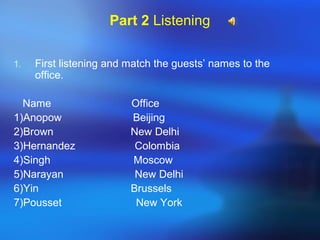
Part 2 Listening
1. First listening and match the guests’ names to the
office.
Name Office
1)Anopow Beijing
2)Brown New Delhi
3)Hernandez Colombia
4)Singh Moscow
5)Narayan New Delhi
6)Yin Brussels
7)Pousset New York
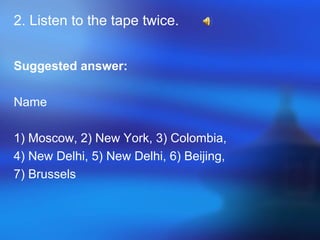
2. Listen to the tape twice.
Suggested answer:
Name
1) Moscow, 2) New York, 3) Colombia,
4) New Delhi, 5) New Delhi, 6) Beijing,
7) Brussels
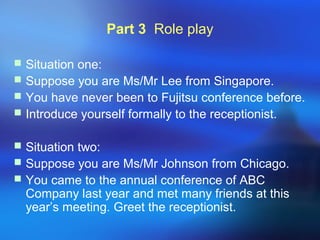
Part 3 Role play
 Situation one:
 Suppose you are Ms/Mr Lee from Singapore.
 You have never been to Fujitsu conference before.
 Introduce yourself formally to the receptionist.
 Situation two:
 Suppose you are Ms/Mr Johnson from Chicago.
 You came to the annual conference of ABC
Company last year and met many friends at this
year’s meeting. Greet the receptionist.
 2. Demonstration and comment.
Task 3 Introducing other people
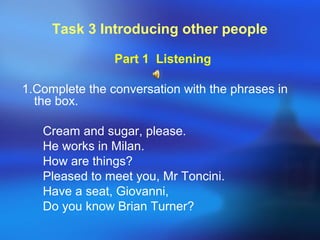
Part 1 Listening
1.Complete the conversation with the phrases in
the box.
Cream and sugar, please.
He works in Milan.
How are things?
Pleased to meet you, Mr Toncini.
Have a seat, Giovanni,
Do you know Brian Turner?
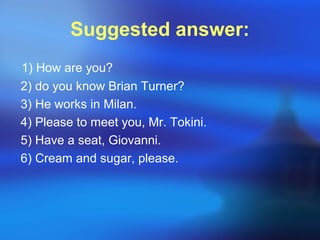
Suggested answer:
1) How are you?
2) do you know Brian Turner?
3) He works in Milan.
4) Please to meet you, Mr. Tokini.
5) Have a seat, Giovanni.
6) Cream and sugar, please.
2. Role play based on the completed
conversation on Page 8. (5’)
3. Group discussion:
Making introduction is a common practice in
business career. How can we do that?
Here are some tips:
If there are people who are different
in ages, sex, positions and etc, you
 Introduce the visited one to the visiting one first.
( 向来
访者介绍被访者 )
 Introduce the junior positioned one to the senior
one first. ( 向高职位者介绍低职位者 )
 Introduce the younger one to the elder one first.
 (向长者介绍年幼者)
 Introduce the male to the female first.
 ( 先向女士介绍男士 )
 After conducting introduction, the introducer
usually should find an excuse as to leave the new
acquaintances to chat.
Part 2 Language focus
 1.Study the examples in the box.
 Situation :
 Introduce Ms/Mr Smith to your sales
manager, Ms/Mr Richards who is from
Sydney. Ms/Mr Smith is from HongKong and
works for the Shanghai Bank.
Situational dialogues:
work in groups, make dialogues according to the
following situations in a proper way, and
remember to use the expressions we learnt.
Situation One:
 A kowns B and C, but B doesn’t know C. Introduce
B to C.
Situation Two:
 A kowns B but doesn’t know C. Introduce C to A.
Situation Three:
 Introduce Ms/Mr Smith to your sales manager,
Ms/Mr Richards who is from Sydney. Ms/Mr Smith
is from HongKong and works for the Shanghai
Bank
 Steps:
greeting---responding to greeting---
introducing other people---giving information
about other people---the other two
introducing each other
Sum-up
 In this project, we learnt:
 1. How to properly make a self introduction
as to establish a relationship.
 2. How to properly make others known each
other by an introduction.
 3. In communication, non-verbal devices are
required and important.
Assignment
 1. Make dialogues according to the steps
we learnt in class.
 2. Learn all the names of countries and
cities by heart.

Project 1

  • 1.
  • 2.
    Learning Objectives  makingintroductions and greetings  making introductions to other people in accordance with business etiquette
  • 3.
    Learning Focus 1. toknow how to initiate a conversation 2.to master the way to establish relations
  • 4.
    Task 1 Makingself-introductions Part 1 Discussion
  • 5.
    1. Read thetwo pictures and work out  What are they doing?  How are they doing?  What are they saying? Introductions and greetingsIntroductions and greetings shake hands, smile, makeshake hands, smile, make eye-contact, bend body,eye-contact, bend body, exchange business cardexchange business card Glad to meet youGlad to meet you
  • 6.
    Steps for makingintroductions and greetings in English  Speaker A:  --- Hi ! (greeting)  My name is/ I am Meimei. ( presenting one’s name)  Nice to meet you. (showing willingness for the meeting)  Speaker B:  ---Nice to meet you, too ! (responding with showing happiness)  My name is/ I am Linda. ( presenting one’s name )
  • 7.
    Ways to greeteach other  Good morning! (afternoon, evening)  How do you do? /How are you?  Good/Nice/Glad/Pleased to see/meet you!  What a pleasant surprise!  Haven’t seen you for some time.  Long time no see!
  • 8.
    How are you? How are you doing?  How are things with you?  How is everything (going with you)?  How are you getting on?  How are you keeping?  How have you been?
  • 9.
    Responses to greetings Fine, thank you. And you?  Very well, thanks. And you?  Not too bad, thanks.  All right, thanks.  Just so so.  Same as usual.  Not very well , I’m afraid.  Can’t complain. ( 还过得去 )
  • 10.
    Part 2. Roleplay Practice with partners as you are at a business meeting, where you are strangers to each other.
  • 11.
  • 12.
    Part 4. Discussionon demonstration with such questions: 1) Is there any room for improving ? 2) What suggestion would you make?
  • 13.
    Part 5. Tosum it up Not only verbal devices should be employed, non-verbal devices are also required in self introduction, such as hand shake, smile, bend body, offer business card, and etc.
  • 14.
    Part 2 Listening 1.Listen to the recording and then finish the1. Listen to the recording and then finish the conversation on Page 5.conversation on Page 5. 2. Useful expression:2. Useful expression: Excuse me. Are you XXX?/ is your name XXX?Excuse me. Are you XXX?/ is your name XXX? Sorry for interruption.Sorry for interruption. That’s alright.That’s alright.
  • 15.
    Task 2 Sayingwhere you are from Part 1. Reading  1. Read the advertisement on the book, and answer the following question.  Are the statements true or false?
  • 16.
    Suggested answer:  1)T, 2) T, 3) F, 4) T, 5) F, 6) T, 7) T, 8) F, 9) T
  • 17.
    Background information  Bogota(波哥大 )[′bəugətə]: capital and largest city of Colombia, which is located in central Colombia on a high fertile plain.  Abu Dhabi( 阿布扎比 ) [′æbu: ′ðæbi:] : is the capital and second most populous city in the United Arab Emirates(UAE) after Dubai( 迪拜 ). One of the world's largest producers of oil, Abu Dhabi has actively attempted to diversify its economy in recent years through investments in financial services and tourism.
  • 18.
     Tehran (orTeheran) [teə′ræn /-′r :n] is the capitalɑ and largest city of Iran, and the administrative center of Tehran Province. Tehran is famous for its numerous ski resorts on the Alborz slopes, large museums, art centers, and palace complexes. Tehran is the largest city in the Middle East and is the most populated city in South Western Asia with a population of 7,404,515 and approximately 15 million in Greater Tehran.
  • 19.
     Brussels [′brslz]: is the capital of Belgium and theʌ administrative centre of the European Union. This has earned the city the title of the Capital of Europe. Brussels has been given its character by the coexistence of French and Flemish culture, and it is nowadays home to nationalities around the world, adding a cosmopolitan flavour to its atmosphere. The vibrant atmosphere of Brussels is further enhanced by picturesque medieval streets, lively squares, beautiful boulevards, impressive monuments, spacious parks, cosy cafés, interesting restaurants and an active cultural life.
  • 20.
     Munich [′mju:nik]:is the capital city of Bavaria, Germany. It is the third largest city in Germany, after Berlin and Hamburg. There are approximately 1.35 million inhabitants within Munich. The city's motto is "München mag Dich" ("Munich Likes You"), before 2006, it was "Weltstadt mit Herz" (world city with heart)
  • 21.
     Kuala Lumpur[′kw :lə ′lumpuə]: oftenɑ abbreviated as K.L. is the capital and the largest city of Malaysia [mə′lei ə].ʒ  Harare [hə’r :rei]: Harare (before 1982ɑ known as Salisbury) is the largest city and capital of Zimbabwe. 哈拉雷 ( 津巴布韦首 都 )( 旧称索尔兹伯里 )
  • 22.
     Amman /:′m :n/ is the capital and largestɑ ɑ city of Jordan. It is the country's political, cultural and commercial centre and one of the oldest continuously inhabited cities in the world.  Jordan(/d :dən/) is a kingdom on the Eastʒɔ Bank of the River Jordan.
  • 23.
     New Delhiis the capital city of India.  Hawaii [h :’waii:] is the newest of the 50 US states (Augustɑ 21, 1959), and is the only U.S. state made up entirely of islands. It is the northernmost island group in Polynesia( 中 太平洋岛群 ), occupying most of an archipelago in the central Pacific Ocean, southwest of the continental United States, southeast of Japan, and northeast of Australia. Hawaii’s natural and diverse scenery, warm tropical climate, abundance of public beaches and oceanic surroundings, and active volcanoes make it a popular destination for tourists, surfers, biologists, and volcanologists alike.
  • 24.
    Part 2 Listening 1.First listening and match the guests’ names to the office. Name Office 1)Anopow Beijing 2)Brown New Delhi 3)Hernandez Colombia 4)Singh Moscow 5)Narayan New Delhi 6)Yin Brussels 7)Pousset New York
  • 25.
    2. Listen tothe tape twice. Suggested answer: Name 1) Moscow, 2) New York, 3) Colombia, 4) New Delhi, 5) New Delhi, 6) Beijing, 7) Brussels
  • 26.
    Part 3 Roleplay  Situation one:  Suppose you are Ms/Mr Lee from Singapore.  You have never been to Fujitsu conference before.  Introduce yourself formally to the receptionist.  Situation two:  Suppose you are Ms/Mr Johnson from Chicago.  You came to the annual conference of ABC Company last year and met many friends at this year’s meeting. Greet the receptionist.
  • 27.
  • 28.
    Task 3 Introducingother people Part 1 Listening 1.Complete the conversation with the phrases in the box. Cream and sugar, please. He works in Milan. How are things? Pleased to meet you, Mr Toncini. Have a seat, Giovanni, Do you know Brian Turner?
  • 29.
    Suggested answer: 1) Howare you? 2) do you know Brian Turner? 3) He works in Milan. 4) Please to meet you, Mr. Tokini. 5) Have a seat, Giovanni. 6) Cream and sugar, please.
  • 30.
    2. Role playbased on the completed conversation on Page 8. (5’)
  • 31.
    3. Group discussion: Makingintroduction is a common practice in business career. How can we do that? Here are some tips:
  • 32.
    If there arepeople who are different in ages, sex, positions and etc, you  Introduce the visited one to the visiting one first. ( 向来 访者介绍被访者 )  Introduce the junior positioned one to the senior one first. ( 向高职位者介绍低职位者 )  Introduce the younger one to the elder one first.  (向长者介绍年幼者)  Introduce the male to the female first.  ( 先向女士介绍男士 )  After conducting introduction, the introducer usually should find an excuse as to leave the new acquaintances to chat.
  • 33.
    Part 2 Languagefocus  1.Study the examples in the box.  Situation :  Introduce Ms/Mr Smith to your sales manager, Ms/Mr Richards who is from Sydney. Ms/Mr Smith is from HongKong and works for the Shanghai Bank.
  • 34.
    Situational dialogues: work ingroups, make dialogues according to the following situations in a proper way, and remember to use the expressions we learnt. Situation One:  A kowns B and C, but B doesn’t know C. Introduce B to C. Situation Two:  A kowns B but doesn’t know C. Introduce C to A. Situation Three:  Introduce Ms/Mr Smith to your sales manager, Ms/Mr Richards who is from Sydney. Ms/Mr Smith is from HongKong and works for the Shanghai Bank
  • 35.
     Steps: greeting---responding togreeting--- introducing other people---giving information about other people---the other two introducing each other
  • 36.
    Sum-up  In thisproject, we learnt:  1. How to properly make a self introduction as to establish a relationship.  2. How to properly make others known each other by an introduction.  3. In communication, non-verbal devices are required and important.
  • 37.
    Assignment  1. Makedialogues according to the steps we learnt in class.  2. Learn all the names of countries and cities by heart.