User-centric Design of Ubiquitous Welfare and Safety Services and Supporting Technologies for China and Finland Timo Korhonen Department of Communication and Networking Comnet Aalto University Page
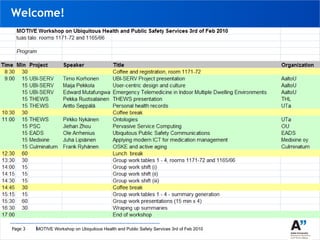
Welcome!
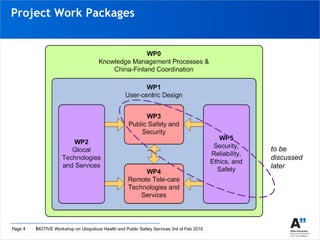
Project Work Packages to be  discussed later
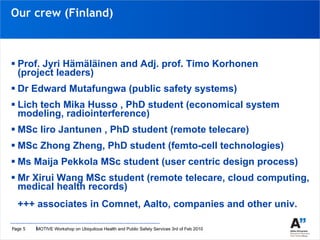
Our crew (Finland) Prof. Jyri Hämäläinen and Adj. prof. Timo Korhonen  (project leaders) Dr Edward Mutafungwa (public safety systems) Lich tech Mika Husso , PhD student (economical system modeling, radiointerference) MSc Iiro Jantunen , PhD student (remote telecare)  MSc Zhong Zheng, PhD student (femto-cell technologies) Ms Maija Pekkola MSc student (user centric design process) Mr Xirui Wang MSc student (remote telecare, cloud computing, medical health records) +++ associates in Comnet, Aalto, companies and other univ.
Prof. Jiao Bingli Prof. Yuping Zhao Associate Profs: XiaoHui Duan, Dou Li  PhD candidates: Leiming Zhang, Feng Wang, Xiao Ruan, Ye ji PKU team
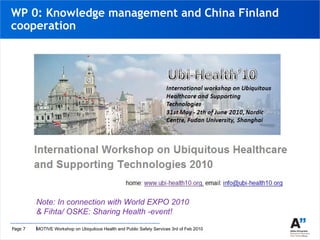
WP 0: Knowledge management and China Finland cooperation  Note: In connection with World EXPO 2010  & Fihta/ OSKE: Sharing Health -event!
Analytical modeling and simulations (femto-cell, cloud computing, economics) UCD methodology as focus groups, contextual enquiry and interviews in Finland and in China (UCD, health personnel, patients) Piloting (medical health records, In China: Prokura Ltd, Nordic Centre) Project members participation to courses in Aalto (S-72.3510 Product development, S-72.2510 UCD, Seminar on Internetworking T-110.5190): student projects, seminars and workshops  Corporate cooperation (especially via Fihta/OSKE but also in some courses of Aalto as S-72.3510) Knowledge management: Research diaries, wiki and PDP Methods
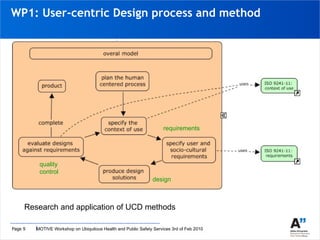
WP1: User-centric Design process and method Research and application of UCD methods requirements design quality control
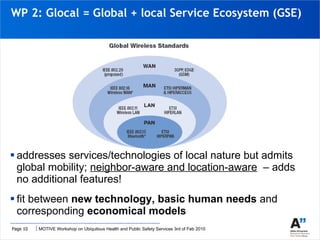
WP 2: Glocal = Global + local Service Ecosystem (GSE) addresses services/technologies of local nature but admits global mobility;  neighbor-aware and location-aware   – adds no additional features! fit between  new technology, basic human needs  and corresponding  economical models
WP 2: Networking technologies and services Services: Location-aware applications Existing and evolving  technological enablers  for glocal (global+local) services Future evolution towards ubiquitous  Human Centered Mobile Computing  (HCMC) Techno-economics  of glocal ecosystems Technologies: femto-cells, RFID, mobile technologies and health/well-being sensors
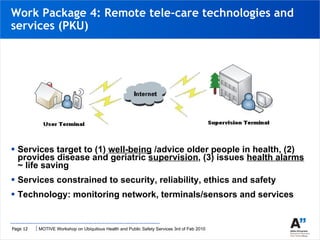
Work Package 4: Remote tele-care technologies and services (PKU) Services target to (1)  well-being  /advice older people in health, (2) provides disease   and geriatric  supervision , (3) issues  health alarms  ~ life saving Services constrained to security, reliability, ethics and safety  Technology: monitoring network, terminals/sensors and services
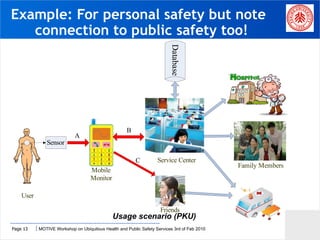
Example: For personal safety but note connection to public safety too! Usage scenario (PKU)
 
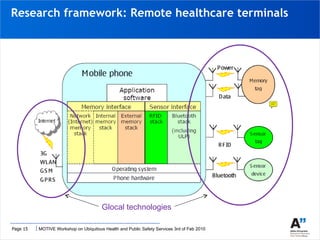
Research framework: Remote healthcare terminals Glocal technologies
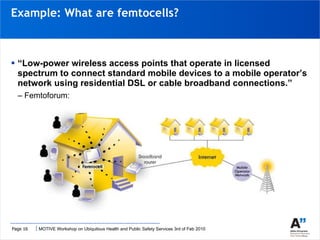
“ Low-power wireless access points that operate in licensed spectrum to connect standard mobile devices to a mobile operator’s network using residential DSL or cable broadband connections.”  –  Femtoforum: Example: What are femtocells?
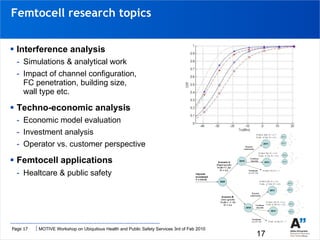
Interference analysis Simulations & analytical work Impact of channel configuration, FC penetration, building size, wall type etc. Techno-economic analysis Economic model evaluation Investment analysis Operator vs. customer perspective Femtocell applications Healtcare & public safety  Femtocell research topics
How synergy between Finnish and Chinese research community could be amplified and utilized? How ubiquitous telecare could be effectively utilize both in richer and poorer countries? Special requirements of senior citizens? What solutions would cloud computing and new services (as mush-ups) offer? Important research question
How systematic  user centric design paradigm  should be developed that it would better take into account cultural aspects? What is the role of Traditional Chinese Medicine (TCM) in older citizens cost-effective ubi-remote care? A practical target : Test and benchmark practical ubi-technology/application development from user centric point of view both in China and in Finland Important research question …
Project publications
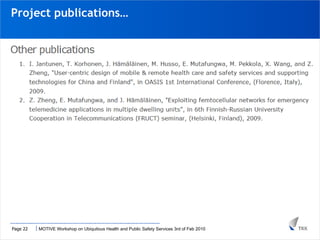
Project publications…
UBI-SERV Group works
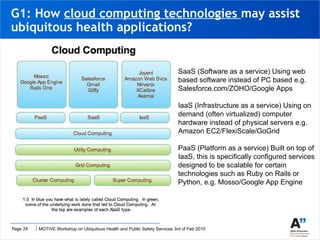
G1: How  cloud computing technologies  may assist ubiquitous health applications? SaaS (Software as a service) Using web based software instead of PC based e.g. Salesforce.com/ZOHO/Google Apps IaaS (Infrastructure as a service) Using on demand (often virtualized) computer hardware instead of physical servers e.g. Amazon EC2/FlexiScale/GoGrid PaaS (Platform as a service) Built on top of IaaS, this is specifically configured services designed to be scalable for certain technologies such as Ruby on Rails or Python, e.g. Mosso/Google App Engine
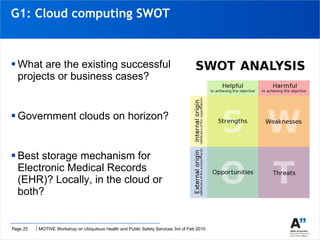
What are the existing successful projects or business cases? Government clouds on horizon? Best storage mechanism for Electronic Medical Records (EHR)? Locally, in the cloud or both?  G1: Cloud computing SWOT
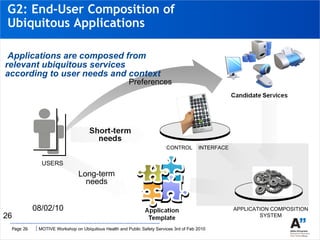
G2: End-User Composition of  Ubiquitous Applications Applications are composed from relevant ubiquitous services according to user needs and context 08/02/10 APPLICATION COMPOSITION  SYSTEM Preferences CONTROL  INTERFACE USERS Long-term needs
G3: Culture Related Effects in User-centric Design Processes and Methods  How culture effects to UCD? Should UCD  processes  be redesigned for different cultures? Should UCD  methods  be ‘tuned’ for different cultures? Special case: China
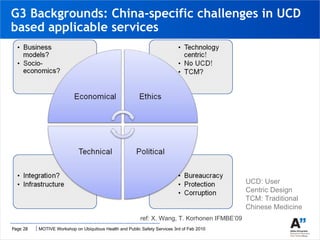
G3 Backgrounds: China-specific challenges in UCD based applicable services ref: X. Wang, T. Korhonen IFMBE’09 UCD: User Centric Design TCM: Traditional Chinese Medicine
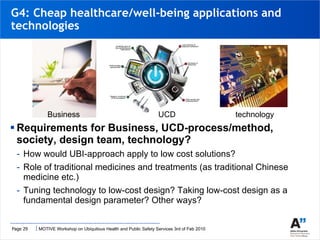
Requirements for Business, UCD-process/method, society, design team, technology? How would UBI-approach apply to low cost solutions? Role of traditional medicines and treatments (as traditional Chinese medicine etc.) Tuning technology to low-cost design? Taking low-cost design as a fundamental design parameter? Other ways? G4: Cheap healthcare/well-being applications and technologies Business UCD technology
Thank you! Questions? Page

Intro: UBI-SERV

  • 1.
  • 2.
    User-centric Design ofUbiquitous Welfare and Safety Services and Supporting Technologies for China and Finland Timo Korhonen Department of Communication and Networking Comnet Aalto University Page
  • 3.
  • 4.
    Project Work Packagesto be discussed later
  • 5.
    Our crew (Finland)Prof. Jyri Hämäläinen and Adj. prof. Timo Korhonen (project leaders) Dr Edward Mutafungwa (public safety systems) Lich tech Mika Husso , PhD student (economical system modeling, radiointerference) MSc Iiro Jantunen , PhD student (remote telecare) MSc Zhong Zheng, PhD student (femto-cell technologies) Ms Maija Pekkola MSc student (user centric design process) Mr Xirui Wang MSc student (remote telecare, cloud computing, medical health records) +++ associates in Comnet, Aalto, companies and other univ.
  • 6.
    Prof. Jiao BingliProf. Yuping Zhao Associate Profs: XiaoHui Duan, Dou Li PhD candidates: Leiming Zhang, Feng Wang, Xiao Ruan, Ye ji PKU team
  • 7.
    WP 0: Knowledgemanagement and China Finland cooperation Note: In connection with World EXPO 2010 & Fihta/ OSKE: Sharing Health -event!
  • 8.
    Analytical modeling andsimulations (femto-cell, cloud computing, economics) UCD methodology as focus groups, contextual enquiry and interviews in Finland and in China (UCD, health personnel, patients) Piloting (medical health records, In China: Prokura Ltd, Nordic Centre) Project members participation to courses in Aalto (S-72.3510 Product development, S-72.2510 UCD, Seminar on Internetworking T-110.5190): student projects, seminars and workshops Corporate cooperation (especially via Fihta/OSKE but also in some courses of Aalto as S-72.3510) Knowledge management: Research diaries, wiki and PDP Methods
  • 9.
    WP1: User-centric Designprocess and method Research and application of UCD methods requirements design quality control
  • 10.
    WP 2: Glocal= Global + local Service Ecosystem (GSE) addresses services/technologies of local nature but admits global mobility; neighbor-aware and location-aware – adds no additional features! fit between new technology, basic human needs and corresponding economical models
  • 11.
    WP 2: Networkingtechnologies and services Services: Location-aware applications Existing and evolving technological enablers for glocal (global+local) services Future evolution towards ubiquitous Human Centered Mobile Computing (HCMC) Techno-economics of glocal ecosystems Technologies: femto-cells, RFID, mobile technologies and health/well-being sensors
  • 12.
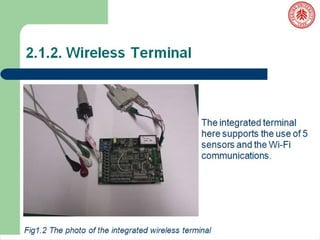
    Work Package 4:Remote tele-care technologies and services (PKU) Services target to (1) well-being /advice older people in health, (2) provides disease and geriatric supervision , (3) issues health alarms ~ life saving Services constrained to security, reliability, ethics and safety Technology: monitoring network, terminals/sensors and services
  • 13.
    Example: For personalsafety but note connection to public safety too! Usage scenario (PKU)
  • 14.
  • 15.
    Research framework: Remotehealthcare terminals Glocal technologies
  • 16.
    “ Low-power wirelessaccess points that operate in licensed spectrum to connect standard mobile devices to a mobile operator’s network using residential DSL or cable broadband connections.” – Femtoforum: Example: What are femtocells?
  • 17.
    Interference analysis Simulations& analytical work Impact of channel configuration, FC penetration, building size, wall type etc. Techno-economic analysis Economic model evaluation Investment analysis Operator vs. customer perspective Femtocell applications Healtcare & public safety Femtocell research topics
  • 18.
    How synergy betweenFinnish and Chinese research community could be amplified and utilized? How ubiquitous telecare could be effectively utilize both in richer and poorer countries? Special requirements of senior citizens? What solutions would cloud computing and new services (as mush-ups) offer? Important research question
  • 19.
    How systematic user centric design paradigm should be developed that it would better take into account cultural aspects? What is the role of Traditional Chinese Medicine (TCM) in older citizens cost-effective ubi-remote care? A practical target : Test and benchmark practical ubi-technology/application development from user centric point of view both in China and in Finland Important research question …
  • 20.
  • 21.
  • 22.
  • 23.
  • 24.
    G1: How cloud computing technologies may assist ubiquitous health applications? SaaS (Software as a service) Using web based software instead of PC based e.g. Salesforce.com/ZOHO/Google Apps IaaS (Infrastructure as a service) Using on demand (often virtualized) computer hardware instead of physical servers e.g. Amazon EC2/FlexiScale/GoGrid PaaS (Platform as a service) Built on top of IaaS, this is specifically configured services designed to be scalable for certain technologies such as Ruby on Rails or Python, e.g. Mosso/Google App Engine
  • 25.
    What are theexisting successful projects or business cases? Government clouds on horizon? Best storage mechanism for Electronic Medical Records (EHR)? Locally, in the cloud or both? G1: Cloud computing SWOT
  • 26.
    G2: End-User Compositionof Ubiquitous Applications Applications are composed from relevant ubiquitous services according to user needs and context 08/02/10 APPLICATION COMPOSITION SYSTEM Preferences CONTROL INTERFACE USERS Long-term needs
  • 27.
    G3: Culture RelatedEffects in User-centric Design Processes and Methods How culture effects to UCD? Should UCD processes be redesigned for different cultures? Should UCD methods be ‘tuned’ for different cultures? Special case: China
  • 28.
    G3 Backgrounds: China-specificchallenges in UCD based applicable services ref: X. Wang, T. Korhonen IFMBE’09 UCD: User Centric Design TCM: Traditional Chinese Medicine
  • 29.
    Requirements for Business,UCD-process/method, society, design team, technology? How would UBI-approach apply to low cost solutions? Role of traditional medicines and treatments (as traditional Chinese medicine etc.) Tuning technology to low-cost design? Taking low-cost design as a fundamental design parameter? Other ways? G4: Cheap healthcare/well-being applications and technologies Business UCD technology
  • 30.