WEB3 FUNDAMENTALS
101blockchains.com
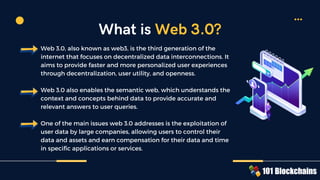
Web 3.0, also known as web3, is the third generation of the
internet that focuses on decentralized data interconnections. It
aims to provide faster and more personalized user experiences
through decentralization, user utility, and openness.
Web 3.0 also enables the semantic web, which understands the
context and concepts behind data to provide accurate and
relevant answers to user queries.
One of the main issues web 3.0 addresses is the exploitation of
user data by large companies, allowing users to control their
data and assets and earn compensation for their data and time
in specific applications or services.
What is Web 3.0?
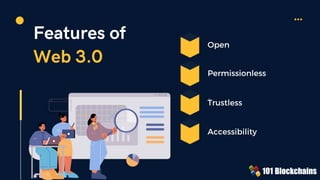
Features of
Web 3.0
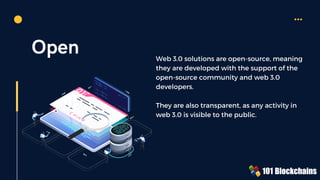
Open
Trustless
Permissionless
Accessibility
Open Web 3.0 solutions are open-source, meaning
they are developed with the support of the
open-source community and web 3.0
developers.
They are also transparent, as any activity in
web 3.0 is visible to the public.
Permissionless
Web 3.0 technologies are permissionless, meaning
that users and service providers do not need
permission from centralized institutions to access or
interact with them.
Decentralization is a key principle of web 3.0
blockchain solutions, enabling users and providers
to interact without needing permission.
Trustless Web 3.0 offers a trustless environment,
allowing users to interact privately or
publicly without intermediaries and
the need to trust third-party
applications or service providers.
This trustless feature is a valuable
advantage for web 3.0 use cases.
Accessibility Web 3.0 aims to make the internet
accessible to anyone, anytime and
from any location.
In the future, the internet may not be
limited to computers and
smartphones.
The main motivation behind the development of web 3.0 is the
desire for decentralization. Web 3.0 aims to democratize access to
data and digital services and promote innovation by
decentralizing control from large companies to user communities.
The shift towards decentralization with web 3.0 blockchain
solutions addresses the problems of fragmentation and
centralization in the digital landscape, including the need for
permission to use products and the negative impact on
innovation.
The internet has undergone a series of improvements and
evolution since its inception, leading to the current web 3.0 stage.
From Centralized to Decentralized
Web 1.0 Web 1.0, the first era of the internet,
was characterized by the use of open
protocols, such as HTTP, TCP, SMTP,
and IP.
These protocols laid the foundations
for the internet we use today and saw
a peak in innovation, with many top
digital companies establishing
themselves during this time.
Web 2.0 During the web 2.0 era, businesses developed
proprietary protocols, leading to a shift towards
centralization. This period saw the rise of
e-commerce and content creation, but also raised
concerns about data privacy.
The need for an alternative led to the development
of web 3.0, which offers the benefits of web 2.0
without the centralization and data privacy issues.
The certified web 3.0 professional course on 101
Blockchains can provide more information about
the evolution of the web.
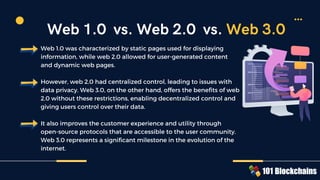
Web 1.0 was characterized by static pages used for displaying
information, while web 2.0 allowed for user-generated content
and dynamic web pages.
However, web 2.0 had centralized control, leading to issues with
data privacy. Web 3.0, on the other hand, offers the benefits of web
2.0 without these restrictions, enabling decentralized control and
giving users control over their data.
It also improves the customer experience and utility through
open-source protocols that are accessible to the user community.
Web 3.0 represents a significant milestone in the evolution of the
internet.
Web 1.0 vs. Web 2.0 vs. Web 3.0
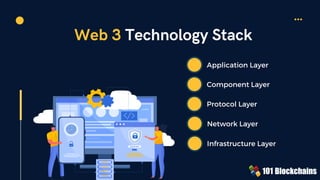
Web 3 Technology Stack
Application Layer
Component Layer
Protocol Layer
Network Layer
Infrastructure Layer
Blockchain is a key technology behind web 3.0, enabling decentralized data
storage and interactions. Web 3.0 relies on blockchain to provide a secure
and transparent platform for decentralized applications and services.
Through the use of smart contracts, blockchain allows for automatic
execution of agreements and the transfer of assets without the need for
intermediaries. This not only increases efficiency, but also enhances trust
and security in online transactions.
Blockchain's decentralized nature also gives users more control over their
data and assets, as it is not stored in a single location and is resistant to
tampering and censorship. Overall, blockchain is playing a significant role in
the development and implementation of web 3.0.
How Blockchain is Affecting Web 3.0?
Web 3.0, focuses on decentralized data interconnections and the
semantic web. It aims to provide faster and more personalized user
experiences through decentralization, user utility, and openness,
and addresses issues such as the exploitation of user data by large
companies.
The metaverse, on the other hand, is a collective virtual shared
space, created by the convergence of virtually enhanced physical
reality and physically persistent virtual space, including the
internet.
While web 3.0 and the metaverse are related in that they both rely
on decentralized technology and aim to enhance user experiences,
the metaverse goes beyond the internet to create a fully immersive
virtual reality world.
Difference between Web 3 and Metaverse
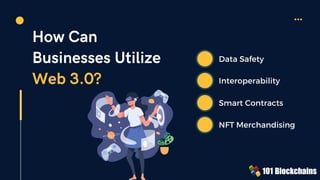
How Can
Businesses Utilize
Web 3.0?
Data Safety
Interoperability
Smart Contracts
NFT Merchandising
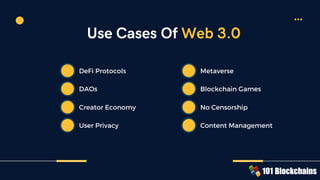
Use Cases Of Web 3.0
DeFi Protocols
DAOs
Creator Economy
User Privacy
Metaverse
Blockchain Games
No Censorship
Content Management
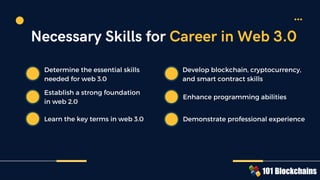
Necessary Skills for Career in Web 3.0
Determine the essential skills
needed for web 3.0
Establish a strong foundation
in web 2.0
Learn the key terms in web 3.0
Develop blockchain, cryptocurrency,
and smart contract skills
Enhance programming abilities
Demonstrate professional experience
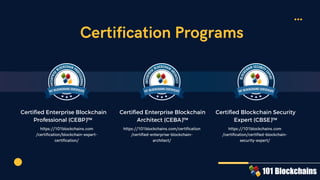
Certification Programs
Certified Enterprise Blockchain
Professional (CEBP)™
Certified Enterprise Blockchain
Architect (CEBA)™
Certified Blockchain Security
Expert (CBSE)™
https://101blockchains.com/certification
/certified-enterprise-blockchain-
architect/
https://101blockchains.com
/certification/certified-blockchain-
security-expert/
https://101blockchains.com
/certification/blockchain-expert-
certification/
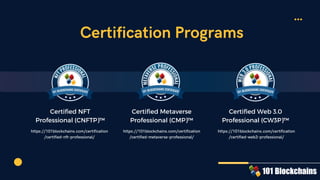
Certification Programs
Certified NFT
Professional (CNFTP)™
Certified Metaverse
Professional (CMP)™
Certified Web 3.0
Professional (CW3P)™
https://101blockchains.com/certification
/certified-metaverse-professional/
https://101blockchains.com/certification
/certified-web3-professional/
https://101blockchains.com/certification
/certified-nft-professional/
Why You Must Go With 101 Blockchains
Certification Programs?
101 Blockchains accredited certification programs are the only
industry-recognized and accredited credentials focused specifically
on Blockchain and Web3 technologies.
Better Standards Reduced Risks Marketable Appeal
101 Blockchains Courses and
Masterclasses
Courses Masterclasses
https://101blockchains.com/courses/ https://101blockchains.com/masterclasses/
Skill Path and Career Path
Skill Learning Paths Career Learning Paths
https://101blockchains.com/skill/ https://101blockchains.com/career/
Free Resources
Blockchains Fundamentals - Free Course
Webinars
Conferences
Access Free Resources Now!
Glossary
Flash Cards
Presentations
Infographics
Trusted By 60,000+ Professionals!
Read real stories on Trustpilot and G2Crowd.
800+ reviews
The presentation is not intended to provide any investment advice and should not be
taken as such. Claims made in this webinar do not constitute investment advice and
should not be taken as such. Do your own research!
While the information contained in this document and presentation has been
obtained from sources believed to be reliable, 101 Blockchains disclaims all
warranties as to the completeness or accuracy.
Although 101 Blockchains research and training may address business, financial,
investment and legal issues, 101 Blockchains does not provide any business, financial,
legal or investment advice and this training should not be construed or used as such.
101 Blockchains shall not be responsible for any loss sustained by any person who
relies on this presentation.
Disclaimer
Thank You
© 2023 101 Blockchains. All rights reserved. This document may not be distributed, transmitted or reproduced in any form or by any means without
101 Blockchains’ prior written permission. While the information contained in this document has been obtained from sources believed to be reliable,
101 Blockchains disclaims all warranties as to the completeness or accuracy. Although 101 Blockchains research may address business, financial,
investment and legal issues, 101 Blockchains does not provide any business, financial, legal or investment advice and this document should not be
construed or used as such. 101 Blockchains shall not be responsible for any loss sustained by any person who relies on this publication.

Web3 Fundamentals

  • 1.
  • 2.
    Web 3.0, alsoknown as web3, is the third generation of the internet that focuses on decentralized data interconnections. It aims to provide faster and more personalized user experiences through decentralization, user utility, and openness. Web 3.0 also enables the semantic web, which understands the context and concepts behind data to provide accurate and relevant answers to user queries. One of the main issues web 3.0 addresses is the exploitation of user data by large companies, allowing users to control their data and assets and earn compensation for their data and time in specific applications or services. What is Web 3.0?
  • 3.
  • 4.
    Open Web 3.0solutions are open-source, meaning they are developed with the support of the open-source community and web 3.0 developers. They are also transparent, as any activity in web 3.0 is visible to the public.
  • 5.
    Permissionless Web 3.0 technologiesare permissionless, meaning that users and service providers do not need permission from centralized institutions to access or interact with them. Decentralization is a key principle of web 3.0 blockchain solutions, enabling users and providers to interact without needing permission.
  • 6.
    Trustless Web 3.0offers a trustless environment, allowing users to interact privately or publicly without intermediaries and the need to trust third-party applications or service providers. This trustless feature is a valuable advantage for web 3.0 use cases.
  • 7.
    Accessibility Web 3.0aims to make the internet accessible to anyone, anytime and from any location. In the future, the internet may not be limited to computers and smartphones.
  • 8.
    The main motivationbehind the development of web 3.0 is the desire for decentralization. Web 3.0 aims to democratize access to data and digital services and promote innovation by decentralizing control from large companies to user communities. The shift towards decentralization with web 3.0 blockchain solutions addresses the problems of fragmentation and centralization in the digital landscape, including the need for permission to use products and the negative impact on innovation. The internet has undergone a series of improvements and evolution since its inception, leading to the current web 3.0 stage. From Centralized to Decentralized
  • 9.
    Web 1.0 Web1.0, the first era of the internet, was characterized by the use of open protocols, such as HTTP, TCP, SMTP, and IP. These protocols laid the foundations for the internet we use today and saw a peak in innovation, with many top digital companies establishing themselves during this time.
  • 10.
    Web 2.0 Duringthe web 2.0 era, businesses developed proprietary protocols, leading to a shift towards centralization. This period saw the rise of e-commerce and content creation, but also raised concerns about data privacy. The need for an alternative led to the development of web 3.0, which offers the benefits of web 2.0 without the centralization and data privacy issues. The certified web 3.0 professional course on 101 Blockchains can provide more information about the evolution of the web.
  • 11.
    Web 1.0 wascharacterized by static pages used for displaying information, while web 2.0 allowed for user-generated content and dynamic web pages. However, web 2.0 had centralized control, leading to issues with data privacy. Web 3.0, on the other hand, offers the benefits of web 2.0 without these restrictions, enabling decentralized control and giving users control over their data. It also improves the customer experience and utility through open-source protocols that are accessible to the user community. Web 3.0 represents a significant milestone in the evolution of the internet. Web 1.0 vs. Web 2.0 vs. Web 3.0
  • 12.
    Web 3 TechnologyStack Application Layer Component Layer Protocol Layer Network Layer Infrastructure Layer
  • 13.
    Blockchain is akey technology behind web 3.0, enabling decentralized data storage and interactions. Web 3.0 relies on blockchain to provide a secure and transparent platform for decentralized applications and services. Through the use of smart contracts, blockchain allows for automatic execution of agreements and the transfer of assets without the need for intermediaries. This not only increases efficiency, but also enhances trust and security in online transactions. Blockchain's decentralized nature also gives users more control over their data and assets, as it is not stored in a single location and is resistant to tampering and censorship. Overall, blockchain is playing a significant role in the development and implementation of web 3.0. How Blockchain is Affecting Web 3.0?
  • 14.
    Web 3.0, focuseson decentralized data interconnections and the semantic web. It aims to provide faster and more personalized user experiences through decentralization, user utility, and openness, and addresses issues such as the exploitation of user data by large companies. The metaverse, on the other hand, is a collective virtual shared space, created by the convergence of virtually enhanced physical reality and physically persistent virtual space, including the internet. While web 3.0 and the metaverse are related in that they both rely on decentralized technology and aim to enhance user experiences, the metaverse goes beyond the internet to create a fully immersive virtual reality world. Difference between Web 3 and Metaverse
  • 15.
    How Can Businesses Utilize Web3.0? Data Safety Interoperability Smart Contracts NFT Merchandising
  • 16.
    Use Cases OfWeb 3.0 DeFi Protocols DAOs Creator Economy User Privacy Metaverse Blockchain Games No Censorship Content Management
  • 17.
    Necessary Skills forCareer in Web 3.0 Determine the essential skills needed for web 3.0 Establish a strong foundation in web 2.0 Learn the key terms in web 3.0 Develop blockchain, cryptocurrency, and smart contract skills Enhance programming abilities Demonstrate professional experience
  • 18.
    Certification Programs Certified EnterpriseBlockchain Professional (CEBP)™ Certified Enterprise Blockchain Architect (CEBA)™ Certified Blockchain Security Expert (CBSE)™ https://101blockchains.com/certification /certified-enterprise-blockchain- architect/ https://101blockchains.com /certification/certified-blockchain- security-expert/ https://101blockchains.com /certification/blockchain-expert- certification/
  • 19.
    Certification Programs Certified NFT Professional(CNFTP)™ Certified Metaverse Professional (CMP)™ Certified Web 3.0 Professional (CW3P)™ https://101blockchains.com/certification /certified-metaverse-professional/ https://101blockchains.com/certification /certified-web3-professional/ https://101blockchains.com/certification /certified-nft-professional/
  • 20.
    Why You MustGo With 101 Blockchains Certification Programs? 101 Blockchains accredited certification programs are the only industry-recognized and accredited credentials focused specifically on Blockchain and Web3 technologies. Better Standards Reduced Risks Marketable Appeal
  • 21.
    101 Blockchains Coursesand Masterclasses Courses Masterclasses https://101blockchains.com/courses/ https://101blockchains.com/masterclasses/
  • 22.
    Skill Path andCareer Path Skill Learning Paths Career Learning Paths https://101blockchains.com/skill/ https://101blockchains.com/career/
  • 23.
    Free Resources Blockchains Fundamentals- Free Course Webinars Conferences Access Free Resources Now! Glossary Flash Cards Presentations Infographics
  • 24.
    Trusted By 60,000+Professionals! Read real stories on Trustpilot and G2Crowd. 800+ reviews
  • 25.
    The presentation isnot intended to provide any investment advice and should not be taken as such. Claims made in this webinar do not constitute investment advice and should not be taken as such. Do your own research! While the information contained in this document and presentation has been obtained from sources believed to be reliable, 101 Blockchains disclaims all warranties as to the completeness or accuracy. Although 101 Blockchains research and training may address business, financial, investment and legal issues, 101 Blockchains does not provide any business, financial, legal or investment advice and this training should not be construed or used as such. 101 Blockchains shall not be responsible for any loss sustained by any person who relies on this presentation. Disclaimer
  • 26.
    Thank You © 2023101 Blockchains. All rights reserved. This document may not be distributed, transmitted or reproduced in any form or by any means without 101 Blockchains’ prior written permission. While the information contained in this document has been obtained from sources believed to be reliable, 101 Blockchains disclaims all warranties as to the completeness or accuracy. Although 101 Blockchains research may address business, financial, investment and legal issues, 101 Blockchains does not provide any business, financial, legal or investment advice and this document should not be construed or used as such. 101 Blockchains shall not be responsible for any loss sustained by any person who relies on this publication.