api3.org
APIdays x API3


The importance of APIs in the Web3 economy
API3 Overview
2
API3’s mission is to make APIs fully
compatible to Web 3.0 for dApps/Smart
Contracts with a first-party infrastructure


▵ APIs are the glue to the internet. Salesforce, Ebay, FB, Google,
Expedia, Uber, Airbnb are powered by APIs.


▵ Web 3.0 must be able to access the kind of services that Web APIs
offer in order to interact with the real world.


▵ Connecting APIs directly to Web 3.0 will create new Dapps and
digital agreements, expanding the markets for decentralized
networks.


▵ Airnode is a plug-and-play API gateway that could be deployed on
AWS as a Lambda function, making it easy for API-based services
to appeal to Web3 applications.


▵ Over 190
+
APIs connected from Web2 into Web3, enabling real
world data to be delivered on-chain into decentralised applications.
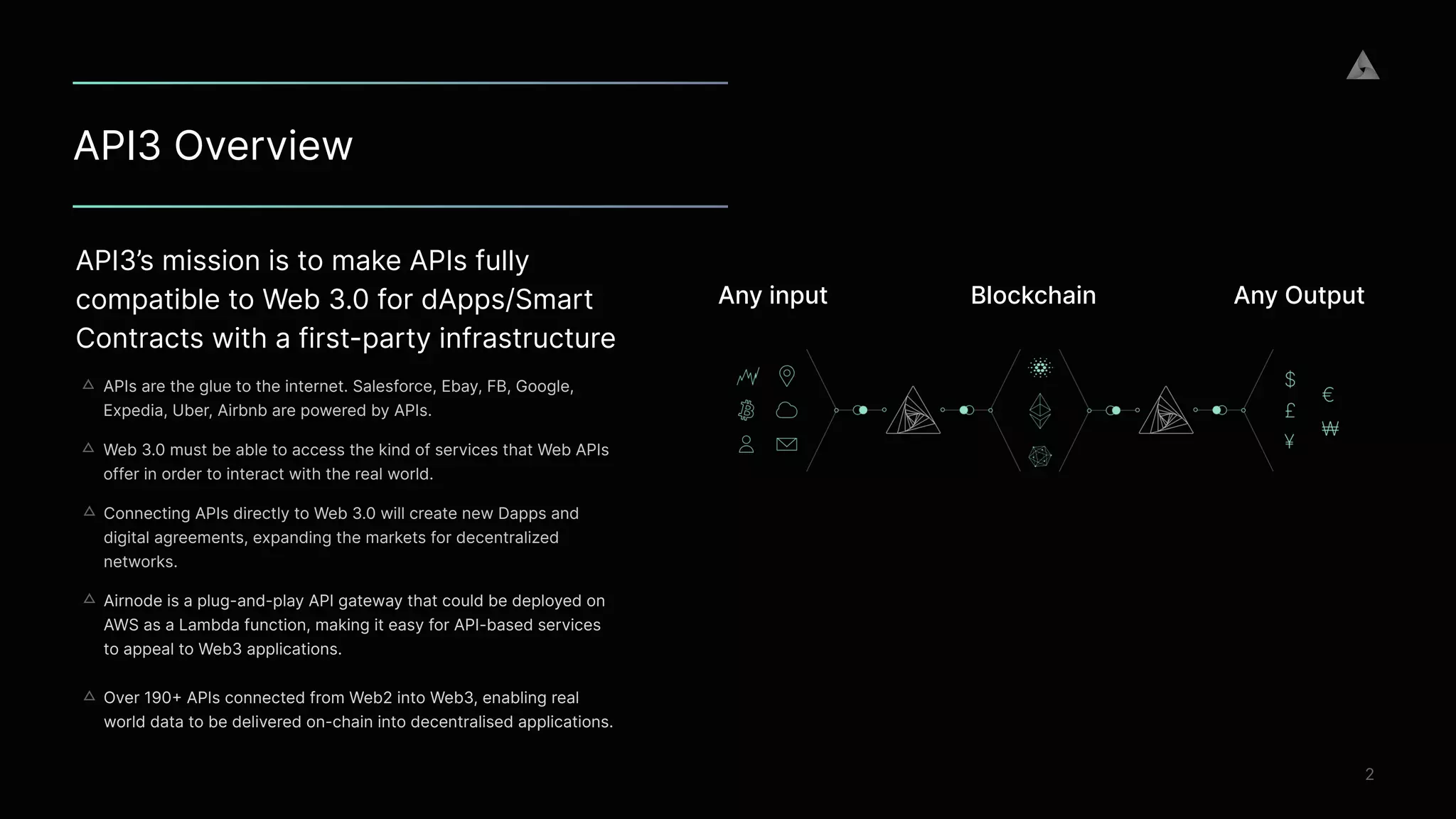
Any input Any Output
Blockchain
Web3 primer
3
• Community / Open Ownership: Anyone can own a piece of the network or project,
and anyone can access the project or network. 


• New economic models: Digital and physical items can now be monetized and
traded in new ways.  For example, selling land or items in a digital world, or
royalties to music in a global marketplace.


• Feature Composability: Any project can be a building block for another.  For
example, one DeFi protocol can use another to price its assets. This allows
successful Web3 components to be leveraged by all, adhering to the values of the
open source community thus increasing the pace of innovation.


• Auditability / Transparency: Transactions are a public record by default and near
impossible to edit. 


• Assets with functionality: AKA “Programmable money” or “Programmable Assets”,
bake in the rules about the transaction to the asset itself.  For example, a US
Dollar that automatically deducts tax in the transaction.  Or art that manages its
own royalties every time its transferred.


Web2 took your data
and turned you into the
product.


Web 3 creates new
economic and financial
primitives. It is the
premise of an internet
like user experience but
where users control
their own data, identity
& destiny.
Smart-contracts & decentralised applications primer
4
Web3 applications, often referred to as Dapps, utilise smart
contracts to deliver services via the blockchain. Users
interact with Dapps with Web3 specific wallets.


A smart-contract is a programmable contract that allows
two counterparts to set conditions of a transaction without
needing to trust another third party for execution.


▵ Smart contracts are autonomous programmable rules, that relies on data
inputs to determine execution


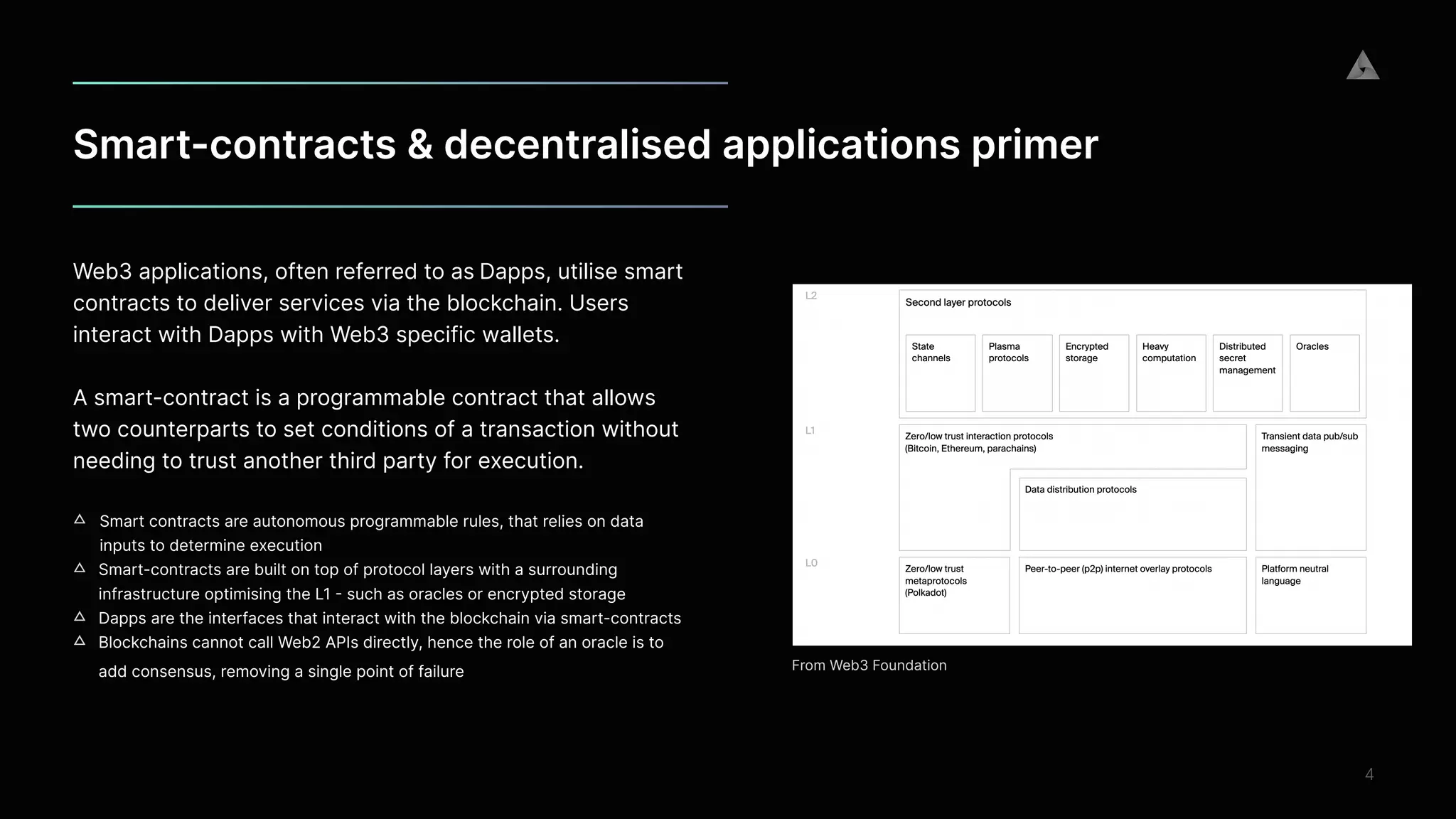
▵ Smart-contracts are built on top of protocol layers with a surrounding
infrastructure optimising the L1
-
such as oracles or encrypted storage


▵ Dapps are the interfaces that interact with the blockchain via smart-contracts


▵ Blockchains cannot call Web2 APIs directly, hence the role of an oracle is to
add consensus, removing a single point of failure


From Web3 Foundation
DeFi primer
5
DeFi seeks to build a better financial landscape made
possible by the advent of the internet & blockchain
technology.


• It has significant advantages over 3 areas of the current banking
system


• Payments & clearance system (remittances)


• Accessibility


• Centralisation & transparency


• DeFi protocols are built on top of public blockchains with transparent
governance mechanisms to prevent bad actors from making decisions


• DeFi Dapps stand to revolutionise finance by removing middlemen,
instead using blockchain as a ledger


• DeFi is often called money LEGO due to its composability


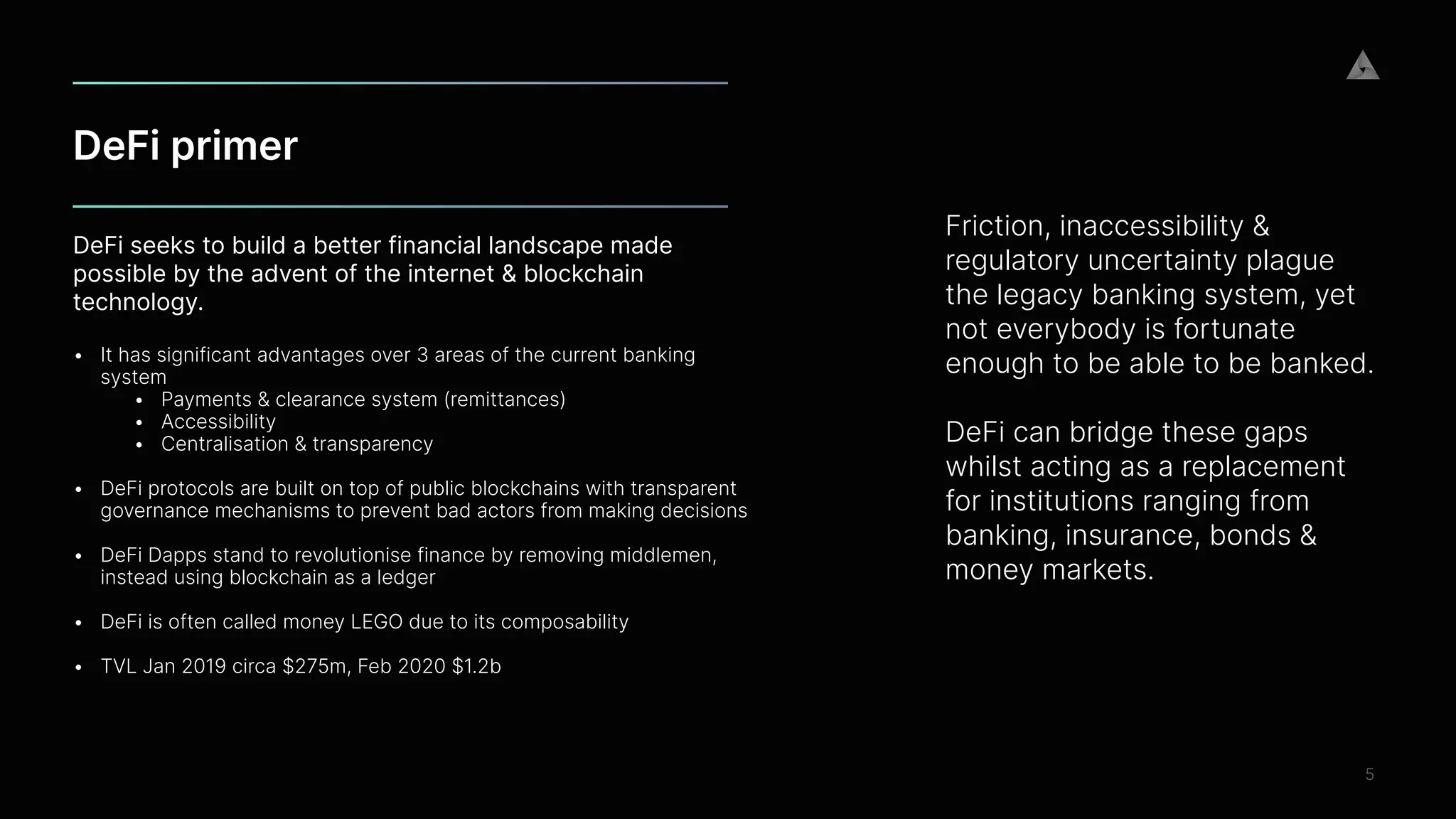
• TVL Jan 2019 circa $275m, Feb 2020 $1.2b


Friction, inaccessibility &
regulatory uncertainty plague
the legacy banking system, yet
not everybody is fortunate
enough to be able to be banked.


DeFi can bridge these gaps
whilst acting as a replacement
for institutions ranging from
banking, insurance, bonds &
money markets.
6
Can APIs underpin new industries in Web3?
Why & how APIs drive utility within
smart contracts?
1. The combination of running code on the blockchain (on-
chain) with data and computation from outside the
blockchain (off-chain) creates new use cases for smart
contracts.


2. To expand the ability for Web 3.0 collaborate with Web 2.0,
there needs to be a secure gateway with the real-world, to
perform the verification of off-chain events or interact with
off-chain systems.


3. This layer is (of course!
)
delivered via APIs


4. To caveat this, Web 2.0 APIs cannot be directly called by the
blockchain.


1. With a blockchain like Ethereum, you need every node in the
network to replay every transaction and end up with the same
result, guaranteed, but APIs introduce variable data. This is
known as the Oracle problem.
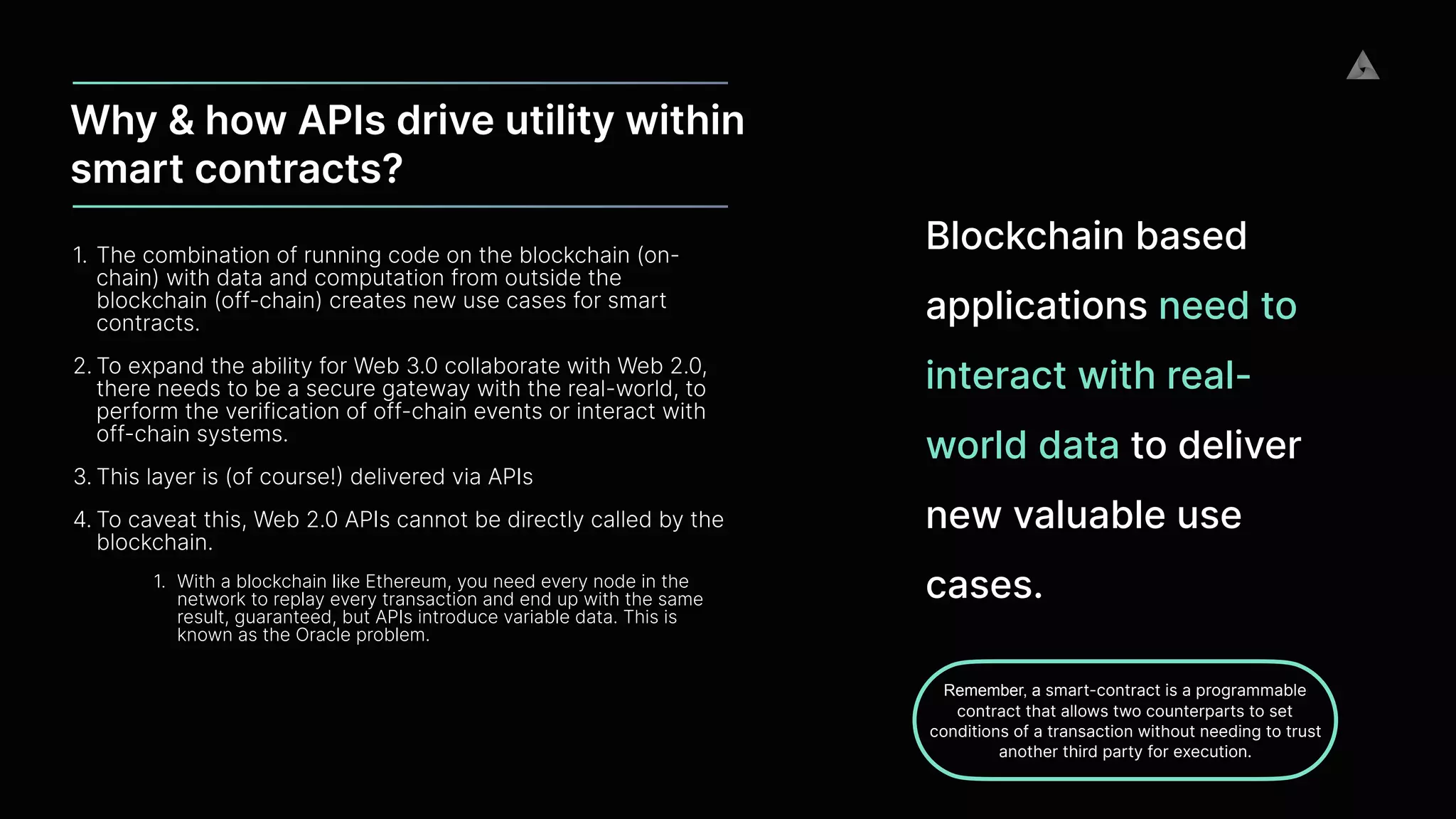
Blockchain based
applications need to
interact with real-
world data to deliver
new valuable use
cases.
Remember, a smart-contract is a programmable
contract that allows two counterparts to set
conditions of a transaction without needing to trust
another third party for execution.
What new use cases can APIs
create within Web 3.0?
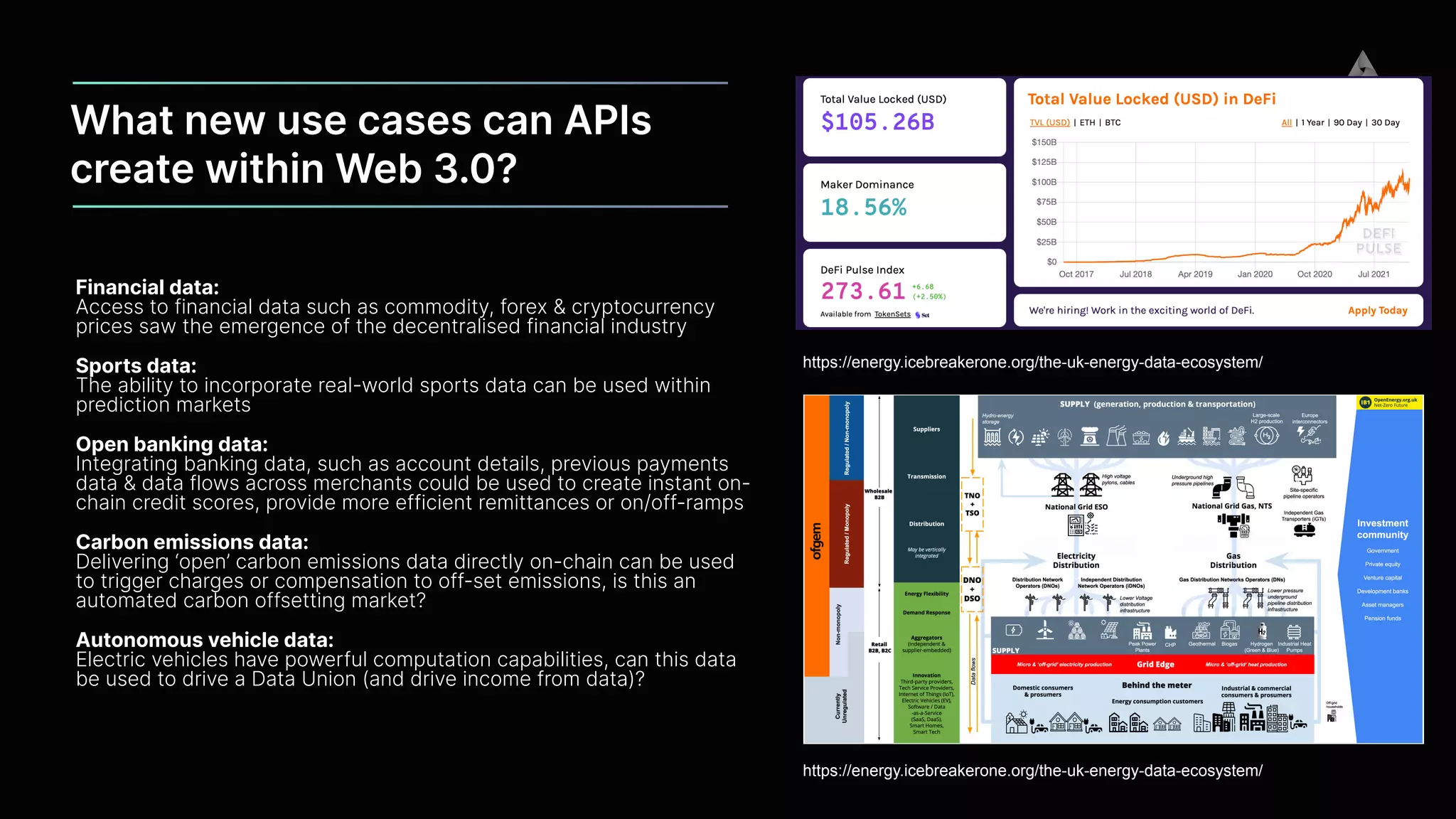
Financial data:


Access to financial data such as commodity, forex & cryptocurrency
prices saw the emergence of the decentralised financial industry


Sports data:


The ability to incorporate real-world sports data can be used within
prediction markets


Open banking data:


Integrating banking data, such as account details, previous payments
data & data flows across merchants could be used to create instant on-
chain credit scores, provide more efficient remittances or on/off-ramps


Carbon emissions data:


Delivering ‘open’ carbon emissions data directly on-chain can be used
to trigger charges or compensation to off-set emissions, is this an
automated carbon offsetting market?


Autonomous vehicle data:


Electric vehicles have powerful computation capabilities, can this data
be used to drive a Data Union (and drive income from data)?
https://energy.icebreakerone.org/the-uk-energy-data-ecosystem/
Where is this all going?


The Open Economy, Web 3.0
○ An ethical shift to Open APIs by previously closed
service providers - mass participation by financial
infrastructure


○ Consumer owned data, with ownership as a core value


○ Participation & community, over acquisition & users
(yield generation via LPs for example)


○ Disruption of multiple industries as well as the
emergence of new sectors (metaverse)


○ Identity, Finance, Insurance, Marketing,
Governance, Supply Chain, Gaming


○ Mass composability (underpinned by Open Source
community)


○ Creation of new & inclusive services that weren’t
economically viable in Web 2.0
10
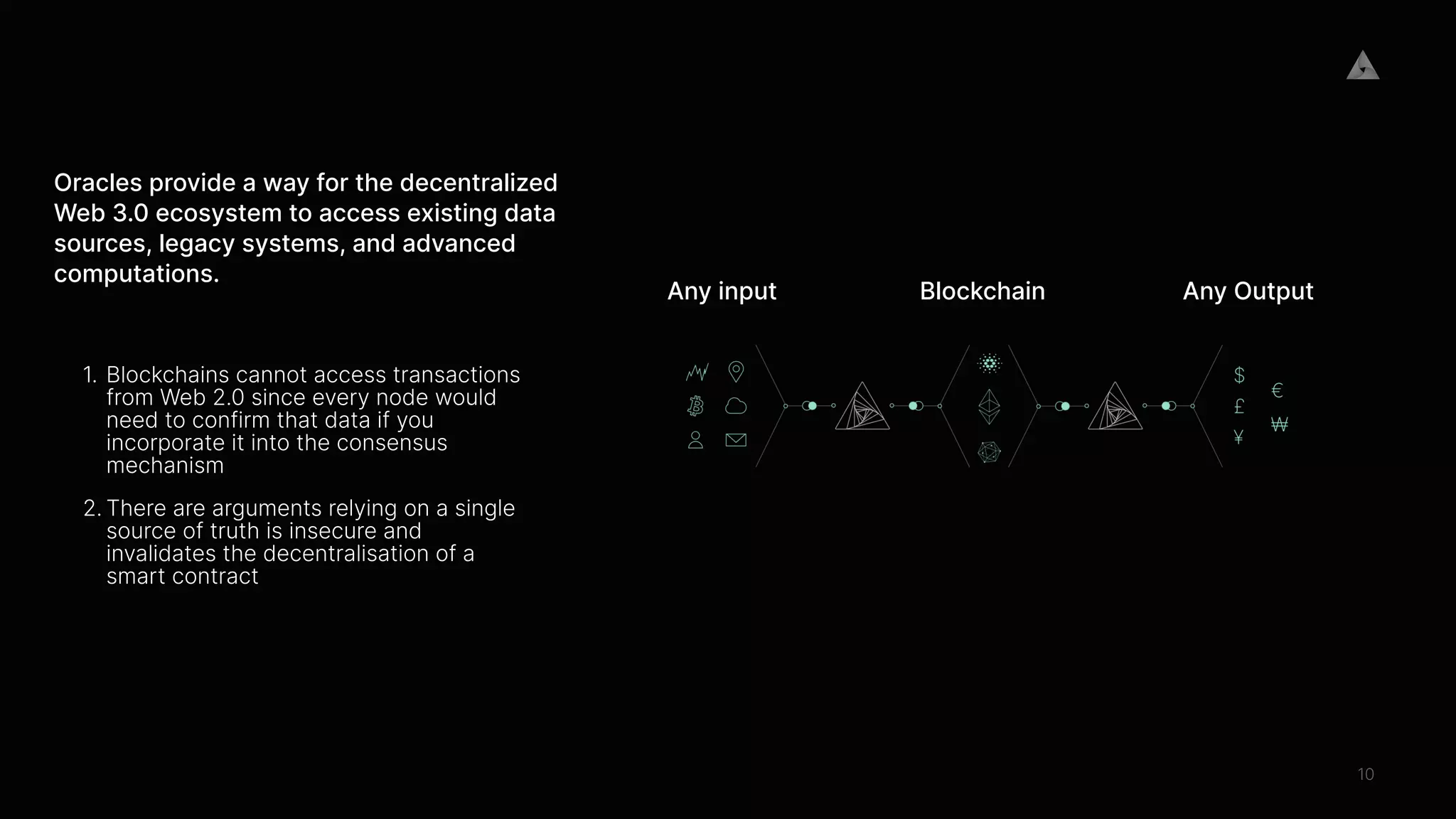
Any input Any Output
Blockchain
Oracles provide a way for the decentralized
Web 3.0 ecosystem to access existing data
sources, legacy systems, and advanced
computations. 
1. Blockchains cannot access transactions
from Web 2.0 since every node would
need to confirm that data if you
incorporate it into the consensus
mechanism


2. There are arguments relying on a single
source of truth is insecure and
invalidates the decentralisation of a
smart contract

Apidays x api3 9th dec

  • 1.
    api3.org APIdays x API3 Theimportance of APIs in the Web3 economy
  • 2.
    API3 Overview 2 API3’s missionis to make APIs fully compatible to Web 3.0 for dApps/Smart Contracts with a first-party infrastructure ▵ APIs are the glue to the internet. Salesforce, Ebay, FB, Google, Expedia, Uber, Airbnb are powered by APIs. ▵ Web 3.0 must be able to access the kind of services that Web APIs offer in order to interact with the real world. ▵ Connecting APIs directly to Web 3.0 will create new Dapps and digital agreements, expanding the markets for decentralized networks. ▵ Airnode is a plug-and-play API gateway that could be deployed on AWS as a Lambda function, making it easy for API-based services to appeal to Web3 applications. 
 ▵ Over 190 + APIs connected from Web2 into Web3, enabling real world data to be delivered on-chain into decentralised applications. Any input Any Output Blockchain
  • 3.
    Web3 primer 3 • Community/ Open Ownership: Anyone can own a piece of the network or project, and anyone can access the project or network.  
 • New economic models: Digital and physical items can now be monetized and traded in new ways.  For example, selling land or items in a digital world, or royalties to music in a global marketplace. • Feature Composability: Any project can be a building block for another.  For example, one DeFi protocol can use another to price its assets. This allows successful Web3 components to be leveraged by all, adhering to the values of the open source community thus increasing the pace of innovation. 
 • Auditability / Transparency: Transactions are a public record by default and near impossible to edit.  
 • Assets with functionality: AKA “Programmable money” or “Programmable Assets”, bake in the rules about the transaction to the asset itself.  For example, a US Dollar that automatically deducts tax in the transaction.  Or art that manages its own royalties every time its transferred. 
 Web2 took your data and turned you into the product. 
 
 Web 3 creates new economic and financial primitives. It is the premise of an internet like user experience but where users control their own data, identity & destiny.
  • 4.
    Smart-contracts & decentralisedapplications primer 4 Web3 applications, often referred to as Dapps, utilise smart contracts to deliver services via the blockchain. Users interact with Dapps with Web3 specific wallets. A smart-contract is a programmable contract that allows two counterparts to set conditions of a transaction without needing to trust another third party for execution. 
 ▵ Smart contracts are autonomous programmable rules, that relies on data inputs to determine execution ▵ Smart-contracts are built on top of protocol layers with a surrounding infrastructure optimising the L1 - such as oracles or encrypted storage ▵ Dapps are the interfaces that interact with the blockchain via smart-contracts ▵ Blockchains cannot call Web2 APIs directly, hence the role of an oracle is to add consensus, removing a single point of failure 
 
 From Web3 Foundation
  • 5.
    DeFi primer 5 DeFi seeksto build a better financial landscape made possible by the advent of the internet & blockchain technology. 
 • It has significant advantages over 3 areas of the current banking system • Payments & clearance system (remittances) • Accessibility • Centralisation & transparency 
 • DeFi protocols are built on top of public blockchains with transparent governance mechanisms to prevent bad actors from making decisions 
 • DeFi Dapps stand to revolutionise finance by removing middlemen, instead using blockchain as a ledger 
 • DeFi is often called money LEGO due to its composability 
 • TVL Jan 2019 circa $275m, Feb 2020 $1.2b Friction, inaccessibility & regulatory uncertainty plague the legacy banking system, yet not everybody is fortunate enough to be able to be banked. DeFi can bridge these gaps whilst acting as a replacement for institutions ranging from banking, insurance, bonds & money markets.
  • 6.
    6 Can APIs underpinnew industries in Web3?
  • 7.
    Why & howAPIs drive utility within smart contracts? 1. The combination of running code on the blockchain (on- chain) with data and computation from outside the blockchain (off-chain) creates new use cases for smart contracts. 2. To expand the ability for Web 3.0 collaborate with Web 2.0, there needs to be a secure gateway with the real-world, to perform the verification of off-chain events or interact with off-chain systems. 3. This layer is (of course! ) delivered via APIs 4. To caveat this, Web 2.0 APIs cannot be directly called by the blockchain. 1. With a blockchain like Ethereum, you need every node in the network to replay every transaction and end up with the same result, guaranteed, but APIs introduce variable data. This is known as the Oracle problem. Blockchain based applications need to interact with real- world data to deliver new valuable use cases. Remember, a smart-contract is a programmable contract that allows two counterparts to set conditions of a transaction without needing to trust another third party for execution.
  • 8.
    What new usecases can APIs create within Web 3.0? Financial data: 
 Access to financial data such as commodity, forex & cryptocurrency prices saw the emergence of the decentralised financial industry Sports data: 
 The ability to incorporate real-world sports data can be used within prediction markets Open banking data: 
 Integrating banking data, such as account details, previous payments data & data flows across merchants could be used to create instant on- chain credit scores, provide more efficient remittances or on/off-ramps Carbon emissions data: 
 Delivering ‘open’ carbon emissions data directly on-chain can be used to trigger charges or compensation to off-set emissions, is this an automated carbon offsetting market? Autonomous vehicle data: 
 Electric vehicles have powerful computation capabilities, can this data be used to drive a Data Union (and drive income from data)? https://energy.icebreakerone.org/the-uk-energy-data-ecosystem/ https://energy.icebreakerone.org/the-uk-energy-data-ecosystem/
  • 9.
    Where is thisall going? The Open Economy, Web 3.0 ○ An ethical shift to Open APIs by previously closed service providers - mass participation by financial infrastructure ○ Consumer owned data, with ownership as a core value ○ Participation & community, over acquisition & users (yield generation via LPs for example) ○ Disruption of multiple industries as well as the emergence of new sectors (metaverse) ○ Identity, Finance, Insurance, Marketing, Governance, Supply Chain, Gaming ○ Mass composability (underpinned by Open Source community) ○ Creation of new & inclusive services that weren’t economically viable in Web 2.0
  • 10.
    10 Any input AnyOutput Blockchain Oracles provide a way for the decentralized Web 3.0 ecosystem to access existing data sources, legacy systems, and advanced computations.  1. Blockchains cannot access transactions from Web 2.0 since every node would need to confirm that data if you incorporate it into the consensus mechanism 2. There are arguments relying on a single source of truth is insecure and invalidates the decentralisation of a smart contract