Introduction to MongoDB
Wang Bo
Background
Creator: 10gen, former doublick
Name: short for humongous ( 芒果 )
Language: C++
What is MongoDB?
Defination: MongoDB is an open source,
document-oriented database designed with both
scalability and developer agility in mind. Instead of
storing your data in tables and rows as you would
with a relational database, in MongoDB you store
JSON-like documents with dynamic
schemas(schema-free, schemaless).
What is MongoDB?
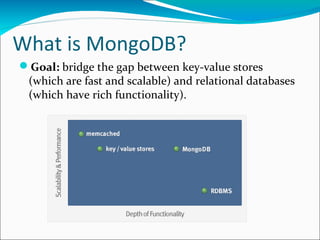
Goal: bridge the gap between key-value stores
(which are fast and scalable) and relational databases
(which have rich functionality).
What is MongoDB?
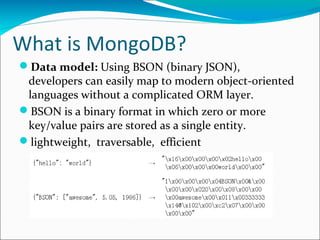
Data model: Using BSON (binary JSON),
developers can easily map to modern object-oriented
languages without a complicated ORM layer.
BSON is a binary format in which zero or more
key/value pairs are stored as a single entity.
lightweight, traversable, efficient
Four Categories
Key-value: Amazon’s Dynamo paper, Voldemort
project by LinkedIn
BigTable: Google’s BigTable paper, Cassandra
developed by Facebook, now Apache project
Graph: Mathematical Graph Theorys, FlockDB
twitter
Document Store: JSON, XML format, CouchDB ,
MongoDB
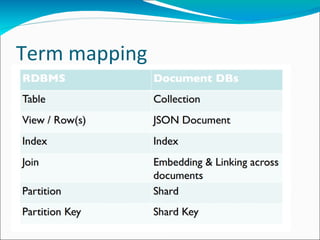
Term mapping
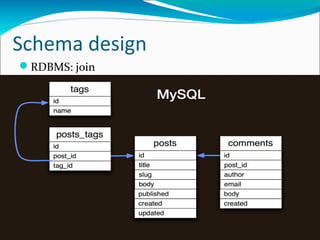
Schema design
RDBMS: join
Schema design
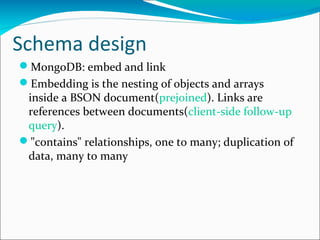
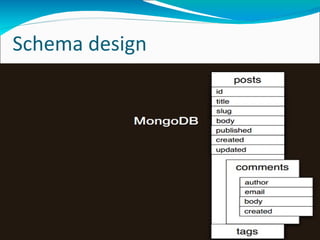
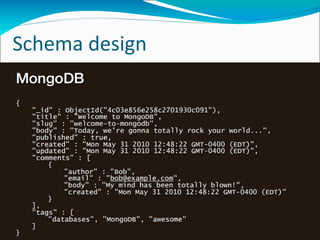
MongoDB: embed and link
Embedding is the nesting of objects and arrays
inside a BSON document(prejoined). Links are
references between documents(client-side follow-up
query).
"contains" relationships, one to many; duplication of
data, many to many
Schema design
Schema design
Replication
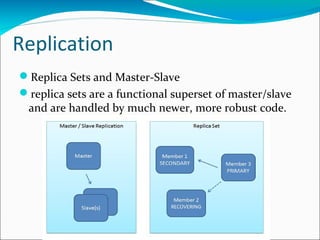
Replica Sets and Master-Slave
replica sets are a functional superset of master/slave
and are handled by much newer, more robust code.
Replication
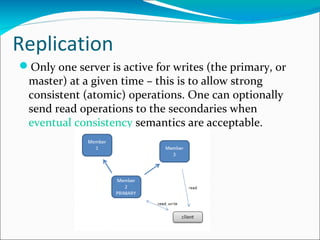
Only one server is active for writes (the primary, or
master) at a given time – this is to allow strong
consistent (atomic) operations. One can optionally
send read operations to the secondaries when
eventual consistency semantics are acceptable.
Why Replica Sets
Data Redundancy
Automated Failover
Read Scaling
Maintenance
Disaster Recovery(delayed secondary)
Replica Sets experiment
bin/mongod --dbpath data/db --logpath
data/log/hengtian.log --logappend --rest --replSet
hengtian
rs.initiate({
 _id : "hengtian",
 members : [

{_id : 0, host : "lab3:27017"},

{_id : 1, host : "cms1:27017"},

{_id : 2, host : "cms2:27017"}
 ]
})
Sharding
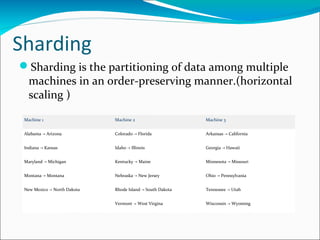
Sharding is the partitioning of data among multiple
machines in an order-preserving manner.(horizontal
scaling )
Machine 1

Machine 2

Machine 3

Alabama → Arizona

Colorado → Florida

Arkansas → California

Indiana → Kansas

Idaho → Illinois

Georgia → Hawaii

Maryland → Michigan

Kentucky → Maine

Minnesota → Missouri

Montana → Montana

Nebraska → New Jersey

Ohio → Pennsylvania

New Mexico → North Dakota

Rhode Island → South Dakota

Tennessee → Utah

Vermont → West Virgina

Wisconsin → Wyoming
Shard Keys
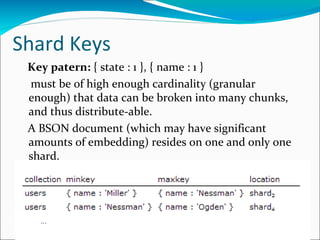
Key patern: { state : 1 }, { name : 1 }
must be of high enough cardinality (granular
enough) that data can be broken into many chunks,
and thus distribute-able.
A BSON document (which may have significant
amounts of embedding) resides on one and only one
shard.
Sharding
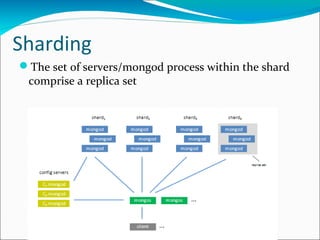
The set of servers/mongod process within the shard
comprise a replica set
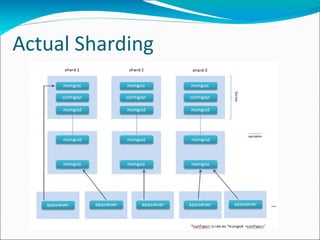
Actual Sharding
Replication & Sharding conclusion
sharding is the tool for scaling a system, and
replication is the tool for data safety, high availability,
and disaster recovery. The two work in tandem yet are
orthogonal concepts in the design.
Map reduce
Often, in a situation where you would have used
GROUP BY in SQL, map/reduce is the right tool in
MongoDB.
experiment
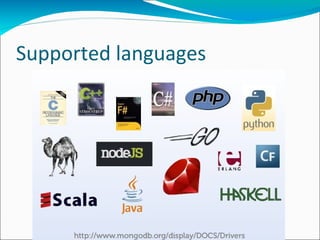
Supported languages
Thank you

Intro to mongo db

  • 1.
  • 2.
    Background Creator: 10gen, formerdoublick Name: short for humongous ( 芒果 ) Language: C++
  • 3.
    What is MongoDB? Defination:MongoDB is an open source, document-oriented database designed with both scalability and developer agility in mind. Instead of storing your data in tables and rows as you would with a relational database, in MongoDB you store JSON-like documents with dynamic schemas(schema-free, schemaless).
  • 4.
    What is MongoDB? Goal:bridge the gap between key-value stores (which are fast and scalable) and relational databases (which have rich functionality).
  • 5.
    What is MongoDB? Datamodel: Using BSON (binary JSON), developers can easily map to modern object-oriented languages without a complicated ORM layer. BSON is a binary format in which zero or more key/value pairs are stored as a single entity. lightweight, traversable, efficient
  • 6.
    Four Categories Key-value: Amazon’sDynamo paper, Voldemort project by LinkedIn BigTable: Google’s BigTable paper, Cassandra developed by Facebook, now Apache project Graph: Mathematical Graph Theorys, FlockDB twitter Document Store: JSON, XML format, CouchDB , MongoDB
  • 7.
  • 8.
  • 9.
    Schema design MongoDB: embedand link Embedding is the nesting of objects and arrays inside a BSON document(prejoined). Links are references between documents(client-side follow-up query). "contains" relationships, one to many; duplication of data, many to many
  • 10.
  • 11.
  • 12.
    Replication Replica Sets andMaster-Slave replica sets are a functional superset of master/slave and are handled by much newer, more robust code.
  • 13.
    Replication Only one serveris active for writes (the primary, or master) at a given time – this is to allow strong consistent (atomic) operations. One can optionally send read operations to the secondaries when eventual consistency semantics are acceptable.
  • 14.
    Why Replica Sets DataRedundancy Automated Failover Read Scaling Maintenance Disaster Recovery(delayed secondary)
  • 15.
    Replica Sets experiment bin/mongod--dbpath data/db --logpath data/log/hengtian.log --logappend --rest --replSet hengtian rs.initiate({  _id : "hengtian",  members : [  {_id : 0, host : "lab3:27017"},  {_id : 1, host : "cms1:27017"},  {_id : 2, host : "cms2:27017"}  ] })
  • 16.
    Sharding Sharding is thepartitioning of data among multiple machines in an order-preserving manner.(horizontal scaling ) Machine 1 Machine 2 Machine 3 Alabama → Arizona Colorado → Florida Arkansas → California Indiana → Kansas Idaho → Illinois Georgia → Hawaii Maryland → Michigan Kentucky → Maine Minnesota → Missouri Montana → Montana Nebraska → New Jersey Ohio → Pennsylvania New Mexico → North Dakota Rhode Island → South Dakota Tennessee → Utah Vermont → West Virgina Wisconsin → Wyoming
  • 17.
    Shard Keys Key patern:{ state : 1 }, { name : 1 } must be of high enough cardinality (granular enough) that data can be broken into many chunks, and thus distribute-able. A BSON document (which may have significant amounts of embedding) resides on one and only one shard.
  • 18.
    Sharding The set ofservers/mongod process within the shard comprise a replica set
  • 19.
  • 20.
    Replication & Shardingconclusion sharding is the tool for scaling a system, and replication is the tool for data safety, high availability, and disaster recovery. The two work in tandem yet are orthogonal concepts in the design.
  • 21.
    Map reduce Often, ina situation where you would have used GROUP BY in SQL, map/reduce is the right tool in MongoDB. experiment
  • 22.
  • 23.