Intro to Drama
roots
• Sympathetic magic
• Early religions
• Greek Civilization produces the first “plays” that we would recognize as
plays.
•
•
•
•
•

Spring fertility festivals: the goat
Tragos: ‘goatsong’
Tragedy
Playwright competitions
Golden Age of Greece: Aeschylus, Sophocles, Euripdes
Roots
• After the Crusades, slowly the Greek and Roman plays and poets
become known again in Europe.
• In England Shakespeare and others are profoundly influenced by the
Classical plays.
• Their Renaissance dramas are part of the creation of the modern
world. That’s part of why Shakespeare makes sense to us.
Elizabethan Drama
• Drama becomes hugely popular in cities. It’s analogous to blockbuster
movies today.
• Plays can be loosely grouped into comedies and tragedies.
• Shakespeare’s first play is a hit comedy. He is best known for
tragedies.
Comedies
• Love is often a central theme.
• Complicated, even improbable plots.
• Mistaken identity.
• A sad or philosophical undercurrent.
• Stock characters (many of which we see today, inherited from Greek
plays and from medieval folks types: the pedant, the braggart, the
clever clown, the dreamy lover, the fool).
• Shelley: tragedies end in death; comedies in marriage.
The Globe
The Globe
The Globe
The Globe
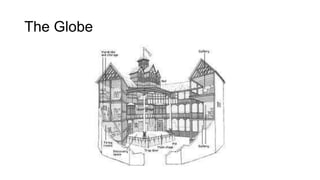
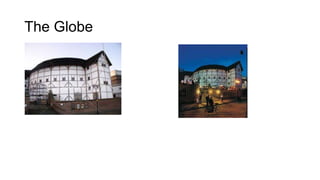
• Built in 1597-98 after the lease on The Theatre expires.
• Also a site for gambling and other notorious activities like bearbaiting.
• Shakespeare himself owned stock in the company and staged and
acted in plays there. The “all the world’s a stage” speech is based on a
pun…world/globe.
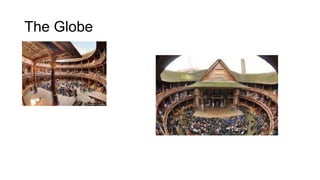
• Poorer theatre goers sat on the ground I front of the stage
(groundlings); wealthy folks sat in the galleries.
• The plays were aimed at both audiences.

Intro to drama

  • 1.
  • 2.
    roots • Sympathetic magic •Early religions • Greek Civilization produces the first “plays” that we would recognize as plays. • • • • • Spring fertility festivals: the goat Tragos: ‘goatsong’ Tragedy Playwright competitions Golden Age of Greece: Aeschylus, Sophocles, Euripdes
  • 3.
    Roots • After theCrusades, slowly the Greek and Roman plays and poets become known again in Europe. • In England Shakespeare and others are profoundly influenced by the Classical plays. • Their Renaissance dramas are part of the creation of the modern world. That’s part of why Shakespeare makes sense to us.
  • 4.
    Elizabethan Drama • Dramabecomes hugely popular in cities. It’s analogous to blockbuster movies today. • Plays can be loosely grouped into comedies and tragedies. • Shakespeare’s first play is a hit comedy. He is best known for tragedies.
  • 5.
    Comedies • Love isoften a central theme. • Complicated, even improbable plots. • Mistaken identity. • A sad or philosophical undercurrent. • Stock characters (many of which we see today, inherited from Greek plays and from medieval folks types: the pedant, the braggart, the clever clown, the dreamy lover, the fool). • Shelley: tragedies end in death; comedies in marriage.
  • 6.
  • 7.
  • 8.
  • 9.
    The Globe • Builtin 1597-98 after the lease on The Theatre expires. • Also a site for gambling and other notorious activities like bearbaiting. • Shakespeare himself owned stock in the company and staged and acted in plays there. The “all the world’s a stage” speech is based on a pun…world/globe. • Poorer theatre goers sat on the ground I front of the stage (groundlings); wealthy folks sat in the galleries. • The plays were aimed at both audiences.