Intro to Art An introduction to the concept of art
Why are we here  . . . geez?
To learn about A-R-T …DuH!
What is art? "Art is something that is both functional and (hopefully) aesthetically pleasing to our eyes."  "Art is in a constant state of change, so nobody can really pin down what it is."  Art is subjective, and means something different to every single person on earth."
For real what is art? Webster defines art as: The conscious use of skill and creative imagination especially in the production of aesthetic objects;  also   :  works so produced  b (1)   :  fine arts
So, Okay….can you be more like…specific?
Art=Aesthetic=…?.. Aesthetic is a big art word A.K.A  creativeness having a sense of the beautiful
Art terms  Elements of   Art - Elements of art are the basic visual symbols found in the work such as lines, shape, form, space, point, light, motion, direction, scale, dimension, texture and color.  Medium - The   art material that is used in a work of art such as clay, paint or pencil. Describing more then one art medium is referred to as media. Any substance added to color to facilitate application or to achieve a desired effect.  Symbol-  A symbol is a form or image that tells a story of what it is without using words.  Style-  A characteristic handling of  media and  elements of form that gives a work its identity as the product of a particular person, group, art movement, period, or culture.
3 simple sections of art Drawing 2-D Design 3-D Design (sculptures) We will only focus on Drawing & 2-D design Please note: 18" x 24“ is the maximum requirement for sip and Shop
Wait! Don’t get ScUrD!
Drawing consists of… Drawings, which consists of mediums such as charcoal, pastel, pencil, pen, color pencil… Paintings Mixed Media: using multiple mediums in one artwork (ie: pastel, watercolor, pencil)
Drawing
Paintings
Mixed Media
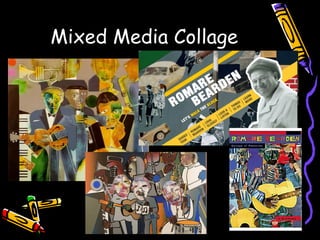
2-D Design consists of… Photography Graphic illustrations Mixed Media Collage: combining drawing and other medias (ie: drawings, paint and graphics)
Photography
Mixed Media Collage
Graphic illustrations/ design
So how do you evaluate art? In this section we will learn how to tell if something is art  In addition we will learn the key elements for any work to be called art
Friendly Rules Think about the questions  There is no right or wrong answer in this portion Participate
Image #1 Is this art? Why or why not? What elements does it have or not have?
Image #2 Is this art? Why or why not? What elements does it have or not have?
Image #3 Is this art? Why or why not? What elements does it have or not have?
Image #4 Is this art? Why or why not? What elements does it have or not have?
Image #5 Is this art? Why or why not? What elements does it have or not have?
Image #6 Is this art? Why or why not? What elements does it have or not have?
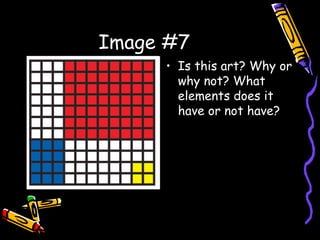
Image #7 Is this art? Why or why not? What elements does it have or not have?
Image #8 Is this art? Why or why not? What elements does it have or not have?
I’m tired of this…can we get to the point?
Well, Sure  
Elements of Art Perspective Light Color Form Motion Proportion Symbols Lines
Perspective Perspective is the way in which artists create an illusion of depth on a flat surface.  For hundreds of years painters have tried to represent accurately a scene that exists in three dimensions on a two-dimensional canvas.  One of the ways to create this illusion is to make the objects that are far away smaller than those that are closer to the viewer.
Great Perspective!  
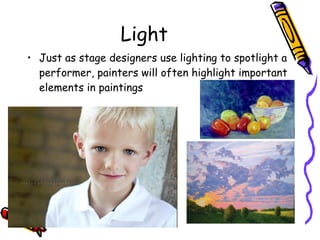
Light Just as stage designers use lighting to spotlight a performer, painters will often highlight important elements in paintings
Color Use of different colors provide emphasis, emotion, etc.  Often colors highlight parts of an image to draw specific attention to it.
Form By using light and shadows, artists give volume to their subjects.  One way one can  give  figures three-dimensional form is to reflect light off their bodies and paint shadows cast by them.
Motion Depicting motion is a technique painters use to keep our attention focused on the picture.
Proportion Proportion usually refers to the way different elements in a painting relate to each other in terms of size.
Lines An identifiable path of a point moving in space. It can vary in width, direction, and length.
Symbols Many artists include items that symbolize other items, emotions, beliefs, ideas, etc. Well come back to this later
Let’s take a break….
Hidden Messages / Clues
Symbolism Because works of art don't usually include words, symbols are used in order to tell the viewer a message or even a story.
Color Symbolism Chart    Peace, tranquility, calm, stability, harmony, unity, trust, truth, confidence, conservatism, security, cleanliness, order, loyalty, sky, water, cold, technology, depression, appetite suppressant. Blue   Joy, happiness, optimism, idealism, imagination, hope, sunshine, summer, gold, philosophy, dishonesty, cowardice, betrayal, jealousy, covetousness, deceit, illness, hazard. Yellow   Excitement, energy, passion, desire, speed, strength, power, heat, love, aggression, danger, fire, blood, war, violence, aggression, all things intense and passionate. Red   Color   Symbolism
Power, sexuality, sophistication, formality, elegance, wealth, mystery, fear, evil, unhappiness, depth, style, evil, sadness, remorse, anger, anonymity, underground, good technical color, mourning, death (Western cultures).   Reverence, purity, birth, simplicity, cleanliness, peace, humility, precision, innocence, youth, winter, snow, good, sterility, marriage (Western cultures), death (Eastern cultures), cold, clinical.   Security, reliability, intelligence, staid, modesty, dignity, maturity, solid, conservative, practical, old age, sadness, boring. Silver symbolizes calm.   Earth, stability, hearth, home, outdoors, reliability, comfort, endurance, simplicity, and comfort.   Nature, environment, healthy, good luck, renewal, youth, spring, generosity, fertility, jealousy, inexperience, envy, misfortune, vigor.   Energy, balance, enthusiasm, warmth, vibrant, expansive, flamboyant, demanding of attention.   Lavender symbolizes femininity, grace and elegance.   Royalty, nobility, spirituality, ceremony, mysterious, transformation, wisdom, enlightenment, cruelty, arrogance, mourning.  
Got the colors down pack… What are some other hidden components of art besides colorful meanings?
Pictorial symbols
~ This organ of perception which makes visible the invisible, nourishes our minds and stirs our emotions with the visual images of a perplexing reality. Its association with the sun (source of light, which light is in itself symbolic of intelligence), makes it the antechamber of understanding and therefore enlightenment and knowledge.  ~The sun is referred to as the eye of the day and the moon as the eye of the night while the stars are the eyes of the Creator and the artist is an instrument of his creator.  Eye
Hole The hole symbolizes the search for knowledge... the desire to know what is beyond.
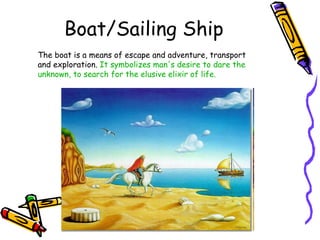
Boat/Sailing Ship The boat is a means of escape and adventure, transport and exploration.  It symbolizes man's desire to dare the unknown, to search for the elusive elixir of life.
Cone The cone is a complex image derived from the metaphysical association of the circle with the triangle, evaluative in its form (vertical thrust), eternal in its oneness.  It is also symbolic of the sun in general and, in my creations, of man in particular. It is a metaphor for manhood.
Bird The bird symbolizes the human soul, the exaltation of thought (cogitation) and imagination, the freedom from any earthly limitations, the catharsis of spiritualization.
Cross " Some hold it to be a sign used by devil worshippers."  The cross is also regarded as the cross of St Peter (who was crucified upside down). Although other people believe this to be a sign of someone who has lost faith.
Plants Carnation:  A symbol of betrothal or engagement.  In China, a carnation is a symbol of marriage.  Bamboo:  A symbol for longevity (it's always got green shoots) as well as strength and grace (it bends readily but doesn't break easily).  In Chinese philosophy the straight stem of bamboo symbolizes the path towards enlightenment, the segments of the stem being the steps along the way.  Clover leaf:  The three divided leaves of clover represent the  Christian Holy Trinity  of God the Father, Christ the Son, and the Holy Spirit. Four-leafed clovers represent luck.

Intro to art

  • 1.
    Intro to ArtAn introduction to the concept of art
  • 2.
    Why are wehere . . . geez?
  • 3.
    To learn aboutA-R-T …DuH!
  • 4.
    What is art?"Art is something that is both functional and (hopefully) aesthetically pleasing to our eyes." "Art is in a constant state of change, so nobody can really pin down what it is." Art is subjective, and means something different to every single person on earth."
  • 5.
    For real whatis art? Webster defines art as: The conscious use of skill and creative imagination especially in the production of aesthetic objects; also : works so produced b (1) : fine arts
  • 6.
    So, Okay….can yoube more like…specific?
  • 7.
    Art=Aesthetic=…?.. Aesthetic isa big art word A.K.A creativeness having a sense of the beautiful
  • 8.
    Art terms Elements of Art - Elements of art are the basic visual symbols found in the work such as lines, shape, form, space, point, light, motion, direction, scale, dimension, texture and color. Medium - The art material that is used in a work of art such as clay, paint or pencil. Describing more then one art medium is referred to as media. Any substance added to color to facilitate application or to achieve a desired effect. Symbol- A symbol is a form or image that tells a story of what it is without using words. Style- A characteristic handling of media and elements of form that gives a work its identity as the product of a particular person, group, art movement, period, or culture.
  • 9.
    3 simple sectionsof art Drawing 2-D Design 3-D Design (sculptures) We will only focus on Drawing & 2-D design Please note: 18" x 24“ is the maximum requirement for sip and Shop
  • 10.
  • 11.
    Drawing consists of…Drawings, which consists of mediums such as charcoal, pastel, pencil, pen, color pencil… Paintings Mixed Media: using multiple mediums in one artwork (ie: pastel, watercolor, pencil)
  • 12.
  • 13.
  • 14.
  • 15.
    2-D Design consistsof… Photography Graphic illustrations Mixed Media Collage: combining drawing and other medias (ie: drawings, paint and graphics)
  • 16.
  • 17.
  • 18.
  • 19.
    So how doyou evaluate art? In this section we will learn how to tell if something is art In addition we will learn the key elements for any work to be called art
  • 20.
    Friendly Rules Thinkabout the questions There is no right or wrong answer in this portion Participate
  • 21.
    Image #1 Isthis art? Why or why not? What elements does it have or not have?
  • 22.
    Image #2 Isthis art? Why or why not? What elements does it have or not have?
  • 23.
    Image #3 Isthis art? Why or why not? What elements does it have or not have?
  • 24.
    Image #4 Isthis art? Why or why not? What elements does it have or not have?
  • 25.
    Image #5 Isthis art? Why or why not? What elements does it have or not have?
  • 26.
    Image #6 Isthis art? Why or why not? What elements does it have or not have?
  • 27.
    Image #7 Isthis art? Why or why not? What elements does it have or not have?
  • 28.
    Image #8 Isthis art? Why or why not? What elements does it have or not have?
  • 29.
    I’m tired ofthis…can we get to the point?
  • 30.
  • 31.
    Elements of ArtPerspective Light Color Form Motion Proportion Symbols Lines
  • 32.
    Perspective Perspective isthe way in which artists create an illusion of depth on a flat surface. For hundreds of years painters have tried to represent accurately a scene that exists in three dimensions on a two-dimensional canvas. One of the ways to create this illusion is to make the objects that are far away smaller than those that are closer to the viewer.
  • 33.
  • 34.
    Light Just asstage designers use lighting to spotlight a performer, painters will often highlight important elements in paintings
  • 35.
    Color Use ofdifferent colors provide emphasis, emotion, etc. Often colors highlight parts of an image to draw specific attention to it.
  • 36.
    Form By usinglight and shadows, artists give volume to their subjects. One way one can give figures three-dimensional form is to reflect light off their bodies and paint shadows cast by them.
  • 37.
    Motion Depicting motionis a technique painters use to keep our attention focused on the picture.
  • 38.
    Proportion Proportion usuallyrefers to the way different elements in a painting relate to each other in terms of size.
  • 39.
    Lines An identifiablepath of a point moving in space. It can vary in width, direction, and length.
  • 40.
    Symbols Many artistsinclude items that symbolize other items, emotions, beliefs, ideas, etc. Well come back to this later
  • 41.
    Let’s take abreak….
  • 42.
  • 43.
    Symbolism Because worksof art don't usually include words, symbols are used in order to tell the viewer a message or even a story.
  • 44.
    Color Symbolism Chart  Peace, tranquility, calm, stability, harmony, unity, trust, truth, confidence, conservatism, security, cleanliness, order, loyalty, sky, water, cold, technology, depression, appetite suppressant. Blue   Joy, happiness, optimism, idealism, imagination, hope, sunshine, summer, gold, philosophy, dishonesty, cowardice, betrayal, jealousy, covetousness, deceit, illness, hazard. Yellow   Excitement, energy, passion, desire, speed, strength, power, heat, love, aggression, danger, fire, blood, war, violence, aggression, all things intense and passionate. Red   Color Symbolism
  • 45.
    Power, sexuality, sophistication,formality, elegance, wealth, mystery, fear, evil, unhappiness, depth, style, evil, sadness, remorse, anger, anonymity, underground, good technical color, mourning, death (Western cultures).   Reverence, purity, birth, simplicity, cleanliness, peace, humility, precision, innocence, youth, winter, snow, good, sterility, marriage (Western cultures), death (Eastern cultures), cold, clinical.   Security, reliability, intelligence, staid, modesty, dignity, maturity, solid, conservative, practical, old age, sadness, boring. Silver symbolizes calm.   Earth, stability, hearth, home, outdoors, reliability, comfort, endurance, simplicity, and comfort.   Nature, environment, healthy, good luck, renewal, youth, spring, generosity, fertility, jealousy, inexperience, envy, misfortune, vigor.   Energy, balance, enthusiasm, warmth, vibrant, expansive, flamboyant, demanding of attention.   Lavender symbolizes femininity, grace and elegance.   Royalty, nobility, spirituality, ceremony, mysterious, transformation, wisdom, enlightenment, cruelty, arrogance, mourning.  
  • 46.
    Got the colorsdown pack… What are some other hidden components of art besides colorful meanings?
  • 47.
  • 48.
    ~ This organof perception which makes visible the invisible, nourishes our minds and stirs our emotions with the visual images of a perplexing reality. Its association with the sun (source of light, which light is in itself symbolic of intelligence), makes it the antechamber of understanding and therefore enlightenment and knowledge. ~The sun is referred to as the eye of the day and the moon as the eye of the night while the stars are the eyes of the Creator and the artist is an instrument of his creator. Eye
  • 49.
    Hole The holesymbolizes the search for knowledge... the desire to know what is beyond.
  • 50.
    Boat/Sailing Ship Theboat is a means of escape and adventure, transport and exploration. It symbolizes man's desire to dare the unknown, to search for the elusive elixir of life.
  • 51.
    Cone The coneis a complex image derived from the metaphysical association of the circle with the triangle, evaluative in its form (vertical thrust), eternal in its oneness. It is also symbolic of the sun in general and, in my creations, of man in particular. It is a metaphor for manhood.
  • 52.
    Bird The birdsymbolizes the human soul, the exaltation of thought (cogitation) and imagination, the freedom from any earthly limitations, the catharsis of spiritualization.
  • 53.
    Cross " Somehold it to be a sign used by devil worshippers." The cross is also regarded as the cross of St Peter (who was crucified upside down). Although other people believe this to be a sign of someone who has lost faith.
  • 54.
    Plants Carnation: A symbol of betrothal or engagement. In China, a carnation is a symbol of marriage. Bamboo: A symbol for longevity (it's always got green shoots) as well as strength and grace (it bends readily but doesn't break easily). In Chinese philosophy the straight stem of bamboo symbolizes the path towards enlightenment, the segments of the stem being the steps along the way. Clover leaf: The three divided leaves of clover represent the Christian Holy Trinity of God the Father, Christ the Son, and the Holy Spirit. Four-leafed clovers represent luck.