SEMINAR
ON
INTRODUCTION TO PHISHING
BY:
– SAYALI DAYAMA
◦ SEMINAR GUIDE :
MRS. SWATI SHIRSATH
1
How To Protect Yourself
Additional Credits: Educause/SonicWall, Hendra Harianto Tuty, Microsoft Corporation, some images from Anti-
Phishing Workgroup’s Phishing Archive,Carnegie Mellon CyLab
2
Recognize Phishing Scams and Fraudulent E-mails
• Phishing is a type of deception designed to steal
your valuable personal data, such as credit card
numbers, passwords, account data, or other
information.
• Con artists might send millions of fraudulent e-mail
messages that appear to come from Web sites you
trust, like your bank or credit card company, and
request that you provide personal information.
3
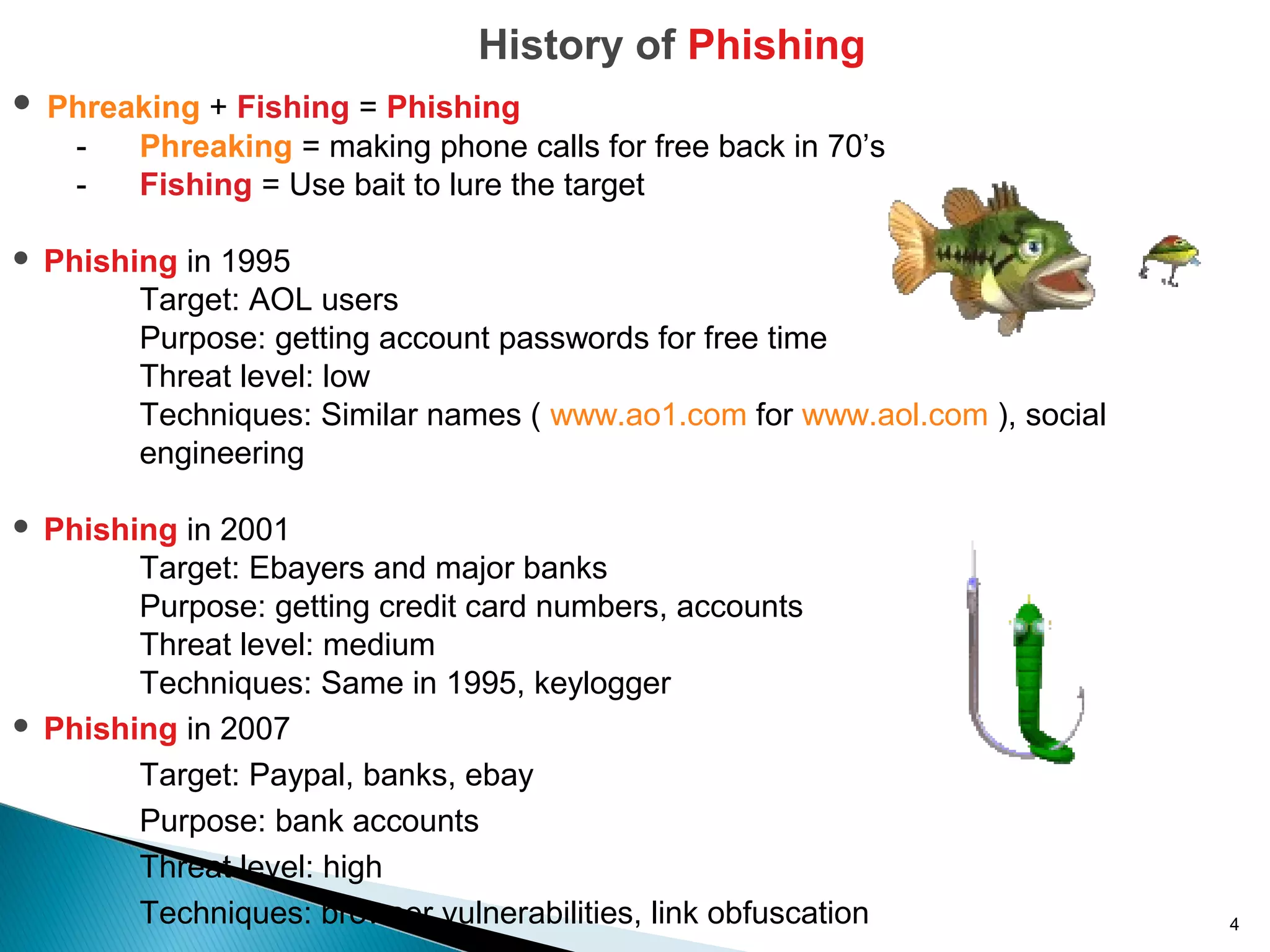
 Phreaking + Fishing = Phishing
- Phreaking = making phone calls for free back in 70’s
- Fishing = Use bait to lure the target
 Phishing in 1995
Target: AOL users
Purpose: getting account passwords for free time
Threat level: low
Techniques: Similar names ( www.ao1.com for www.aol.com ), social
engineering
 Phishing in 2001
Target: Ebayers and major banks
Purpose: getting credit card numbers, accounts
Threat level: medium
Techniques: Same in 1995, keylogger
 Phishing in 2007
Target: Paypal, banks, ebay
Purpose: bank accounts
Threat level: high
Techniques: browser vulnerabilities, link obfuscation
History of Phishing
4
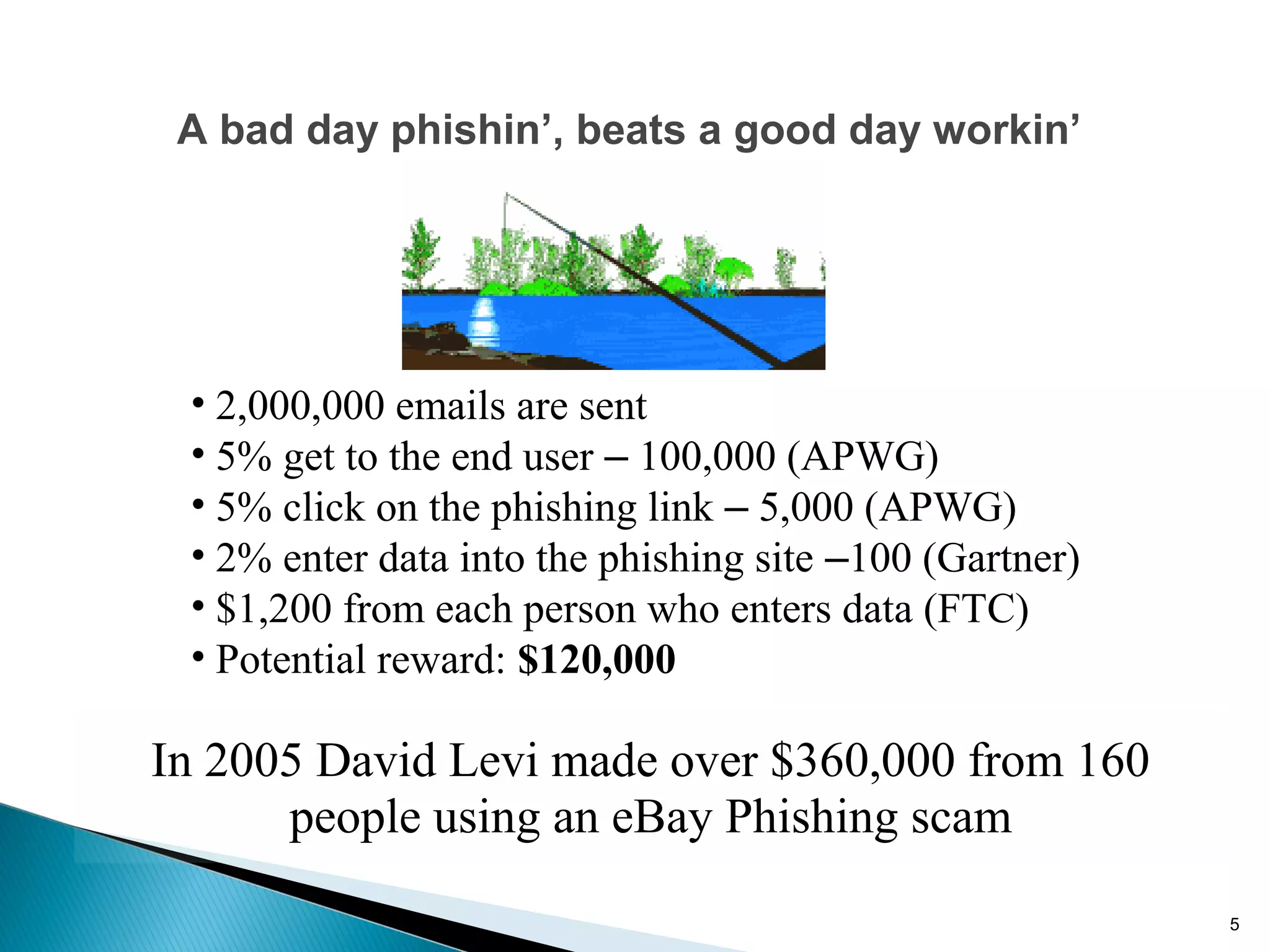
• 2,000,000 emails are sent
• 5% get to the end user – 100,000 (APWG)
• 5% click on the phishing link – 5,000 (APWG)
• 2% enter data into the phishing site –100 (Gartner)
• $1,200 from each person who enters data (FTC)
• Potential reward: $120,000
A bad day phishin’, beats a good day workin’
In 2005 David Levi made over $360,000 from 160
people using an eBay Phishing scam
5
People today prefer card payments as well as online
shopping and ecommerce as the world is at
fingertips! The number of incidents are rising at an
alarming pace and its necessary to educate people
about the what measures should be taken to avoid
becoming a victim of such an attack.
6
• Over 28,000 unique phishing attacks reported in Dec.
2006, about double the number from 2005
• Estimates suggest phishing affected 2 million US
citizens and cost businesses billions of dollars in
2005
• Additional losses due to consumer fears
Phishing: A Growing Problem
7
 Customer unknowingly gives confidential
details of credit card on the fake bank website
after receiving the threat via mail of strict
actions.
8
What Does a Phishing Scam Look Like?
• As scam artists become more sophisticated, so
do their phishing e-mail messages and pop-up
windows.
• They often include official-looking logos from real
organizations and other identifying information
taken directly from legitimate Web sites.
9
• Employ visual elements from target site
• DNS Tricks:
–www.ebay.com.kr
–www.ebay.com@192.168.0.5
–www.gooogle.com
–Unicode attacks
• JavaScript Attacks
–Spoofed SSL lock
• Certificates
–Phishers can acquire certificates for domains
they own
–Certificate authorities make mistakes
Current Phishing Techniques
10
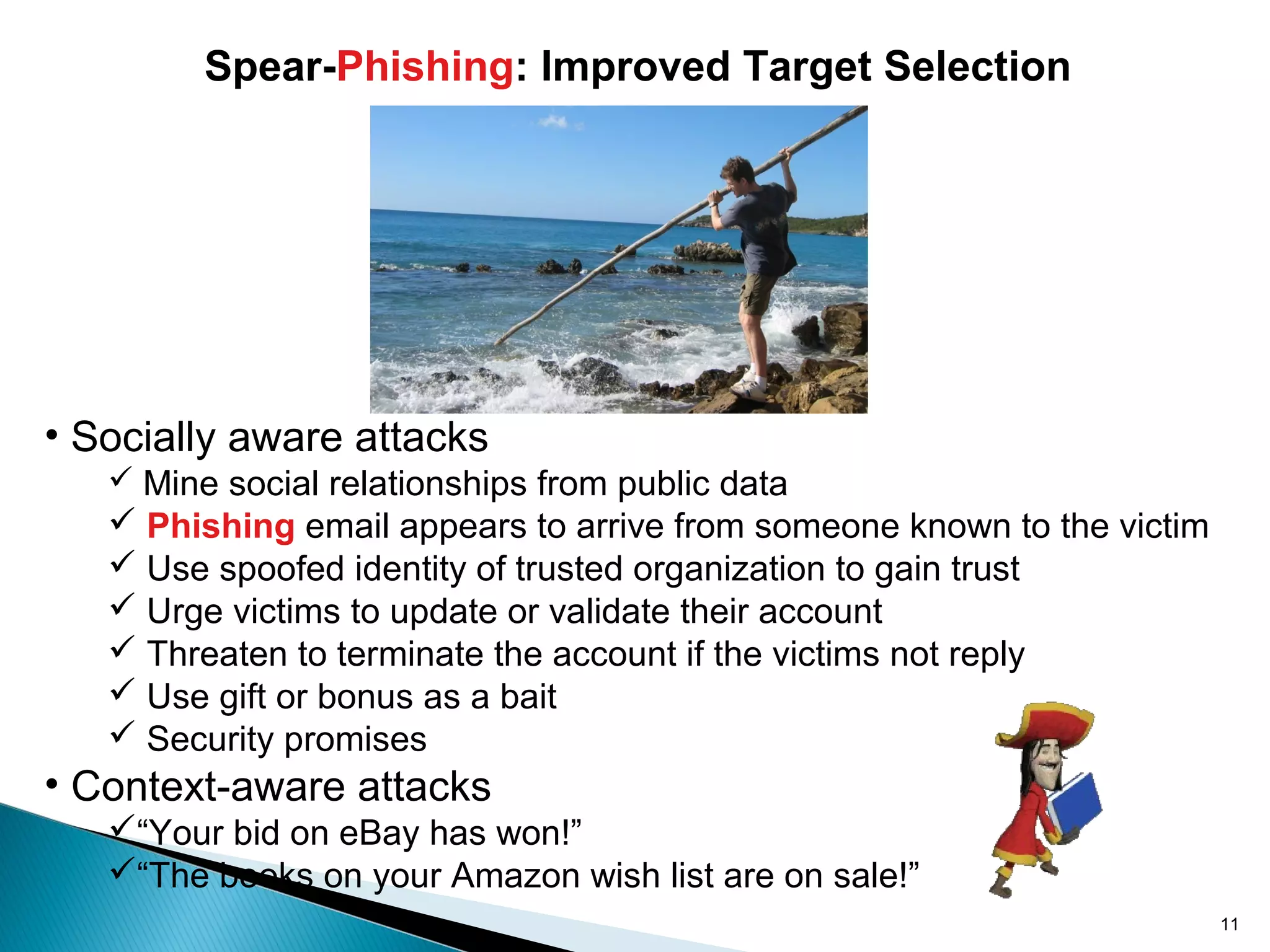
• Socially aware attacks
 Mine social relationships from public data
 Phishing email appears to arrive from someone known to the victim
 Use spoofed identity of trusted organization to gain trust
 Urge victims to update or validate their account
 Threaten to terminate the account if the victims not reply
 Use gift or bonus as a bait
 Security promises
• Context-aware attacks
“Your bid on eBay has won!”
“The books on your Amazon wish list are on sale!”
Spear-Phishing: Improved Target Selection
11
Another Example:
12
But wait…
WHOIS 210.104.211.21:
Location: Korea, Republic Of
Even bigger problem:
I don’t have an account with US Bank!
13
Link Guard works by analysing the differences between the
visible link and the actual link. It also calculates the similarities of
URI with a known trusted site. The algorithm is illustrated below.
The following terminologies are used in the algorithm:
v_link: visual link;
a_link: actual link;
v_dns: visual DNS name;
a_dns: actual DNS name;
sender_dns: sender’s DNS name;
14
15
a_link: actual link;
v_link: visual link;
a_dns: actual DNS name;
v_dns: visual DNS name;
sender_dns: sender DNS
names.
intLinkGuard (a_link,v_link)
{
a_dns=GetDNSName(a_link);
v_dns=GetDNSName(v_link);
if ((a_dns and v_dns are both
empty) and (a_dns ! = a_dns))
return phishing;
if (a_dns is dotted decimal)
returnpossible_phishing;
if (v_link or a_link is encoded)
{
a_link2=decode(a_link);
v_link2=decode(v_link);
returnLinkGuard (v_link2,
a_link2);
}
if (v_dns is NULL)
returnAnalyzeDNS(a_link);
}
intAnalyzeDNS(actual_link)
{
if (actual_dns in blacklist)
return PHISHING;
if (actual_dns in whitelist)
return NOTPHISHING;
returnPatternMatchingactual_link);
}
intPatternMatching(actual_link)
{
if(sender_dns and actual_dns are
different)
return POSSIBLE_PHISHING;
for (each item prev_dns in seed_set)
{
bv=Similarity (prev_dns,actual_link);
if (bv==true)
return POSSIBLE_PHISHING;
}
return NO_PHISHING;
}
float similarity(str,actual_link)
{
if (str is part of actual_link)
return=true;
intmaxlen=the maximum string
lengths of str and actual_dns
intminchange=the minimum number of
changes needed to transform str to
actual_dns;
if(thresh<(maxlen-
minchange)/maxlen<1)
return true
16
IMPLEMENTATION ENVIRONMENT
A. Execution Setup
 Intel R core TM i3 processor-2310M CPU @2.10ghz
 main memory RAM 3GB
 operating system 64bits
 java development lit jdk 1.7.0
B.Results and discussions
When we compare with both link guard algorithm and
SHA algorithm. SHA algorithm has more time complexity
and it has
less secure because it is having more storage capacity.
Link guard algorithm has more secure and has less
rounds.
17
Attributes
 
 
Existing
algorithm
Proposed
 
Name SHA Algorithm Link guard
algorithm
Security 90% 94%
Data storage 513bytes 100bytes
Number of
phishing attacks
 
 
5 3
Generation time 4milliseconds 3milliseconds
COMPARISON OF SHA AND LINK GUARD
18
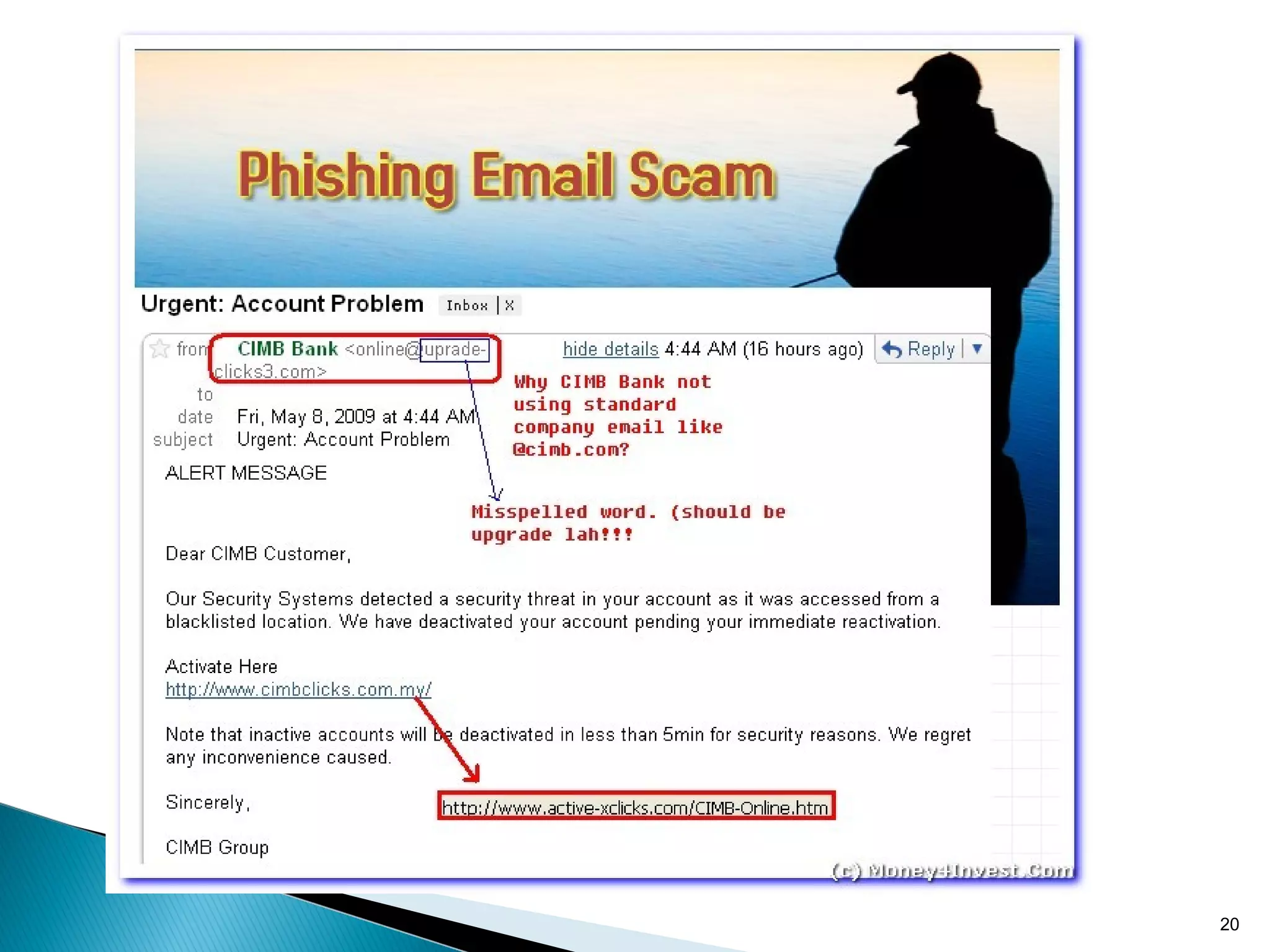
Here are a few phrases to look for if you think an e-mail message is a
phishing scam.
 "Verify your account."Businesses should not ask you to send
passwords, login names, Social Security numbers, or other personal
information through e-mail. If you receive an e-mail from anyone asking
you to update your credit card information, do not respond: this is a
phishing scam.
 "If you don't respond within 48 hours, your account will be
closed."These messages convey a sense of urgency so that you'll
respond immediately without thinking.
How To Tell If An E-mail Message is Fraudulent
19
20
How To Tell If An E-mail Message is Fraudulent (cont’d)
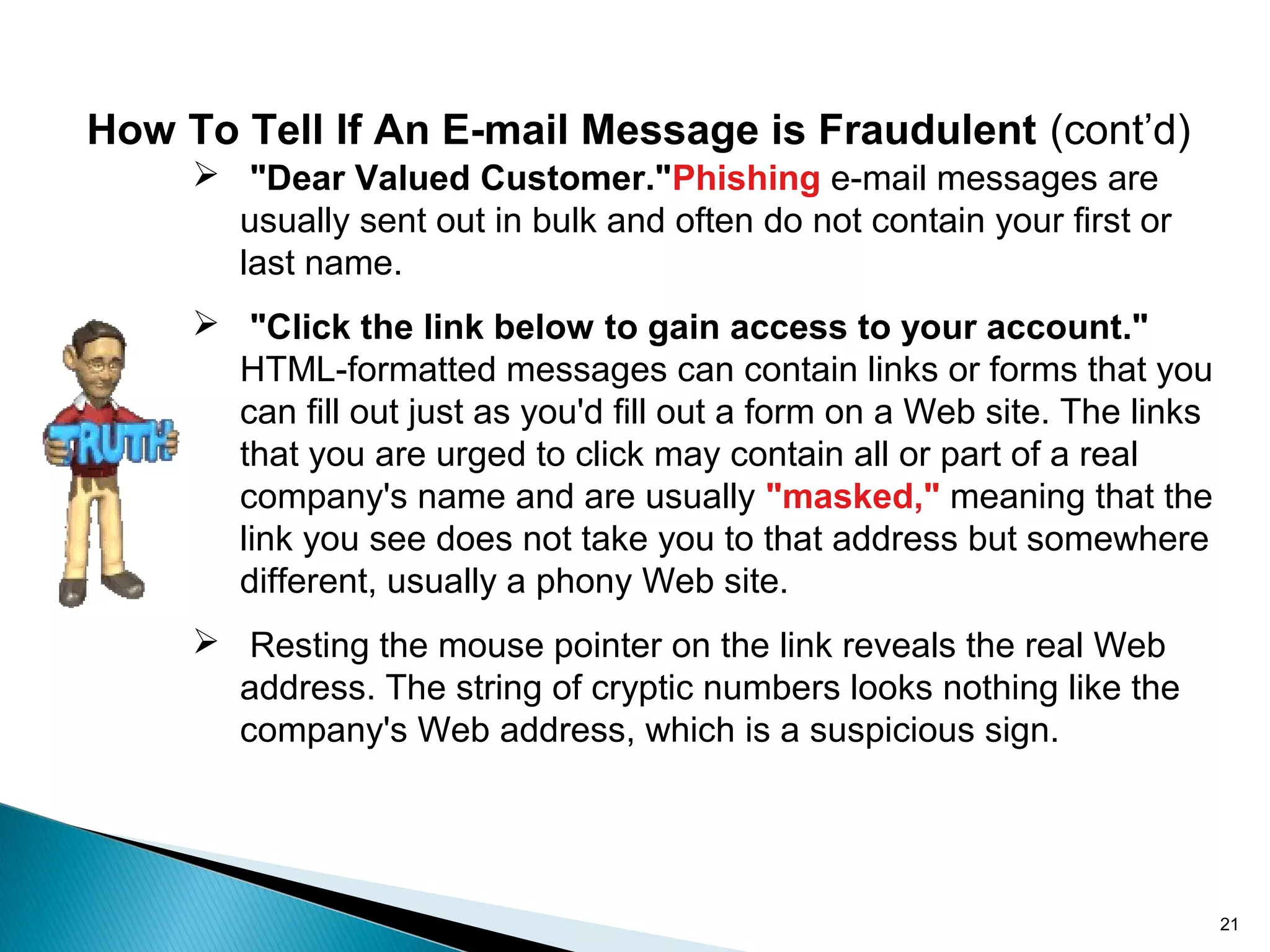
 "Dear Valued Customer."Phishing e-mail messages are
usually sent out in bulk and often do not contain your first or
last name.
 "Click the link below to gain access to your account."
HTML-formatted messages can contain links or forms that you
can fill out just as you'd fill out a form on a Web site. The links
that you are urged to click may contain all or part of a real
company's name and are usually "masked," meaning that the
link you see does not take you to that address but somewhere
different, usually a phony Web site.
 Resting the mouse pointer on the link reveals the real Web
address. The string of cryptic numbers looks nothing like the
company's Web address, which is a suspicious sign.
21
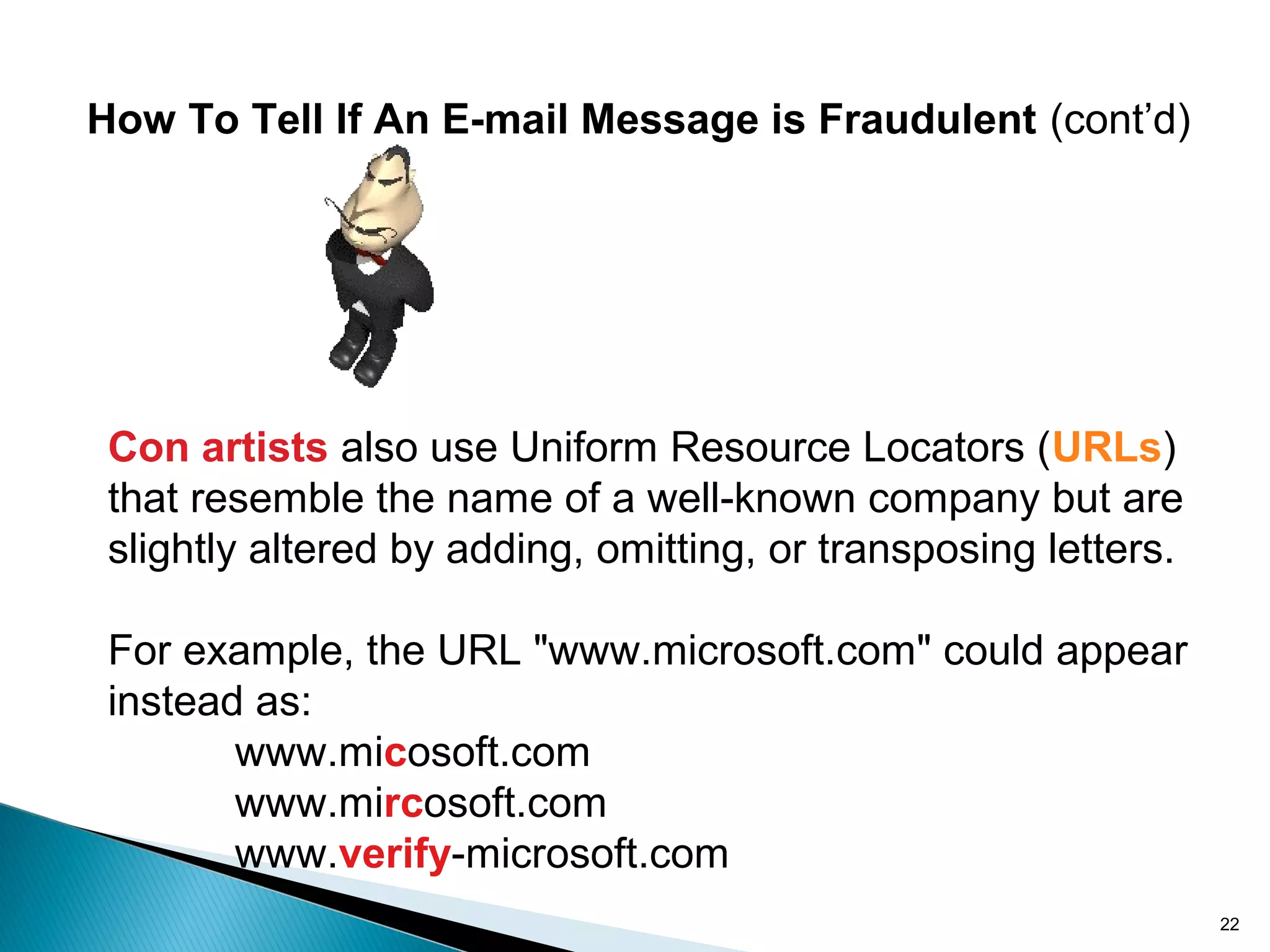
Con artists also use Uniform Resource Locators (URLs)
that resemble the name of a well-known company but are
slightly altered by adding, omitting, or transposing letters.
For example, the URL "www.microsoft.com" could appear
instead as:
www.micosoft.com
www.mircosoft.com
www.verify-microsoft.com
How To Tell If An E-mail Message is Fraudulent (cont’d)
22
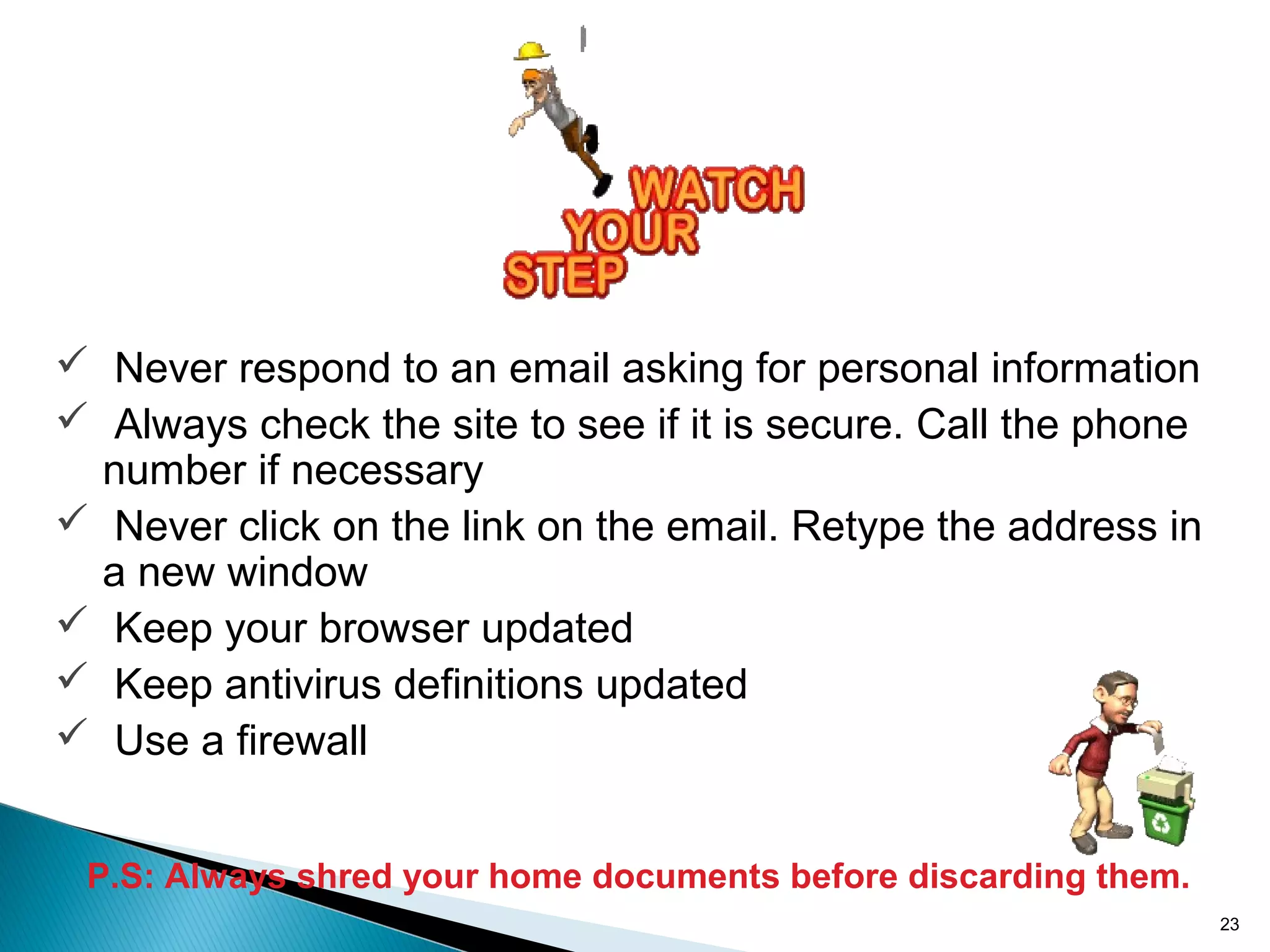
 Never respond to an email asking for personal information
 Always check the site to see if it is secure. Call the phone
number if necessary
 Never click on the link on the email. Retype the address in
a new window
 Keep your browser updated
 Keep antivirus definitions updated
 Use a firewall
P.S: Always shred your home documents before discarding them.
23
24
25

Intro phishing

  • 1.
    SEMINAR ON INTRODUCTION TO PHISHING BY: –SAYALI DAYAMA ◦ SEMINAR GUIDE : MRS. SWATI SHIRSATH 1
  • 2.
    How To ProtectYourself Additional Credits: Educause/SonicWall, Hendra Harianto Tuty, Microsoft Corporation, some images from Anti- Phishing Workgroup’s Phishing Archive,Carnegie Mellon CyLab 2
  • 3.
    Recognize Phishing Scamsand Fraudulent E-mails • Phishing is a type of deception designed to steal your valuable personal data, such as credit card numbers, passwords, account data, or other information. • Con artists might send millions of fraudulent e-mail messages that appear to come from Web sites you trust, like your bank or credit card company, and request that you provide personal information. 3
  • 4.
     Phreaking +Fishing = Phishing - Phreaking = making phone calls for free back in 70’s - Fishing = Use bait to lure the target  Phishing in 1995 Target: AOL users Purpose: getting account passwords for free time Threat level: low Techniques: Similar names ( www.ao1.com for www.aol.com ), social engineering  Phishing in 2001 Target: Ebayers and major banks Purpose: getting credit card numbers, accounts Threat level: medium Techniques: Same in 1995, keylogger  Phishing in 2007 Target: Paypal, banks, ebay Purpose: bank accounts Threat level: high Techniques: browser vulnerabilities, link obfuscation History of Phishing 4
  • 5.
    • 2,000,000 emailsare sent • 5% get to the end user – 100,000 (APWG) • 5% click on the phishing link – 5,000 (APWG) • 2% enter data into the phishing site –100 (Gartner) • $1,200 from each person who enters data (FTC) • Potential reward: $120,000 A bad day phishin’, beats a good day workin’ In 2005 David Levi made over $360,000 from 160 people using an eBay Phishing scam 5
  • 6.
    People today prefercard payments as well as online shopping and ecommerce as the world is at fingertips! The number of incidents are rising at an alarming pace and its necessary to educate people about the what measures should be taken to avoid becoming a victim of such an attack. 6
  • 7.
    • Over 28,000unique phishing attacks reported in Dec. 2006, about double the number from 2005 • Estimates suggest phishing affected 2 million US citizens and cost businesses billions of dollars in 2005 • Additional losses due to consumer fears Phishing: A Growing Problem 7
  • 8.
     Customer unknowinglygives confidential details of credit card on the fake bank website after receiving the threat via mail of strict actions. 8
  • 9.
    What Does aPhishing Scam Look Like? • As scam artists become more sophisticated, so do their phishing e-mail messages and pop-up windows. • They often include official-looking logos from real organizations and other identifying information taken directly from legitimate Web sites. 9
  • 10.
    • Employ visualelements from target site • DNS Tricks: –www.ebay.com.kr –www.ebay.com@192.168.0.5 –www.gooogle.com –Unicode attacks • JavaScript Attacks –Spoofed SSL lock • Certificates –Phishers can acquire certificates for domains they own –Certificate authorities make mistakes Current Phishing Techniques 10
  • 11.
    • Socially awareattacks  Mine social relationships from public data  Phishing email appears to arrive from someone known to the victim  Use spoofed identity of trusted organization to gain trust  Urge victims to update or validate their account  Threaten to terminate the account if the victims not reply  Use gift or bonus as a bait  Security promises • Context-aware attacks “Your bid on eBay has won!” “The books on your Amazon wish list are on sale!” Spear-Phishing: Improved Target Selection 11
  • 12.
  • 13.
    But wait… WHOIS 210.104.211.21: Location:Korea, Republic Of Even bigger problem: I don’t have an account with US Bank! 13
  • 14.
    Link Guard worksby analysing the differences between the visible link and the actual link. It also calculates the similarities of URI with a known trusted site. The algorithm is illustrated below. The following terminologies are used in the algorithm: v_link: visual link; a_link: actual link; v_dns: visual DNS name; a_dns: actual DNS name; sender_dns: sender’s DNS name; 14
  • 15.
  • 16.
    a_link: actual link; v_link:visual link; a_dns: actual DNS name; v_dns: visual DNS name; sender_dns: sender DNS names. intLinkGuard (a_link,v_link) { a_dns=GetDNSName(a_link); v_dns=GetDNSName(v_link); if ((a_dns and v_dns are both empty) and (a_dns ! = a_dns)) return phishing; if (a_dns is dotted decimal) returnpossible_phishing; if (v_link or a_link is encoded) { a_link2=decode(a_link); v_link2=decode(v_link); returnLinkGuard (v_link2, a_link2); } if (v_dns is NULL) returnAnalyzeDNS(a_link); } intAnalyzeDNS(actual_link) { if (actual_dns in blacklist) return PHISHING; if (actual_dns in whitelist) return NOTPHISHING; returnPatternMatchingactual_link); } intPatternMatching(actual_link) { if(sender_dns and actual_dns are different) return POSSIBLE_PHISHING; for (each item prev_dns in seed_set) { bv=Similarity (prev_dns,actual_link); if (bv==true) return POSSIBLE_PHISHING; } return NO_PHISHING; } float similarity(str,actual_link) { if (str is part of actual_link) return=true; intmaxlen=the maximum string lengths of str and actual_dns intminchange=the minimum number of changes needed to transform str to actual_dns; if(thresh<(maxlen- minchange)/maxlen<1) return true 16
  • 17.
    IMPLEMENTATION ENVIRONMENT A. ExecutionSetup  Intel R core TM i3 processor-2310M CPU @2.10ghz  main memory RAM 3GB  operating system 64bits  java development lit jdk 1.7.0 B.Results and discussions When we compare with both link guard algorithm and SHA algorithm. SHA algorithm has more time complexity and it has less secure because it is having more storage capacity. Link guard algorithm has more secure and has less rounds. 17
  • 18.
    Attributes     Existing algorithm Proposed   Name SHA AlgorithmLink guard algorithm Security 90% 94% Data storage 513bytes 100bytes Number of phishing attacks     5 3 Generation time 4milliseconds 3milliseconds COMPARISON OF SHA AND LINK GUARD 18
  • 19.
    Here are afew phrases to look for if you think an e-mail message is a phishing scam.  "Verify your account."Businesses should not ask you to send passwords, login names, Social Security numbers, or other personal information through e-mail. If you receive an e-mail from anyone asking you to update your credit card information, do not respond: this is a phishing scam.  "If you don't respond within 48 hours, your account will be closed."These messages convey a sense of urgency so that you'll respond immediately without thinking. How To Tell If An E-mail Message is Fraudulent 19
  • 20.
  • 21.
    How To TellIf An E-mail Message is Fraudulent (cont’d)  "Dear Valued Customer."Phishing e-mail messages are usually sent out in bulk and often do not contain your first or last name.  "Click the link below to gain access to your account." HTML-formatted messages can contain links or forms that you can fill out just as you'd fill out a form on a Web site. The links that you are urged to click may contain all or part of a real company's name and are usually "masked," meaning that the link you see does not take you to that address but somewhere different, usually a phony Web site.  Resting the mouse pointer on the link reveals the real Web address. The string of cryptic numbers looks nothing like the company's Web address, which is a suspicious sign. 21
  • 22.
    Con artists alsouse Uniform Resource Locators (URLs) that resemble the name of a well-known company but are slightly altered by adding, omitting, or transposing letters. For example, the URL "www.microsoft.com" could appear instead as: www.micosoft.com www.mircosoft.com www.verify-microsoft.com How To Tell If An E-mail Message is Fraudulent (cont’d) 22
  • 23.
     Never respondto an email asking for personal information  Always check the site to see if it is secure. Call the phone number if necessary  Never click on the link on the email. Retype the address in a new window  Keep your browser updated  Keep antivirus definitions updated  Use a firewall P.S: Always shred your home documents before discarding them. 23
  • 24.
  • 25.