CS4513
Distributed Computer
       Systems

       Introduction
   (Ch 1: 1.1-1.2, 1.4-1.5)
Outline

• Overview
• Goals
• Software
• Client Server
The Rise of Distributed Systems

•   Computer hardware prices falling, power increasing
    – If cars the same, Rolls Royce would cost 1 dollar and
      get 1 billion miles per gallon (with 200 page manual to
      open the door)
•   Network connectivity increasing
    – Everyone is connected with fat pipes
•   It is easy to connect hardware together
•   Definition: a distributed system is
    – A collection of independent computers that appears
      to its users as a single coherent system.
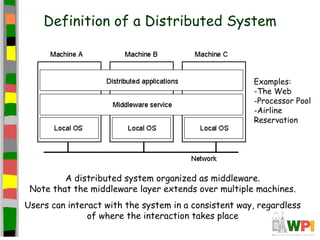
Definition of a Distributed System


                                                      Examples:
                                                      -The Web
                                                      -Processor Pool
                                                      -Airline
                                                      Reservation


         A distributed system organized as middleware.
 Note that the middleware layer extends over multiple machines.
Users can interact with the system in a consistent way, regardless
               of where the interaction takes place
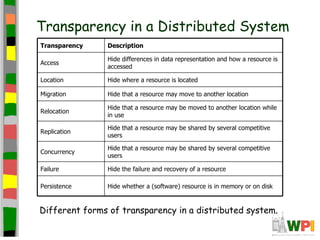
Transparency in a Distributed System
Transparency    Description

                Hide differences in data representation and how a resource is
Access
                accessed

Location        Hide where a resource is located

Migration       Hide that a resource may move to another location

                Hide that a resource may be moved to another location while
Relocation
                in use

                Hide that a resource may be shared by several competitive
Replication
                users

                Hide that a resource may be shared by several competitive
Concurrency
                users

Failure         Hide the failure and recovery of a resource

Persistence     Hide whether a (software) resource is in memory or on disk


Different forms of transparency in a distributed system.
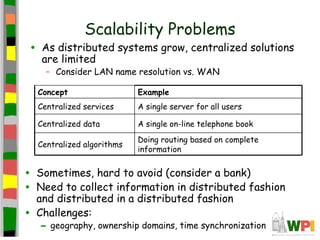
Scalability Problems
•    As distributed systems grow, centralized solutions
     are limited
      – Consider LAN name resolution vs. WAN

    Concept                  Example
    Centralized services     A single server for all users

    Centralized data         A single on-line telephone book
                             Doing routing based on complete
    Centralized algorithms
                             information


•   Sometimes, hard to avoid (consider a bank)
•   Need to collect information in distributed fashion
    and distributed in a distributed fashion
•   Challenges:
    –   geography, ownership domains, time synchronization
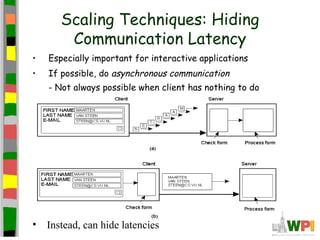
Scaling Techniques: Hiding
        Communication Latency
•   Especially important for interactive applications
•   If possible, do asynchronous communication
    - Not always possible when client has nothing to do


•   Instead, can hide latencies
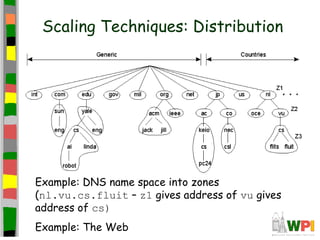
Scaling Techniques: Distribution


                   1.5


Example: DNS name space into zones
(nl.vu.cs.fluit – z1 gives address of vu gives
address of cs)
Example: The Web
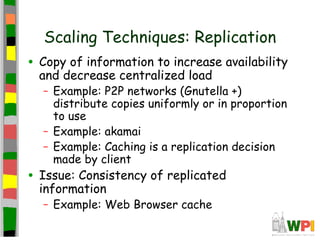
Scaling Techniques: Replication
• Copy of information to increase availability
  and decrease centralized load
  – Example: P2P networks (Gnutella +)
    distribute copies uniformly or in proportion
    to use
  – Example: akamai
  – Example: Caching is a replication decision
    made by client
• Issue: Consistency of replicated
  information
  – Example: Web Browser cache
Outline

• Overview          (done)
• Goals             (done)
• Software          ←
• Client Server
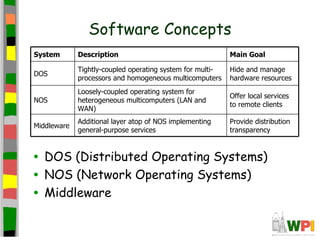
Software Concepts
System       Description                                   Main Goal

             Tightly-coupled operating system for multi-   Hide and manage
DOS
             processors and homogeneous multicomputers     hardware resources
             Loosely-coupled operating system for
                                                           Offer local services
NOS          heterogeneous multicomputers (LAN and
                                                           to remote clients
             WAN)
             Additional layer atop of NOS implementing     Provide distribution
Middleware
             general-purpose services                      transparency


• DOS (Distributed Operating Systems)
• NOS (Network Operating Systems)
• Middleware
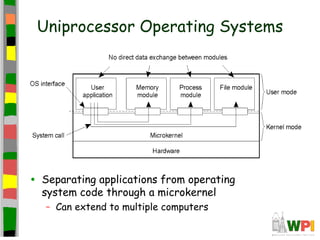
Uniprocessor Operating Systems


•   Separating applications from operating
    system code through a microkernel
     – Can extend to multiple computers
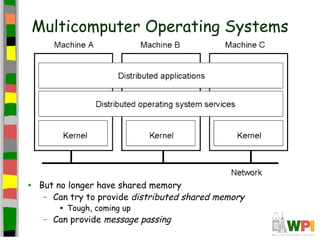
Multicomputer Operating Systems


•   But no longer have shared memory
     – Can try to provide distributed shared memory
        • Tough, coming up
    – Can provide message passing
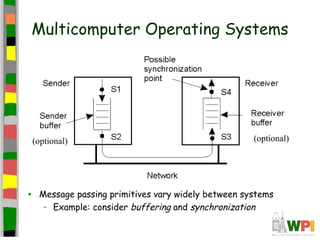
Multicomputer Operating Systems


    (optional)                                        (optional)


•    Message passing primitives vary widely between systems
      – Example: consider buffering and synchronization
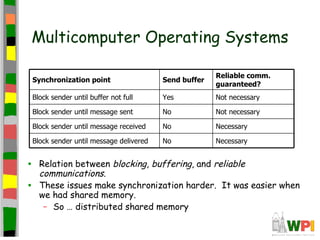
Multicomputer Operating Systems

                                                         Reliable comm.
    Synchronization point                  Send buffer
                                                         guaranteed?
    Block sender until buffer not full     Yes           Not necessary

    Block sender until message sent        No            Not necessary

    Block sender until message received    No            Necessary

    Block sender until message delivered   No            Necessary


•     Relation between blocking, buffering, and reliable
      communications.
•     These issues make synchronization harder. It was easier when
      we had shared memory.
       – So … distributed shared memory
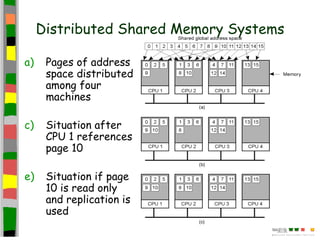
Distributed Shared Memory Systems

a)    Pages of address
      space distributed
      among four
      machines

c)    Situation after
      CPU 1 references
      page 10

e)    Situation if page
      10 is read only
      and replication is
      used
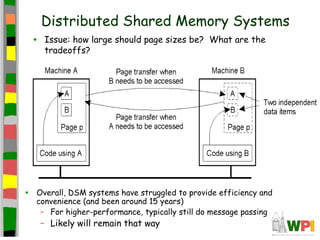
Distributed Shared Memory Systems
    •   Issue: how large should page sizes be? What are the
        tradeoffs?


•   Overall, DSM systems have struggled to provide efficiency and
    convenience (and been around 15 years)
     – For higher-performance, typically still do message passing
        – Likely will remain that way
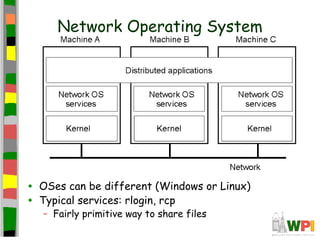
Network Operating System


•   OSes can be different (Windows or Linux)
•   Typical services: rlogin, rcp
    – Fairly primitive way to share files
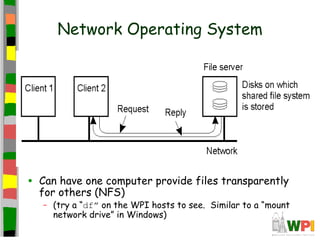
Network Operating System


•   Can have one computer provide files transparently
    for others (NFS)
    – (try a “df” on the WPI hosts to see. Similar to a “mount
      network drive” in Windows)
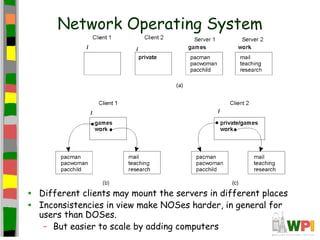
Network Operating System


•   Different clients may mount the servers in different places
•   Inconsistencies in view make NOSes harder, in general for
    users than DOSes.
     – But easier to scale by adding computers
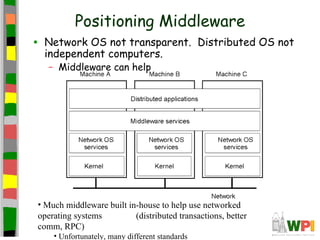
Positioning Middleware
•   Network OS not transparent. Distributed OS not
    independent computers.
    – Middleware can help


• Much middleware built in-house to help use networked
operating systems         (distributed transactions, better
comm, RPC)
     • Unfortunately, many different standards
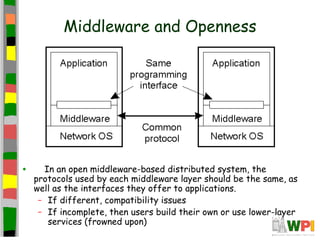
Middleware and Openness


                           1.23


•     In an open middleware-based distributed system, the
    protocols used by each middleware layer should be the same, as
    well as the interfaces they offer to applications.
     – If different, compatibility issues
     – If incomplete, then users build their own or use lower-layer
       services (frowned upon)
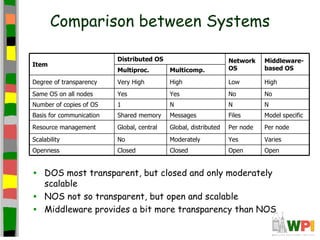
Comparison between Systems

                          Distributed OS                          Network    Middleware-
Item
                          Multiproc.        Multicomp.            OS         based OS

Degree of transparency    Very High         High                  Low        High
Same OS on all nodes      Yes               Yes                   No         No
Number of copies of OS    1                 N                     N          N
Basis for communication   Shared memory     Messages              Files      Model specific
Resource management       Global, central   Global, distributed   Per node   Per node
Scalability               No                Moderately            Yes        Varies
Openness                  Closed            Closed                Open       Open


•   DOS most transparent, but closed and only moderately
    scalable
•   NOS not so transparent, but open and scalable
•   Middleware provides a bit more transparency than NOS
Outline

• Overview          (done)
• Goals             (done)
• Software          (done)
• Client Server     ←
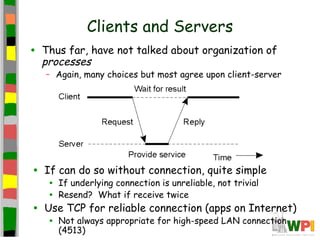
Clients and Servers
•   Thus far, have not talked about organization of
    processes
    – Again, many choices but most agree upon client-server


•   If can do so without connection, quite simple
     •   If underlying connection is unreliable, not trivial
     •   Resend? What if receive twice
•   Use TCP for reliable connection (apps on Internet)
     •   Not always appropriate for high-speed LAN connection
         (4513)
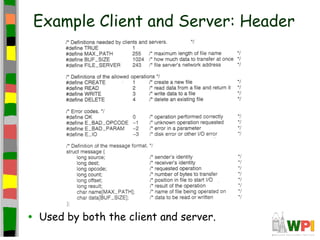
Example Client and Server: Header


•   Used by both the client and server.
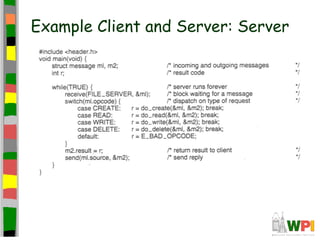
Example Client and Server: Server
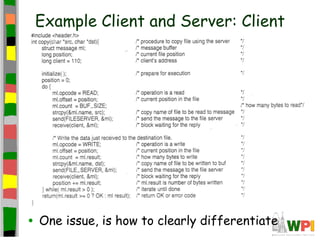
Example Client and Server: Client


• One issue, is how to clearly differentiate
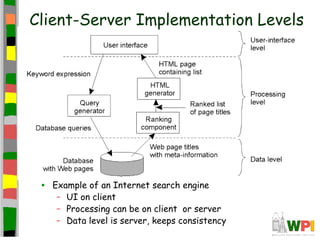
Client-Server Implementation Levels


 •   Example of an Internet search engine
      – UI on client
      – Processing can be on client or server
      – Data level is server, keeps consistency
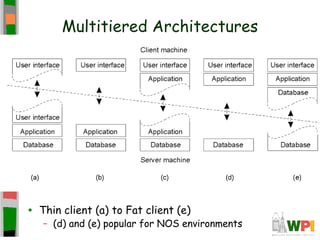
Multitiered Architectures


•   Thin client (a) to Fat client (e)
    – (d) and (e) popular for NOS environments
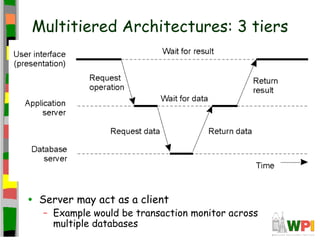
Multitiered Architectures: 3 tiers


•   Server may act as a client
    – Example would be transaction monitor across
      multiple databases
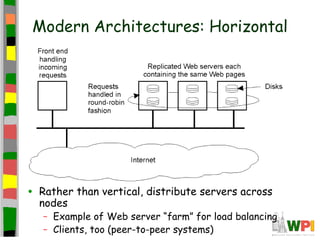
Modern Architectures: Horizontal


•   Rather than vertical, distribute servers across
    nodes
    – Example of Web server “farm” for load balancing
    – Clients, too (peer-to-peer systems)

Intro

  • 1.
    CS4513 Distributed Computer Systems Introduction (Ch 1: 1.1-1.2, 1.4-1.5)
  • 2.
    Outline • Overview • Goals •Software • Client Server
  • 3.
    The Rise ofDistributed Systems • Computer hardware prices falling, power increasing – If cars the same, Rolls Royce would cost 1 dollar and get 1 billion miles per gallon (with 200 page manual to open the door) • Network connectivity increasing – Everyone is connected with fat pipes • It is easy to connect hardware together • Definition: a distributed system is – A collection of independent computers that appears to its users as a single coherent system.
  • 4.
    Definition of aDistributed System Examples: -The Web -Processor Pool -Airline Reservation A distributed system organized as middleware. Note that the middleware layer extends over multiple machines. Users can interact with the system in a consistent way, regardless of where the interaction takes place
  • 5.
    Transparency in aDistributed System Transparency Description Hide differences in data representation and how a resource is Access accessed Location Hide where a resource is located Migration Hide that a resource may move to another location Hide that a resource may be moved to another location while Relocation in use Hide that a resource may be shared by several competitive Replication users Hide that a resource may be shared by several competitive Concurrency users Failure Hide the failure and recovery of a resource Persistence Hide whether a (software) resource is in memory or on disk Different forms of transparency in a distributed system.
  • 6.
    Scalability Problems • As distributed systems grow, centralized solutions are limited – Consider LAN name resolution vs. WAN Concept Example Centralized services A single server for all users Centralized data A single on-line telephone book Doing routing based on complete Centralized algorithms information • Sometimes, hard to avoid (consider a bank) • Need to collect information in distributed fashion and distributed in a distributed fashion • Challenges: – geography, ownership domains, time synchronization
  • 7.
    Scaling Techniques: Hiding Communication Latency • Especially important for interactive applications • If possible, do asynchronous communication - Not always possible when client has nothing to do • Instead, can hide latencies
  • 8.
    Scaling Techniques: Distribution 1.5 Example: DNS name space into zones (nl.vu.cs.fluit – z1 gives address of vu gives address of cs) Example: The Web
  • 9.
    Scaling Techniques: Replication •Copy of information to increase availability and decrease centralized load – Example: P2P networks (Gnutella +) distribute copies uniformly or in proportion to use – Example: akamai – Example: Caching is a replication decision made by client • Issue: Consistency of replicated information – Example: Web Browser cache
  • 10.
    Outline • Overview (done) • Goals (done) • Software ← • Client Server
  • 11.
    Software Concepts System Description Main Goal Tightly-coupled operating system for multi- Hide and manage DOS processors and homogeneous multicomputers hardware resources Loosely-coupled operating system for Offer local services NOS heterogeneous multicomputers (LAN and to remote clients WAN) Additional layer atop of NOS implementing Provide distribution Middleware general-purpose services transparency • DOS (Distributed Operating Systems) • NOS (Network Operating Systems) • Middleware
  • 12.
    Uniprocessor Operating Systems • Separating applications from operating system code through a microkernel – Can extend to multiple computers
  • 13.
    Multicomputer Operating Systems • But no longer have shared memory – Can try to provide distributed shared memory • Tough, coming up – Can provide message passing
  • 14.
    Multicomputer Operating Systems (optional) (optional) • Message passing primitives vary widely between systems – Example: consider buffering and synchronization
  • 15.
    Multicomputer Operating Systems Reliable comm. Synchronization point Send buffer guaranteed? Block sender until buffer not full Yes Not necessary Block sender until message sent No Not necessary Block sender until message received No Necessary Block sender until message delivered No Necessary • Relation between blocking, buffering, and reliable communications. • These issues make synchronization harder. It was easier when we had shared memory. – So … distributed shared memory
  • 16.
    Distributed Shared MemorySystems a) Pages of address space distributed among four machines c) Situation after CPU 1 references page 10 e) Situation if page 10 is read only and replication is used
  • 17.
    Distributed Shared MemorySystems • Issue: how large should page sizes be? What are the tradeoffs? • Overall, DSM systems have struggled to provide efficiency and convenience (and been around 15 years) – For higher-performance, typically still do message passing – Likely will remain that way
  • 18.
    Network Operating System • OSes can be different (Windows or Linux) • Typical services: rlogin, rcp – Fairly primitive way to share files
  • 19.
    Network Operating System • Can have one computer provide files transparently for others (NFS) – (try a “df” on the WPI hosts to see. Similar to a “mount network drive” in Windows)
  • 20.
    Network Operating System • Different clients may mount the servers in different places • Inconsistencies in view make NOSes harder, in general for users than DOSes. – But easier to scale by adding computers
  • 21.
    Positioning Middleware • Network OS not transparent. Distributed OS not independent computers. – Middleware can help • Much middleware built in-house to help use networked operating systems (distributed transactions, better comm, RPC) • Unfortunately, many different standards
  • 22.
    Middleware and Openness 1.23 • In an open middleware-based distributed system, the protocols used by each middleware layer should be the same, as well as the interfaces they offer to applications. – If different, compatibility issues – If incomplete, then users build their own or use lower-layer services (frowned upon)
  • 23.
    Comparison between Systems Distributed OS Network Middleware- Item Multiproc. Multicomp. OS based OS Degree of transparency Very High High Low High Same OS on all nodes Yes Yes No No Number of copies of OS 1 N N N Basis for communication Shared memory Messages Files Model specific Resource management Global, central Global, distributed Per node Per node Scalability No Moderately Yes Varies Openness Closed Closed Open Open • DOS most transparent, but closed and only moderately scalable • NOS not so transparent, but open and scalable • Middleware provides a bit more transparency than NOS
  • 24.
    Outline • Overview (done) • Goals (done) • Software (done) • Client Server ←
  • 25.
    Clients and Servers • Thus far, have not talked about organization of processes – Again, many choices but most agree upon client-server • If can do so without connection, quite simple • If underlying connection is unreliable, not trivial • Resend? What if receive twice • Use TCP for reliable connection (apps on Internet) • Not always appropriate for high-speed LAN connection (4513)
  • 26.
    Example Client andServer: Header • Used by both the client and server.
  • 27.
    Example Client andServer: Server
  • 28.
    Example Client andServer: Client • One issue, is how to clearly differentiate
  • 29.
    Client-Server Implementation Levels • Example of an Internet search engine – UI on client – Processing can be on client or server – Data level is server, keeps consistency
  • 30.
    Multitiered Architectures • Thin client (a) to Fat client (e) – (d) and (e) popular for NOS environments
  • 31.
    Multitiered Architectures: 3tiers • Server may act as a client – Example would be transaction monitor across multiple databases
  • 32.
    Modern Architectures: Horizontal • Rather than vertical, distribute servers across nodes – Example of Web server “farm” for load balancing – Clients, too (peer-to-peer systems)