Definition of a Distributed System (1)
A distributed system is:
A collection of independent
computers that appears to its users
as a single coherent system.
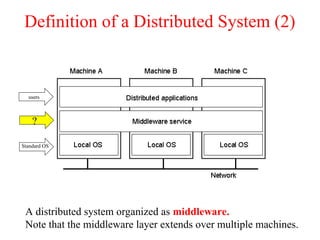
Definition of a Distributed System (2)
A distributed system organized as middleware.
Note that the middleware layer extends over multiple machines.
1.1
?
users
Standard OS
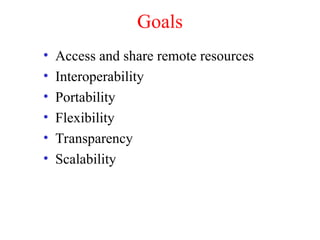
Goals
• Access and share remote resources
• Interoperability
• Portability
• Flexibility
• Transparency
• Scalability
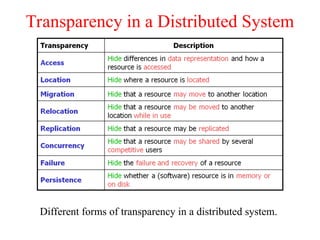
Transparency in a Distributed System
Different forms of transparency in a distributed system.
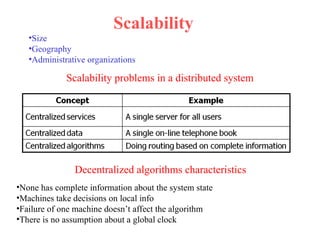
Scalability problems in a distributed system
Scalability
•Size
•Geography
•Administrative organizations
Decentralized algorithms characteristics
•None has complete information about the system state
•Machines take decisions on local info
•Failure of one machine doesn’t affect the algorithm
•There is no assumption about a global clock
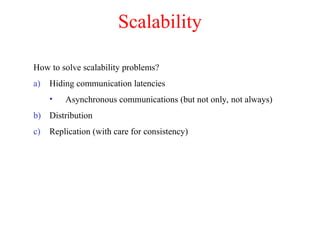
Scalability
How to solve scalability problems?
a) Hiding communication latencies
• Asynchronous communications (but not only, not always)
b) Distribution
c) Replication (with care for consistency)
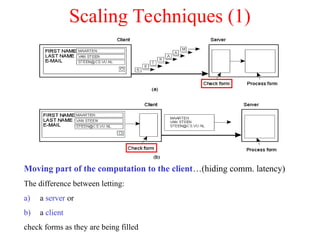
Scaling Techniques (1)
1.4
Moving part of the computation to the client…(hiding comm. latency)
The difference between letting:
a) a server or
b) a client
check forms as they are being filled
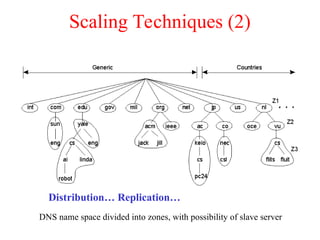
Scaling Techniques (2)
1.5
Distribution… Replication…
DNS name space divided into zones, with possibility of slave server
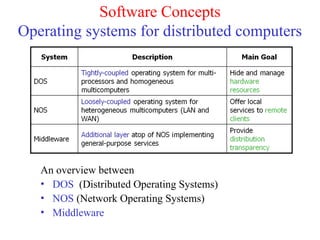
Software Concepts
Operating systems for distributed computers
An overview between
• DOS (Distributed Operating Systems)
• NOS (Network Operating Systems)
• Middleware
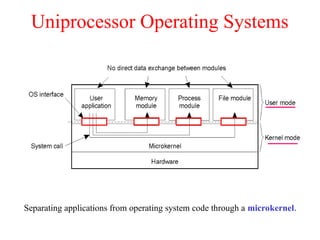
Uniprocessor Operating Systems
Separating applications from operating system code through a microkernel.
1.11
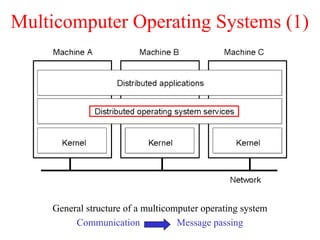
Multicomputer Operating Systems (1)
General structure of a multicomputer operating system
Communication Message passing
1.14
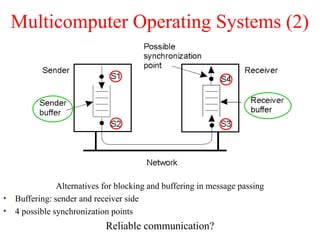
Multicomputer Operating Systems (2)
Alternatives for blocking and buffering in message passing
• Buffering: sender and receiver side
• 4 possible synchronization points
Reliable communication?
1.15
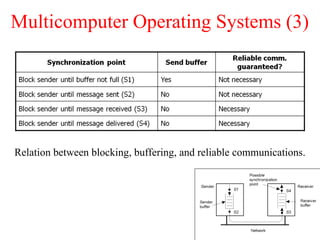
Multicomputer Operating Systems (3)
Relation between blocking, buffering, and reliable communications.
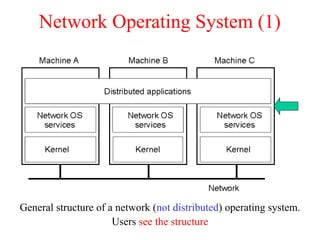
Network Operating System (1)
General structure of a network (not distributed) operating system.
Users see the structure
1-19
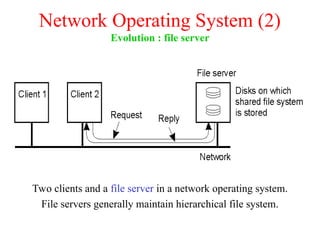
Network Operating System (2)
Evolution : file server
Two clients and a file server in a network operating system.
File servers generally maintain hierarchical file system.
1-20
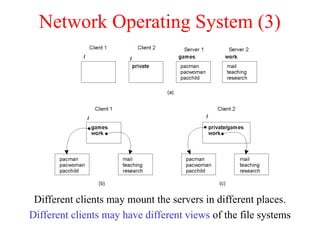
Network Operating System (3)
Different clients may mount the servers in different places.
Different clients may have different views of the file systems
1.21
With a basic network operating system we loose in
transparency
•Explicit remote login
•Independent accounting
•Independent access permission
•Low protection
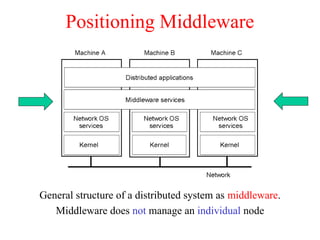
Positioning Middleware
General structure of a distributed system as middleware.
Middleware does not manage an individual node
1-22
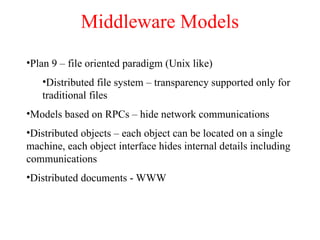
Middleware Models
•Plan 9 – file oriented paradigm (Unix like)
•Distributed file system – transparency supported only for
traditional files
•Models based on RPCs – hide network communications
•Distributed objects – each object can be located on a single
machine, each object interface hides internal details including
communications
•Distributed documents - WWW
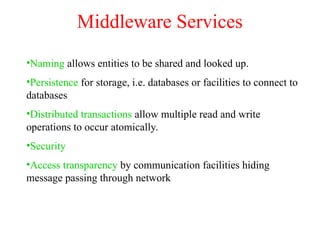
Middleware Services
•Naming allows entities to be shared and looked up.
•Persistence for storage, i.e. databases or facilities to connect to
databases
•Distributed transactions allow multiple read and write
operations to occur atomically.
•Security
•Access transparency by communication facilities hiding
message passing through network
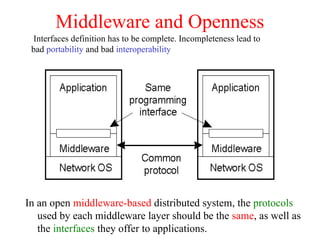
Middleware and Openness
In an open middleware-based distributed system, the protocols
used by each middleware layer should be the same, as well as
the interfaces they offer to applications.
1.23
Interfaces definition has to be complete. Incompleteness lead to
bad portability and bad interoperability
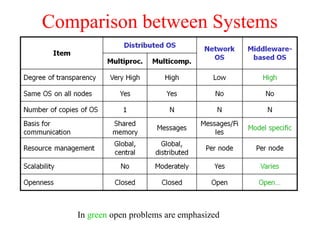
Comparison between Systems
In green open problems are emphasized
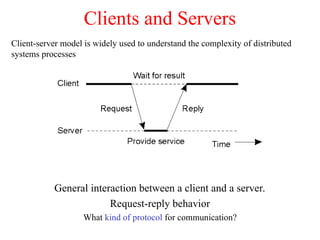
Clients and Servers
General interaction between a client and a server.
Request-reply behavior
What kind of protocol for communication?
1.25
Client-server model is widely used to understand the complexity of distributed
systems processes
Clients and Servers
• Connectionless protocol
– Efficient
– Not reliable
• Retransmission on “failure” can be dangerous
• Connection oriented protocol
– Lower performance
– reliable
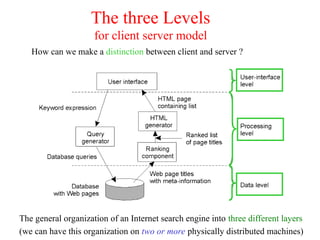
The three Levels
for client server model
The general organization of an Internet search engine into three different layers
(we can have this organization on two or more physically distributed machines)
1-28
How can we make a distinction between client and server ?
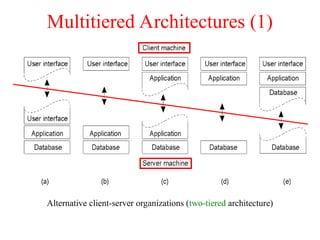
Multitiered Architectures (1)
Alternative client-server organizations (two-tiered architecture)
1-29
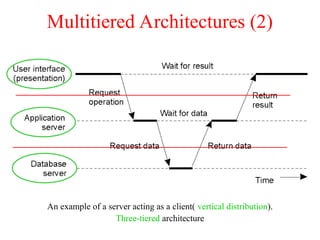
Multitiered Architectures (2)
An example of a server acting as a client( vertical distribution).
Three-tiered architecture
1-30
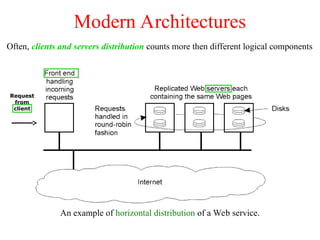
Modern Architectures
An example of horizontal distribution of a Web service.
1-31
Often, clients and servers distribution counts more then different logical components
Request
from
client

2-distri-intro nos mos.ppt Distributed systems Introduction

  • 1.
    Definition of aDistributed System (1) A distributed system is: A collection of independent computers that appears to its users as a single coherent system.
  • 2.
    Definition of aDistributed System (2) A distributed system organized as middleware. Note that the middleware layer extends over multiple machines. 1.1 ? users Standard OS
  • 3.
    Goals • Access andshare remote resources • Interoperability • Portability • Flexibility • Transparency • Scalability
  • 4.
    Transparency in aDistributed System Different forms of transparency in a distributed system.
  • 5.
    Scalability problems ina distributed system Scalability •Size •Geography •Administrative organizations Decentralized algorithms characteristics •None has complete information about the system state •Machines take decisions on local info •Failure of one machine doesn’t affect the algorithm •There is no assumption about a global clock
  • 6.
    Scalability How to solvescalability problems? a) Hiding communication latencies • Asynchronous communications (but not only, not always) b) Distribution c) Replication (with care for consistency)
  • 7.
    Scaling Techniques (1) 1.4 Movingpart of the computation to the client…(hiding comm. latency) The difference between letting: a) a server or b) a client check forms as they are being filled
  • 8.
    Scaling Techniques (2) 1.5 Distribution…Replication… DNS name space divided into zones, with possibility of slave server
  • 9.
    Software Concepts Operating systemsfor distributed computers An overview between • DOS (Distributed Operating Systems) • NOS (Network Operating Systems) • Middleware
  • 10.
    Uniprocessor Operating Systems Separatingapplications from operating system code through a microkernel. 1.11
  • 11.
    Multicomputer Operating Systems(1) General structure of a multicomputer operating system Communication Message passing 1.14
  • 12.
    Multicomputer Operating Systems(2) Alternatives for blocking and buffering in message passing • Buffering: sender and receiver side • 4 possible synchronization points Reliable communication? 1.15
  • 13.
    Multicomputer Operating Systems(3) Relation between blocking, buffering, and reliable communications.
  • 14.
    Network Operating System(1) General structure of a network (not distributed) operating system. Users see the structure 1-19
  • 15.
    Network Operating System(2) Evolution : file server Two clients and a file server in a network operating system. File servers generally maintain hierarchical file system. 1-20
  • 16.
    Network Operating System(3) Different clients may mount the servers in different places. Different clients may have different views of the file systems 1.21
  • 17.
    With a basicnetwork operating system we loose in transparency •Explicit remote login •Independent accounting •Independent access permission •Low protection
  • 18.
    Positioning Middleware General structureof a distributed system as middleware. Middleware does not manage an individual node 1-22
  • 19.
    Middleware Models •Plan 9– file oriented paradigm (Unix like) •Distributed file system – transparency supported only for traditional files •Models based on RPCs – hide network communications •Distributed objects – each object can be located on a single machine, each object interface hides internal details including communications •Distributed documents - WWW
  • 20.
    Middleware Services •Naming allowsentities to be shared and looked up. •Persistence for storage, i.e. databases or facilities to connect to databases •Distributed transactions allow multiple read and write operations to occur atomically. •Security •Access transparency by communication facilities hiding message passing through network
  • 21.
    Middleware and Openness Inan open middleware-based distributed system, the protocols used by each middleware layer should be the same, as well as the interfaces they offer to applications. 1.23 Interfaces definition has to be complete. Incompleteness lead to bad portability and bad interoperability
  • 22.
    Comparison between Systems Ingreen open problems are emphasized
  • 23.
    Clients and Servers Generalinteraction between a client and a server. Request-reply behavior What kind of protocol for communication? 1.25 Client-server model is widely used to understand the complexity of distributed systems processes
  • 24.
    Clients and Servers •Connectionless protocol – Efficient – Not reliable • Retransmission on “failure” can be dangerous • Connection oriented protocol – Lower performance – reliable
  • 25.
    The three Levels forclient server model The general organization of an Internet search engine into three different layers (we can have this organization on two or more physically distributed machines) 1-28 How can we make a distinction between client and server ?
  • 26.
    Multitiered Architectures (1) Alternativeclient-server organizations (two-tiered architecture) 1-29
  • 27.
    Multitiered Architectures (2) Anexample of a server acting as a client( vertical distribution). Three-tiered architecture 1-30
  • 28.
    Modern Architectures An exampleof horizontal distribution of a Web service. 1-31 Often, clients and servers distribution counts more then different logical components Request from client