A NOVEL APPROACH TO INTRA-STATION TRANSFERS BETWEEN
    LARGE CENTRIPETAL HABITATION WHEELS AND STATIONARY
                       UTILITY CORES

                                 Stephen A. Sywak, PE1

Abstract:
In previous studies of centripetally induced artificial gravity for use in orbital habitats
and other long-duration space facilities, large diameter rotating habitats are shown to
provide suitable living and working quarters for long-term missions in space.
One of the important practical issues typically missing from these discussions is the
need for a central, non-rotating hub for docking resupply and crew-exchange
vehicles. The issue is how to move equipment, supplies, and personnel between the
crew quarters and facilities on the habitat’s revolving rim and the docking and
loading platforms in the stationary core.
This presentation proposes a solution to this issue.

Introduction:
The idea of a large, revolving ring or wheel for long-term habitation in zero-gravity
space has been around probably as long as people have been thinking and writing
about space exploration (Noordung, 1929). A space asset this large presumes a
relatively large crew complement, with the attendant needs to support and supply that
crew. Recent discussions regarding the commercialization of space through space
tourism (Collins, 2000) also beg the question of how to move personnel and supplies
from a fixed docking location to the rotating portion of the habitat.
Presentations of tethered stations (Lansdorp, et. al., 2003; Gemini/Agena experiment,
1969), which rely on a counterweight on the opposite end of a large tether from the
habitat of interest (similar to the Argentinean “bola”), have failed to address any need
to access the crew quarters on a real-time basis. The rotation of the entire assembly
must be stopped before any crew or material exchange can be made. This may be an
acceptable risk (as regards tether stability) for short-duration, Low Earth Orbit
testing, but could pose substantial problems regarding both safety and energy
management if this approach were to be used for long duration or permanently
manned habitats.

1
 ASME Member; BSME, Washington University, St. Louis, MO; Senior Mechanical
Engineer, M. G. McLaren Engineering Group, 100 Snake Hill Rd; West Nyack, NY
10994; SSYWAK@MGMCLAREN.COM; Phone: (845) 353-6400 x350:
FAX: (845) 353-6509


                                            1
Even a recent student paper on an “Orbital Hilton” (Applebaum, et. al., 2002)
mentions a zero gravity hub as part of a ring-style station, but does not mention a
means of accessing that section of the station.
The film 2001: A Space Odyssey (Kubrik, Clark, Trumbull, 1968) provides the image
of a large, revolving, wheeled space station with a synchronously revolving hub, and
a manned vessel docking with this rotating target. As visually intriguing as this
imagery may be, the impracticality of docking to a constantly rotating target (Sywak,
1989) will need to be addressed if centripetally driven habitats are to be constructed.
This paper proposes a possible design solution, which consists of two steps: the first
step would be to counter-rotate the central utility core of the centripetally rotating
habitat, such that the center remains stationary with respect to an external, inertial
reference frame (such as an approaching vehicle in an Earth-orbit trajectory). The
second step would be to provide a means of crossing the gap between the rotating
wheel and the counter-rotating central core. The means of moving from the rotating
reference frame to the stationary one would be placed at a distance far enough from
the central axis to be relatively free of the unique rotational problems associated with
small-radius centripetal effects, and to allow sufficient flow of people and supplies
such that the transfer point does not become a bottle-neck, regarding either simple
logistics or personnel safety. In addition, future space station designs may require the
central core area to be reserved for storage, docking facilities, equipment rooms,
laboratories, or the transfer of power, data, air, or other utilities.

Selection of principal operating values:
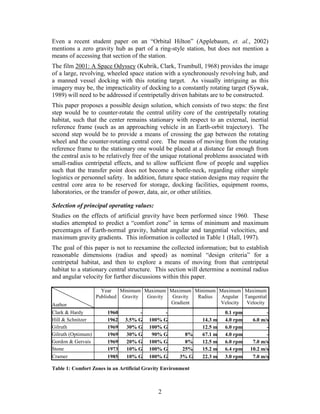
Studies on the effects of artificial gravity have been performed since 1960. These
studies attempted to predict a “comfort zone” in terms of minimum and maximum
percentages of Earth-normal gravity, habitat angular and tangential velocities, and
maximum gravity gradients. This information is collected in Table 1 (Hall, 1997).
The goal of this paper is not to reexamine the collected information; but to establish
reasonable dimensions (radius and speed) as nominal “design criteria” for a
centripetal habitat, and then to explore a means of moving from that centripetal
habitat to a stationary central structure. This section will determine a nominal radius
and angular velocity for further discussions within this paper.

                      Year    Minimum Maximum Maximum Minimum Maximum Maximum
                    Published Gravity  Gravity Gravity  Radius Angular Tangential
Author                                         Gradient        Velocity Velocity
Clark & Hardy           1960         -         -                       0.1 rpm          -
Hill & Schnitzer        1962   3.5% G    100% G               14.3 m   4.0 rpm    6.0 m/s
Gilruth                 1969   30% G     100% G               12.5 m   6.0 rpm          -
Gilruth (Optimum)       1969   30% G      90% G         8%    67.1 m   4.0 rpm          -
Gordon & Gervais        1969   20% G     100% G         8%    12.5 m   6.0 rpm    7.0 m/s
Stone                   1973   10% G     100% G        25%    15.2 m   6.4 rpm   10.2 m/s
Cramer                  1985   10% G     100% G       3% G    22.3 m   3.0 rpm    7.0 m/s

Table 1: Comfort Zones in an Artificial Gravity Environment


                                             2
Gravity Gradient is the difference in centripetal acceleration that a person would
experience between their head and their feet, due to their location at different radii.
The basic equation:    gradient = [w2Rf – w2(Rf-1m)]/ (w2Rf)
Solves as:             gradient = 1m / Rf
Or:                    Rf_min = 1m / gradient
(where “w” is angular velocity in radians/sec; Rf is the radial distance from the
habitat’s rotational axis to the floor surface, in meters)
With this in mind, an 8% gradient yields an Rf_min = 12.5m; a 25% gradient yields an
Rf_min = 4.0m. Cramer’s 3% G delta yields a 33.3m minimum floor radius for 1G
nominal habitats, For a 30% G nominal habitat, Cramer’s 3% G delta represents a
10% gradient, and therefore a 10.0m minimum floor radius.
The Maximum Angular Velocity of the habitat bears directly upon the likelihood of
inducing motion sickness in the occupants. This motion sickness is related to
gyroscopic coupling of normal head rotations of the occupants within the rotating
frame of reference of the centripetal habitat, as it affects the vestibular fluid within
their inner ears (Graybiel, 1975). Graybiel states that, “at 1.0 rpm even highly
susceptible subjects were [relatively] symptom-free. At 3.0 rpm subjects experienced
symptoms, but were not significantly handicapped. At 5.4 rpm, only subjects with
low susceptibility performed well and by the second day were almost free from
symptoms.” A two-day acclimation period for subjects with “low susceptibility”
would appear to place 5.4 rpm as an upper limit, with 3.0 rpm as a reasonable value.
Since Earth-based centrifuge testing naturally imposes a 1G reference, it cannot be
known if this reference adds an offset (physical or perceptual) to the test subject’s
sensitivity to the rotational cross-coupling effects. In addition, these tests dealt
primarily with acclimation, and not long-term health effects.
A maximum angular velocity of 3 rpm is therefore selected.
In general, the “comfortable” gravity range falls within 30% to 100% of Earth-normal
gravity. Hill & Schnitzer’s value of 3.5% G has been classified as more of a
mathematical limit than a true physical requirement (Hall, 1997). What none of the
previous estimates were able to determine, however, was the minimum value
acceptable for long-term health of the inhabitants (Czarnik, 1999). In the absence of
these additional data, and in light of the known value of a 1G environment, a value of
100% Earth-normal gravity is proposed.
The expression for centripetal acceleration is straightforward:
                       Acent = Rf* w2
Solving for Rf:        Rf = Acent/w2
Using the previously selected values, a floor radius of 99.41m is achieved.


                                           3
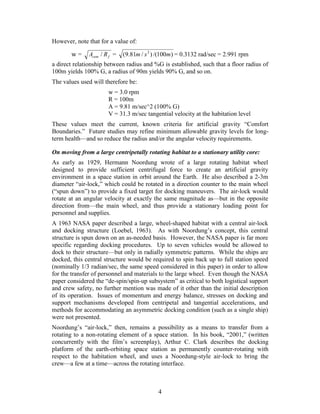
However, note that for a value of:

       w=     Acent / R f =   (9.81m / s 2 ) /(100m) = 0.3132 rad/sec = 2.991 rpm
a direct relationship between radius and %G is established, such that a floor radius of
100m yields 100% G, a radius of 90m yields 90% G, and so on.
The values used will therefore be:
                       w = 3.0 rpm
                       R = 100m
                       A = 9.81 m/sec^2 (100% G)
                       V = 31.3 m/sec tangential velocity at the habitation level
These values meet the current, known criteria for artificial gravity “Comfort
Boundaries.” Future studies may refine minimum allowable gravity levels for long-
term health—and so reduce the radius and/or the angular velocity requirements.

On moving from a large centripetally rotating habitat to a stationary utility core:
As early as 1929, Hermann Noordung wrote of a large rotating habitat wheel
designed to provide sufficient centrifugal force to create an artificial gravity
environment in a space station in orbit around the Earth. He also described a 2-3m
diameter “air-lock,” which could be rotated in a direction counter to the main wheel
(“spun down”) to provide a fixed target for docking maneuvers. The air-lock would
rotate at an angular velocity at exactly the same magnitude as—but in the opposite
direction from—the main wheel, and thus provide a stationary loading point for
personnel and supplies.
A 1963 NASA paper described a large, wheel-shaped habitat with a central air-lock
and docking structure (Loebel, 1963). As with Noordung’s concept, this central
structure is spun down on an as-needed basis. However, the NASA paper is far more
specific regarding docking procedures. Up to seven vehicles would be allowed to
dock to their structure—but only in radially symmetric patterns. While the ships are
docked, this central structure would be required to spin back up to full station speed
(nominally 1/3 radian/sec, the same speed considered in this paper) in order to allow
for the transfer of personnel and materials to the large wheel. Even though the NASA
paper considered the “de-spin/spin-up subsystem” as critical to both logistical support
and crew safety, no further mention was made of it other than the initial description
of its operation. Issues of momentum and energy balance, stresses on docking and
support mechanisms developed from centripetal and tangential accelerations, and
methods for accommodating an asymmetric docking condition (such as a single ship)
were not presented.
Noordung’s “air-lock,” then, remains a possibility as a means to transfer from a
rotating to a non-rotating element of a space station. In his book, “2001,” (written
concurrently with the film’s screenplay), Arthur C. Clark describes the docking
platform of the earth-orbiting space station as permanently counter-rotating with
respect to the habitation wheel, and uses a Noordung-style air-lock to bring the
crew—a few at a time—across the rotating interface.


                                            4
But suppose we need to transfer personnel and supplies at a radius roughly the same
as the living quarters? For the purposes of this paper, that would be at a radius of
100m from the central axis. As previously stated, the tangential velocity of a point
100m out and running at nominally 3.0 rpm would be 31.3m/sec (about 70 miles an
hour). The goal is to provide a design that will safely and repeatedly bring a payload
from 31.3m/sec to zero speed, and back again, on an as-needed basis. This design
should affect neither the speed of the centripetal wheel, nor the speed of the stationary
core. Additionally, the final design needs to consider energy/momentum balance, as
well as eccentric loads and their dynamic-balance issues.
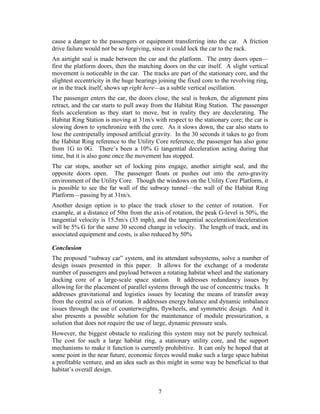
The concept presented incorporates a dedicated “Subway System” to move payloads
from rotating to stationary elements and back again (as shown in Figure 2). A special
subway car would run on a dedicated track at a given radius from the center of the
station. The track is built onto a concentric platform (“shelf”) extending from the
side of the stationary central core. Multiple cars can be provided by incorporating
more concentric tracks at lesser and greater radii, with one car per track. The wheels
of the cars are held to the track in the same manner as the track systems used for
roller coasters, since the cars are normally parked on the zero-G side of the space
station. Motive force for the cars would likely be from a linear-induction motor, with
the car providing its “rotor” field either from a series of permanent magnets, or a
wound coil. Friction drives are to be avoided, for reasons to be mentioned shortly.
Some combination of contact-conductor rails or inductive power transfer rails would
provide data and electrical power to the car.
Energy/momentum balance issues would be handled through the use of momentum
wheels in the stationary core of the station, or electromagnetic torquers, common to
many of today’s satellites.
Eccentric imbalance issues would be resolved through the use of shuttling
counterweights on adjacent tracks, servo-controlled to remain 180º opposed to the
active subway cars, or through the use of mechanical linkages tying a number of cars
together in a radially symmetric (and therefore balanced) pattern on a common track.
Access platforms to the car would exist on both the rotating and non-rotating sides of
the track. Sliding partition doors, similar to those found on the Japanese subway
system, would prevent people and materials from falling on to the track. The cars
themselves would possess their own sets of sliding doors. The cars would be fitted
with seats and seat belts, as well as cargo tie-down rails and related equipment.
Interior surfaces of the cars would be padded to accommodate the zero-G
environment when the cars are parked at the stationary core.
Alignment pins would extend from the edge of the platforms on command, and
engage receiving holes on the car when it was stationary against that particular
platform. The holes would be elongated vertically, to allow slight vertical dynamic
misalignment from any eccentricity in the local track or overall assembly of the space
station main elements.
The subway system might also be used to solve a problem not yet mentioned:
maintaining pressurization of the rotating and stationary sections of the space station.
Given a space station with rotating and non-rotating components, there is a choice of


                                           5
how to maintain pressurization within the habitable areas. Specifically: does the
interface between the rotating and stationary components maintain the atmospheric
pressure differential with respect to the vacuum of space (such as through the use of a
large sealing ring), or do the two components maintain their own atmospheric
pressures independent of each other? Assuming the latter, the subway system would
also perform the duty of an air-lock between the rotating and stationary components
of the space station. The cars would be independently pressurized, and the tunnels
they run in would be at vacuum. The platform doors and the subway car doors would
be built to withstand the 1 atmosphere differential, and a sealing/docking mechanism
would be built into the interface between the platforms and the subway cars.
                               Axis of Habitat Rotation

                                          "Subway Car"        Rotating Habitat

                                       Sliding Doors
                              Possible Air-Lock (typ.)


                                                                                                 (Not To Scale)
                                                                                                     100m
   Docking Occurs This Side


                                                                                                                  Effective Gravity Vector
                                                                                                                                             To Outside of Wheel
                                                                                 Hallway
                                                                                 Alignment Pin
                                                           Hallway               Carriage Wheels/Track

                                                                                     Linear Induction Motor
                                                          Stationary
                                                          Core                       Inductive Power/Data Transfer


Figure 1: Illustration of the "Subway System"
Method of Operation:
For the purpose of this discussion, a station occupant would start out in the 1G
Habitation Ring; the rotating part of the space station. Upon arriving at the “Subway
Station” area, he or she would press the call button for the car. Through the windows
in the platform door, and through windows to the left and right of the door along a
common wall, the far side of the space station can be seen moving past at about
31m/s (70mph). Every 20 seconds, the subway car—stationed at the far wall—
swings by. In 20-second vignettes, the subway car is seen to slow down from its
31m/s speed, until it has come to a full stop aligned with the nearby platform door.
The car hasn’t really slowed down, though: it has sped up from 0m/s to 31m/s in
about 30 seconds (roughly 10% G uniform tangential acceleration), until it has
synchronized with the rotating section of the station.
The alignment mechanism extends the locking pins into the receiver slots in the car.
These pins keep the car aligned to the entry door, with the tracks below moving by at
31m/s. With the locking pins engaged, a failure in the induction drive system will not


                                                                                 6
cause a danger to the passengers or equipment transferring into the car. A friction
drive failure would not be so forgiving, since it could lock the car to the rack.
An airtight seal is made between the car and the platform. The entry doors open—
first the platform doors, then the matching doors on the car itself. A slight vertical
movement is noticeable in the car. The tracks are part of the stationary core, and the
slightest eccentricity in the huge bearings joining the fixed core to the revolving ring,
or in the track itself, shows up right here—as a subtle vertical oscillation.
The passenger enters the car, the doors close, the seal is broken, the alignment pins
retract, and the car starts to pull away from the Habitat Ring Station. The passenger
feels acceleration as they start to move, but in reality they are decelerating. The
Habitat Ring Station is moving at 31m/s with respect to the stationary core; the car is
slowing down to synchronize with the core. As it slows down, the car also starts to
lose the centripetally imposed artificial gravity. In the 30 seconds it takes to go from
the Habitat Ring reference to the Utility Core reference, the passenger has also gone
from 1G to 0G. There’s been a 10% G tangential deceleration acting during that
time, but it is also gone once the movement has stopped.
The car stops, another set of locking pins engage, another airtight seal, and the
opposite doors open. The passenger floats or pushes out into the zero-gravity
environment of the Utility Core. Though the windows on the Utility Core Platform, it
is possible to see the far wall of the subway tunnel—the wall of the Habitat Ring
Platform—passing by at 31m/s.
Another design option is to place the track closer to the center of rotation. For
example, at a distance of 50m from the axis of rotation, the peak G-level is 50%, the
tangential velocity is 15.5m/s (35 mph), and the tangential acceleration/deceleration
will be 5% G for the same 30 second change in velocity. The length of track, and its
associated equipment and costs, is also reduced by 50%

Conclusion
The proposed “subway car” system, and its attendant subsystems, solve a number of
design issues presented in this paper. It allows for the exchange of a moderate
number of passengers and payload between a rotating habitat wheel and the stationary
docking core of a large-scale space station. It addresses redundancy issues by
allowing for the placement of parallel systems through the use of concentric tracks. It
addresses gravitational and logistics issues by locating the means of transfer away
from the central axis of rotation. It addresses energy balance and dynamic imbalance
issues through the use of counterweights, flywheels, and symmetric design. And it
also presents a possible solution for the maintenance of module pressurization, a
solution that does not require the use of large, dynamic pressure seals.
However, the biggest obstacle to realizing this system may not be purely technical.
The cost for such a large habitat ring, a stationary utility core, and the support
mechanisms to make it function is currently prohibitive. It can only be hoped that at
some point in the near future, economic forces would make such a large space habitat
a profitable venture, and an idea such as this might in some way be beneficial to that
habitat’s overall design.


                                           7
REFERENCES:
Applebaum, Mark; et. al. (2002). Orbital Hilton: Research, Feasibility Assessment,
    and      Design     of    a    Low-Earth-Orbit      Space     Hotel,    also    on
    http://www.ssoar.org/outreach/undergraduate/projects/project1/space-hotel/space-
    hotel.pdf
Clark, Arthur C.; Kubrik, Stanley; Trumbull, Douglas (1968). 2001: A Space
    Odyssey, MGM/UA
C.C. Clark and J.D. Hardy (1960). “Gravity Problems in Manned Space Stations”,
  Proceedings of the Manned Space Stations Symposium, Institute of the Aeronautical
  Sciences, p. 104-113
Collins, Patrick (2000). “Space Hotels—Civil Engineering’s New Fronteir” Advances
    in Civil Engineering IV, International Congress; also at: www.spacefuture.com
Cramer, D. Bryant. (1983) "Physiological Considerations of Artificial Gravity."
  Applications of Tethers in Space. NASA Scientific and Technical Information
  Branch, 1985. Conference Publication 2364, vol. 1, sec. 3, p. 95-107.
Czarnik, Tamarack R., MD (1999). Artificial Gravity: Current Concerns and Design
  Considerations, http://mars.complete-isp.com/aero2.htm
Gilruth, Robert R. (1969) "Manned Space Stations - Gateway to our Future in
  Space." Manned Laboratories in Space, Springer-Verlag, p. 1-10.
Gordon, Theodore J.; and Gervais, Robert L. "Critical Engineering Problems of
  Space Stations." Manned Laboratories in Space. Springer-Verlag, p. 11-32.
Graybiel, Ashton. (1975) "Some Physiological Effects of Alternation Between Zero
  Gravity and One Gravity." Space Manufacturing Facilities (Space Colonies):
  Proceedings of the Princeton /AIAA / NASA Conference, May 7-9, 1975. American
  Institute of Aeronautics and Astronautics, 1977, p. 137-149.
Hall, Theodore (1997). “Artificial Gravity and the Architecture of Orbital Habitats”,
  Proceedings of 1st International Symposium on Space Tourism; Daimler-Chrysler
  Aerospace; GmbH; also at www.spacefuture.com
Hill, Paul R.; and Schnitzer, Emanuel. (September, 1962) "Rotating Manned Space
  Stations." Astronautics, American Rocket Society, vol. 7, no. 9, p. 14-18.
Lansdorp, Bas; Kruijiff; Jan v.d. Heide, Erik (2003). The Need for Mars-g in LEO:
    Manned Antecedent for Reduced & Simulated Gravity, www.delta utec.com
                                                                     -
Loebel, Mitchell, (1963). “Stabilization and Control of a Rotating Space Station—A
  Total System Concept”, AIAA Guidance and Control Conference at MIT, Paper No.
  63-340, p 5-6.
Noordung, Hermann (Poto nik, Herman) (1929). The problem of Space Travel: The
    Rocket Motor, NASA History Series SP-4026, pp. 95-116.
Stone, Ralph W. (1970) "An Overview of Artificial Gravity." Fifth Symposium on
  the Role of the Vestibular Organs in Space Exploration. NASA Scientific and
  Technical Information Division, 1973. Special Publication 115, p. 23-33.
Sywak, Stephen (1989). Personal observations during testing of the Satellite Retrieval
    System on the Orbital Maneuvering Vehicle mock-up at the Large Amplitude
    Space Simulator at Grumman, Bethpage, NY.


                                          8

Intra ~3

  • 1.
    A NOVEL APPROACHTO INTRA-STATION TRANSFERS BETWEEN LARGE CENTRIPETAL HABITATION WHEELS AND STATIONARY UTILITY CORES Stephen A. Sywak, PE1 Abstract: In previous studies of centripetally induced artificial gravity for use in orbital habitats and other long-duration space facilities, large diameter rotating habitats are shown to provide suitable living and working quarters for long-term missions in space. One of the important practical issues typically missing from these discussions is the need for a central, non-rotating hub for docking resupply and crew-exchange vehicles. The issue is how to move equipment, supplies, and personnel between the crew quarters and facilities on the habitat’s revolving rim and the docking and loading platforms in the stationary core. This presentation proposes a solution to this issue. Introduction: The idea of a large, revolving ring or wheel for long-term habitation in zero-gravity space has been around probably as long as people have been thinking and writing about space exploration (Noordung, 1929). A space asset this large presumes a relatively large crew complement, with the attendant needs to support and supply that crew. Recent discussions regarding the commercialization of space through space tourism (Collins, 2000) also beg the question of how to move personnel and supplies from a fixed docking location to the rotating portion of the habitat. Presentations of tethered stations (Lansdorp, et. al., 2003; Gemini/Agena experiment, 1969), which rely on a counterweight on the opposite end of a large tether from the habitat of interest (similar to the Argentinean “bola”), have failed to address any need to access the crew quarters on a real-time basis. The rotation of the entire assembly must be stopped before any crew or material exchange can be made. This may be an acceptable risk (as regards tether stability) for short-duration, Low Earth Orbit testing, but could pose substantial problems regarding both safety and energy management if this approach were to be used for long duration or permanently manned habitats. 1 ASME Member; BSME, Washington University, St. Louis, MO; Senior Mechanical Engineer, M. G. McLaren Engineering Group, 100 Snake Hill Rd; West Nyack, NY 10994; SSYWAK@MGMCLAREN.COM; Phone: (845) 353-6400 x350: FAX: (845) 353-6509 1
  • 2.
    Even a recentstudent paper on an “Orbital Hilton” (Applebaum, et. al., 2002) mentions a zero gravity hub as part of a ring-style station, but does not mention a means of accessing that section of the station. The film 2001: A Space Odyssey (Kubrik, Clark, Trumbull, 1968) provides the image of a large, revolving, wheeled space station with a synchronously revolving hub, and a manned vessel docking with this rotating target. As visually intriguing as this imagery may be, the impracticality of docking to a constantly rotating target (Sywak, 1989) will need to be addressed if centripetally driven habitats are to be constructed. This paper proposes a possible design solution, which consists of two steps: the first step would be to counter-rotate the central utility core of the centripetally rotating habitat, such that the center remains stationary with respect to an external, inertial reference frame (such as an approaching vehicle in an Earth-orbit trajectory). The second step would be to provide a means of crossing the gap between the rotating wheel and the counter-rotating central core. The means of moving from the rotating reference frame to the stationary one would be placed at a distance far enough from the central axis to be relatively free of the unique rotational problems associated with small-radius centripetal effects, and to allow sufficient flow of people and supplies such that the transfer point does not become a bottle-neck, regarding either simple logistics or personnel safety. In addition, future space station designs may require the central core area to be reserved for storage, docking facilities, equipment rooms, laboratories, or the transfer of power, data, air, or other utilities. Selection of principal operating values: Studies on the effects of artificial gravity have been performed since 1960. These studies attempted to predict a “comfort zone” in terms of minimum and maximum percentages of Earth-normal gravity, habitat angular and tangential velocities, and maximum gravity gradients. This information is collected in Table 1 (Hall, 1997). The goal of this paper is not to reexamine the collected information; but to establish reasonable dimensions (radius and speed) as nominal “design criteria” for a centripetal habitat, and then to explore a means of moving from that centripetal habitat to a stationary central structure. This section will determine a nominal radius and angular velocity for further discussions within this paper. Year Minimum Maximum Maximum Minimum Maximum Maximum Published Gravity Gravity Gravity Radius Angular Tangential Author Gradient Velocity Velocity Clark & Hardy 1960 - - 0.1 rpm - Hill & Schnitzer 1962 3.5% G 100% G 14.3 m 4.0 rpm 6.0 m/s Gilruth 1969 30% G 100% G 12.5 m 6.0 rpm - Gilruth (Optimum) 1969 30% G 90% G 8% 67.1 m 4.0 rpm - Gordon & Gervais 1969 20% G 100% G 8% 12.5 m 6.0 rpm 7.0 m/s Stone 1973 10% G 100% G 25% 15.2 m 6.4 rpm 10.2 m/s Cramer 1985 10% G 100% G 3% G 22.3 m 3.0 rpm 7.0 m/s Table 1: Comfort Zones in an Artificial Gravity Environment 2
  • 3.
    Gravity Gradient isthe difference in centripetal acceleration that a person would experience between their head and their feet, due to their location at different radii. The basic equation: gradient = [w2Rf – w2(Rf-1m)]/ (w2Rf) Solves as: gradient = 1m / Rf Or: Rf_min = 1m / gradient (where “w” is angular velocity in radians/sec; Rf is the radial distance from the habitat’s rotational axis to the floor surface, in meters) With this in mind, an 8% gradient yields an Rf_min = 12.5m; a 25% gradient yields an Rf_min = 4.0m. Cramer’s 3% G delta yields a 33.3m minimum floor radius for 1G nominal habitats, For a 30% G nominal habitat, Cramer’s 3% G delta represents a 10% gradient, and therefore a 10.0m minimum floor radius. The Maximum Angular Velocity of the habitat bears directly upon the likelihood of inducing motion sickness in the occupants. This motion sickness is related to gyroscopic coupling of normal head rotations of the occupants within the rotating frame of reference of the centripetal habitat, as it affects the vestibular fluid within their inner ears (Graybiel, 1975). Graybiel states that, “at 1.0 rpm even highly susceptible subjects were [relatively] symptom-free. At 3.0 rpm subjects experienced symptoms, but were not significantly handicapped. At 5.4 rpm, only subjects with low susceptibility performed well and by the second day were almost free from symptoms.” A two-day acclimation period for subjects with “low susceptibility” would appear to place 5.4 rpm as an upper limit, with 3.0 rpm as a reasonable value. Since Earth-based centrifuge testing naturally imposes a 1G reference, it cannot be known if this reference adds an offset (physical or perceptual) to the test subject’s sensitivity to the rotational cross-coupling effects. In addition, these tests dealt primarily with acclimation, and not long-term health effects. A maximum angular velocity of 3 rpm is therefore selected. In general, the “comfortable” gravity range falls within 30% to 100% of Earth-normal gravity. Hill & Schnitzer’s value of 3.5% G has been classified as more of a mathematical limit than a true physical requirement (Hall, 1997). What none of the previous estimates were able to determine, however, was the minimum value acceptable for long-term health of the inhabitants (Czarnik, 1999). In the absence of these additional data, and in light of the known value of a 1G environment, a value of 100% Earth-normal gravity is proposed. The expression for centripetal acceleration is straightforward: Acent = Rf* w2 Solving for Rf: Rf = Acent/w2 Using the previously selected values, a floor radius of 99.41m is achieved. 3
  • 4.
    However, note thatfor a value of: w= Acent / R f = (9.81m / s 2 ) /(100m) = 0.3132 rad/sec = 2.991 rpm a direct relationship between radius and %G is established, such that a floor radius of 100m yields 100% G, a radius of 90m yields 90% G, and so on. The values used will therefore be: w = 3.0 rpm R = 100m A = 9.81 m/sec^2 (100% G) V = 31.3 m/sec tangential velocity at the habitation level These values meet the current, known criteria for artificial gravity “Comfort Boundaries.” Future studies may refine minimum allowable gravity levels for long- term health—and so reduce the radius and/or the angular velocity requirements. On moving from a large centripetally rotating habitat to a stationary utility core: As early as 1929, Hermann Noordung wrote of a large rotating habitat wheel designed to provide sufficient centrifugal force to create an artificial gravity environment in a space station in orbit around the Earth. He also described a 2-3m diameter “air-lock,” which could be rotated in a direction counter to the main wheel (“spun down”) to provide a fixed target for docking maneuvers. The air-lock would rotate at an angular velocity at exactly the same magnitude as—but in the opposite direction from—the main wheel, and thus provide a stationary loading point for personnel and supplies. A 1963 NASA paper described a large, wheel-shaped habitat with a central air-lock and docking structure (Loebel, 1963). As with Noordung’s concept, this central structure is spun down on an as-needed basis. However, the NASA paper is far more specific regarding docking procedures. Up to seven vehicles would be allowed to dock to their structure—but only in radially symmetric patterns. While the ships are docked, this central structure would be required to spin back up to full station speed (nominally 1/3 radian/sec, the same speed considered in this paper) in order to allow for the transfer of personnel and materials to the large wheel. Even though the NASA paper considered the “de-spin/spin-up subsystem” as critical to both logistical support and crew safety, no further mention was made of it other than the initial description of its operation. Issues of momentum and energy balance, stresses on docking and support mechanisms developed from centripetal and tangential accelerations, and methods for accommodating an asymmetric docking condition (such as a single ship) were not presented. Noordung’s “air-lock,” then, remains a possibility as a means to transfer from a rotating to a non-rotating element of a space station. In his book, “2001,” (written concurrently with the film’s screenplay), Arthur C. Clark describes the docking platform of the earth-orbiting space station as permanently counter-rotating with respect to the habitation wheel, and uses a Noordung-style air-lock to bring the crew—a few at a time—across the rotating interface. 4
  • 5.
    But suppose weneed to transfer personnel and supplies at a radius roughly the same as the living quarters? For the purposes of this paper, that would be at a radius of 100m from the central axis. As previously stated, the tangential velocity of a point 100m out and running at nominally 3.0 rpm would be 31.3m/sec (about 70 miles an hour). The goal is to provide a design that will safely and repeatedly bring a payload from 31.3m/sec to zero speed, and back again, on an as-needed basis. This design should affect neither the speed of the centripetal wheel, nor the speed of the stationary core. Additionally, the final design needs to consider energy/momentum balance, as well as eccentric loads and their dynamic-balance issues. The concept presented incorporates a dedicated “Subway System” to move payloads from rotating to stationary elements and back again (as shown in Figure 2). A special subway car would run on a dedicated track at a given radius from the center of the station. The track is built onto a concentric platform (“shelf”) extending from the side of the stationary central core. Multiple cars can be provided by incorporating more concentric tracks at lesser and greater radii, with one car per track. The wheels of the cars are held to the track in the same manner as the track systems used for roller coasters, since the cars are normally parked on the zero-G side of the space station. Motive force for the cars would likely be from a linear-induction motor, with the car providing its “rotor” field either from a series of permanent magnets, or a wound coil. Friction drives are to be avoided, for reasons to be mentioned shortly. Some combination of contact-conductor rails or inductive power transfer rails would provide data and electrical power to the car. Energy/momentum balance issues would be handled through the use of momentum wheels in the stationary core of the station, or electromagnetic torquers, common to many of today’s satellites. Eccentric imbalance issues would be resolved through the use of shuttling counterweights on adjacent tracks, servo-controlled to remain 180º opposed to the active subway cars, or through the use of mechanical linkages tying a number of cars together in a radially symmetric (and therefore balanced) pattern on a common track. Access platforms to the car would exist on both the rotating and non-rotating sides of the track. Sliding partition doors, similar to those found on the Japanese subway system, would prevent people and materials from falling on to the track. The cars themselves would possess their own sets of sliding doors. The cars would be fitted with seats and seat belts, as well as cargo tie-down rails and related equipment. Interior surfaces of the cars would be padded to accommodate the zero-G environment when the cars are parked at the stationary core. Alignment pins would extend from the edge of the platforms on command, and engage receiving holes on the car when it was stationary against that particular platform. The holes would be elongated vertically, to allow slight vertical dynamic misalignment from any eccentricity in the local track or overall assembly of the space station main elements. The subway system might also be used to solve a problem not yet mentioned: maintaining pressurization of the rotating and stationary sections of the space station. Given a space station with rotating and non-rotating components, there is a choice of 5
  • 6.
    how to maintainpressurization within the habitable areas. Specifically: does the interface between the rotating and stationary components maintain the atmospheric pressure differential with respect to the vacuum of space (such as through the use of a large sealing ring), or do the two components maintain their own atmospheric pressures independent of each other? Assuming the latter, the subway system would also perform the duty of an air-lock between the rotating and stationary components of the space station. The cars would be independently pressurized, and the tunnels they run in would be at vacuum. The platform doors and the subway car doors would be built to withstand the 1 atmosphere differential, and a sealing/docking mechanism would be built into the interface between the platforms and the subway cars. Axis of Habitat Rotation "Subway Car" Rotating Habitat Sliding Doors Possible Air-Lock (typ.) (Not To Scale) 100m Docking Occurs This Side Effective Gravity Vector To Outside of Wheel Hallway Alignment Pin Hallway Carriage Wheels/Track Linear Induction Motor Stationary Core Inductive Power/Data Transfer Figure 1: Illustration of the "Subway System" Method of Operation: For the purpose of this discussion, a station occupant would start out in the 1G Habitation Ring; the rotating part of the space station. Upon arriving at the “Subway Station” area, he or she would press the call button for the car. Through the windows in the platform door, and through windows to the left and right of the door along a common wall, the far side of the space station can be seen moving past at about 31m/s (70mph). Every 20 seconds, the subway car—stationed at the far wall— swings by. In 20-second vignettes, the subway car is seen to slow down from its 31m/s speed, until it has come to a full stop aligned with the nearby platform door. The car hasn’t really slowed down, though: it has sped up from 0m/s to 31m/s in about 30 seconds (roughly 10% G uniform tangential acceleration), until it has synchronized with the rotating section of the station. The alignment mechanism extends the locking pins into the receiver slots in the car. These pins keep the car aligned to the entry door, with the tracks below moving by at 31m/s. With the locking pins engaged, a failure in the induction drive system will not 6
  • 7.
    cause a dangerto the passengers or equipment transferring into the car. A friction drive failure would not be so forgiving, since it could lock the car to the rack. An airtight seal is made between the car and the platform. The entry doors open— first the platform doors, then the matching doors on the car itself. A slight vertical movement is noticeable in the car. The tracks are part of the stationary core, and the slightest eccentricity in the huge bearings joining the fixed core to the revolving ring, or in the track itself, shows up right here—as a subtle vertical oscillation. The passenger enters the car, the doors close, the seal is broken, the alignment pins retract, and the car starts to pull away from the Habitat Ring Station. The passenger feels acceleration as they start to move, but in reality they are decelerating. The Habitat Ring Station is moving at 31m/s with respect to the stationary core; the car is slowing down to synchronize with the core. As it slows down, the car also starts to lose the centripetally imposed artificial gravity. In the 30 seconds it takes to go from the Habitat Ring reference to the Utility Core reference, the passenger has also gone from 1G to 0G. There’s been a 10% G tangential deceleration acting during that time, but it is also gone once the movement has stopped. The car stops, another set of locking pins engage, another airtight seal, and the opposite doors open. The passenger floats or pushes out into the zero-gravity environment of the Utility Core. Though the windows on the Utility Core Platform, it is possible to see the far wall of the subway tunnel—the wall of the Habitat Ring Platform—passing by at 31m/s. Another design option is to place the track closer to the center of rotation. For example, at a distance of 50m from the axis of rotation, the peak G-level is 50%, the tangential velocity is 15.5m/s (35 mph), and the tangential acceleration/deceleration will be 5% G for the same 30 second change in velocity. The length of track, and its associated equipment and costs, is also reduced by 50% Conclusion The proposed “subway car” system, and its attendant subsystems, solve a number of design issues presented in this paper. It allows for the exchange of a moderate number of passengers and payload between a rotating habitat wheel and the stationary docking core of a large-scale space station. It addresses redundancy issues by allowing for the placement of parallel systems through the use of concentric tracks. It addresses gravitational and logistics issues by locating the means of transfer away from the central axis of rotation. It addresses energy balance and dynamic imbalance issues through the use of counterweights, flywheels, and symmetric design. And it also presents a possible solution for the maintenance of module pressurization, a solution that does not require the use of large, dynamic pressure seals. However, the biggest obstacle to realizing this system may not be purely technical. The cost for such a large habitat ring, a stationary utility core, and the support mechanisms to make it function is currently prohibitive. It can only be hoped that at some point in the near future, economic forces would make such a large space habitat a profitable venture, and an idea such as this might in some way be beneficial to that habitat’s overall design. 7
  • 8.
    REFERENCES: Applebaum, Mark; et.al. (2002). Orbital Hilton: Research, Feasibility Assessment, and Design of a Low-Earth-Orbit Space Hotel, also on http://www.ssoar.org/outreach/undergraduate/projects/project1/space-hotel/space- hotel.pdf Clark, Arthur C.; Kubrik, Stanley; Trumbull, Douglas (1968). 2001: A Space Odyssey, MGM/UA C.C. Clark and J.D. Hardy (1960). “Gravity Problems in Manned Space Stations”, Proceedings of the Manned Space Stations Symposium, Institute of the Aeronautical Sciences, p. 104-113 Collins, Patrick (2000). “Space Hotels—Civil Engineering’s New Fronteir” Advances in Civil Engineering IV, International Congress; also at: www.spacefuture.com Cramer, D. Bryant. (1983) "Physiological Considerations of Artificial Gravity." Applications of Tethers in Space. NASA Scientific and Technical Information Branch, 1985. Conference Publication 2364, vol. 1, sec. 3, p. 95-107. Czarnik, Tamarack R., MD (1999). Artificial Gravity: Current Concerns and Design Considerations, http://mars.complete-isp.com/aero2.htm Gilruth, Robert R. (1969) "Manned Space Stations - Gateway to our Future in Space." Manned Laboratories in Space, Springer-Verlag, p. 1-10. Gordon, Theodore J.; and Gervais, Robert L. "Critical Engineering Problems of Space Stations." Manned Laboratories in Space. Springer-Verlag, p. 11-32. Graybiel, Ashton. (1975) "Some Physiological Effects of Alternation Between Zero Gravity and One Gravity." Space Manufacturing Facilities (Space Colonies): Proceedings of the Princeton /AIAA / NASA Conference, May 7-9, 1975. American Institute of Aeronautics and Astronautics, 1977, p. 137-149. Hall, Theodore (1997). “Artificial Gravity and the Architecture of Orbital Habitats”, Proceedings of 1st International Symposium on Space Tourism; Daimler-Chrysler Aerospace; GmbH; also at www.spacefuture.com Hill, Paul R.; and Schnitzer, Emanuel. (September, 1962) "Rotating Manned Space Stations." Astronautics, American Rocket Society, vol. 7, no. 9, p. 14-18. Lansdorp, Bas; Kruijiff; Jan v.d. Heide, Erik (2003). The Need for Mars-g in LEO: Manned Antecedent for Reduced & Simulated Gravity, www.delta utec.com - Loebel, Mitchell, (1963). “Stabilization and Control of a Rotating Space Station—A Total System Concept”, AIAA Guidance and Control Conference at MIT, Paper No. 63-340, p 5-6. Noordung, Hermann (Poto nik, Herman) (1929). The problem of Space Travel: The Rocket Motor, NASA History Series SP-4026, pp. 95-116. Stone, Ralph W. (1970) "An Overview of Artificial Gravity." Fifth Symposium on the Role of the Vestibular Organs in Space Exploration. NASA Scientific and Technical Information Division, 1973. Special Publication 115, p. 23-33. Sywak, Stephen (1989). Personal observations during testing of the Satellite Retrieval System on the Orbital Maneuvering Vehicle mock-up at the Large Amplitude Space Simulator at Grumman, Bethpage, NY. 8