


Josefino Tulabing Larena ,MPA
Introduction to Tourism
Learning Objectives
 Understand what tourism is and its many
definitions.
 Learn the component of tourism and tourism
management.
 Knows the benefits and costs of tourism
Introduction
 Tourism is the leader in the production of new
jobs.
 Tourism has developed an important part of
the economic foundation of many countries.
 Growth rate of services sector faster than any
other.
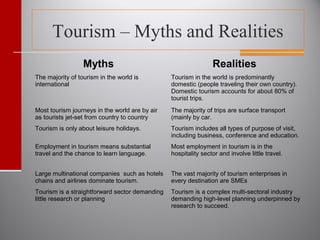
Tourism – Myths and Realities
Myths Realities
The majority of tourism in the world is
international
Tourism in the world is predominantly
domestic (people traveling their own country).
Domestic tourism accounts for about 80% of
tourist trips.
Most tourism journeys in the world are by air
as tourists jet-set from country to country
The majority of trips are surface transport
(mainly by car.
Tourism is only about leisure holidays. Tourism includes all types of purpose of visit,
including business, conference and education.
Employment in tourism means substantial
travel and the chance to learn language.
Most employment in tourism is in the
hospitality sector and involve little travel.
Large multinational companies such as hotels
chains and airlines dominate tourism.
The vast majority of tourism enterprises in
every destination are SMEs
Tourism is a straightforward sector demanding
little research or planning
Tourism is a complex multi-sectoral industry
demanding high-level planning underpinned by
research to succeed.
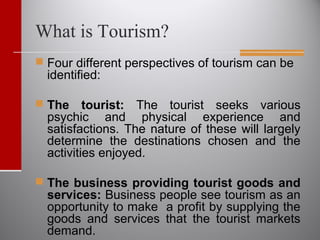
What is Tourism?
 Four different perspectives of tourism can be
identified:
 The tourist: The tourist seeks various
psychic and physical experience and
satisfactions. The nature of these will largely
determine the destinations chosen and the
activities enjoyed.
 The business providing tourist goods and
services: Business people see tourism as an
opportunity to make a profit by supplying the
goods and services that the tourist markets
demand.
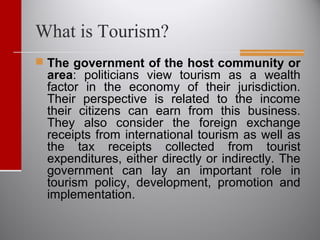
What is Tourism?
 The government of the host community or
area: politicians view tourism as a wealth
factor in the economy of their jurisdiction.
Their perspective is related to the income
their citizens can earn from this business.
They also consider the foreign exchange
receipts from international tourism as well as
the tax receipts collected from tourist
expenditures, either directly or indirectly. The
government can lay an important role in
tourism policy, development, promotion and
implementation.
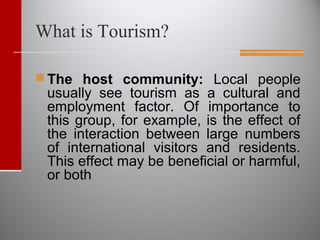
What is Tourism?
 The host community: Local people
usually see tourism as a cultural and
employment factor. Of importance to
this group, for example, is the effect of
the interaction between large numbers
of international visitors and residents.
This effect may be beneficial or harmful,
or both
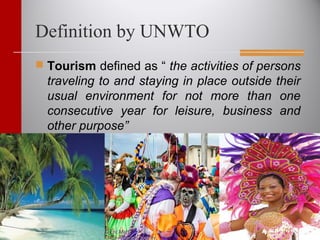
Definition by UNWTO
 Tourism defined as “ the activities of persons
traveling to and staying in place outside their
usual environment for not more than one
consecutive year for leisure, business and
other purpose”
Tourism Category
 Tourism can be divided by four category:
1. International tourism
1. Inbound tourism: Visits to a country by nonresidents
2. Outbound tourism: Visits by residents of a country to
another country
2. Internal tourism : Visits by resident and non
residents of the country of reference
3. Domestic tourism : Visits by residents of a country
to their own country
4. National tourism : Internal tourism plus outbound
tourism
Traveler Terminology for Tourism.
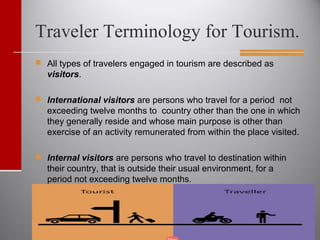
 All types of travelers engaged in tourism are described as
visitors.
 International visitors are persons who travel for a period not
exceeding twelve months to country other than the one in which
they generally reside and whose main purpose is other than
exercise of an activity remunerated from within the place visited.
 Internal visitors are persons who travel to destination within
their country, that is outside their usual environment, for a
period not exceeding twelve months.
Traveler Terminology for Tourism
 All travelers are subdivided into two further
categories:
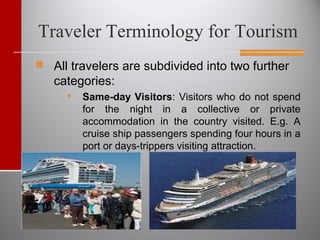
 Same-day Visitors: Visitors who do not spend
for the night in a collective or private
accommodation in the country visited. E.g. A
cruise ship passengers spending four hours in a
port or days-trippers visiting attraction.
Traveler Terminology for Tourism
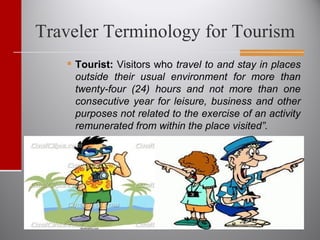
 Tourist: Visitors who travel to and stay in places
outside their usual environment for more than
twenty-four (24) hours and not more than one
consecutive year for leisure, business and other
purposes not related to the exercise of an activity
remunerated from within the place visited”.
Classification of Visitors Segments.
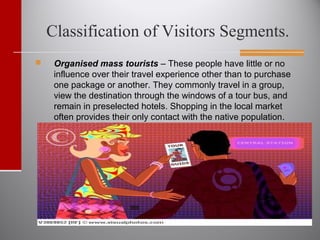
 Organised mass tourists – These people have little or no
influence over their travel experience other than to purchase
one package or another. They commonly travel in a group,
view the destination through the windows of a tour bus, and
remain in preselected hotels. Shopping in the local market
often provides their only contact with the native population.
Classification of Visitors Segments
 Individual Mass Tourist – These people are similar to the
previous category but have somewhat more control over their
itinerary. E.g. The tourist may rent an auto to visit attractions
 Explorers – These people plan for their own itinerary and make
their own reservations. They tend to be sociable people who
enjoy interacting with people at the destination.
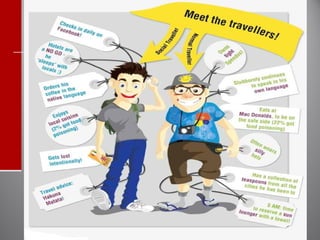
 Drifters – These people, the backpackers group, will seldom, if
ever be found in a a traditional hotel. They may stay out at the
youth hostels with friends or camp out. They tend to mix with the
lower-socio-economics native groups and are commonly found
riding third-class rail or bus. Most tend to be young.
Classification of Visitors Segments
 Visiting Friends or Relatives (VFR) – These people are stay in
the homes of friends and relatives.
 Business Travelers – This often encompasses any form of
business including conventions, trade shows, job seeking and
many other reasons

 Pleasure travel – This too is a very wide and all-encompassing
classification .
 Business and pleasure travelers – many convention and
business travelers plan to incorporate a period of relaxation
prior to or after their business.
Classification of Visitors Segments
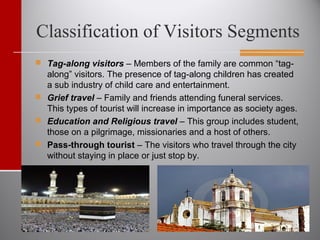
 Tag-along visitors – Members of the family are common “tag-
along” visitors. The presence of tag-along children has created
a sub industry of child care and entertainment.
 Grief travel – Family and friends attending funeral services.
This types of tourist will increase in importance as society ages.
 Education and Religious travel – This group includes student,
those on a pilgrimage, missionaries and a host of others.
 Pass-through tourist – The visitors who travel through the city
without staying in place or just stop by.
Classification of Visitors Segments
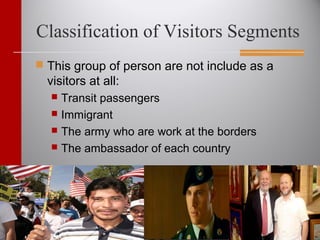
 This group of person are not include as a
visitors at all:
 Transit passengers
 Immigrant
 The army who are work at the borders
 The ambassador of each country
Purposes of Travel
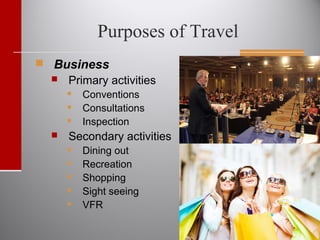
 Business
 Primary activities
 Conventions
 Consultations
 Inspection
 Secondary activities
 Dining out
 Recreation
 Shopping
 Sight seeing
 VFR
Purposes of Travel
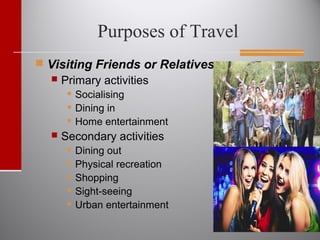
 Visiting Friends or Relatives
 Primary activities
 Socialising
 Dining in
 Home entertainment
 Secondary activities
 Dining out
 Physical recreation
 Shopping
 Sight-seeing
 Urban entertainment
Purposes of Travel
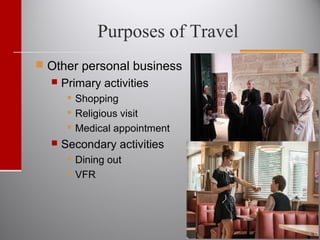
 Other personal business
 Primary activities
 Shopping
 Religious visit
 Medical appointment
 Secondary activities
 Dining out
 VFR
Purposes of Travel
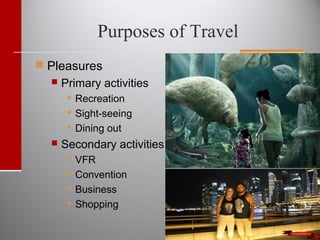
 Pleasures
 Primary activities
 Recreation
 Sight-seeing
 Dining out
 Secondary activities
 VFR
 Convention
 Business
 Shopping
Component of Tourism & Tourism Management
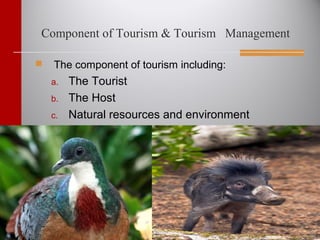
 The component of tourism including:
a. The Tourist
b. The Host
c. Natural resources and environment
Component of Tourism & Tourism Management
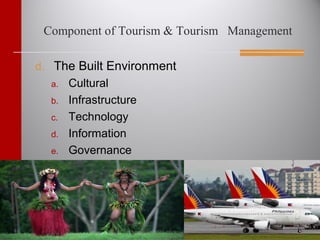
d. The Built Environment
a. Cultural
b. Infrastructure
c. Technology
d. Information
e. Governance
Component of Tourism & Tourism Management
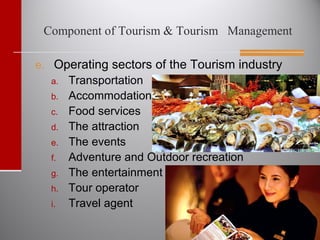
e. Operating sectors of the Tourism industry
a. Transportation
b. Accommodation
c. Food services
d. The attraction
e. The events
f. Adventure and Outdoor recreation
g. The entertainment
h. Tour operator
i. Travel agent
Benefits and Costs of Tourism
 Tourism brings both economic and non-economic
benefits and costs to host communities.
 The benefits including:
a) Provides employment opportunities, both skilled and
unskilled, because it is labor-intensive industry.
b) Generates a supply of needed foreign exchange
c) Increase income
d) Creates increased gross national product
e) Reinforces preservation of heritage and tradition
f) Develops an infrastructure that will also help stimulate
local commerce and industry
g) Can be develop with local product and resources
h) Spreads development
Benefits and Costs of Tourism
 The costs including:
a) Develop excess demand for resources
b) Create social problems
c) Degrades the natural physical environment and
create pollution.
d) Degrades the cultural environment
e) Increase the incidence of crime, prostitution and
gambling
f) Commercialize culture, religion and the arts
g) Creates conflict in the host community
h) Contributes to disease, economic fluctuation
and transportation problems
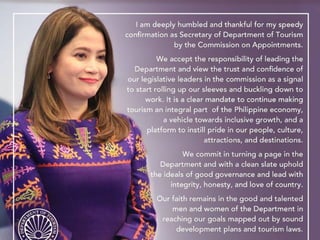
Wanda Teo DOT Secretary
"Our faith remains in the good
and talented men and women
of the Department in reaching
our goals mapped out by sound
development plans and tourism
laws."
Secretary Bernadette Romulo-
Puyat
DUMAGUETE LOVES ME!!!

Intoduction to Tourism

  • 1.
    Josefino Tulabing Larena,MPA Introduction to Tourism
  • 2.
    Learning Objectives  Understandwhat tourism is and its many definitions.  Learn the component of tourism and tourism management.  Knows the benefits and costs of tourism
  • 3.
    Introduction  Tourism isthe leader in the production of new jobs.  Tourism has developed an important part of the economic foundation of many countries.  Growth rate of services sector faster than any other.
  • 4.
    Tourism – Mythsand Realities Myths Realities The majority of tourism in the world is international Tourism in the world is predominantly domestic (people traveling their own country). Domestic tourism accounts for about 80% of tourist trips. Most tourism journeys in the world are by air as tourists jet-set from country to country The majority of trips are surface transport (mainly by car. Tourism is only about leisure holidays. Tourism includes all types of purpose of visit, including business, conference and education. Employment in tourism means substantial travel and the chance to learn language. Most employment in tourism is in the hospitality sector and involve little travel. Large multinational companies such as hotels chains and airlines dominate tourism. The vast majority of tourism enterprises in every destination are SMEs Tourism is a straightforward sector demanding little research or planning Tourism is a complex multi-sectoral industry demanding high-level planning underpinned by research to succeed.
  • 5.
    What is Tourism? Four different perspectives of tourism can be identified:  The tourist: The tourist seeks various psychic and physical experience and satisfactions. The nature of these will largely determine the destinations chosen and the activities enjoyed.  The business providing tourist goods and services: Business people see tourism as an opportunity to make a profit by supplying the goods and services that the tourist markets demand.
  • 6.
    What is Tourism? The government of the host community or area: politicians view tourism as a wealth factor in the economy of their jurisdiction. Their perspective is related to the income their citizens can earn from this business. They also consider the foreign exchange receipts from international tourism as well as the tax receipts collected from tourist expenditures, either directly or indirectly. The government can lay an important role in tourism policy, development, promotion and implementation.
  • 7.
    What is Tourism? The host community: Local people usually see tourism as a cultural and employment factor. Of importance to this group, for example, is the effect of the interaction between large numbers of international visitors and residents. This effect may be beneficial or harmful, or both
  • 8.
    Definition by UNWTO Tourism defined as “ the activities of persons traveling to and staying in place outside their usual environment for not more than one consecutive year for leisure, business and other purpose”
  • 9.
    Tourism Category  Tourismcan be divided by four category: 1. International tourism 1. Inbound tourism: Visits to a country by nonresidents 2. Outbound tourism: Visits by residents of a country to another country 2. Internal tourism : Visits by resident and non residents of the country of reference 3. Domestic tourism : Visits by residents of a country to their own country 4. National tourism : Internal tourism plus outbound tourism
  • 10.
    Traveler Terminology forTourism.  All types of travelers engaged in tourism are described as visitors.  International visitors are persons who travel for a period not exceeding twelve months to country other than the one in which they generally reside and whose main purpose is other than exercise of an activity remunerated from within the place visited.  Internal visitors are persons who travel to destination within their country, that is outside their usual environment, for a period not exceeding twelve months.
  • 11.
    Traveler Terminology forTourism  All travelers are subdivided into two further categories:  Same-day Visitors: Visitors who do not spend for the night in a collective or private accommodation in the country visited. E.g. A cruise ship passengers spending four hours in a port or days-trippers visiting attraction.
  • 12.
    Traveler Terminology forTourism  Tourist: Visitors who travel to and stay in places outside their usual environment for more than twenty-four (24) hours and not more than one consecutive year for leisure, business and other purposes not related to the exercise of an activity remunerated from within the place visited”.
  • 14.
    Classification of VisitorsSegments.  Organised mass tourists – These people have little or no influence over their travel experience other than to purchase one package or another. They commonly travel in a group, view the destination through the windows of a tour bus, and remain in preselected hotels. Shopping in the local market often provides their only contact with the native population.
  • 15.
    Classification of VisitorsSegments  Individual Mass Tourist – These people are similar to the previous category but have somewhat more control over their itinerary. E.g. The tourist may rent an auto to visit attractions  Explorers – These people plan for their own itinerary and make their own reservations. They tend to be sociable people who enjoy interacting with people at the destination.  Drifters – These people, the backpackers group, will seldom, if ever be found in a a traditional hotel. They may stay out at the youth hostels with friends or camp out. They tend to mix with the lower-socio-economics native groups and are commonly found riding third-class rail or bus. Most tend to be young.
  • 16.
    Classification of VisitorsSegments  Visiting Friends or Relatives (VFR) – These people are stay in the homes of friends and relatives.  Business Travelers – This often encompasses any form of business including conventions, trade shows, job seeking and many other reasons   Pleasure travel – This too is a very wide and all-encompassing classification .  Business and pleasure travelers – many convention and business travelers plan to incorporate a period of relaxation prior to or after their business.
  • 17.
    Classification of VisitorsSegments  Tag-along visitors – Members of the family are common “tag- along” visitors. The presence of tag-along children has created a sub industry of child care and entertainment.  Grief travel – Family and friends attending funeral services. This types of tourist will increase in importance as society ages.  Education and Religious travel – This group includes student, those on a pilgrimage, missionaries and a host of others.  Pass-through tourist – The visitors who travel through the city without staying in place or just stop by.
  • 18.
    Classification of VisitorsSegments  This group of person are not include as a visitors at all:  Transit passengers  Immigrant  The army who are work at the borders  The ambassador of each country
  • 19.
    Purposes of Travel Business  Primary activities  Conventions  Consultations  Inspection  Secondary activities  Dining out  Recreation  Shopping  Sight seeing  VFR
  • 20.
    Purposes of Travel Visiting Friends or Relatives  Primary activities  Socialising  Dining in  Home entertainment  Secondary activities  Dining out  Physical recreation  Shopping  Sight-seeing  Urban entertainment
  • 21.
    Purposes of Travel Other personal business  Primary activities  Shopping  Religious visit  Medical appointment  Secondary activities  Dining out  VFR
  • 22.
    Purposes of Travel Pleasures  Primary activities  Recreation  Sight-seeing  Dining out  Secondary activities  VFR  Convention  Business  Shopping
  • 23.
    Component of Tourism& Tourism Management  The component of tourism including: a. The Tourist b. The Host c. Natural resources and environment
  • 24.
    Component of Tourism& Tourism Management d. The Built Environment a. Cultural b. Infrastructure c. Technology d. Information e. Governance
  • 25.
    Component of Tourism& Tourism Management e. Operating sectors of the Tourism industry a. Transportation b. Accommodation c. Food services d. The attraction e. The events f. Adventure and Outdoor recreation g. The entertainment h. Tour operator i. Travel agent
  • 26.
    Benefits and Costsof Tourism  Tourism brings both economic and non-economic benefits and costs to host communities.  The benefits including: a) Provides employment opportunities, both skilled and unskilled, because it is labor-intensive industry. b) Generates a supply of needed foreign exchange c) Increase income d) Creates increased gross national product e) Reinforces preservation of heritage and tradition f) Develops an infrastructure that will also help stimulate local commerce and industry g) Can be develop with local product and resources h) Spreads development
  • 27.
    Benefits and Costsof Tourism  The costs including: a) Develop excess demand for resources b) Create social problems c) Degrades the natural physical environment and create pollution. d) Degrades the cultural environment e) Increase the incidence of crime, prostitution and gambling f) Commercialize culture, religion and the arts g) Creates conflict in the host community h) Contributes to disease, economic fluctuation and transportation problems
  • 28.
    Wanda Teo DOTSecretary
  • 29.
    "Our faith remainsin the good and talented men and women of the Department in reaching our goals mapped out by sound development plans and tourism laws." Secretary Bernadette Romulo- Puyat
  • 31.