Entrepreneurial Mind
Lesson 1
Nature and Development of
Entrepreneurship
OBJECTIVES
• At the end of this module, you are
expected to:
• a. Define Entrepreneurship and
Entrepreneur;
• b. Identify the attributes of an
entrepreneur; and
• c. Explore opportunities for
Entrepreneurs.
• D. Understand the role of
entrepreneurship in economic
development
Define
Entrepreneurship?
and
What is an
entrepreneur?
Entrepreneur
• Derived from French word Enterprendre means “to
undertake”
• To an economist: Entrepreneur is a person who bring
resources, labor, material & other assets into
combination that make their value greater than before
• To a businessman: An entrepreneur appears as a
threat, a competitor.
• To a psychologist: a person that is driven by a certain
forces
Entrepreneur
• Is an owner or manager of a business
enterprise who makes money through
risk and initiative.
Entrepreneurship
• An activity undertaking innovations, finance
and business acumen in an effort to transform
innovations into economic goods or services.
• It is the process of creating something new
with value by devoting their necessary time
and effort.
• It is a dynamic process of vision, change and
creation
Types of
Entrepreneur
Social Entrepreneur
• Motivated by the desire to help or address,
improve and transform social, environmental,
educational and economic conditions like poverty
and educational deprivation rather than to profit.
• They seek innovative solution to global problems
than be copied by others to enact change.
Serial Entrepreneur
• One who continuously comes up with new ideas
and starts new business.
• They are more likely to experience repeated
entrepreneurial success. They take risks and
recover form failure.
Lifestyle Entrepreneur
• They place passion before profit when launching
a business in order to combine personal interests
and talent with the ability to earn a living.
Novice Entrepreneur
• Has no prior business ownership experience as a
business founder, inheritor or purchaser.
Habitual Entrepreneur
• Has prior business ownership
experience.
Nascent Entrepreneur
• In the process of starting a new
business.
• Can be either a novice or a habitual
entrepreneur
Why do we need to
study
entrepreneurship?
How
entrepreneurship
does affect us?
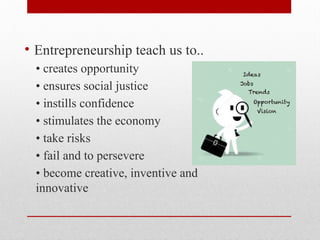
• Entrepreneurship teach us to..
• creates opportunity
• ensures social justice
• instills confidence
• stimulates the economy
• take risks
• fail and to persevere
• become creative, inventive and
innovative
Entrepreneurship is a key
driver of our economy.
• The 1987 Philippine Constitution recognizes
entrepreneurship as an engine of economic growth.
• -Article XII Section 1 highlights the role of private
enterprises in supporting equitable distribution of income
and wealth, sustaining production of goods and services
and expanding productivity, therefore raising the quality
of life.
Entrepreneurship is more than just
an economic term — it is a way of
thinking.
• -People exposed to entrepreneurship frequently express
that they have more opportunity to exercise creative
freedoms, higher self-esteem, and an overall greater sense
of control over their own lives.
• -Entrepreneurship is a way of inspiring creative
individuals to pursue opportunities despite its risks.
Career
Opportunities
for Entrepreneurs
Business Consultant
• Advice about business issues, such as
the development and implementation
of business plans, how streamline
operations or how to expand into new
market.
Management Analysts
• Person who evaluates a business
systems, procedures and operation,
and may also review business
financial matters.
Sales
• Someone who works in sales or run the department needs
to know how business run. They need to know how to
represent a company, manage accounts and follow up on
leads.
Research and
Development
• Understanding business concepts,
procedures and practices with all of
training and education received from
learning entrepreneurship are prepared for
this type of job.
Not-for-Profit Fundraiser
• Raise money for charitable or nonprofit
organization, companies, and/or
foundation grants. Learn different methods
of fundraising and choose those that are
truly best suited for you organization.
Intrapreneur
• An inside entrepreneur or within a large
firm, who uses entrepreneurial skills
without incurring the risks associated with
those activates.
A manager within a company…
What Makes Someone an
Entrepreneur?
8 Personal Attributes of
an Entrepreneur
Creativity
The spark that drives the
development of new products or
services or ways to do business. It
is the push for innovation and
improvement.
Dedication
Is what motivates the entrepreneur
to work hard. Planning of an ideas
must be joined by hard work to
succeed.
Determination
The extremely strong desire to
achieve success. It includes
persistence and the ability to
bounce back after rough times.
Determination
Dedication
VS.
Dedication is defined as the quality of being
dedicated or committed to a task or purpose.
Synonyms include commitment, application,
diligence, industry, resolve, enthusiasm, zeal,
conscientiousness, perseverance, persistence,
tenacity, drive, staying power;
Determination is defined as firmness of purpose;
resoluteness. Synonyms include resolution,
resolve, willpower, strength of character, single-
mindedness, purposefulness, intentness.
Flexibility
The ability to move quickly in
response to changing market needs.
It is being true to a dream while
also being mindful of market
realities.
Leadership
The ability to create
rules and to set goals
Passion
Feeling of intense enthusiasm
towards or compelling desire for
someone or something. What
gets entrepreneurs started and
keeps them there.
Self-confidence
Is self-assurance in one's
personal judgment, ability,
power, etc. Comes from thorough
planning, which reduces
uncertainty and the level of risk
Smart
Consists of common sense
joined with knowledge or
experience in a related business
or endeavor
Role of Entrepreneurship in
Economic Development
Role of Entrepreneurship
• It involves more than just increasing per capita
output and income, it involves change in business
and society.
• This change is accompanied by growth and
increased output, which allows more wealth to be
divided among the various participants
What facilitates needed
change and development?
• One theory of economic growth depicts innovation
as the key not only in developing new products but
also stimulating investment interest in the new
ventures being created.
• It is the process through which innovation develops
and commercializes through entrepreneurial activity
which in turn stimulates economic growth
THE END!

Lesson1 Nature development entrep mind.pptx

  • 1.
    Entrepreneurial Mind Lesson 1 Natureand Development of Entrepreneurship
  • 2.
    OBJECTIVES • At theend of this module, you are expected to: • a. Define Entrepreneurship and Entrepreneur; • b. Identify the attributes of an entrepreneur; and • c. Explore opportunities for Entrepreneurs. • D. Understand the role of entrepreneurship in economic development
  • 3.
  • 4.
    Entrepreneur • Derived fromFrench word Enterprendre means “to undertake” • To an economist: Entrepreneur is a person who bring resources, labor, material & other assets into combination that make their value greater than before • To a businessman: An entrepreneur appears as a threat, a competitor. • To a psychologist: a person that is driven by a certain forces
  • 5.
    Entrepreneur • Is anowner or manager of a business enterprise who makes money through risk and initiative.
  • 6.
    Entrepreneurship • An activityundertaking innovations, finance and business acumen in an effort to transform innovations into economic goods or services. • It is the process of creating something new with value by devoting their necessary time and effort. • It is a dynamic process of vision, change and creation
  • 7.
  • 8.
    Social Entrepreneur • Motivatedby the desire to help or address, improve and transform social, environmental, educational and economic conditions like poverty and educational deprivation rather than to profit. • They seek innovative solution to global problems than be copied by others to enact change.
  • 9.
    Serial Entrepreneur • Onewho continuously comes up with new ideas and starts new business. • They are more likely to experience repeated entrepreneurial success. They take risks and recover form failure.
  • 10.
    Lifestyle Entrepreneur • Theyplace passion before profit when launching a business in order to combine personal interests and talent with the ability to earn a living.
  • 11.
    Novice Entrepreneur • Hasno prior business ownership experience as a business founder, inheritor or purchaser.
  • 12.
    Habitual Entrepreneur • Hasprior business ownership experience.
  • 13.
    Nascent Entrepreneur • Inthe process of starting a new business. • Can be either a novice or a habitual entrepreneur
  • 14.
    Why do weneed to study entrepreneurship? How entrepreneurship does affect us?
  • 15.
    • Entrepreneurship teachus to.. • creates opportunity • ensures social justice • instills confidence • stimulates the economy • take risks • fail and to persevere • become creative, inventive and innovative
  • 16.
    Entrepreneurship is akey driver of our economy. • The 1987 Philippine Constitution recognizes entrepreneurship as an engine of economic growth. • -Article XII Section 1 highlights the role of private enterprises in supporting equitable distribution of income and wealth, sustaining production of goods and services and expanding productivity, therefore raising the quality of life.
  • 17.
    Entrepreneurship is morethan just an economic term — it is a way of thinking. • -People exposed to entrepreneurship frequently express that they have more opportunity to exercise creative freedoms, higher self-esteem, and an overall greater sense of control over their own lives. • -Entrepreneurship is a way of inspiring creative individuals to pursue opportunities despite its risks.
  • 18.
  • 19.
    Business Consultant • Adviceabout business issues, such as the development and implementation of business plans, how streamline operations or how to expand into new market.
  • 20.
    Management Analysts • Personwho evaluates a business systems, procedures and operation, and may also review business financial matters.
  • 21.
    Sales • Someone whoworks in sales or run the department needs to know how business run. They need to know how to represent a company, manage accounts and follow up on leads.
  • 22.
    Research and Development • Understandingbusiness concepts, procedures and practices with all of training and education received from learning entrepreneurship are prepared for this type of job.
  • 23.
    Not-for-Profit Fundraiser • Raisemoney for charitable or nonprofit organization, companies, and/or foundation grants. Learn different methods of fundraising and choose those that are truly best suited for you organization.
  • 24.
    Intrapreneur • An insideentrepreneur or within a large firm, who uses entrepreneurial skills without incurring the risks associated with those activates. A manager within a company…
  • 25.
    What Makes Someonean Entrepreneur?
  • 26.
    8 Personal Attributesof an Entrepreneur
  • 27.
    Creativity The spark thatdrives the development of new products or services or ways to do business. It is the push for innovation and improvement.
  • 28.
    Dedication Is what motivatesthe entrepreneur to work hard. Planning of an ideas must be joined by hard work to succeed.
  • 29.
    Determination The extremely strongdesire to achieve success. It includes persistence and the ability to bounce back after rough times.
  • 30.
  • 31.
    Dedication is definedas the quality of being dedicated or committed to a task or purpose. Synonyms include commitment, application, diligence, industry, resolve, enthusiasm, zeal, conscientiousness, perseverance, persistence, tenacity, drive, staying power; Determination is defined as firmness of purpose; resoluteness. Synonyms include resolution, resolve, willpower, strength of character, single- mindedness, purposefulness, intentness.
  • 32.
    Flexibility The ability tomove quickly in response to changing market needs. It is being true to a dream while also being mindful of market realities.
  • 33.
    Leadership The ability tocreate rules and to set goals
  • 34.
    Passion Feeling of intenseenthusiasm towards or compelling desire for someone or something. What gets entrepreneurs started and keeps them there.
  • 35.
    Self-confidence Is self-assurance inone's personal judgment, ability, power, etc. Comes from thorough planning, which reduces uncertainty and the level of risk
  • 36.
    Smart Consists of commonsense joined with knowledge or experience in a related business or endeavor
  • 37.
    Role of Entrepreneurshipin Economic Development
  • 38.
    Role of Entrepreneurship •It involves more than just increasing per capita output and income, it involves change in business and society. • This change is accompanied by growth and increased output, which allows more wealth to be divided among the various participants
  • 39.
    What facilitates needed changeand development? • One theory of economic growth depicts innovation as the key not only in developing new products but also stimulating investment interest in the new ventures being created. • It is the process through which innovation develops and commercializes through entrepreneurial activity which in turn stimulates economic growth
  • 40.