Dr. Anurag Yadav
BHMS MD(Hom)
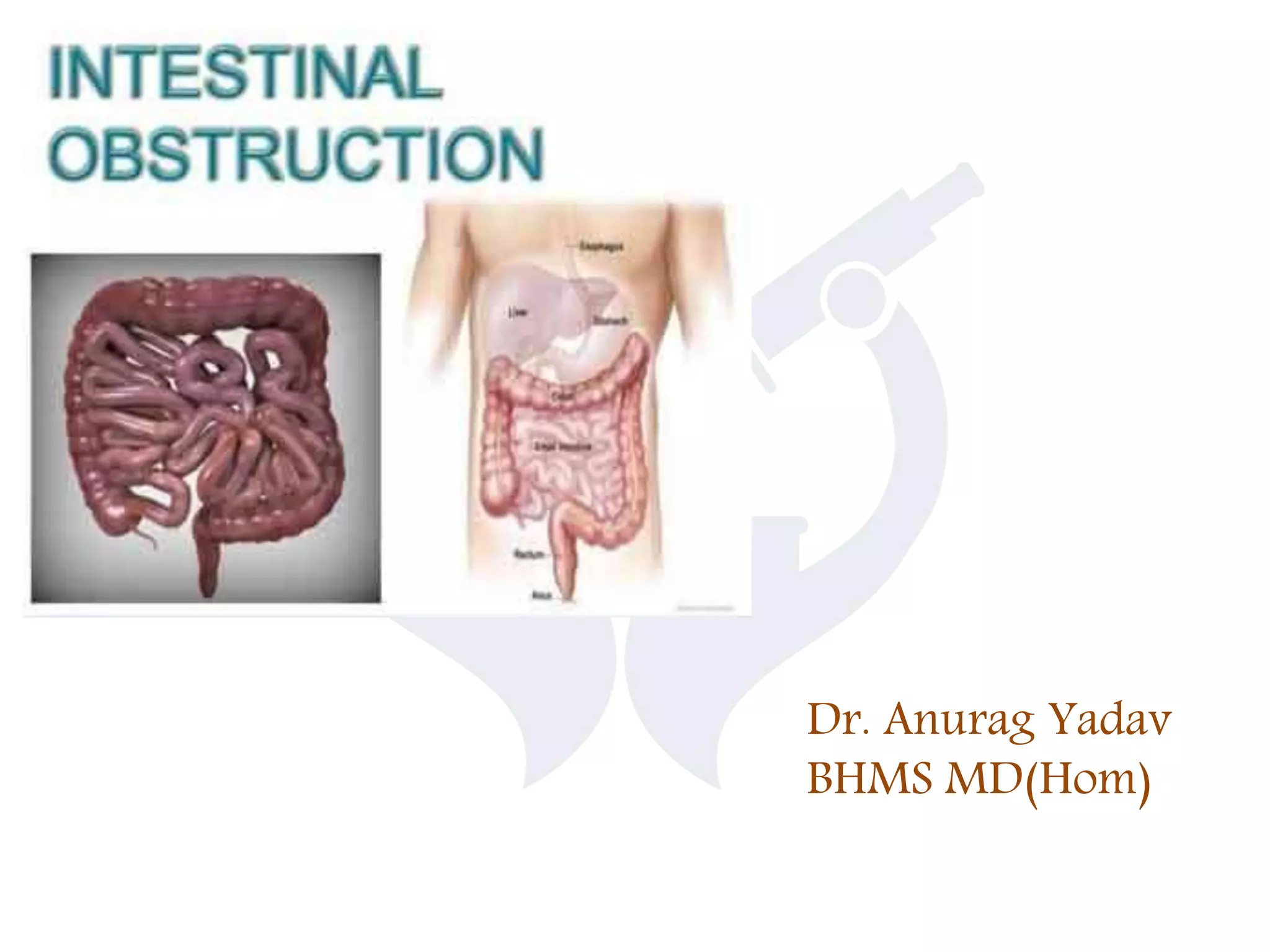
Intestinal Obstruction
Intestinal obstruction is significant
mechanical impairment or complete
arrest of the passage of contents
through the intestine due to
pathology that causes blockage of
the bowel.
Types of Intestinal Obstruction
•Small Bowel Obstruction
•Large Bowel Obstruction
A-
Types of Intestinal Obstruction
•Partial Obstruction- Still can pass gas +/-
diarrhoea
•Complete Obstruction- can not pass gas or
stool
B-
Types of Intestinal Obstruction
•Mechanical Obstruction
•Pseudo Obstruction
C-
Mechanical Obstruction
•Adhesion
•Tumors
•Intussusception
•Volvulus
•Hernia
Adhesion
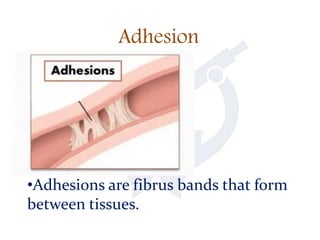
•Adhesions are fibrus bands that form
between tissues.
•Most common cause of mechanical
obstruction
•Post operative surgery of abd cavity
causes fibrous bridges between bowel
segments
•Causes extrinsic compression of bowel
which lead to obstruction
Tumors
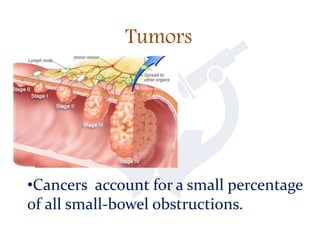
•Cancers account for a small percentage
of all small-bowel obstructions.
•Colorectal tumours are common cause.
•In most cases, the tumor does not
begin in the small intestine itself. More
often, it is a cancer that has spread
(metastasized) to the small bowel from
another site in the colon, female
reproductive tract, breast, lung or skin.
•Tumours formation depends on age,
family history, obesity, IBD & diet
•Cancerous tumours can cause small-
bowel obstruction either by pressing
on the outside of the bowel and
pinching it closed, or by growing
within the wall of the intestine and
slowly blocking its inner passageway
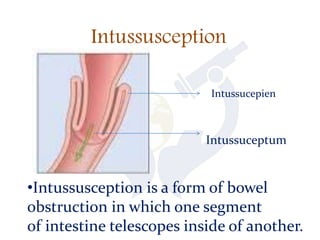
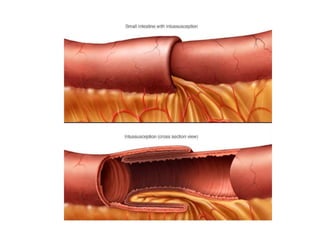
Intussusception
•Intussusception is a form of bowel
obstruction in which one segment
of intestine telescopes inside of another.
Intussucepien
Intussuceptum
•Rare in adults
•Intussusception is the most common
cause of intestinal obstruction in
children younger than 3. The cause of
most cases of intussusception in
children is unknown.
•Common site- illiocecal valve
•The pain of intussusception comes and
goes, usually every 15 to 20 minutes at
first. These painful episodes last longer
and happen more often as time passes.
Other signs and symptoms of
intussusception include:
Stool mixed with blood and mucus ( “
Red currant jelly" stool because of its
appearance)
•Vomiting
•A lump in the abdomen
•Lethargy
•Diarrhoea
•Fever
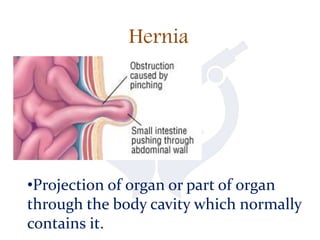
Hernia
•Projection of organ or part of organ
through the body cavity which normally
contains it.
•Hernias are the second most common
cause of small-bowel obstruction,
accounting for about 25% of all cases.
•It may be
1- Internal
2- External
•Internal- Protrusion does not seen on
external surface
•External- Protrusion seen on external
surface.
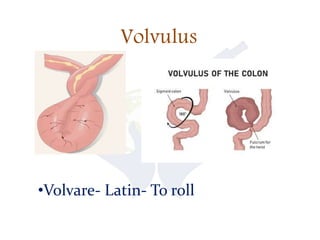
Volvulus
•Volvare- Latin- To roll
•Volvulus occurs when a loop of
intestine twists around itself and the
mesentery that supports it.
•Common site- Caecum & sigmoid area
of colon
•A volvulus is a medical emergency, If
left untreated, the parts of the bowels
that are not receiving enough blood
will start to die.
•In both the instances, the sigmoid
colon becomes dilated and heavy
making it susceptible to torsion. With
repeated attacks of torsion, the
mesentery shortens. The chronic
inflammation leads to the formation of
adhesions which then entrap the
sigmoid colon into fixed twisted
position
Risk Factors
•Birth Defects -
-Intestinal Malrotation
-Enlarged Colon
-Hirschspurng Disease
•Pregnancy
•Abdominal Adhesions
•Middle Age
Pseudo Obstruction
•Myopathy
•Neuropathy
•Obstruction in the absence of any
demonstrable evidence of such an
obstruction in the intestine
Types
Hirschspurng Disease
•Congenital disorder of the colon
•Absent enteric ganglion cells in
submucosal and myenteric plexuses in
distal colon, i.e. no nerve at distal end
of colon.
•No or reduced peristaltic movement
•Surgery can correct it.
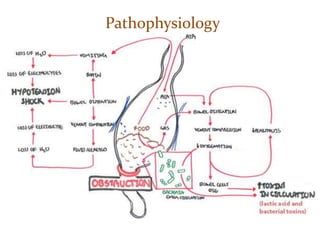
Pathophysiology
Clinical Features
•Nausea
•Vomiting
•Cramping Abdominal Pain
•Diarrhoea
•Distended Abdomen
•Constipation
•Fever & Tachycardia
Complications
•Bowel Ischemia
•Perforation- Gut content exudates in
peritoneum leading to peritonitis.
•Sepsis- venous compression- bowel cell
die-toxin in blood supply
Thank You

Intestinal obstruction Pathology