INTERVIEWING
YOUR CHARACTERS
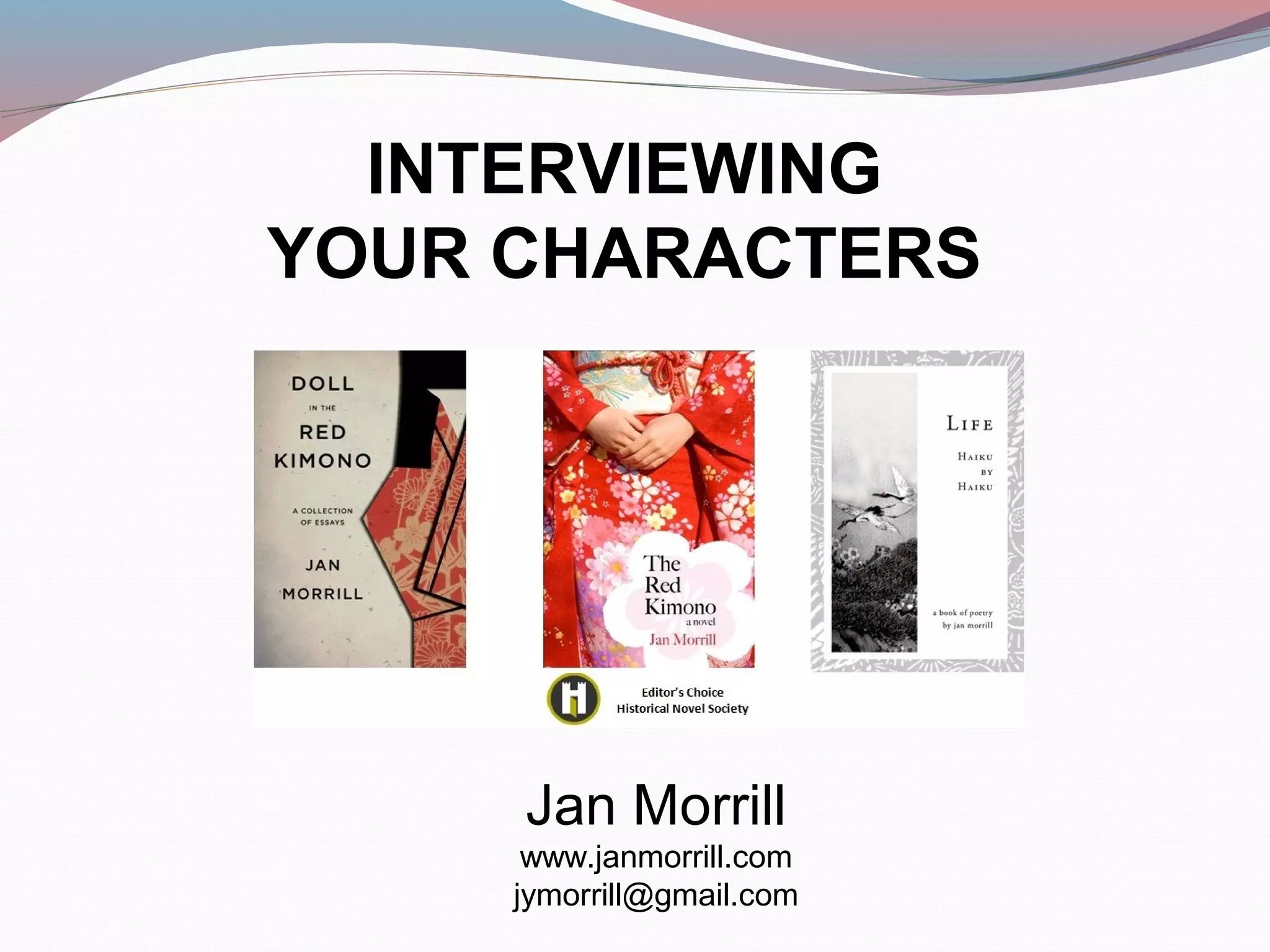
Jan Morrill
www.janmorrill.com
jymorrill@gmail.com
MAKING CHARACTERS MEMORABLEMAKING CHARACTERS MEMORABLE
 
 Interview your character.
 On paper
 With a friend
INTERVIEWING YOUR CHARACTERINTERVIEWING YOUR CHARACTER
 Write down several questions to ask.
 Close your eyes and imagine sitting with the character. Imagine
the setting – sights, sounds, smells.
 Carry on a conversation in your mind and . . . write it down!
 Record the conversation without lifting your pen from the page or
fingers from the keyboard. Don’t censor. Don’t edit.
 Pay attention to character’s “voice” in dialogue and
internalization.
 Ask a friend to interview you as your character.
 Sometimes this will develop into a short story!
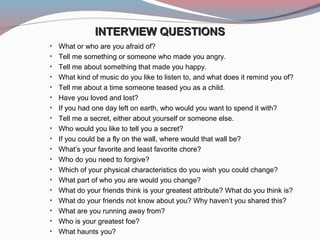
INTERVIEW QUESTIONSINTERVIEW QUESTIONS
• What or who are you afraid of?
• Tell me something or someone who made you angry.
• Tell me about something that made you happy.
• What kind of music do you like to listen to, and what does it remind you of?
• Tell me about a time someone teased you as a child.
• Have you loved and lost?
• If you had one day left on earth, who would you want to spend it with?
• Tell me a secret, either about yourself or someone else.
• Who would you like to tell you a secret?
• If you could be a fly on the wall, where would that wall be?
• What’s your favorite and least favorite chore?
• Who do you need to forgive?
• Which of your physical characteristics do you wish you could change?
• What part of who you are would you change?
• What do your friends think is your greatest attribute? What do you think is?
• What do your friends not know about you? Why haven’t you shared this?
• What are you running away from?
• Who is your greatest foe?
• What haunts you?
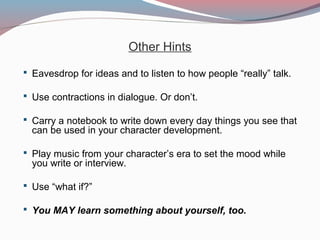
Other Hints
 Eavesdrop for ideas and to listen to how people “really” talk.
 Use contractions in dialogue. Or don’t.
 Carry a notebook to write down every day things you see that
can be used in your character development.
 Play music from your character’s era to set the mood while
you write or interview.
 Use “what if?”
 You MAY learn something about yourself, too.
Questions?
jymorrill@gmail.com
www.janmorrill.com
Questions?
jymorrill@gmail.com
www.janmorrill.com

Interview Your Characters

  • 1.
  • 2.
    MAKING CHARACTERS MEMORABLEMAKINGCHARACTERS MEMORABLE    Interview your character.  On paper  With a friend
  • 3.
    INTERVIEWING YOUR CHARACTERINTERVIEWINGYOUR CHARACTER  Write down several questions to ask.  Close your eyes and imagine sitting with the character. Imagine the setting – sights, sounds, smells.  Carry on a conversation in your mind and . . . write it down!  Record the conversation without lifting your pen from the page or fingers from the keyboard. Don’t censor. Don’t edit.  Pay attention to character’s “voice” in dialogue and internalization.  Ask a friend to interview you as your character.  Sometimes this will develop into a short story!
  • 4.
    INTERVIEW QUESTIONSINTERVIEW QUESTIONS •What or who are you afraid of? • Tell me something or someone who made you angry. • Tell me about something that made you happy. • What kind of music do you like to listen to, and what does it remind you of? • Tell me about a time someone teased you as a child. • Have you loved and lost? • If you had one day left on earth, who would you want to spend it with? • Tell me a secret, either about yourself or someone else. • Who would you like to tell you a secret? • If you could be a fly on the wall, where would that wall be? • What’s your favorite and least favorite chore? • Who do you need to forgive? • Which of your physical characteristics do you wish you could change? • What part of who you are would you change? • What do your friends think is your greatest attribute? What do you think is? • What do your friends not know about you? Why haven’t you shared this? • What are you running away from? • Who is your greatest foe? • What haunts you?
  • 5.
    Other Hints  Eavesdropfor ideas and to listen to how people “really” talk.  Use contractions in dialogue. Or don’t.  Carry a notebook to write down every day things you see that can be used in your character development.  Play music from your character’s era to set the mood while you write or interview.  Use “what if?”  You MAY learn something about yourself, too.
  • 6.
  • 7.