Prof. M. P. Poonia
Professor, Department of
Mechanical Engineering
Malaviya National Institute of
Technology Jaipur
VISION STATEMENT OF MNIT
To Create a Center for Imparting
Technical Education of International
Standards and Conduct Research at the
Cutting Edge of Technology to Meet the
Current and Future Challenges of
Technological Development.
MISSION STATEMENT OF MNIT
• To Create Technical Manpower for Meeting
the Current and Future Demands of Industry
• To Recognize Education and Research in
Close Interaction with Industry with
Emphasis on the Development of Leadership
Qualities in the Young Men and Women
Entering the Portal of the Institute with
Sensitivity to Social Development and Eye
for Opportunities for Growth in the
International Perspective.
MECHANICAL ENGINEERING
It is an Engineering Branch that Combines
Engineering Physics and Mathematics
Principles with Materials Science, to Design,
Analyze, Manufacture, and Maintain
Mechanical Systems.
Lack Fundamental Knowledge of
Terminology, Concepts, Principles etc. in
their Own Disciplines
Lack Knowledge of Current Developments in
their Disciplines and Technology
Lack Practical Skills
Unable to Read Engineering Drawings
Lack Analytical Ability, Willingness to Learn,
Managerial Skills and Creativity
INDUSTRY OBSERVATIONS
 Lack Positive Attitude and have
Become More Materialistic
 Prefer to Look for White Collar Jobs and
Prefer to Work in IT or ITeS sector and
do not Continue in the Core
Engineering Branches
 Commitment
 Stability
INDUSTRY OBSERVATIONS
Contd…
Entrepreneurial
INDUSTRY EXPECTATIONS
CHALLENGE OF LESSER EXPOSURE
TO REALITY
INDUSTRY NEEDS - CAR
1. Mechanical
engineering
2. Electrical
engineering
3. Chemical
engineering
4. Industrial
engineering
5. Computer
engineering
6. Materials
engineering
7. Environmen
tal
engineering
8. Structural
engineering
9. Acoustical
engineering
10. Thermal
engineering
11. Aerodynamic
s engineering
12. Control
systems
engineering
13. Mechatronics
engineering
14. Robotics
engineering
15. Manufacturin
g engineering
16. Quality
engineering
17. Safety
engineering
18. Human
factors
engineering
19. Ergonomics
engineering
20. Biomechanic
al
engineering
21. Optics
engineering
22. Nanotechnology
engineering
23. Software
engineering
24. Data science
and analytics
25. Artificial
intelligence and
machine
learning
26. Cybersecurity
engineering
27. Battery
engineering
28. Powertrain
engineering
29. Autonomous
driving
engineering
30. Connected car
engineering
31. Marketing
32. Product
management
33. Sales and
distribution
34. Brand
management
35. Customer
experience
36. Market
research
37. Pricing
strategy
38. Advertising
39. Public
relations
40. Social media
management
41. Event
planning
42. Graphic
design
43. User
interface
design
44. User
experience
design
45. Web
development
46. Mobile app
development
47. Cloud
computing
48. Big data
analysis
49. Database
managemen
t
50. Information
technology,
9
ASSESSMENT SYSTEM
10
KNOWLEDGE, SKILLS AND
ATTITUDE
ASK Description
Attitude Feelings, Emotions, Beliefs, or
Values About Something
Skills Abilities Based on Performance
Measured in Time and Precision
Knowledge Condition of Being Aware of
Something (Facts and
Concepts)
12
Excellence is not
a Skill, it’s an
Attitude…
1. Engineering Knowledge
2. Problem Analysis
3. Design/Development of Solutions
4. Conduct Investigations of Complex
Problems
5. Modern Tool Usage
GRADUATE ATTRIBUTES (CORE
KNOWLEDGE AND SKILLS)
GRADUATE OUTCOMES (ATTITUDE)
6. The Graduate and the Society
7. Environment and Sustainability
8. Ethics
9. Individual and Team Work
10. Communication
11. Project Management and Finance
12. Life-Long Learning
STANFORD’S - STUDENT LEARNING
ASSESSMENT SURVEY - GAP
Survey Indicates:
• In academic skill levels - students in the India performed
comparable to students in Russia but well behind China in
years 1 and 2.
• In higher order thinking skill levels- students in India were
behind Russia and well behind China in years 1 and 2.
Survey Suggested:
• Developing higher order thinking skills relative to academic
skills before college.
• Greater improvements, higher gains in both academic and
higher order thinking skills in college can be achieved than
students in Russia and China. 15
BLOOM'S TAXONOMY
COURSE CONTENTS:
Unit I - Modes of road transportation, power plants for
road vehicles, transmission and transmission systems,
running system including steering, frame and body,
electrical systems. Other mobility systems.
(no. of lectures- 3)
MODES OF ROAD TRANSPORTATION
ENGINE AND TRANSMISSION
Gear Box
Clutch
Crankcase
Engine Piston
Cooling
Fan
POWER TRANSMISSION
BMW M340i 3.0L Turbo I-6
POWER PLANTS FOR ROAD VEHICLES
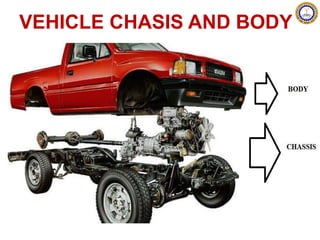
VEHICLE CHASIS AND BODY
Unit II - Machining operations and machine tools:
lathe, drilling, shaper, milling; Joining methods:
shielded metal arc welding, oxy-acetylene gas welding,
basic welded joints, soldering, brazing; foundry tools
and sand casting; additive manufacturing
(no. of lectures- 7)
COURSE CONTENTS (contd.)
Foundry
Welding
Machining
Turning
Facing
Drilling,
Boring,
Reaming
Slot
Cutting
Chamfering
Knurling
Thread Cutting
Parting
1. Determine the rpm(n) of the shaft. diameter(d)=25 mm, cutting
speed(cs)=50 m/min.
a) 636.9
b) 202.83
c) 10.615
d) none of the mentioned
2. Determine the diameter(d) of the shaft in mm. rpm(n)=25,
cutting speed(cs)=100 mm/min.
a) 21.23
b) 405.47
c) 1273.2
d) none of the mentioned
Lathe is the oldest machine tool,
stemming from the early tree lathe,
which was turned by a rope passed
around the work and attached to a
spring branch overhead. The work
was supported by two adjacent
trees. The operator’s foot supplied
the motion. The tool was held in the
operator’s hand. Later a strip of
wood called a “lath” was used to
support the rope and hence named
as a lathe.
TREE LATHE
INDUSTRIAL REVOLUTION
LATHE OPERATIONS
First Industrial Revolution: Coal in 1765.
Second Industrial Revolution: Gas in 1870.
Third Revolution: Electronics and Nuclear in 1969.
Fourth Revolution: Internet , Software+Hardware in 2000.
1. Drilling Machine 2. Milling Machine
3. Shaper Machine
1 2 3
Foundry
ecb ppt.pptx
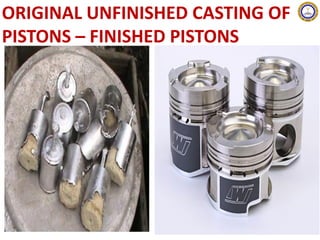
ORIGINAL UNFINISHED CASTING OF
PISTONS – FINISHED PISTONS
•At first, heat the die and spray
coating (chromium nitride)
inside the cavity.
•Then melt the metal and
convey it through a ladle.
•After that, slowly pour the
liquid metal into the cavity.
•Then wait for it to solidify.
•Next, take out the part after
opening the die.
•Finally, machine the part as
necessary.
CASTING PROCESS
FINAL CASTING
DIE OR MOLD MATERIAL
Die casting is a manufacturing
process in which molten
metal is poured or forced into
steel molds. The molds—also
known as tools or dies—are
created using steel and are
specially designed for each
project. This allows each
component to be created with
accuracy and repeatability.
CASTING MATERIAL
Metals are some of the
most commonly used
materials for casting,
particularly those with low
melting points, such as
aluminum and zinc. Metals
like iron, steel, brass,
bronze, and lead can also
be cast, but they require
the use of more advanced
equipment and materials.
FINISHING ON LATHE MACHINE
FINISHING PROCESS
GRINDING
REAMING
FINAL PRODUCT
Unit III - Classification, properties, criteria for material
selection. (no. of lectures- 1)
COURSE CONTENTS (contd.)
1.Performance
Requirements
2.Reliability Requirements
3.Size, Shape,
and Mass Requirements
4.Cost Requirements
5.Manufacturing
Requirements
6.Industry Standards
7.Government Regulations
8.Intellectual Property
Requirements
9.Sustainability
Requirements
COURSE CONTENTS (contd.)
Unit IV - Power generation systems: Steam
generation, properties of steam, thermodynamic cycle,
steam tables, Mollier diagram; internal combustion
engines, thermodynamic cycles, petrol and diesel
engine, cooling systems. (no. of
lectures- 9)
COURSE CONTENTS (contd.)
Road Transportation and
Prime movers
Coal-fired Power Station Diagram
steamtables.pdf
1 N/m2- 1 Pa
1 bar- 105 N/m2 =100 kPa=0.10 MPa
Unit V - Refrigeration and Air conditioning:
Refrigerator, heat pump, heat engine, coefficient of
performance, unit of Refrigeration, thermodynamic
cycles; domestic refrigerator, desert cooler, unitary air
conditioner, ice plant. (no. of lectures- 4)
COURSE CONTENTS (contd.)
VAPOR COMPRESSION SYSTEM
-15 0 C
+290C
PARAMETER, VALUE
(R-12)
Critical point
temperature [K]
385.12
Critical point density
[kg/m3]
565.0
Critical point pressure
[Pa]
4136100.0
R12 Properties table.pdf
CARNOT HEAT
ENGINE
Unit VI - Basics of Machines and Power
Transmission: Simple and compound machines, belts,
ropes, chains, gears, clutches. (no. of lectures- 4)
COURSE CONTENTS (contd.)
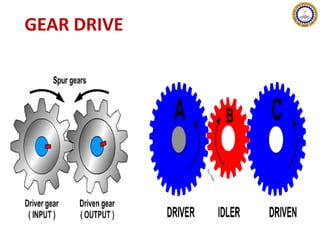
GEAR DRIVE
SCHEME/SPECIALIZATION: B.TECH.
(ALL BRANCHES OF ENGINEERING)
DETAILS OF THE COURSE
PREREQUISITE: None.
Course
Code
Course Title Credits Lecture
/ Week
22MET 101 Introduction to
Mechanical
Systems
2 2
COURSE OBJECTIVE(s)
To Acquaint the Students with Mechanical
Systems and Manufacturing Processes so
that they are Equipped with the Basic
Knowledge Needed to Develop Energy-
Efficient Solutions.
CO1 To Understand the Construction and
Working of a Mobility System.
CO2 To Ascertain the Manufacturing Processes
Appropriate for Hardware Development.
CO3 To Select Favorable Engineering
Material(s) for the Given Application.
CO4 To Analyze the Efficiency of Different
Thermal Systems.
CO5 To Select Appropriate Power Transmission
Drive(s) for the Given Application.
COURSE OUTCOMES
COURSE ASSESSMENT
Course Assessment (Culminating to the Final Grade),
will Comprise of Following Three Components.
S. No. Component Weightage
a) CWS- Class Work Sessional
(Weekly Assignments and Quizzes)
20%
b) MTE - Mid-Term Examination 30%
c) ETE - End Term
Examination
50%
TEXT BOOKS
 Basics of Mechanical Engineering by Pravin Kumar,
Pearson Publishing co.
 Elements of Mechanical Engineering by D. S.
Kumar, Kataria & Sons, New Delhi.
 Engineering Thermodynamics by P. K. Nag,
McGraw-Hill Publishing Co., New Delhi.
 Workshop Technology by S. K. Garg, Laxmi
Publications, New Delhi.
FOUR STROKE PETROL ENGINE
FOUR STROKE DIESEL ENGINE
TWO STROKE ENGINE
ENGINE, CLUTCH AND GEAR BOX
SPEED VS POWER AND TORQUE
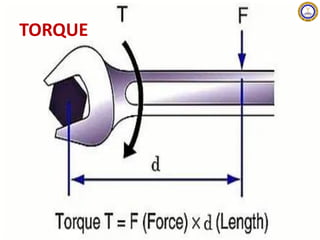
TORQUE
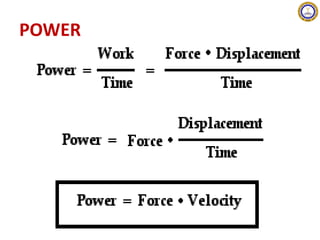
POWER
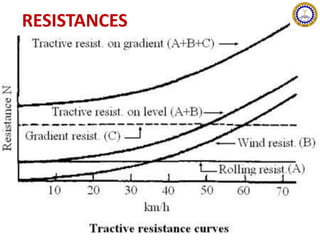
RESISTANCES
HOW TO OVERCOME
RESISTANCES FOR
ACCLERATING THE
VEHICLE
SLIDING MESH GEAR BOX
POWER TRANSMISSION
LATHE SPECIFICATIONS
1. Speed
2. Feed
3. Depth of Cut
LATHE SPECIFICATIONS
Brief Technical Specifications
Bed Length- 7' to 24'
Distance between Centers-2'7" (800) to 19'6" (5950)
Bed Width -18" (457), 20" (508) & 24" (610)
Centre Height 15" (381), 18" (457), 20" (508), 22"
(558) & 24" (610)
Spindle Hole- 2-1/8" (54) to 6-1/8" (156)
TYPES OF LATHES
1. A Speed Lathe Machine is
a high-speed, hand-operated,
mainly used by woodworkers.
It can provide a spindle speed
from 1200 to 3600rpm.
The machine comes with a
very simple design, it
contains headstock, bed,
tailstock, and tool post.
These machines are used for
woodturning, furniture
making, metal polishing,
spinning, and centering.
TYPES OF LATHES
2. Engine Lathe – These lathes emerged during the
Industrial Revolution and originally used steam power
for operation before later being fitted with gas or electric
motors. The engine lathe is considered as the most
common type of manual lathes, which are widely used
in all machine shop applications. The engine lathe or
center lathe can perform operations such as turning,
end face, grooving, knurling, and threading.
Tool-Room Lathe – A high precision lathe having a
gearbox in the headstock offering a extended range of
thread pitches for both internal end external threads
and feeds. It has a low spindle runout and precision
guideway and leadscrews offering high stability, low
clearances and backlash. It is used for making
precision components in the tool room.
TYPES OF LATHES
Capstan and Turret Lathes – A capstan and turret
lathe is a production lathe. The turret head is mounted
on the ram fitted with turret slides longitudinally on the
saddle. Turret head has a hexagonal block having six
faces with a bore for mounting six or more than six
tools at a time.
TYPES OF LATHES
The main difference between the capstan and turret
lathe machine is the capstan lathe is fast because of
light construction but the turret lathe is slow (rigid
construction).These machines are used for mass
production.
DIFFERENCE BETWEEN TURRET AND
CAPSTAN LATHE
TYPES OF LATHES
These lathes utilize a computerized system that
results in high precision and accuracy. The popularity
of these lathes has led to them replacing many other
lathe types in machinist shops.
CNC Lathes: The CNC meaning can be defined as a
process in which pre-programmed computer software
dictates the movement of factory machinery and tools.
As a result, manufacturers can produce parts in less
time, reduce waste and eliminate the risk of human
error.
NAMING LATHE MACHINE,
SPECIFICATIONS
BEST WISHES…

Lecture 1 final.pdf

  • 1.
    Prof. M. P.Poonia Professor, Department of Mechanical Engineering Malaviya National Institute of Technology Jaipur
  • 2.
    VISION STATEMENT OFMNIT To Create a Center for Imparting Technical Education of International Standards and Conduct Research at the Cutting Edge of Technology to Meet the Current and Future Challenges of Technological Development.
  • 3.
    MISSION STATEMENT OFMNIT • To Create Technical Manpower for Meeting the Current and Future Demands of Industry • To Recognize Education and Research in Close Interaction with Industry with Emphasis on the Development of Leadership Qualities in the Young Men and Women Entering the Portal of the Institute with Sensitivity to Social Development and Eye for Opportunities for Growth in the International Perspective.
  • 4.
    MECHANICAL ENGINEERING It isan Engineering Branch that Combines Engineering Physics and Mathematics Principles with Materials Science, to Design, Analyze, Manufacture, and Maintain Mechanical Systems.
  • 5.
    Lack Fundamental Knowledgeof Terminology, Concepts, Principles etc. in their Own Disciplines Lack Knowledge of Current Developments in their Disciplines and Technology Lack Practical Skills Unable to Read Engineering Drawings Lack Analytical Ability, Willingness to Learn, Managerial Skills and Creativity INDUSTRY OBSERVATIONS
  • 6.
     Lack PositiveAttitude and have Become More Materialistic  Prefer to Look for White Collar Jobs and Prefer to Work in IT or ITeS sector and do not Continue in the Core Engineering Branches  Commitment  Stability INDUSTRY OBSERVATIONS Contd…
  • 7.
  • 8.
    CHALLENGE OF LESSEREXPOSURE TO REALITY
  • 9.
    INDUSTRY NEEDS -CAR 1. Mechanical engineering 2. Electrical engineering 3. Chemical engineering 4. Industrial engineering 5. Computer engineering 6. Materials engineering 7. Environmen tal engineering 8. Structural engineering 9. Acoustical engineering 10. Thermal engineering 11. Aerodynamic s engineering 12. Control systems engineering 13. Mechatronics engineering 14. Robotics engineering 15. Manufacturin g engineering 16. Quality engineering 17. Safety engineering 18. Human factors engineering 19. Ergonomics engineering 20. Biomechanic al engineering 21. Optics engineering 22. Nanotechnology engineering 23. Software engineering 24. Data science and analytics 25. Artificial intelligence and machine learning 26. Cybersecurity engineering 27. Battery engineering 28. Powertrain engineering 29. Autonomous driving engineering 30. Connected car engineering 31. Marketing 32. Product management 33. Sales and distribution 34. Brand management 35. Customer experience 36. Market research 37. Pricing strategy 38. Advertising 39. Public relations 40. Social media management 41. Event planning 42. Graphic design 43. User interface design 44. User experience design 45. Web development 46. Mobile app development 47. Cloud computing 48. Big data analysis 49. Database managemen t 50. Information technology, 9
  • 10.
  • 11.
    KNOWLEDGE, SKILLS AND ATTITUDE ASKDescription Attitude Feelings, Emotions, Beliefs, or Values About Something Skills Abilities Based on Performance Measured in Time and Precision Knowledge Condition of Being Aware of Something (Facts and Concepts)
  • 12.
    12 Excellence is not aSkill, it’s an Attitude…
  • 13.
    1. Engineering Knowledge 2.Problem Analysis 3. Design/Development of Solutions 4. Conduct Investigations of Complex Problems 5. Modern Tool Usage GRADUATE ATTRIBUTES (CORE KNOWLEDGE AND SKILLS)
  • 14.
    GRADUATE OUTCOMES (ATTITUDE) 6.The Graduate and the Society 7. Environment and Sustainability 8. Ethics 9. Individual and Team Work 10. Communication 11. Project Management and Finance 12. Life-Long Learning
  • 15.
    STANFORD’S - STUDENTLEARNING ASSESSMENT SURVEY - GAP Survey Indicates: • In academic skill levels - students in the India performed comparable to students in Russia but well behind China in years 1 and 2. • In higher order thinking skill levels- students in India were behind Russia and well behind China in years 1 and 2. Survey Suggested: • Developing higher order thinking skills relative to academic skills before college. • Greater improvements, higher gains in both academic and higher order thinking skills in college can be achieved than students in Russia and China. 15
  • 16.
  • 17.
    COURSE CONTENTS: Unit I- Modes of road transportation, power plants for road vehicles, transmission and transmission systems, running system including steering, frame and body, electrical systems. Other mobility systems. (no. of lectures- 3)
  • 18.
    MODES OF ROADTRANSPORTATION
  • 19.
    ENGINE AND TRANSMISSION GearBox Clutch Crankcase Engine Piston Cooling Fan
  • 20.
  • 21.
    BMW M340i 3.0LTurbo I-6 POWER PLANTS FOR ROAD VEHICLES
  • 22.
  • 23.
    Unit II -Machining operations and machine tools: lathe, drilling, shaper, milling; Joining methods: shielded metal arc welding, oxy-acetylene gas welding, basic welded joints, soldering, brazing; foundry tools and sand casting; additive manufacturing (no. of lectures- 7) COURSE CONTENTS (contd.) Foundry Welding Machining
  • 25.
  • 26.
    1. Determine therpm(n) of the shaft. diameter(d)=25 mm, cutting speed(cs)=50 m/min. a) 636.9 b) 202.83 c) 10.615 d) none of the mentioned 2. Determine the diameter(d) of the shaft in mm. rpm(n)=25, cutting speed(cs)=100 mm/min. a) 21.23 b) 405.47 c) 1273.2 d) none of the mentioned
  • 27.
    Lathe is theoldest machine tool, stemming from the early tree lathe, which was turned by a rope passed around the work and attached to a spring branch overhead. The work was supported by two adjacent trees. The operator’s foot supplied the motion. The tool was held in the operator’s hand. Later a strip of wood called a “lath” was used to support the rope and hence named as a lathe. TREE LATHE
  • 28.
  • 29.
  • 30.
    First Industrial Revolution:Coal in 1765. Second Industrial Revolution: Gas in 1870. Third Revolution: Electronics and Nuclear in 1969. Fourth Revolution: Internet , Software+Hardware in 2000.
  • 31.
    1. Drilling Machine2. Milling Machine 3. Shaper Machine 1 2 3
  • 32.
  • 33.
  • 34.
    ORIGINAL UNFINISHED CASTINGOF PISTONS – FINISHED PISTONS
  • 35.
    •At first, heatthe die and spray coating (chromium nitride) inside the cavity. •Then melt the metal and convey it through a ladle. •After that, slowly pour the liquid metal into the cavity. •Then wait for it to solidify. •Next, take out the part after opening the die. •Finally, machine the part as necessary. CASTING PROCESS
  • 36.
  • 37.
    DIE OR MOLDMATERIAL Die casting is a manufacturing process in which molten metal is poured or forced into steel molds. The molds—also known as tools or dies—are created using steel and are specially designed for each project. This allows each component to be created with accuracy and repeatability.
  • 38.
    CASTING MATERIAL Metals aresome of the most commonly used materials for casting, particularly those with low melting points, such as aluminum and zinc. Metals like iron, steel, brass, bronze, and lead can also be cast, but they require the use of more advanced equipment and materials.
  • 39.
  • 40.
  • 41.
  • 42.
  • 43.
  • 44.
    Unit III -Classification, properties, criteria for material selection. (no. of lectures- 1) COURSE CONTENTS (contd.)
  • 45.
    1.Performance Requirements 2.Reliability Requirements 3.Size, Shape, andMass Requirements 4.Cost Requirements 5.Manufacturing Requirements 6.Industry Standards 7.Government Regulations 8.Intellectual Property Requirements 9.Sustainability Requirements COURSE CONTENTS (contd.)
  • 46.
    Unit IV -Power generation systems: Steam generation, properties of steam, thermodynamic cycle, steam tables, Mollier diagram; internal combustion engines, thermodynamic cycles, petrol and diesel engine, cooling systems. (no. of lectures- 9) COURSE CONTENTS (contd.) Road Transportation and Prime movers Coal-fired Power Station Diagram
  • 48.
    steamtables.pdf 1 N/m2- 1Pa 1 bar- 105 N/m2 =100 kPa=0.10 MPa
  • 58.
    Unit V -Refrigeration and Air conditioning: Refrigerator, heat pump, heat engine, coefficient of performance, unit of Refrigeration, thermodynamic cycles; domestic refrigerator, desert cooler, unitary air conditioner, ice plant. (no. of lectures- 4) COURSE CONTENTS (contd.)
  • 60.
  • 62.
  • 65.
    PARAMETER, VALUE (R-12) Critical point temperature[K] 385.12 Critical point density [kg/m3] 565.0 Critical point pressure [Pa] 4136100.0
  • 66.
  • 67.
  • 68.
    Unit VI -Basics of Machines and Power Transmission: Simple and compound machines, belts, ropes, chains, gears, clutches. (no. of lectures- 4) COURSE CONTENTS (contd.)
  • 70.
  • 72.
    SCHEME/SPECIALIZATION: B.TECH. (ALL BRANCHESOF ENGINEERING) DETAILS OF THE COURSE PREREQUISITE: None. Course Code Course Title Credits Lecture / Week 22MET 101 Introduction to Mechanical Systems 2 2
  • 73.
    COURSE OBJECTIVE(s) To Acquaintthe Students with Mechanical Systems and Manufacturing Processes so that they are Equipped with the Basic Knowledge Needed to Develop Energy- Efficient Solutions.
  • 74.
    CO1 To Understandthe Construction and Working of a Mobility System. CO2 To Ascertain the Manufacturing Processes Appropriate for Hardware Development. CO3 To Select Favorable Engineering Material(s) for the Given Application. CO4 To Analyze the Efficiency of Different Thermal Systems. CO5 To Select Appropriate Power Transmission Drive(s) for the Given Application. COURSE OUTCOMES
  • 75.
    COURSE ASSESSMENT Course Assessment(Culminating to the Final Grade), will Comprise of Following Three Components. S. No. Component Weightage a) CWS- Class Work Sessional (Weekly Assignments and Quizzes) 20% b) MTE - Mid-Term Examination 30% c) ETE - End Term Examination 50%
  • 76.
    TEXT BOOKS  Basicsof Mechanical Engineering by Pravin Kumar, Pearson Publishing co.  Elements of Mechanical Engineering by D. S. Kumar, Kataria & Sons, New Delhi.  Engineering Thermodynamics by P. K. Nag, McGraw-Hill Publishing Co., New Delhi.  Workshop Technology by S. K. Garg, Laxmi Publications, New Delhi.
  • 77.
  • 78.
  • 79.
  • 80.
  • 81.
  • 82.
    SPEED VS POWERAND TORQUE
  • 83.
  • 85.
  • 90.
  • 91.
    HOW TO OVERCOME RESISTANCESFOR ACCLERATING THE VEHICLE
  • 92.
  • 93.
  • 94.
  • 95.
  • 96.
  • 97.
    Brief Technical Specifications BedLength- 7' to 24' Distance between Centers-2'7" (800) to 19'6" (5950) Bed Width -18" (457), 20" (508) & 24" (610) Centre Height 15" (381), 18" (457), 20" (508), 22" (558) & 24" (610) Spindle Hole- 2-1/8" (54) to 6-1/8" (156)
  • 98.
    TYPES OF LATHES 1.A Speed Lathe Machine is a high-speed, hand-operated, mainly used by woodworkers. It can provide a spindle speed from 1200 to 3600rpm. The machine comes with a very simple design, it contains headstock, bed, tailstock, and tool post. These machines are used for woodturning, furniture making, metal polishing, spinning, and centering.
  • 99.
    TYPES OF LATHES 2.Engine Lathe – These lathes emerged during the Industrial Revolution and originally used steam power for operation before later being fitted with gas or electric motors. The engine lathe is considered as the most common type of manual lathes, which are widely used in all machine shop applications. The engine lathe or center lathe can perform operations such as turning, end face, grooving, knurling, and threading.
  • 100.
    Tool-Room Lathe –A high precision lathe having a gearbox in the headstock offering a extended range of thread pitches for both internal end external threads and feeds. It has a low spindle runout and precision guideway and leadscrews offering high stability, low clearances and backlash. It is used for making precision components in the tool room. TYPES OF LATHES
  • 101.
    Capstan and TurretLathes – A capstan and turret lathe is a production lathe. The turret head is mounted on the ram fitted with turret slides longitudinally on the saddle. Turret head has a hexagonal block having six faces with a bore for mounting six or more than six tools at a time. TYPES OF LATHES The main difference between the capstan and turret lathe machine is the capstan lathe is fast because of light construction but the turret lathe is slow (rigid construction).These machines are used for mass production.
  • 102.
    DIFFERENCE BETWEEN TURRETAND CAPSTAN LATHE
  • 103.
    TYPES OF LATHES Theselathes utilize a computerized system that results in high precision and accuracy. The popularity of these lathes has led to them replacing many other lathe types in machinist shops. CNC Lathes: The CNC meaning can be defined as a process in which pre-programmed computer software dictates the movement of factory machinery and tools. As a result, manufacturers can produce parts in less time, reduce waste and eliminate the risk of human error.
  • 104.
  • 105.