INTERPERSONAL RELATIONSHIP
DEVELOPMENT
DEFINITION….
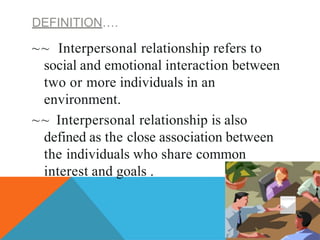
~~ Interpersonal relationship refers to
social and emotional interaction between
two or more individuals in an
environment.
~~ Interpersonal relationship is also
defined as the close association between
the individuals who share common
interest and goals .
IMPORTANCE OR PURPOSES…
for example..
~ Interpersonal relationship for an individual
- Personal growth and development.
- Source of enjoyment.
- Sense of security.
- Context of understanding.
- Interpersonal needs.
- Establishing personal identity.
TYPES OF INTERPERSONAL RELATIONSHIP..
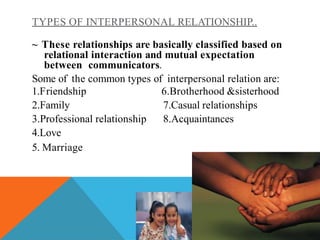
~ These relationships are basically classified based on
relational interaction and mutual expectation
between communicators.
Some of the common types of interpersonal relation are:
6.Brotherhood &sisterhood
7.Casual relationships
8.Acquaintances
1.Friendship
2.Family
3.Professional relationship
4.Love
5. Marriage
PHASES OF INTERPERSONAL RELATIONSHIP
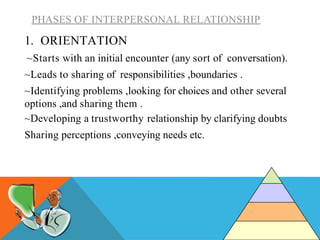
1. ORIENTATION
~Starts with an initial encounter (any sort of conversation).
~Leads to sharing of responsibilities ,boundaries .
~Identifying problems ,looking for choices and other several
options ,and sharing them .
~Developing a trustworthy relationship by clarifying doubts
Sharing perceptions ,conveying needs etc.
SECOND PHASE - IDENTIFICATION
~Approaching and understanding to perceive the feeling
of the other person.
~Must avoid all the distractions for the communication to
be more effective.
~Identifying the problems and helping others with the
resources available.
~As these take place our feelings as well as the
listeners, boost up and gives us a feeling of
belongingness .
THIRD PHASE - EXPLOITATION
~In this , the listener is made to understand the problem
by all available avenue.
~We are supposed to extend for any minimal assistance
needed by others to understand the problem .
~Slowly we see that the listener starts exploiting instead
of asking help .
~Finally the person is ready to deal with the problems
adequately.
FOURTH PHASE –RESOLUTION
~Starts with the termination of professional relationship.
~Collaborative efforts have been already met earlier
among the communicators.
~No psychological dependence must persist between them
if its an outsider or not a well known.
~The relationship must be terminated by just maintaining
a healthy and friendly relationship.
BARRIERS OF INTERPERSONAL
RELATIONSHIP
1. SITUATIONAL BARRIERS .
2. PERSONAL BARRIERS .
3. SOCIOCULTURAL BARRIERS .
SITUATIONAL BARRIERS..
~Complex interaction .
~Large distance.
~Lack of time.
~Adverse environmental situations.
~High density of an individual.
PERSONAL BARRIERS..
~Fear of rejection.
~Lack of flexibility.
~Ineffective communication.
~Lack of honesty and trust.
~Feeling of insecurity.
Etc..
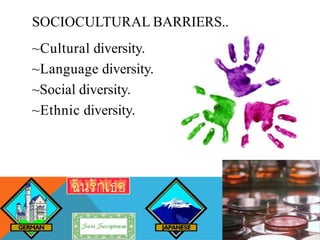
SOCIOCULTURAL BARRIERS..
~Cultural diversity.
~Language diversity.
~Social diversity.
~Ethnic diversity.
BY : Akshita Rathee
Enrollement No: ASU2023010200235

interpersonalrelationship and relationship management .pptx

  • 1.
  • 2.
    DEFINITION…. ~~ Interpersonal relationshiprefers to social and emotional interaction between two or more individuals in an environment. ~~ Interpersonal relationship is also defined as the close association between the individuals who share common interest and goals .
  • 3.
    IMPORTANCE OR PURPOSES… forexample.. ~ Interpersonal relationship for an individual - Personal growth and development. - Source of enjoyment. - Sense of security. - Context of understanding. - Interpersonal needs. - Establishing personal identity.
  • 4.
    TYPES OF INTERPERSONALRELATIONSHIP.. ~ These relationships are basically classified based on relational interaction and mutual expectation between communicators. Some of the common types of interpersonal relation are: 6.Brotherhood &sisterhood 7.Casual relationships 8.Acquaintances 1.Friendship 2.Family 3.Professional relationship 4.Love 5. Marriage
  • 5.
    PHASES OF INTERPERSONALRELATIONSHIP 1. ORIENTATION ~Starts with an initial encounter (any sort of conversation). ~Leads to sharing of responsibilities ,boundaries . ~Identifying problems ,looking for choices and other several options ,and sharing them . ~Developing a trustworthy relationship by clarifying doubts Sharing perceptions ,conveying needs etc.
  • 6.
    SECOND PHASE -IDENTIFICATION ~Approaching and understanding to perceive the feeling of the other person. ~Must avoid all the distractions for the communication to be more effective. ~Identifying the problems and helping others with the resources available. ~As these take place our feelings as well as the listeners, boost up and gives us a feeling of belongingness .
  • 7.
    THIRD PHASE -EXPLOITATION ~In this , the listener is made to understand the problem by all available avenue. ~We are supposed to extend for any minimal assistance needed by others to understand the problem . ~Slowly we see that the listener starts exploiting instead of asking help . ~Finally the person is ready to deal with the problems adequately.
  • 8.
    FOURTH PHASE –RESOLUTION ~Startswith the termination of professional relationship. ~Collaborative efforts have been already met earlier among the communicators. ~No psychological dependence must persist between them if its an outsider or not a well known. ~The relationship must be terminated by just maintaining a healthy and friendly relationship.
  • 9.
    BARRIERS OF INTERPERSONAL RELATIONSHIP 1.SITUATIONAL BARRIERS . 2. PERSONAL BARRIERS . 3. SOCIOCULTURAL BARRIERS .
  • 10.
    SITUATIONAL BARRIERS.. ~Complex interaction. ~Large distance. ~Lack of time. ~Adverse environmental situations. ~High density of an individual.
  • 11.
    PERSONAL BARRIERS.. ~Fear ofrejection. ~Lack of flexibility. ~Ineffective communication. ~Lack of honesty and trust. ~Feeling of insecurity. Etc..
  • 12.
    SOCIOCULTURAL BARRIERS.. ~Cultural diversity. ~Languagediversity. ~Social diversity. ~Ethnic diversity.
  • 13.
    BY : AkshitaRathee Enrollement No: ASU2023010200235