INTERNET SAFETY
What is the Internet
&
Why is it important to be safe?
What are some of the names for
THE INTERNET
• CYBERSPACE
• THE WEB
• THE NET
• THE INFORMATION HIGHWAY
• THE WORLD WIDE WEB
• W3
How Do You Receive/Send
Information?
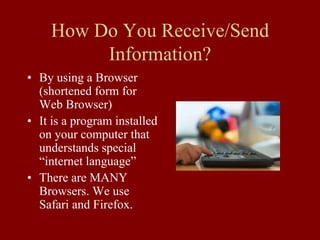
• By using a Browser
(shortened form for
Web Browser)
• It is a program installed
on your computer that
understands special
“internet language”
• There are MANY
Browsers. We use
Safari and Firefox.
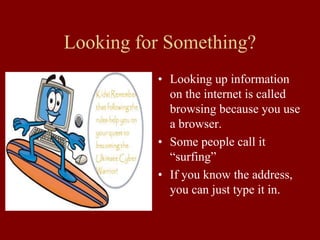
Looking for Something?
• Looking up information
on the internet is called
browsing because you use
a browser.
• Some people call it
“surfing”
• If you know the address,
you can just type it in.
Rules for the Real World vs. the Net
• Stranger Danger
• Say you’re sorry when
you hurt someone
• Go to bed on time
• Share your toys and take
turns playing a game.
• Brush your teeth
• Don’t answer the door
when Mom’s in the
shower
• Never meet someone in
person you’ve met in the
cyber world.
• Limit time on the
computer. Have a social
life.
• Never give out personal
information
• Don’t respond to
messages that are
threatening or obscene.
MORE BASIC RULES TO KEEP SAFE
• Never share your name, age, phone number,
address, or even your school
• Never send any pictures to a stranger
• Keep passwords private - Don’t share even with
your school buddies.
• Never open an email from someone you don’t
recognize. It may contain a virus that will totally
shut down your computer OR let someone use your
computer without your knowing it.
• Visit age appropriate sites.
• Tell an adult you trust if you see something that
makes you feel uncomfortable.
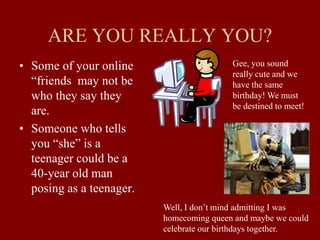
ARE YOU REALLY YOU?
• Some of your online
“friends may not be
who they say they
are.
• Someone who tells
you “she” is a
teenager could be a
40-year old man
posing as a teenager.
Gee, you sound
really cute and we
have the same
birthday! We must
be destined to meet!
Well, I don’t mind admitting I was
homecoming queen and maybe we could
celebrate our birthdays together.
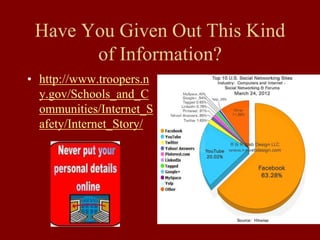
Have You Given Out This Kind
of Information?
• http://www.troopers.n
y.gov/Schools_and_C
ommunities/Internet_S
afety/Internet_Story/
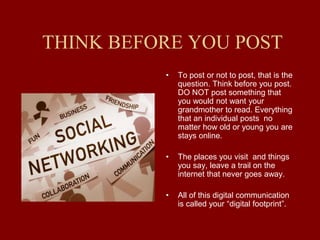
THINK BEFORE YOU POST
• To post or not to post, that is the
question. Think before you post.
DO NOT post something that
you would not want your
grandmother to read. Everything
that an individual posts no
matter how old or young you are
stays online.
• The places you visit and things
you say, leave a trail on the
internet that never goes away.
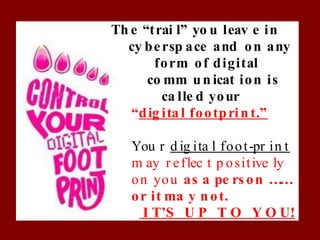
• All of this digital communication
is called your “digital footprint”.
Th e “trai l” yo u leav e in
cy bersp ace and on any
form of digital
co mm un icat ion is
ca lle d your
“dig ita l footprin t.”
You r d ig ita l foot-pr in t
m ay r eflec t p ositive ly
on you as a pe rs on …
…
or it ma y n ot.
I T’S U P T O Y O U!
The words we say, the pictures we
post, the places we visit make
up our digital “reputations.”
They cannot be washed away
like footprints in the sand.
Don’t be a Cyber Bully
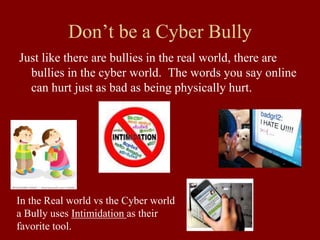
Just like there are bullies in the real world, there are
bullies in the cyber world. The words you say online
can hurt just as bad as being physically hurt.
In the Real world vs the Cyber world
a Bully uses Intimidation as their
favorite tool.
YOU ARE NOT ALONE!
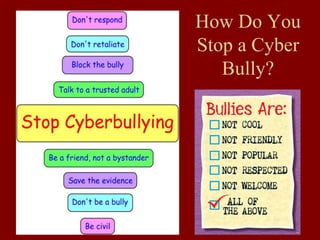
How Do You
Stop a Cyber
Bully?
MORE TIPS
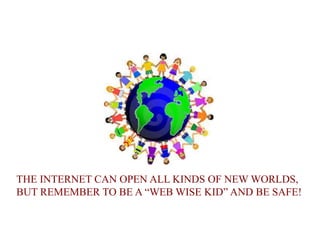
THE INTERNET CAN OPEN ALL KINDS OF NEW WORLDS,
BUT REMEMBER TO BE A “WEB WISE KID” AND BE SAFE!

Internet Safety for K-5

  • 2.
    INTERNET SAFETY What isthe Internet & Why is it important to be safe?
  • 3.
    What are someof the names for THE INTERNET • CYBERSPACE • THE WEB • THE NET • THE INFORMATION HIGHWAY • THE WORLD WIDE WEB • W3
  • 4.
    How Do YouReceive/Send Information? • By using a Browser (shortened form for Web Browser) • It is a program installed on your computer that understands special “internet language” • There are MANY Browsers. We use Safari and Firefox.
  • 5.
    Looking for Something? •Looking up information on the internet is called browsing because you use a browser. • Some people call it “surfing” • If you know the address, you can just type it in.
  • 7.
    Rules for theReal World vs. the Net • Stranger Danger • Say you’re sorry when you hurt someone • Go to bed on time • Share your toys and take turns playing a game. • Brush your teeth • Don’t answer the door when Mom’s in the shower • Never meet someone in person you’ve met in the cyber world. • Limit time on the computer. Have a social life. • Never give out personal information • Don’t respond to messages that are threatening or obscene.
  • 8.
    MORE BASIC RULESTO KEEP SAFE • Never share your name, age, phone number, address, or even your school • Never send any pictures to a stranger • Keep passwords private - Don’t share even with your school buddies. • Never open an email from someone you don’t recognize. It may contain a virus that will totally shut down your computer OR let someone use your computer without your knowing it. • Visit age appropriate sites. • Tell an adult you trust if you see something that makes you feel uncomfortable.
  • 9.
    ARE YOU REALLYYOU? • Some of your online “friends may not be who they say they are. • Someone who tells you “she” is a teenager could be a 40-year old man posing as a teenager. Gee, you sound really cute and we have the same birthday! We must be destined to meet! Well, I don’t mind admitting I was homecoming queen and maybe we could celebrate our birthdays together.
  • 10.
    Have You GivenOut This Kind of Information? • http://www.troopers.n y.gov/Schools_and_C ommunities/Internet_S afety/Internet_Story/
  • 11.
    THINK BEFORE YOUPOST • To post or not to post, that is the question. Think before you post. DO NOT post something that you would not want your grandmother to read. Everything that an individual posts no matter how old or young you are stays online. • The places you visit and things you say, leave a trail on the internet that never goes away. • All of this digital communication is called your “digital footprint”.
  • 12.
    Th e “trail” yo u leav e in cy bersp ace and on any form of digital co mm un icat ion is ca lle d your “dig ita l footprin t.” You r d ig ita l foot-pr in t m ay r eflec t p ositive ly on you as a pe rs on … … or it ma y n ot. I T’S U P T O Y O U!
  • 13.
    The words wesay, the pictures we post, the places we visit make up our digital “reputations.” They cannot be washed away like footprints in the sand.
  • 14.
    Don’t be aCyber Bully Just like there are bullies in the real world, there are bullies in the cyber world. The words you say online can hurt just as bad as being physically hurt. In the Real world vs the Cyber world a Bully uses Intimidation as their favorite tool.
  • 15.
  • 16.
    How Do You Stopa Cyber Bully?
  • 17.
  • 18.
    THE INTERNET CANOPEN ALL KINDS OF NEW WORLDS, BUT REMEMBER TO BE A “WEB WISE KID” AND BE SAFE!