INTERNET OF THINGS
By:-Devdutta Chakrabarti
CONTENTS
 Introduction
 Moving toward a Smarter Internet
 Market Trends
 Technology Trends
 IOT Architecture
 Market Opportunities
 Conclusion
 References
INTRODUCTION
 The internet of things(IOT) is an environment in which
objects, animals or people are provided with unique
identifiers and the ability to transfer data over a network
without requiring human-to-human or human –to-
computer interaction.
 The internet of things (IoT) is the network of physical
objects or “things” embedded with electronics, software,
sensors and connectivity to enable objects to exchange
data with the production, operator and /or other
connected devices based on the infrastructure of
international telecommunication union’s global standard
initiative.
MOVING TOWARD A SMARTER INTERNET
 The IOT concept was coined by a member of the Radio
Frequency Identification (RFID) development community
in 1999, and it has recently become more relevant to the
practical world largely because of the growth of mobile
devices, embedded and ubiquitous communication, cloud
computing and data analytics.
 Since then, many visionaries have seized on the phrase
“Internet of Things” to refer to the general idea of things,
especially everyday objects, that are readable,
recognizable, locatable, addressable, and/or controllable
via the Internet, irrespective of the communication means
(whether via RFID, wireless LAN, wide- area networks, or
other means).
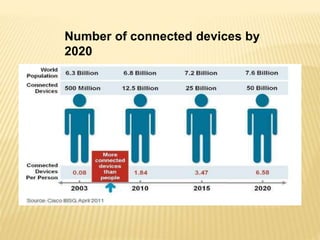
Number of connected devices by
2020
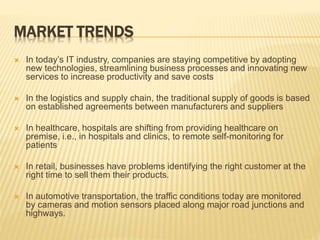
MARKET TRENDS
 In today’s IT industry, companies are staying competitive by adopting
new technologies, streamlining business processes and innovating new
services to increase productivity and save costs
 In the logistics and supply chain, the traditional supply of goods is based
on established agreements between manufacturers and suppliers
 In healthcare, hospitals are shifting from providing healthcare on
premise, i.e., in hospitals and clinics, to remote self-monitoring for
patients
 In retail, businesses have problems identifying the right customer at the
right time to sell them their products.
 In automotive transportation, the traffic conditions today are monitored
by cameras and motion sensors placed along major road junctions and
highways.
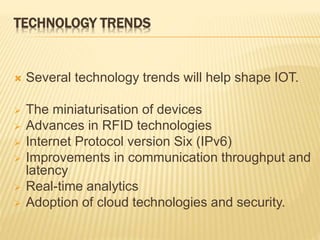
TECHNOLOGY TRENDS
 Several technology trends will help shape IOT.
 The miniaturisation of devices
 Advances in RFID technologies
 Internet Protocol version Six (IPv6)
 Improvements in communication throughput and
latency
 Real-time analytics
 Adoption of cloud technologies and security.
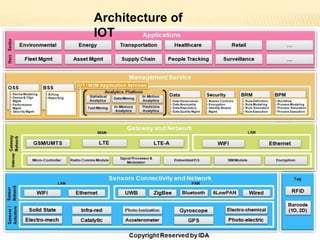
Architecture of
IOT
SENSOR LAYER
 There are various types of sensors for different
purposes. The sensors have the capacity to take
measurements such as temperature, air quality,
movement and electricity. In some cases, they may
also have a degree of memory, enabling them to
record a certain number of measurements.
 A sensor can measure the physical property and
convert it into signal that can be understood by an
instrument. Sensors are grouped according to their
unique purpose such as environmental sensors, body
sensors, home appliance sensors and vehicle
telematics sensors, etc.
GATEWAYS AND NETWORKS
 Massive volume of data will be produced by
these tiny sensors and this requires a robust
and high performance wired or wireless
network infrastructure as a transport
medium. Current networks, often tied with
very different protocols, have been used to
support machine-to-machine (M2M)
networks and their applications.
MANAGEMENT SERVICE LAYER
 The management service renders the processing of information
possible through analytics, security controls, process modelling
and management of devices.
 IOT brings connection and interaction of objects and systems
together providing information in the form of events or contextual
data such as temperature of goods, current location and traffic
data
 Data management is the ability to manage data information flow.
 security must be enforced across the whole dimension of the IOT
architecture right from the smart object layer all the way to the
application layer
APPLICATION LAYER
 There are various applications from industry
sectors that can leverage on IOT.
Applications can be verticalised ones that are
specific to a particular industry sector, and
other applications such as Fleet
Management, Asset Tracking, and
Surveillance can cut across multiple industry
sectors.
APPLICATIONS
 Dynamic Ordering Management Tool
 Crowd Control during Emergencies and Events
 Shopping Assistants
 Elderly Family Member Monitoring
 Continuous Patient Monitoring
 Special Needs and Elderly Transportation Assistant
 Accident Avoidance Detection
 Distributed Urban Traffic Control systems
 Home Energy Management/Consumer Energy
Management
 Retail, Manufacturing and Supply Chain Industries
CHALLENGES
 Silo IOT solutions
 Cost versus Usability
 Privacy and Security
 Interoperability
 Network Capacity Constraints
CONCLUSION
 The internet of things is closer to being
implemented than the average person would think.
 Most of the necessary technological advances
needed for it have already been made, and some
manufacturers and agencies have already begun
implementing a small-scale version of it.
 The main reasons why it has not truly been
implemented is the impact it will have on the legal,
ethical, security and social fields.
 For these reasons, the internet of things may very
well be pushed back longer then it truly needs to
be

Internet of things

  • 1.
  • 2.
    CONTENTS  Introduction  Movingtoward a Smarter Internet  Market Trends  Technology Trends  IOT Architecture  Market Opportunities  Conclusion  References
  • 3.
    INTRODUCTION  The internetof things(IOT) is an environment in which objects, animals or people are provided with unique identifiers and the ability to transfer data over a network without requiring human-to-human or human –to- computer interaction.  The internet of things (IoT) is the network of physical objects or “things” embedded with electronics, software, sensors and connectivity to enable objects to exchange data with the production, operator and /or other connected devices based on the infrastructure of international telecommunication union’s global standard initiative.
  • 4.
    MOVING TOWARD ASMARTER INTERNET  The IOT concept was coined by a member of the Radio Frequency Identification (RFID) development community in 1999, and it has recently become more relevant to the practical world largely because of the growth of mobile devices, embedded and ubiquitous communication, cloud computing and data analytics.  Since then, many visionaries have seized on the phrase “Internet of Things” to refer to the general idea of things, especially everyday objects, that are readable, recognizable, locatable, addressable, and/or controllable via the Internet, irrespective of the communication means (whether via RFID, wireless LAN, wide- area networks, or other means).
  • 5.
    Number of connecteddevices by 2020
  • 6.
    MARKET TRENDS  Intoday’s IT industry, companies are staying competitive by adopting new technologies, streamlining business processes and innovating new services to increase productivity and save costs  In the logistics and supply chain, the traditional supply of goods is based on established agreements between manufacturers and suppliers  In healthcare, hospitals are shifting from providing healthcare on premise, i.e., in hospitals and clinics, to remote self-monitoring for patients  In retail, businesses have problems identifying the right customer at the right time to sell them their products.  In automotive transportation, the traffic conditions today are monitored by cameras and motion sensors placed along major road junctions and highways.
  • 7.
    TECHNOLOGY TRENDS  Severaltechnology trends will help shape IOT.  The miniaturisation of devices  Advances in RFID technologies  Internet Protocol version Six (IPv6)  Improvements in communication throughput and latency  Real-time analytics  Adoption of cloud technologies and security.
  • 8.
  • 9.
    SENSOR LAYER  Thereare various types of sensors for different purposes. The sensors have the capacity to take measurements such as temperature, air quality, movement and electricity. In some cases, they may also have a degree of memory, enabling them to record a certain number of measurements.  A sensor can measure the physical property and convert it into signal that can be understood by an instrument. Sensors are grouped according to their unique purpose such as environmental sensors, body sensors, home appliance sensors and vehicle telematics sensors, etc.
  • 10.
    GATEWAYS AND NETWORKS Massive volume of data will be produced by these tiny sensors and this requires a robust and high performance wired or wireless network infrastructure as a transport medium. Current networks, often tied with very different protocols, have been used to support machine-to-machine (M2M) networks and their applications.
  • 11.
    MANAGEMENT SERVICE LAYER The management service renders the processing of information possible through analytics, security controls, process modelling and management of devices.  IOT brings connection and interaction of objects and systems together providing information in the form of events or contextual data such as temperature of goods, current location and traffic data  Data management is the ability to manage data information flow.  security must be enforced across the whole dimension of the IOT architecture right from the smart object layer all the way to the application layer
  • 12.
    APPLICATION LAYER  Thereare various applications from industry sectors that can leverage on IOT. Applications can be verticalised ones that are specific to a particular industry sector, and other applications such as Fleet Management, Asset Tracking, and Surveillance can cut across multiple industry sectors.
  • 13.
    APPLICATIONS  Dynamic OrderingManagement Tool  Crowd Control during Emergencies and Events  Shopping Assistants  Elderly Family Member Monitoring  Continuous Patient Monitoring  Special Needs and Elderly Transportation Assistant  Accident Avoidance Detection  Distributed Urban Traffic Control systems  Home Energy Management/Consumer Energy Management  Retail, Manufacturing and Supply Chain Industries
  • 14.
    CHALLENGES  Silo IOTsolutions  Cost versus Usability  Privacy and Security  Interoperability  Network Capacity Constraints
  • 15.
    CONCLUSION  The internetof things is closer to being implemented than the average person would think.  Most of the necessary technological advances needed for it have already been made, and some manufacturers and agencies have already begun implementing a small-scale version of it.  The main reasons why it has not truly been implemented is the impact it will have on the legal, ethical, security and social fields.  For these reasons, the internet of things may very well be pushed back longer then it truly needs to be